A drone to blind the enemy radar from within: Helsing’s autonomous CA-1EA debuts in Berlin


The aircraft on stage at the ILA 2026 air show in Berlin looked ordinary at a glance — a clean wing-body-wing form. Inside, however, sat an idea Europe’s defence industry has been chasing for years: a combat drone that takes off on its own, makes its own decisions, and is designed to blind an enemy radar from within. Its name is CA-1EA; its maker, the German firm Helsing.
At a Glance
- What: Helsing CA-1EA autonomous electronic-warfare combat aircraft
- Debut: ILA Berlin 2026 (10 June)
- Class: 3-5 tons, jet, high-subsonic
- Size: 11 m length, 10 m wingspan
- Payload: ~500 kg internal weapons bay
- AI: Centaur autonomous pilot
- First flight: early 2027 (attack variant)
- Doctrine: a jamming pathfinder opening a “safe corridor” for the strike package behind it
When Helsing presented the main platform — the CA-1 Europa attack variant — last September, European media latched on to the “AI-piloted fighter” headline. The company is now filling in the story it teased then. The CA-1EA is the sibling aircraft, sharing the same airframe and propulsion but carrying an electronic-warfare payload. Its mission can be stated in a single sentence: fly ahead of a strike package, suppress enemy radars and data links from within, and clear a “safe corridor” for the F-35s or manned aircraft following behind. The chief design engineer summarised it during the unveiling: “Imagine an EA-18G Growler — but without a pilot, and well below its price tag.”
The outer form is as telling as the design choices behind it: cranked-kite wings, canted vertical tails, side air inlets, a single engine. The combination targets reduced radar signature, aerodynamic efficiency for long mission times and low maintenance load. At 11 metres long with a 10-metre wingspan and in the 3-5 ton high-subsonic jet class, the numbers position Helsing’s bird as a “small fighter” rather than a shrunken F-16: a fresh class of its own. The internal weapons bay carries roughly 500 kilograms of air-launched munitions.
Worth remembering is that Helsing is fundamentally a software house; its primary sales argument is code, not steel or composite. Its Centaur AI pilot manages the entire flight and mission cycle. Operators can plan and supervise from the ground — but the second-by-second reaction belongs to the machine. The doctrine is clear: not a single combat aircraft but a Centaur swarm. Here a fair question presses: is pilotless air combat still “under human control” in terms of decisions and errors? Helsing says mission planning and rules of engagement always stay with the operator — but a new set of questions for the laws of war is clearly visible on the horizon.
Step back and the CA-1EA simultaneously answers two debates that have hung over Europe’s defence industry for the past three years. First is the European sovereignty argument: an AI combat drone independent of US and UK technologies offers a concrete reply to the EU’s “strategic autonomy” rhetoric. Second is the cost problem: against an EA-18G Growler at around $70 million, a fleet of autonomous CA-1EAs can produce similar — or in some scenarios superior — effect at a far lower unit cost. Helsing targets a 2027 first flight and 2029 entry to service. Germany, the United Kingdom and Sweden look like the most likely early customers.

A separate question: where does this aircraft leave Turkey?
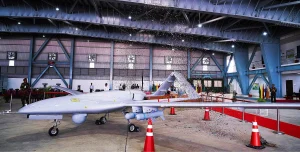
Turkey’s autonomous-combat-aircraft journey runs deeper than the debate Helsing has now sharpened. Bayraktar KIZILELMA first flew in December 2022; its attack variant is in the field and has already won an export customer. TUSAS ANKA-3 is Turkey’s first serious bid in the low-observable league, with a stealth airframe. And HURJET closes the cycle as an advanced jet-trainer platform that fits naturally into the semi-autonomous combat-drone constellation. Together, this trio has Turkey already trying — at platform level — the architecture Europe is now wondering whether to attempt.
Where Helsing is different is its software-first stance. An AI-pilot architecture like Centaur has become a focus area for Turkey’s defence industry too. Baykar’s autonomous-mission systems work, ASELSAN’s AI swarm-control prototypes, STM’s algorithmic targeting research — all of them are different windows onto the same gap. The CA-1EA’s EW-focused variant is a meaningful reference for Turkey here: one airframe, two distinct variants (attack + EW), one software backbone. Integrating a modular EW package into Aksungur and ANKA-3 — sitting one shelf above the MEROPS system family — would track the same logic.
The wider picture is striking: Europe’s move will indirectly shape Turkey’s next-generation air-power vision around KAAN. In the F-35 and post-F-35 scenes, Europe is making the “manned fighter + autonomous loyal wingman + EW drone” trio standard. For Turkey, the problem is not producing the capability — KIZILELMA and ANKA-3 exist — it is integrating those capabilities at swarm and doctrine level. The CA-1EA’s arrival is not a setback for Turkish industry; it is a clear signal that the timeline must be compressed.

Sources
- Defence Industry Europe — “Helsing presents CA-1EA autonomous electronic warfare aircraft”
- Breaking Defense
- The Aviationist
- Helsing official site
- Wikipedia — Helsing / CA-1 Europa
Related Coverage
- KIZILELMA’s first export goes to Indonesia: a deal for up to 60 unmanned fighters
- Pentagon’s $53.6 billion drone push: more than 200,000 unmanned aircraft
- Congress blocks the Pentagon: US Air Force pushes E-7A Wedgetail buy to seven aircraft