From Harpoon to Atmaca: Türkiye’s Naval Missile Transition

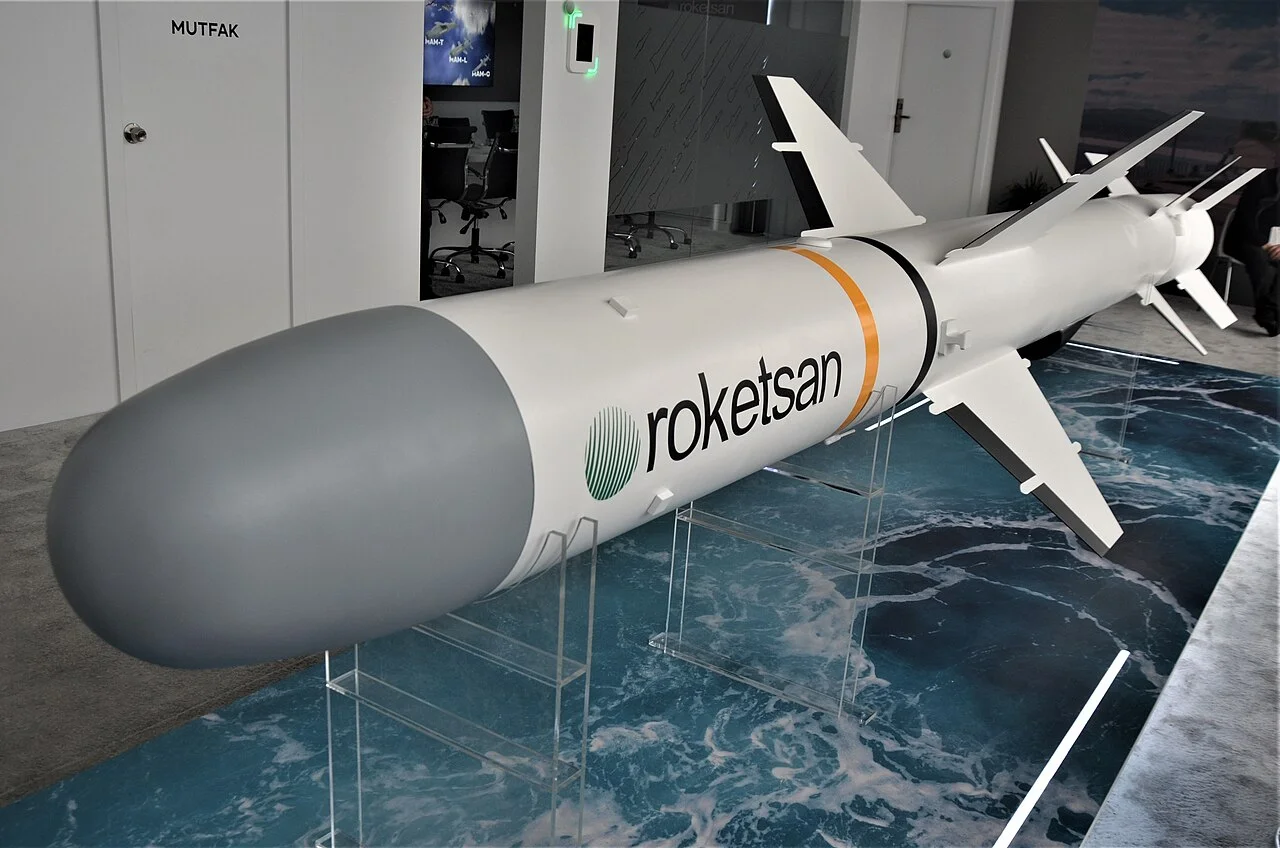
From Imported to Indigenous series · File 3 · Sarp Güçlü
Class: B — Phased Replacement
Current status: Atmaca is being fielded on new-build platforms and ships entering modernisation, while the RGM-84 Harpoon remains in the inventory on platforms not yet upgraded.
For decades, the Turkish Navy’s anti-ship missile inventory has rested on the American-made RGM-84 Harpoon. Today, that role is being taken over by Roketsan’s domestically developed Atmaca — but the handover is not a single ceremony, it is a platform-by-platform process still under way.
What was the old system?
The RGM-84 Harpoon, developed by McDonnell Douglas (later Boeing), is one of the most widely fielded anti-ship cruise missiles among NATO navies. In Turkish service, Harpoon arms the German MEKO 200-design Yavuz-class frigates (four ships, 8 missiles each via twin quad Mk141 launchers), the Barbaros-class frigates (four ships, similar loadout), the ex-US Oliver Hazard Perry-class frigates known in Turkish service as the Gabya class (Mk13 launchers), and the submarine-launched UGM-84 variant aboard the Preveze- and Gür-class Type 209/1400 boats. The lead ship of her class, TCG Yavuz, is now a museum ship; her sisters remain active. Historical trade records point to a Turkish request for 16 Harpoons through McDonnell Douglas, but the exact date of that order and Turkey’s total Harpoon inventory are not disclosed in any single public record.
Why was a domestic replacement needed?
According to Defense News reporting from 2022, Roketsan officials framed the shift to Atmaca largely in cost terms: the domestic missile is priced at roughly half of a Harpoon, and the transition programme is projected to save Turkey up to $500 million. The same reporting notes that Harpoon stocks are purchased piecemeal from Boeing and age over time, creating a recurring procurement dependency. No documented embargo or supply cutoff was found to justify this file’s “why” section, so that framing is not used here — the stated rationale is cost, stock renewal, and the broader industrial-independence push coordinated by Turkey’s Presidency of Defence Industries (SSB).
How was the domestic missile developed?
Roketsan received the Atmaca development contract in 2009. Initial land-based test firings followed in 2015. In November 2018, SSB and Roketsan signed the serial production contract, formally moving the programme from prototype to series manufacture. In November 2019, the corvette TCG Kınalıada carried out the first ship-launched firing, a milestone Naval News recorded as the first time a Turkish surface combatant had fired the missile. Firings in March 2021 brought Atmaca to initial operational capability (IOC) with the Navy. Janes reported in December 2021 that SSB President İsmail Demir confirmed deliveries to Naval Forces Command had begun, naming the fourth Ada-class corvette, TCG Kınalıada — delivered in 2019 — as the lead platform. In November 2022, Roketsan and defence contractor STM signed an integration contract covering 11 naval platforms, including Ada-class corvettes, İstanbul/I-class frigates and the modernised Barbaros class, with completion targeted for April 2027. A 2024 test firing integrated the domestically built KTJ-3200 turbojet engine, and in March 2025 Defense News reported a submarine-launched test of Atmaca from TCG Preveze off Mersin, extending the programme from surface ships toward the submarine fleet.
Old versus new: a side-by-side comparison
| Specification | RGM-84 Harpoon | Atmaca |
|---|---|---|
| Manufacturer | McDonnell Douglas / Boeing (US) | Roketsan (Türkiye) |
| Range | Not disclosed for the Turkish-held block variant | Over 220 km (Roketsan / Janes) |
| Engine | Teledyne CAE J402 turbojet (US) | KTJ-3200 turbojet, Kale Arge (domestic) |
| Turkish IOC date | Not disclosed | 2021 (Janes) |
| Platform integration target | — | 11 platforms by April 2027 (Roketsan–STM contract, Naval News) |
How much of it is domestic?
Atmaca’s KTJ-3200 turbojet engine was developed by Turkish firm Kale Arge and reported integrated into the missile in a 2024 test firing — reducing reliance on the US-made Teledyne CAE J402 used in Harpoon. Guidance architecture, flight software and airframe design were carried out by Roketsan, which markets the missile as autonomous, all-weather, low radar cross-section and capable of three-dimensional route planning. The land-attack variant, Kara Atmaca, uses an imaging infrared (IIR) seeker for terminal guidance rather than the active radar seeker used at sea, per Janes. No disaggregated, publicly available breakdown of the missile’s electronic sub-component supply chain exists, so this file does not use the phrase “fully domestic” — engine, airframe and guidance architecture are documented as domestic; the share of underlying electronic components is not disclosed.
Has it really replaced the old system?
It is being phased in gradually. The evidence: the November 2022 Roketsan–STM contract targets integration across 11 naval platforms by April 2027 (Naval News); Ada-class corvettes have carried and test-fired the missile since 2019 and reached IOC in 2021 (Janes); SSB President İsmail Demir confirmed deliveries had begun as of December 2021 (Janes); and a submarine-launched variant was test-fired in March 2025 (Defense News) — though that marks a test, not yet operational submarine deployment. Meanwhile, Barbaros-class frigates and other platforms still awaiting modernisation continue to carry Harpoon, and no dated official delivery schedule for their conversion could be confirmed in this research. The upshot: the transition is real and advancing, but the two missile systems will coexist in the inventory until the 2027 target.
Global parallels
Türkiye is not alone in this pattern. The series’ second file covered Poland’s Piorun, which is gradually displacing the Soviet-licensed Strzała-2 — another case where replacement proceeds ship by ship or unit by unit rather than all at once. South Korea’s SSM-700K Haeseong and Norway’s Kongsberg NSM follow a similar industrial logic: domestically designed missiles built specifically to challenge Harpoon’s long-standing dominance among Western and allied navies. Envanter Medya’s own archive carries separate, detailed comparisons of Atmaca against both NSM and Haeseong; this file’s focus is Türkiye’s own inventory transition rather than a head-to-head product comparison.
Strategic and industrial outcome
The Atmaca programme gave Türkiye a domestic supply chain for anti-ship missile propulsion, guidance software and airframe design. Roketsan’s export of the missile — sales to Indonesia have been publicly reported — signals that the programme functions as more than a domestic-only product. On cost, Roketsan’s own estimate, as cited by Defense News, points to savings of up to $500 million across the transition. The 2024 domestic-engine milestone also matters for reducing import dependence in a critical subsystem, an outcome that intersects with the series’ Class E (critical subsystem) cases. These are real gains, but the engine was foreign-sourced until recently and the submarine variant remains in testing — this is progress, not a finished picture of full independence.
Frequently asked questions
What missile is Atmaca replacing?
Atmaca is gradually taking over the role of the American-made RGM-84 Harpoon, which the Turkish Navy has operated for decades.
When did Atmaca enter service?
Atmaca reached initial operational capability with the Turkish Navy after firings in March 2021; SSB confirmed deliveries had begun by December 2021.
Has Harpoon been fully retired?
No. Barbaros-class frigates and other platforms awaiting modernisation still carry Harpoon; the transition continues in phases toward the 2027 target.
How many platforms will carry Atmaca?
Under the November 2022 Roketsan–STM contract, Atmaca is to be integrated across 11 naval platforms by April 2027.
Is Atmaca’s engine domestically made?
Yes — the KTJ-3200 turbojet, built by Kale Arge, was reported integrated into the missile during a 2024 firing test, reducing reliance on the foreign engine used in Harpoon.
Can Atmaca be launched from submarines?
A submarine-launched variant was test-fired from TCG Preveze off Mersin in March 2025; it is not yet in operational submarine service.
Sources
- SSB President İsmail Demir’s delivery confirmation, via Janes, December 2021
- Naval News, August 2023 — Roketsan–STM integration contract
- Defense News, February 2022 — cost rationale
- Defense News, March 2025 — submarine-launched test
- Naval News, November 2019 — first ship-launched firing
- Envanter Medya archive: Atmaca vs Harpoon, What is Atmaca
More files in the From Imported to Indigenous series