From Strela-2 and Igla to Piorun: Poland’s MANPADS Transition

From Imported to Indigenous series · File 2 · Sarp Güçlü
Class: D — From Licensed Production to Indigenous Design
Status today: Piorun is gradually replacing Grom in Poland’s arsenal; Grom production and inventory continue, while the Soviet-origin Strzała-2M was fully retired decades ago.
Poland’s Soviet-licensed Strzała-2M, and the Igla license that was never completed, gave way first to the indigenous Grom and now to Piorun, a genuine export success. But Grom is still being built and fielded — the handover is not as finished as the headlines suggest.
1. What was the old system?
Strzała-2M was Poland’s license-built version of the Soviet SA-7 Grail (9K32M Strela-2M). Mesko’s plant in Skarżysko-Kamienna produced the shoulder-fired missile under Soviet license from the 1970s, with critical components sourced from the USSR. By the late 1980s it was considered obsolete, and Poland planned to license-produce the newer 9K38 Igla instead.
2. Why was a domestic replacement needed?
The need came from a supply-chain collapse, not an embargo: when Poland left the Soviet bloc in 1990, the planned Igla license stalled. Sources differ on the exact mechanics — some say the license was never granted, others that it began and was cut short by the Soviet collapse — but all agree Igla never reached series production in Poland. The result, as GlobalSecurity.org puts it, left Poland “with no modern MANPADS at hand” just as it moved toward NATO membership, achieved in 1999.
3. How was the domestic product developed?
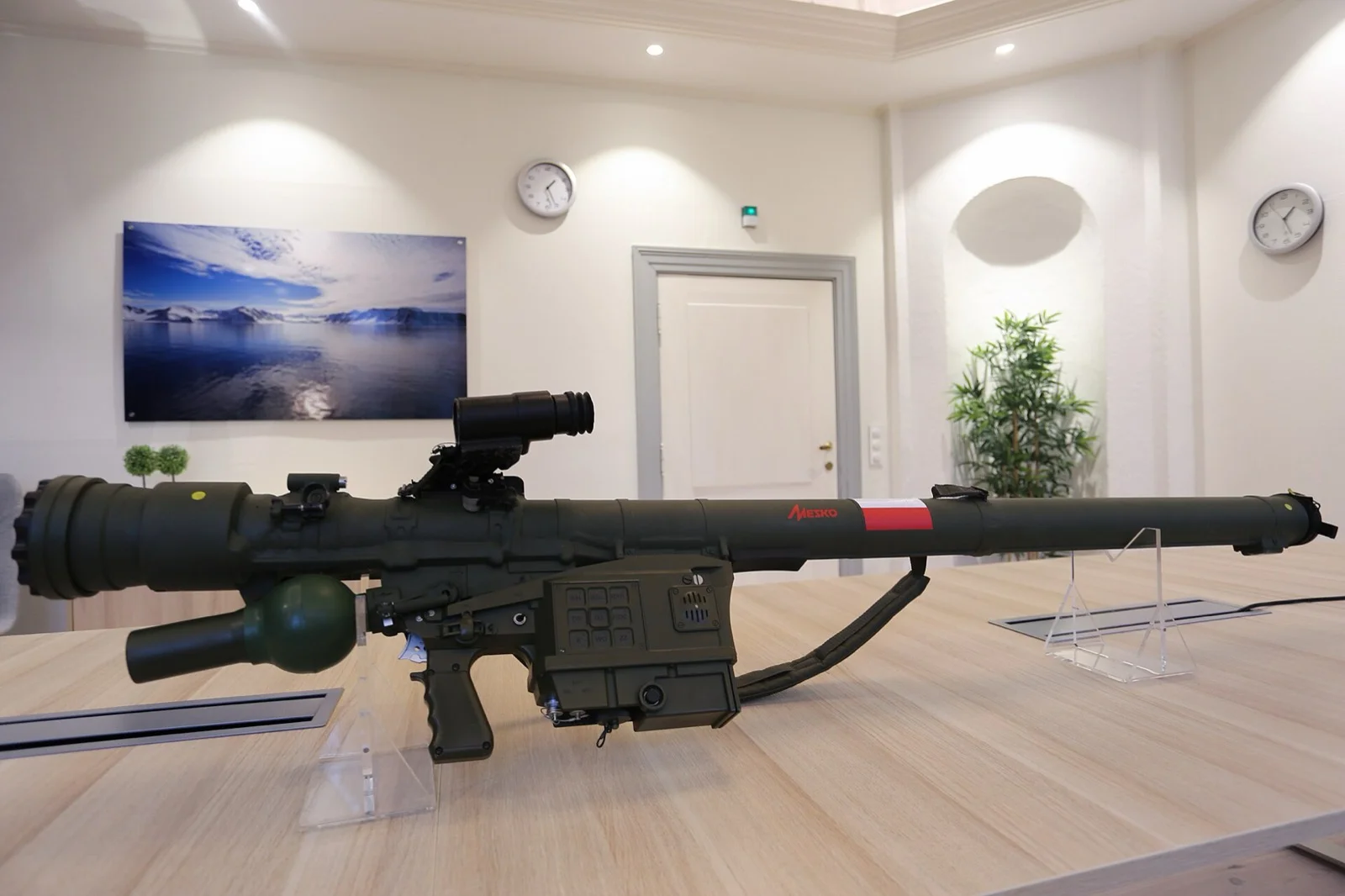
In late 1992, the Military Institute of Armament Technology, the WAT Military University of Technology and the Skarżysko Rocket Design Bureau began work on an Igla-like missile. Some accounts say Polish intelligence obtained Igla design data from the LOMO plant in Leningrad during the Soviet collapse, feeding the new project. The first Grom-1 batch entered service in 1995, initially using Russian-sourced components that were replaced with Polish-designed parts by the late 1990s; the Grom-2 variant produced from 2004 onward used fully domestic components. On 1 January 2013, Bumar Amunicja (now Mesko) delivered its 2,000th Grom missile set. In 2010, an R&D agreement between Mesko and Poland’s Ministry of National Defence launched Piorun as a deep modernisation of Grom, with the new seeker developed by Telesystem-MESKO. A contract signed on 20 December 2016 covered 420 launchers and 1,300 missiles for about PLN 932 million. Deliveries slipped in 2018 after more than ten test missiles failed to meet specification, reportedly due to a subcontracted component; the first batch, originally due in 2017, arrived by around March 2018. In June 2022 the ministry amended the contract to add 3,500 missiles and 600 launchers. PGZ said in August 2022 that delivery problems had been overcome and annual output had doubled from 300 to 600 missiles, with a target above 1,000. On 24 August 2026, Poland, Lithuania, Latvia and Norway signed a joint procurement framework worth roughly PLN 8 billion (about $2.16 billion), funded under the EU’s SAFE programme, with Poland’s share above 80 percent and deliveries running through 2030.
4. Old vs. new system comparison
| Feature | Strzała-2M (SA-7) | Grom | Piorun |
|---|---|---|---|
| Origin | Soviet license (1970s) | Indigenous design, informed by Igla data (1992-1995) | Indigenous deep modernisation (R&D from 2010) |
| Manufacturer | Mesko (licensed) | Mesko / Bumar Amunicja | Mesko; seeker by Telesystem-MESKO |
| Range | not disclosed | ~5.5 km | 400 m – 6.5 km (manufacturer data) |
| Ceiling | not disclosed | ~3.5 km | 10 m – 4 km |
| Seeker | Infrared, early photoresistor type | Infrared | Digital, argon-cooled, photodiode-based — reportedly more jam-resistant than Grom’s |
| Service entry | 1970s | 1995 | Contract 2016, first deliveries around 2018-2019 |
| Inventory status | Retired | ~400 launchers / ~2,000 missiles (current official figure not disclosed) | 420+600 launchers, 1,300+3,500 missiles under contract, plus the new EDIRPA/SAFE order; exact delivered total not disclosed |
No verified, current range figure for the Strzała-2M has been published, so that cell is marked “not disclosed”; the Grom and Piorun figures come from GlobalSecurity.org and manufacturer statements respectively.
5. How much of it is domestic?
Propulsion: Grom’s and Piorun’s rocket motors are built by Mesko; no public indigenisation percentage has been released. Electronics/seeker: Piorun’s digital seeker was developed by Telesystem-MESKO, reportedly more resistant to jamming than Grom’s analogue, photoresistor-based unit; the launcher’s thermal sight comes from PCO, another PGZ group member — so the electro-optical chain runs across several specialised PGZ subsidiaries, not one company. Software: not disclosed by the manufacturer. Warhead/weapon: Mesko-built, reportedly around 1.82 kg, with a total missile weight near 10.5 kg. Production: series manufacturing at Mesko’s Skarżysko-Kamienna plant, with annual capacity raised to 600 missiles by 2022 and a target above 1,000. Design: Grom and Piorun are described as indigenous, but their lineage reportedly includes Igla design data obtained from the USSR — so “built from data” is more accurate than “built from scratch.” The “domestic” label we use here reflects that the production-to-design chain now closes inside the PGZ group; it does not erase the foreign data at the root of the lineage.
6. Did it really take over?
It is replacing Grom gradually. Grom, per Defence24’s August 2022 report, is still being manufactured for domestic and export demand — Piorun has not erased it from the inventory, but it has become the system winning new contracts and export orders. The original Soviet-era Strzała-2M, by contrast, was fully retired decades ago — that substitution is complete. The 2026 EDIRPA/SAFE framework (Poland, Lithuania, Latvia, Norway; roughly PLN 8 billion; deliveries through 2030) shows Piorun has become the default choice for Poland and its allies, but no dated, official statement says Grom has been fully withdrawn — so we classify this as a gradual transition rather than a completed one. In practice, the two systems will coexist for a while: Piorun is taking almost all new contracts and export orders, while previously delivered Grom units remain with troops and the production line stays open as long as demand holds.
7. International parallels
The move from licensed production to indigenous design is not unique to Poland’s MANPADS story: the US FIM-92 Stinger, the UK’s Starstreak, and the Igla-S still common across the Russia-Ukraine theatre all sit in the same comparative class as Piorun. Elsewhere in Eastern Europe, countries with similar Soviet-licensed production bases largely shifted to NATO/Western procurement after the Cold War; Poland instead kept and grew its own engineering base, channelling it first into Grom and then Piorun. The series’ first file on ALTAY told a similar “gradual replacement” story: the M60/Leopard family still forms the bulk of Türkiye’s tank fleet while ALTAY deliveries remain limited — a pattern close to the Piorun/Grom pairing.
8. Strategic and industrial outcome
Piorun has become a tangible export win for Poland’s defence industry: Norway ordered it in late 2022 and began live-fire testing in Finnmark in August 2024; Sweden received its first Pioruns; a US-bound Piorun EX export variant was delivered; and on 24 August 2026 Poland signed the four-nation EDIRPA/SAFE framework with Lithuania, Latvia and Norway. Annual production capacity rose from 300 to 600 missiles, with a target above 1,000 — translating into deeper domestic supply chains and jobs. Poland’s Defence Minister Władysław Kosiniak-Kamysz called the framework “the first agreement of this type where the consortium is formed not by a company, but by a state,” while Deputy Minister Magdalena Sobkowiak-Czarnecka described Piorun as “our export hit.” Poland’s 2022 transfers of Piorun to Ukraine, and Ukrainian claims of shooting down Russian aircraft and helicopters (Su-34, Su-25, Mi-24, Ka-52 — claims that remain independently unverified), gave PGZ’s “combat-proven” marketing line a foundation it has used repeatedly in later export deals.
9. Frequently asked questions
Did Piorun replace Grom?
Not entirely. Grom is still manufactured and remains in the inventory; Piorun has become the system winning new contracts and export orders.
Is Piorun entirely Polish-made?
Production and final design close inside the PGZ group (Mesko, Telesystem-MESKO, PCO), but the Grom/Piorun lineage reportedly traces back to Igla design data obtained from the USSR.
What is Piorun’s range?
According to manufacturer data, 400 metres to 6.5 kilometres, with a ceiling of about 4 kilometres.
Which countries has Piorun been exported to?
Ukraine received it as military aid; Norway, Sweden and a US customer (via the Piorun EX variant) have also received it, and in August 2026 Lithuania, Latvia and Norway joined a joint procurement framework with Poland.
What comes after Piorun?
Mesko is working on the Piorun+ upgrade and the longer-term, differently engineered Piorun 2 / Grzmot, which may eventually merge with Piorun+.
10. Sources
Primary / official statements:
- Breaking Defense, “Polish firm MESKO signs $2B deal to arm 4 NATO nations with MANPADS” (24 August 2026) — quotes from Defence Minister Władysław Kosiniak-Kamysz and Deputy Minister Magdalena Sobkowiak-Czarnecka.
- Defence24, “Piorun MANPADS Missile Programme Delayed, Deliveries Expected Soon” (24 January 2018) — details of the December 2016 contract.
- Defence24, “Poland Outlines The Future Of Combat-Proven Piorun MANPADS” (1 August 2022) — PGZ production figures.
Independent:
- GlobalSecurity.org, “Piorun [Thunderbolt].”
- Wikipedia, “PZR Grom” and “Piorun (missile)” (cross-check).
- Defence Matters, “Four states sign PLN8bn-plus Piorun procurement framework.”
- Euro-SD, “Swedes receive first Pioruns.”
envantermedya archive:
More files in the From Imported to Indigenous series