ATMACA vs Harpoon: How Turkey’s Missile Compares to RGM-84

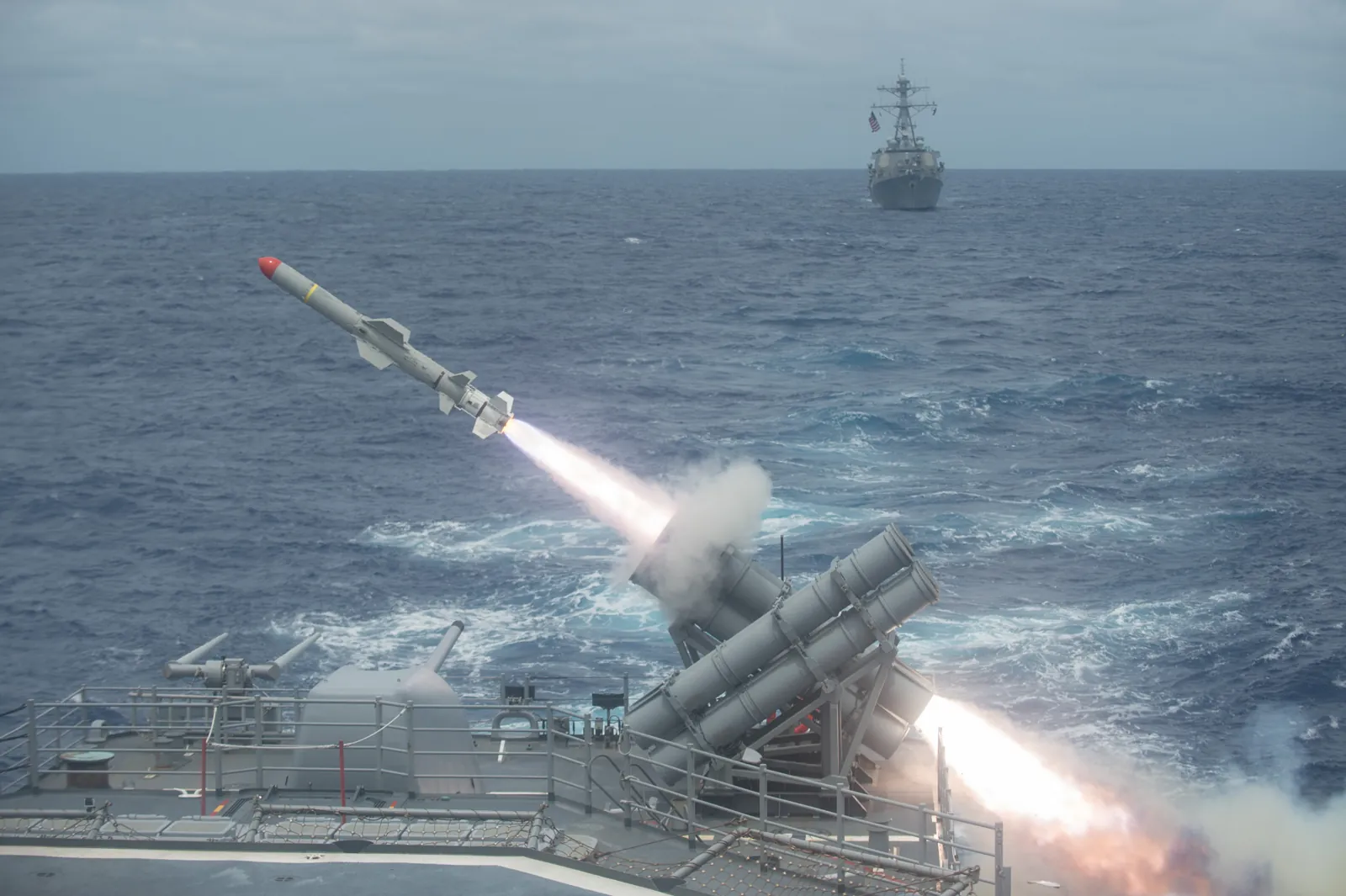
ATMACA and Harpoon are two generations of the same weapon concept: a subsonic, sea-skimming anti-ship cruise missile. Turkey’s ROKETSAN-built ATMACA offers a range of roughly 250 km with datalink-supported guidance, while the American RGM-84 Harpoon, in service since 1977, delivers ~124-240 km depending on variant. The Turkish Navy is now replacing its Harpoons with ATMACA.
| ATMACA vs Harpoon — At a Glance | |
|---|---|
| Comparison class | Anti-ship cruise missiles |
| ATMACA | ROKETSAN (Türkiye), in service since 2022 |
| Harpoon | McDonnell Douglas/Boeing (USA), in service since 1977 |
| Shared traits | Subsonic speed, sea-skimming flight, active radar terminal homing |
| Key difference | ATMACA has a two-way datalink for in-flight retargeting; classic ship-launched Harpoons do not |
| Range | ATMACA ~250 km; Harpoon ~124-240 km depending on variant |
| Warhead | ATMACA ~220-250 kg; Harpoon 221 kg |
| Context | Turkish Navy transitioning from Harpoon to ATMACA |
Two missiles, 45 years apart
The Harpoon, developed by McDonnell Douglas (now Boeing), entered US Navy service in 1977 and became the Western world’s most widely fielded anti-ship missile. Produced for nearly half a century, it exists in ship-launched (RGM-84), submarine-launched (UGM-84) and air-launched (AGM-84) versions and serves with close to 30 navies. Türkiye was one of them, relying on Harpoon for decades aboard its frigates, fast attack craft and submarines.
ATMACA is the missile ROKETSAN developed specifically to end that dependence. It formally entered Turkish Navy service in 2022 and has been progressively replacing Harpoon aboard TCG warships since. A land-based version, Kara ATMACA, was reported to exceed 400 km in a 2025 test, and a submarine-launched derivative, AKATA, made its first test flight in 2025.
This comparison therefore carries more weight than a typical export rivalry: within the Turkish fleet, ATMACA is Harpoon’s direct successor. The differences between the two largely reflect the 45-year design generation that separates them — modern electronics, networked guidance and unrestricted national control on one side; unmatched service maturity on the other.
Range, warhead and guidance: what the numbers say
On range, ATMACA holds a clear edge in the standard comparison: roughly 250 km for the ship-launched version. Harpoon’s range varies sharply by variant: open sources list about 124 km for the widely fielded RGM-84D/Block 1C class, while figures approaching 240 km are quoted for the newest Block II+ ER. In other words, ATMACA delivers as standard what Harpoon reaches only in its latest and least common upgrade.
On warhead, the two are effectively peers: Harpoon carries a 221 kg semi-armour-piercing warhead, while ATMACA is credited in open sources with a semi-armour-piercing high-explosive warhead of roughly 220-250 kg. Either is sufficient to cripple a medium or large surface combatant.
The guidance architecture is similar in outline: both cruise on inertial navigation, fly a sea-skimming profile below the radar horizon, and lock on with an active radar seeker in the terminal phase. Harpoon gained GPS with Block II; ATMACA was designed from the outset with INS/GPS, a radar altimeter and a two-way datalink. That datalink lets ATMACA receive target updates mid-flight, be redirected or have its mission aborted — a capability absent from classic ship-launched Harpoon versions. On speed there is no meaningful difference: both are subsonic (ATMACA Mach 0.85-0.90; Harpoon around 864 km/h).
The table below places the two missiles’ open-source figures side by side. Harpoon values vary by variant; the widely fielded RGM-84 ship-launched version is used as the baseline, with variant differences noted.
Platforms and user base: Harpoon’s home ground
A fair comparison must concede Harpoon its strongest suit: ubiquity and combat pedigree. Harpoon has been in production for nearly 50 years and serves with close to 30 navies in ship, submarine and aircraft versions. Its logistics chain, integration experience and doctrinal track record are unmatched in the class, and the family — including the air-launched AGM-84 and submarine-launched UGM-84 — is thoroughly proven.
ATMACA is far earlier in its life cycle: its only confirmed operational user is the Turkish Armed Forces. Its platform envelope, however, is expanding quickly — beyond frigates, corvettes and fast attack craft, there is a coastal battery version, integration work for unmanned surface vessels (USV), and the submarine-launched AKATA derivative tested in 2025. Export interest from Indonesia, Malaysia and Algeria has been reported in open sources, but independent confirmation of firm contracts remains limited.
Cost and export independence: ATMACA’s strategic case
The technical scoreboard is balanced; the real divergence lies in procurement sovereignty. Harpoon is subject to US export controls (FMS/ITAR): purchases, munition resupply, software updates and integration changes all require American approval. Türkiye’s past experience with delivery delays and embargo debates illustrated the operational risk of that dependence.
ATMACA removes that layer entirely: design, production, guidance software and integration are national, so Türkiye can integrate the missile on its own ships to its own schedule, and third-country sales need no US sign-off. Neither manufacturer publishes unit prices, so a hard cost comparison is not possible; defence analysts nonetheless widely assess that domestic production favours ATMACA on life-cycle cost and supply security.
Bottom line: Harpoon is the proven, globally fielded classic; ATMACA is the rational successor for the Turkish fleet, with longer standard range, datalink-enabled guidance and full export independence. What ATMACA still has to earn is what Harpoon accumulated over decades — an operational record and a multinational user base.
Harpoon figures in this comparison (range ~124-240 km by variant, 221 kg warhead, 1977 service entry) are drawn from US Navy fact files, Boeing materials and open-source defence publications; ATMACA figures (~250 km range, ~220-250 kg warhead) come from ROKETSAN statements and open sources. Neither manufacturer discloses all technical details officially, and unit prices are not published, so cost comparisons are qualitative. Independent confirmation of reported ATMACA export talks remains limited.
Frequently Asked Questions
Which has the longer range, ATMACA or Harpoon?
In the standard comparison, ATMACA: roughly 250 km versus about 124 km for the widely fielded RGM-84D. Harpoon’s newest Block II+ ER, however, is credited with up to ~240 km, largely closing the gap for that variant.
Is ATMACA replacing Harpoon in the Turkish Navy?
Yes. ATMACA formally entered service in 2022 and is progressively replacing Harpoon missiles aboard Turkish Navy warships as the fleet’s standard anti-ship weapon.
Do the two missiles carry different warheads?
In practice they are in the same class: Harpoon carries a 221 kg semi-armour-piercing warhead, while ATMACA is credited with roughly 220-250 kg of semi-armour-piercing high explosive.
What can ATMACA do that Harpoon cannot?
Its two-way datalink allows mid-flight target updates, redirection or mission abort — absent from classic ship-launched Harpoons. ATMACA is also free of US export controls, unlike the ITAR-regulated Harpoon.
Where does Harpoon still hold the advantage?
In maturity: nearly 50 years of service, a combat record, close to 30 user navies, a mature logistics chain and a proven family spanning ship, submarine and air-launched versions.
Are both missiles subsonic?
Yes. ATMACA flies at Mach 0.85-0.90 and Harpoon at roughly 864 km/h; both approach their targets in a sea-skimming profile below the radar horizon.
Sources
- ROKETSAN official — roketsan.com.tr
- US Navy Harpoon fact file and Boeing product materials (open source)
- Wikipedia — Harpoon (missile) and ATMACA (missile); open-source defence media (Naval News, Janes reporting)