From French Agosta to S-80 Plus: Spain’s Submarine Handover

From Imported to Indigenous series · File 10 · Sarp Güçlü
Class: B — Phased Replacement
Current status: Being phased in gradually. The first S-80 Plus boat entered service in 2023, but by late 2026 it is still operating alone while the 1983-built Galerna (S-71) remains active on NATO duty.
1. What was the old system?
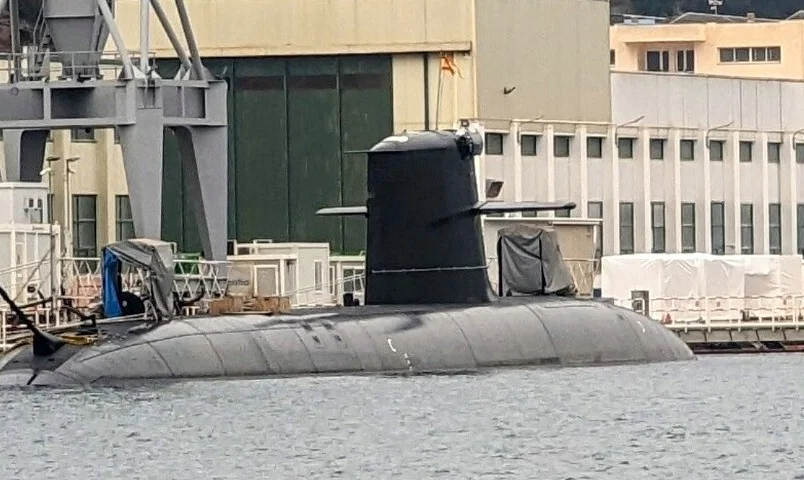
Spain’s conventional attack-submarine force has rested on the French-designed Agosta class, known in Spanish service as the S-70 or Galerna class. The four boats — Galerna (S-71, 1983), Siroco (S-72, 1983), Mistral (S-73, 1985) and Tramontana (S-74, 1986) — were built under French licence at Cartagena by the former state yard Bazán, Navantia’s predecessor.[1] Siroco was retired in 2012 and Mistral in 2020. Tramontana underwent a major Navantia refit from 2014 to 2017, logged 315,144 nautical miles (218,384 submerged) and was decommissioned in a February 2024 ceremony at Cartagena’s Arsenal submarine base.[2] That leaves Galerna (S-71) as the sole surviving Agosta-type boat; as of late 2025 it was still deployed on NATO’s Sea Guardian operation in the Mediterranean, returning to Cartagena in December 2025 after logging more than 500 hours submerged.[3]
2. Why was a domestic replacement needed?
With all four Agosta/Galerna boats commissioned in 1983-1986, Spain signed a contract with Navantia in 2004 for an entirely new, domestically designed class.[4] The documented rationale was closing the capability gap that the ageing Agosta/Galerna fleet would eventually create, and building Spain’s own submarine-design and industrial base; officials emphasised the sovereignty argument explicitly at the October 2025 float-out ceremony for the second boat.[5] No embargo or supply-restriction claim could be verified for this file — the documented drivers are fleet age and industrial policy.
3. How was the domestic system developed?
2004: contract signed with Navantia. 2007: keel laid for Isaac Peral (S-81). 2013: a weight and buoyancy calculation error surfaced publicly — reports put the boat 100-125 tonnes over its design weight, prompting “submarine that can’t swim” headlines.[6] Spain’s Defence Ministry confirmed that Navantia brought in the US firm General Dynamics Electric Boat to fix the problem; the solution was to stretch the hull by roughly 10 metres (to about 81m) to restore buoyancy margin, applied first to S-82 since S-81’s construction was already too advanced.[7] 2021: S-81 launched. 27 May 2022: S-81 put to sea for the first time from Cartagena.[8] November 2023: S-81 delivered to the Navy and entered high-readiness service.[9] 3 October 2025: the second boat, Narciso Monturiol (S-82), was floated out in Cartagena in a ceremony attended by Defence Minister Margarita Robles; the government disclosed a €4 billion investment programme for 2018-2032 supporting more than 6,000 jobs.[5] 30 July 2026: Navantia announced S-82’s first static dive off Cartagena.[10] 16 June 2026: Navantia began AIP testing on the third boat, Cosme García (S-83); on 23 September 2026 it announced those tests complete, calling it “a key technology milestone for Spanish naval industry.”[11]
4. Old vs. new system
| Feature | Galerna/Agosta (S-70) | S-80 Plus/Isaac Peral |
|---|---|---|
| Design origin | France (Agosta design), built under licence | Spain (Navantia), with US (Electric Boat) redesign input[7] |
| In service | 1983-1986[1] | S-81: Nov 2023[9]; S-82: targeted late 2026[5] |
| Propulsion | Diesel-electric | Diesel-electric + BEST AIP fuel cell, built in from S-83[11] |
| Fleet active now (Nov 2026) | 1 active (Galerna, S-71)[3] | 1 in service (S-81); S-82 on trials, not yet delivered[10] |
5. How much of it is domestic?
- Design: Navantia engineering, but the 2013 hull-redesign that fixed the weight crisis relied directly on US firm General Dynamics Electric Boat.[7]
- Propulsion: Core diesel-electric system is Navantia-integrated; the AIP fuel cell is marketed as the Spanish “BEST” system, but its 300kW PEM fuel cell is US-made by Collins Aerospace (formerly UTC Aerospace), with the bioethanol reformer from Spain’s Abengoa.[12]
- Weapons/electronics: No verifiable public breakdown found for this file.
- Production: Hull construction and final assembly take place at Navantia’s Cartagena yard.
- Note: AIP is marketed as the class-defining feature, yet S-82 is conducting sea trials without it installed; Navy plans call for S-83 and S-84 to get AIP built-in, while S-81 and S-82 are to receive it during their first major overhaul.[11][13]
6. Has it actually replaced the old system?
It is being phased in gradually. As of November 2026 only one of the four planned S-80 Plus boats — Isaac Peral (S-81) — is in active service; delivered in November 2023, it took part in NATO’s Noble Shield exercise in February 2026.[9][3] Meanwhile the 1983-built Galerna (S-71), now 43 years old, was still on active NATO duty in late 2025 and, per reporting, relieved S-81 for Noble Shield — meaning the old and new boats effectively rotated through the same mission.[3] The second new boat, Narciso Monturiol (S-82), remains in sea trials; the government’s target is delivery by the end of 2026, though trade press flags a risk of slippage into 2027.[14] The third boat, Cosme García (S-83), is still under construction, with delivery now officially slated for 2028 (versus an earlier early-2026 target); the fourth, Mateo García de los Reyes (S-84), is projected for 2029-2030.[15] Full fleet renewal is therefore unlikely before the late 2020s at best — for now, old and new submarines are literally sharing the same limited rotation.
7. Comparable cases worldwide
The licence-to-indigenous-design arc recurs across this series: Türkiye’s shift from the G3 to the MPT-76/MPT-55 rifle, or South Korea’s move from licence-built M109 to the K9 Thunder howitzer, both followed a similar “licence first, capability later” curve.[16][17] In submarines specifically, Germany and Sweden fielded AIP-equipped diesel-electric boats decades ago; the S-80 Plus’s AIP is not a new technology so much as a delayed catch-up move. Spain’s approach differs from, say, Portugal’s, which simply bought a foreign (German) replacement class for its own Agosta-derived boats rather than attempting a home-grown design — a choice that trades sovereignty for speed.
8. Strategic and industrial outcome
The programme has given Spain a genuine capability to design and build a large ocean-going submarine — a capability held by only a handful of NATO states. But the 2013 crisis and the reliance on US firm Electric Boat undercut any claim of a fully independent design, and the US-made AIP fuel cell shows continued foreign dependence in a critical subsystem. Industrially, the €4 billion 2018-2032 investment and more than 6,000 supported jobs underline the programme’s weight for Spain’s shipbuilding sector.[5] S-81’s live-fire sinking of a target ship with a single torpedo in exercise SINKEX-26 shows the boat is now treated as an operational asset, not a symbolic one[18] — but that single success does not change the fact that the four-boat class remains unfinished.
9. Frequently Asked Questions
Has the S-80 Plus fully replaced the Galerna class?
No, not yet. As of November 2026 only one S-80 Plus boat (S-81) is in service, while Galerna (S-71) remains active.
Is the S-80 Plus a fully Spanish design?
No. US firm General Dynamics Electric Boat helped fix the 2013 weight crisis, and the AIP fuel cell is made by US-based Collins Aerospace.
Is the Galerna class still operational?
Yes. Three of the four boats have retired, but Galerna (S-71) was still active on NATO operations as of late 2025.
Why was the S-80 programme delayed so long?
A 2013 weight and stability miscalculation forced the hull to be lengthened by about 10 metres, delaying the programme by years.
Do all S-80 Plus boats have AIP?
No. S-81 and S-82 currently operate without it; AIP will be built into S-83 and S-84, and retrofitted to the first two during their first major overhaul.
When will the full programme be complete?
The fourth and final boat, S-84, is projected to join the fleet in 2029-2030 — a date that has already slipped more than once.
10. Sources
- Wikipedia, “Spanish submarine Galerna”; Seaforces.org, Isaac Peral class S-80P.
- Shephard Media, “Spain farewells the last of its Galerna-class submarines”, 20 Feb 2024.
- El Debate, on Galerna’s Sea Guardian deployment, 21 Dec 2025.
- Janes, “First Spanish S-80 Plus submarine starts sea trials”.
- La Moncloa / Spanish Ministry of Defence official release, “Robles asiste a la puesta a flote del S-82 ‘Narciso Monturiol'”, 3 Oct 2025.
- Qz.com; Vozpópuli, on the Isaac Peral cost overrun.
- Naval Technology, “GD to help fix Spanish Navy overweight issue S-80 submarine”.
- Janes, on S-81’s first sea trial, 27 May 2022.
- Shephard Media, on S-81’s delivery, November 2023.
- Navantia official newsroom, “Navantia carries out first dive of S-82 submarine”, 30 Jul 2026.
- Navantia official newsroom, S-83 AIP testing releases, 16 Jun and 23 Sep 2026.
- Naval News, on Navantia’s AIP development; defensa.com, on BEST system components.
- Escudo Digital, “El S-82 navega sin el AIP que define la clase S-80”.
- Defensa.com, on the S-82 delivery timeline, 2026.
- Cronista.com / El Español, on S-83/S-84 scheduling, 2025-2026.
- Envanter Medya, on Türkiye’s G3-to-MPT-76/MPT-55 transition.
- Envanter Medya, on South Korea’s licensed-M109-to-K9-Thunder transition.
- Army Recognition / Spanish Navy, “Spain’s Isaac Peral S-81 submarine sinks retired warship with one torpedo in live exercise (SINKEX-26)”.
Other files in the From Imported to Indigenous series
- From MiG-21 to Tejas: India’s Fighter Jet Transition
- From Cobra to ATAK: Türkiye’s Attack Helicopter Transition
- From the BTR-70/80 to ARLAN: Kazakhstan’s Licensed-Production Transition
- From the G3 to the MPT-76/MPT-55: Türkiye’s Rifle Transition
- From the M109 to the K9 Thunder: South Korea’s Howitzer Transition
- From the T-38 Talon to HÜRJET: Türkiye’s Jet Trainer Transition