From G3 to MPT-76: Turkiye’s Indigenous Rifle Transition

From Imported to Indigenous series · File 7 · Sarp Güçlü
Class B — Gradual Replacement: the domestic MPT-76 family is in frontline service, while the licensed German G3 remains in limited use.
Current status: MPT-76 has been the standard infantry rifle of the Turkish Armed Forces (TSK) and Gendarmerie since 2014; the G3 continues in training, reserve stock and some gendarmerie units.
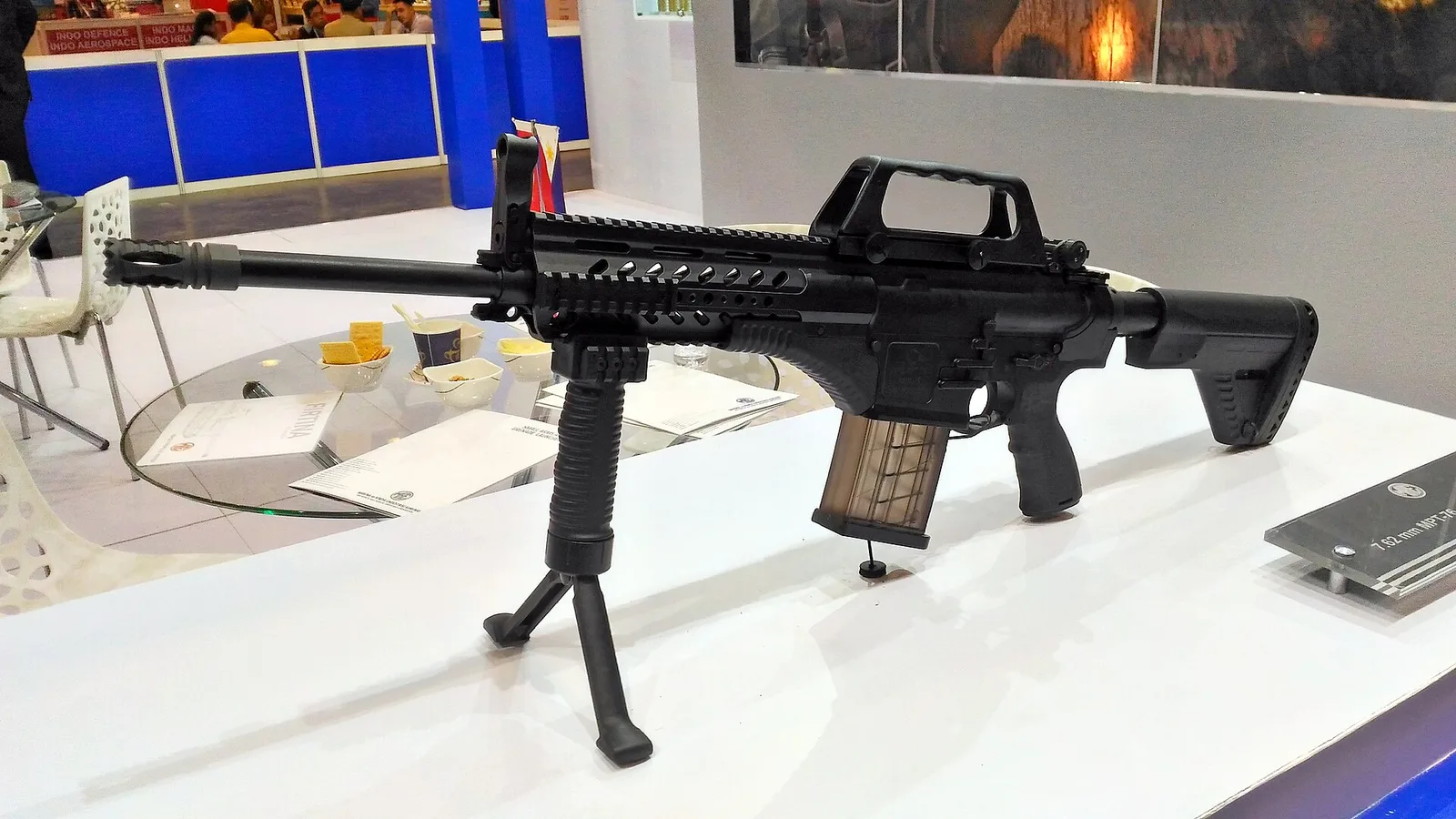
For more than sixty years, Makine ve Kimya Endüstrisi (MKE) built the Heckler & Koch G3 rifle under license at its Kırıkkale plant. The same factory now produces the MPT-76 family that has become Türkiye’s standard service rifle. But claims that the G3 has fully disappeared from the inventory overstate the case: both rifles, in very different proportions, still sit in the same force structure.
What was the old system?
The G3 traces its lineage to the postwar German StG45(M) concept and the Spanish CETME development, operating on a roller-delayed blowback action. West Germany’s Bundeswehr adopted it in 1959, with Heckler & Koch taking over production and adapting the calibre to NATO’s new 7.62x51mm standard. Türkiye adopted the G3 as its standard infantry rifle in 1967, with MKE (then MKEK) producing it under licence at Kırıkkale. The G3 weighs roughly 4.4kg empty in its fixed-stock G3A3 form and 4.7kg in the telescoping-stock G3A4 variant, feeds from a 20-round magazine and fires at around 500-600 rounds per minute. Worldwide production reached roughly 7.8 million units across more than 15 licensed-production countries, including Pakistan (POF), Iran (DIO), Portugal (FBP) and Greece (EBO). In Türkiye, the G3 held the primary infantry-rifle role for more than six decades.
Why was a domestic rifle needed?
MKE officials, presenting the national rifle project that began in 2009, said the G3 was designed mainly for conventional front-line warfare and was comparatively heavy and harder to maintain; they wanted a lighter, easier-to-maintain next-generation rifle instead. Open sources carry no documented statement tying the switch to an embargo or licence restriction — the stated drivers were modernisation, weight and ergonomics, and building a domestic small-arms industrial base. The design-and-development contract between the then Undersecretariat for Defence Industries (SSM, now SSB) and MKE, signed on 22 January 2009, marked the programme’s formal start. Industry estimates from the period put the Turkish Land Forces’ standalone rifle requirement at roughly 600,000 units, a scale that required bringing private manufacturers Kale Kalıp and Sarsılmaz into serial production alongside MKE.
How was the domestic rifle developed?
MKE tested prototypes at its Kırıkkale Small Arms Factory between 2009 and 2013; the rifle passed more than 50 tests and roughly 1.1 million rounds fired before TSK selection in 2014. Sources diverge on the first delivery date: some cite a 200-unit batch to the Land Forces Command in May 2014, others a 500-unit serial batch in January 2017. In December 2015, SSM contracted 20,000 units from MKEK (about $21 million) and 15,014 from Kale Kalıp. Sarsılmaz joined in 2017, its 5.56x45mm MPT-55/55K earning a Ministry of National Defence qualification certificate in August 2016 and debuting at IDEF 2017. By August 2019, Anadolu Agency put cumulative deliveries across the three manufacturers above 40,000. A plan reported in January 2018 called for 38,000 units that year to MİT, the Land Forces Command, police and other agencies, with a 250,000-unit target by 2026. In February 2021, SSB President İsmail Demir announced via his official social media account that qualification testing was complete for the lightened MPT-76 MH variant, which cuts weight from 4.2kg to roughly 3.75kg. In July 2026, MKE delivered the MPT-76 MH to the Land Forces Command; per MKE’s own statement the rifle passed 58 tests in total, 42 to NATO standards and 16 to domestic ones. In September 2026, MKE announced a broad delivery wave to security forces that included the MPT-76 MH, framed as part of a $1.5 billion investment programme.
Old vs new: a side-by-side comparison
| Spec | G3 (A3/A4) | MPT-76 | MPT-76 MH |
|---|---|---|---|
| Calibre | 7.62x51mm NATO | 7.62x51mm NATO | 7.62x51mm NATO |
| Action | Roller-delayed blowback (gasless) | Gas piston, rotating bolt | Gas piston, rotating bolt |
| Weight (empty) | ~4.4kg (A3) / ~4.7kg (A4) | 4,200g | 3,750g |
| Muzzle velocity | ~800 m/s | 800 m/s | 800 m/s |
| Rate of fire | ~500-600 rpm | 700 rpm | 750 rpm |
| Effective range | ~400-600m | 600m | 600m |
| Magazine | 20 rounds | 20 rounds | 20 rounds |
| Turkish service entry | 1967 (licensed) | 2014 | 2026 (delivery) |
| Manufacturer | Heckler & Koch (license: MKE) | MKE, Kale Kalıp, Sarsılmaz | MKE |
Source: Envanter Medya archive (G3 data) and MKE’s official product pages, verified 20 September 2026, for MPT-76/MH figures. Rate-of-fire figures vary slightly between press reports (700-750 rpm) and the official product page.
How much of it is domestic?
Engine: Not applicable — a firearm has no internal-combustion powerplant.
Electronics: None integral to the base rifle; optics and lasers are procured separately.
Software: None — a fully mechanical weapon system.
Weapon system: Designed jointly by MKE and Kale Kalıp to the TSK’s technical requirement.
Production: Entirely domestic, across three separate lines at MKE (Kırıkkale), Kale Kalıp and Sarsılmaz.
Design: MKE states the rifle was developed without foreign technology transfer. That claim has not been independently verified in detail in open sources; still, the fact that three separate Turkish firms can produce the rifle end-to-end demonstrates a genuinely domestic manufacturing capability.
Has it really replaced the G3?
It is being gradually replaced. MPT-76 has held the TSK’s standard infantry-rifle role since 2014; cumulative deliveries passed 40,000 by August 2019, and the lightened MH variant reached the Land Forces Command in July 2026, followed by a broad September 2026 delivery wave. The G3, meanwhile, has lost the primary role but not left the inventory: Envanter Medya’s own reporting on the Gendarmerie’s weapons inventory describes the G3 as an “older-generation” rifle still in limited use, and our file on the G3’s long service life confirms it continues in training, reserve stock and some reserve/gendarmerie units. There is no current official confirmation of whether the 250,000-unit 2026 target has actually been met. Both rifles, in very different proportions, still occupy the same force structure — one in the primary role, the other in reserve and training.
Parallels elsewhere
Localising the standard service rifle is not unique to Türkiye. The series’ second file, on Poland’s transition from the Strzała-2M/Igla to PIORUN, traces a similar axis from licensed technology to domestic design. Singapore’s ST Engineering, developing the BR18 bullpup rifle to succeed the SAR 21, repeats the same logic elsewhere: a mixed licensed/domestic inventory, then a gradual transition. The G3’s NATO-calibre rival, the FN FAL, retired along a comparable worldwide trajectory, much like the Cold War’s AK-47-to-AK-74 and M16-to-M4 transitions: the new rifle enters with priority units first, while the old one lingers in training and reserve roles for years.
Strategic and industrial outcome
The MPT-76 programme brought three Turkish manufacturers — MKE, Kale Kalıp and Sarsılmaz — to full, end-to-end rifle production, expanding on the single-licensee G3 era. Design changes and export decisions, once out of reach under licensed production, now sit entirely with domestic firms. Confirmed export users include the Cyprus Turkish Security Forces Command (2,500 units ordered), Somalia (450 units in an initial batch), Cameroon (fielded by the Rapid Intervention Battalion, BIR), Montenegro (15 units donated) and Albania (30 units donated alongside the MPT-55); unconfirmed interest has been reported from the United States, Chile, Pakistan and Azerbaijan, which Envanter Medya treats as “prospective,” not confirmed users, absent an order. The programme also built the engineering and production base behind derivatives such as the MPT-55 (5.56mm), MPT-76 SH and KNT-76.
Frequently asked questions
Which rifle is the MPT-76 replacing?
The MPT-76 is gradually replacing the Heckler & Koch G3, which the Turkish Armed Forces produced under licence from 1967.
Is the G3 still in TSK service?
Yes, in limited numbers. It has lost the primary infantry-rifle role to the MPT-76 but remains in training, reserve stock and some gendarmerie units.
What is the difference between MPT-76 and MPT-55?
MPT-76 is chambered in 7.62x51mm NATO; MPT-55 is a 5.56x45mm NATO variant from the same family, added to production by Sarsılmaz in 2017.
How different is the MPT-76 MH from the standard MPT-76?
The MH variant keeps the same calibre and range but cuts weight from 4,200g to 3,750g; the rate of fire and stock adjustment range also differ.
Is the MPT-76 fully domestic?
Production is entirely Turkish, across three separate companies. MKE says the design involved no foreign technology transfer, but that claim has not been independently verified in detail in public sources.
How many MPT-76 rifles have been delivered so far?
Cumulative deliveries passed 40,000 by August 2019. A 2018 plan targeted 250,000 units by 2026; there is no current official confirmation of whether that target has been met.
Sources
Primary:
MKE official product pages (mke.gov.tr) — MPT-76/MPT-76 MH technical data
SSB President İsmail Demir, official statement (7 February 2021) — MPT-76 MH qualification complete
SSM (Undersecretariat for Defence Industries) serial-production contract, December 2015 — MKEK/Kale Kalıp delivery contracts
MKE corporate announcement (5 September 2026) — delivery wave to security forces
Independent:
Army Recognition — IDEF 2017: MPT-55/55K unveiled
Shephard Media — Turkey receives new assault rifle
Quwa — The Turkish Forces Receive First MPT-76 Rifles
NTV/DHA — MKE delivers MPT-76 MH to the TSK
Envanter Medya archive:
Why Did the G3 Stay in Service So Long?
What Weapons Does the Turkish Gendarmerie Use?
MPT-76 vs MPT-76MH: What’s the Difference?
What Is the MPT-55?
Which Countries Use the MPT-76?