IAI (Israel Aerospace Industries) Company Profile: The $7.4 Billion Defense and Space Giant

Overview
IAI (Israel Aerospace Industries) is Israel’s largest defense, aviation and space company. Founded in 1953 as a state-owned enterprise, IAI continues to be fully owned by the Israeli government and operates across land, sea, air, space and cyber domains with a broad product portfolio exported to more than 70 countries.
⚠️ Critical Context: IAI, the Occupation and Gaza
Israel Aerospace Industries (IAI) is one of the largest state-owned defense companies of Israel; its drones, guided munitions, radars and missile systems are used by the Israeli military in operations across the occupied Palestinian territories.
IAI’s unmanned systems such as the Heron and Harop, and its guided munitions, have been used in practice in air operations against densely populated civilian areas of Gaza. The company’s “combat-proven” marketing is directly tied to the deployment of these systems against civilian areas.
Over its campaign in Gaza, Israel faces a genocide case brought by South Africa at the International Court of Justice (ICJ), which ordered provisional measures against the risk of genocide; the UN independent Commission of Inquiry and UN Special Rapporteurs have reported findings of war crimes and genocide.
IAI’s $7.4 billion revenue and “export success” should therefore not be read in isolation from its human cost or from its role in the occupation economy.
In 2025, IAI closed the year with record revenue of $7.38 billion, a 20.8% increase over the previous year. The total order backlog reached $28.75 billion, representing approximately 3.9 years of revenue. The Missiles and Space Systems division alone generated $3.48 billion in external revenue in 2025.
IAI operates through four main business segments: ELTA Systems (radar and electronic warfare), Missiles and Space, Military Aircraft, and Aviation Services. Civilian customers include British Airways, General Electric, Lockheed Martin and UPS.
Official Links
- Official Website: www.iai.co.il
- Systems and Products: iai.co.il/systems
- ELTA Radar Systems: iai.co.il/elta
- Press Center: iai.co.il/about/press-releases
Company Data
| Data | Value |
|---|---|
| Founded | 1953 (as Bedek Aviation, 1951) |
| Headquarters | Lod, Israel (near Ben Gurion Airport) |
| Employees | ~20,000 (December 2025) |
| Annual Revenue | $7.38 billion USD (2025, record) |
| Order Backlog | $28.75 billion USD |
| Defense News Top 100 Rank | #28 (2024) |
| Export Countries | 70+ |
| Ownership | 100% Israeli Government |
| Key Divisions | ELTA Systems, Missiles & Space, Military Aircraft, Aviation |
History
IAI’s roots trace back to 1951 when it was established as Bedek Aviation Company immediately after Israeli independence, initially focused on maintaining and repairing used military aircraft. The company was renamed Israel Aerospace Industries in 1953.
In the 1960s, the Gabriel sea-to-sea missile was developed and used effectively in the 1967 and 1973 wars. The 1970s saw the Scout and Searcher UAVs reshape the global unmanned systems landscape. The Lavi fighter jet developed in 1986-1987 was ultimately cancelled under US pressure and cost overruns, but gave IAI invaluable advanced aerospace engineering expertise.
Since the early 2000s, the Arrow missile defense system, satellite programs and ELTA radar products have placed IAI among global defense technology leaders. Post-2023 regional conflicts demonstrated IAI systems capabilities worldwide: Arrow 3 successfully neutralized Iranian-origin ballistic missiles while Harop loitering munitions appeared in the India-Pakistan conflict.
Product Inventory
Missile and Air Defense Systems
Arrow 3 (Hetz 3) — Exo-Atmospheric Missile Defense
Arrow 3 is one of the world’s most advanced long-range missile defense systems, designed to intercept ballistic missiles above the atmosphere at altitudes exceeding 100 km and ranges over 2,000 km. A single Arrow 3 battery can intercept a salvo of more than five ballistic missiles within 30 seconds.
- Radar: ELTA Super Green Pine (L-band AESA)
- Combat Record: First combat use November 2023 against Houthi ballistic missiles; April and October 2024 against Iranian attacks; 90%+ success rate in 2025 Israel-Iran conflict
- Exports: Germany — $3.5 billion contract (2023), $3.1 billion expansion (January 2026), first Arrow 3 delivery December 2025. Total Germany package: $6.5 billion — first European export of the system
Barak MX — Naval and Land-Based Air Defense
Barak MX is a multi-layered air defense system capable of engaging aircraft, UAVs, cruise missiles and ballistic threats with a range of up to 150 km (Barak ER variant).
- Exports: India ($1.6 billion, Barak 8 / LRSAM), Cyprus, Slovakia, Azerbaijan, Thailand ($107 million), Morocco and UAE (per foreign reports)
Gabriel — Anti-Ship Missile Family
Gabriel is IAI’s iconic anti-ship missile family first deployed in 1970, now in its fifth-generation variant with a range of approximately 400 km and active radar plus infrared guidance. The Gabriel V is in service with the Israeli and Finnish navies.
Harop — Loitering Munition (Kamikaze Drone)
Harop is a loitering munition that homes in on enemy radar emissions and destroys them by direct impact, achieving a 98% mission success rate. It was used extensively in the 2016 and 2020 Nagorno-Karabakh conflicts and by India against Pakistan in May 2025.
UAV Systems
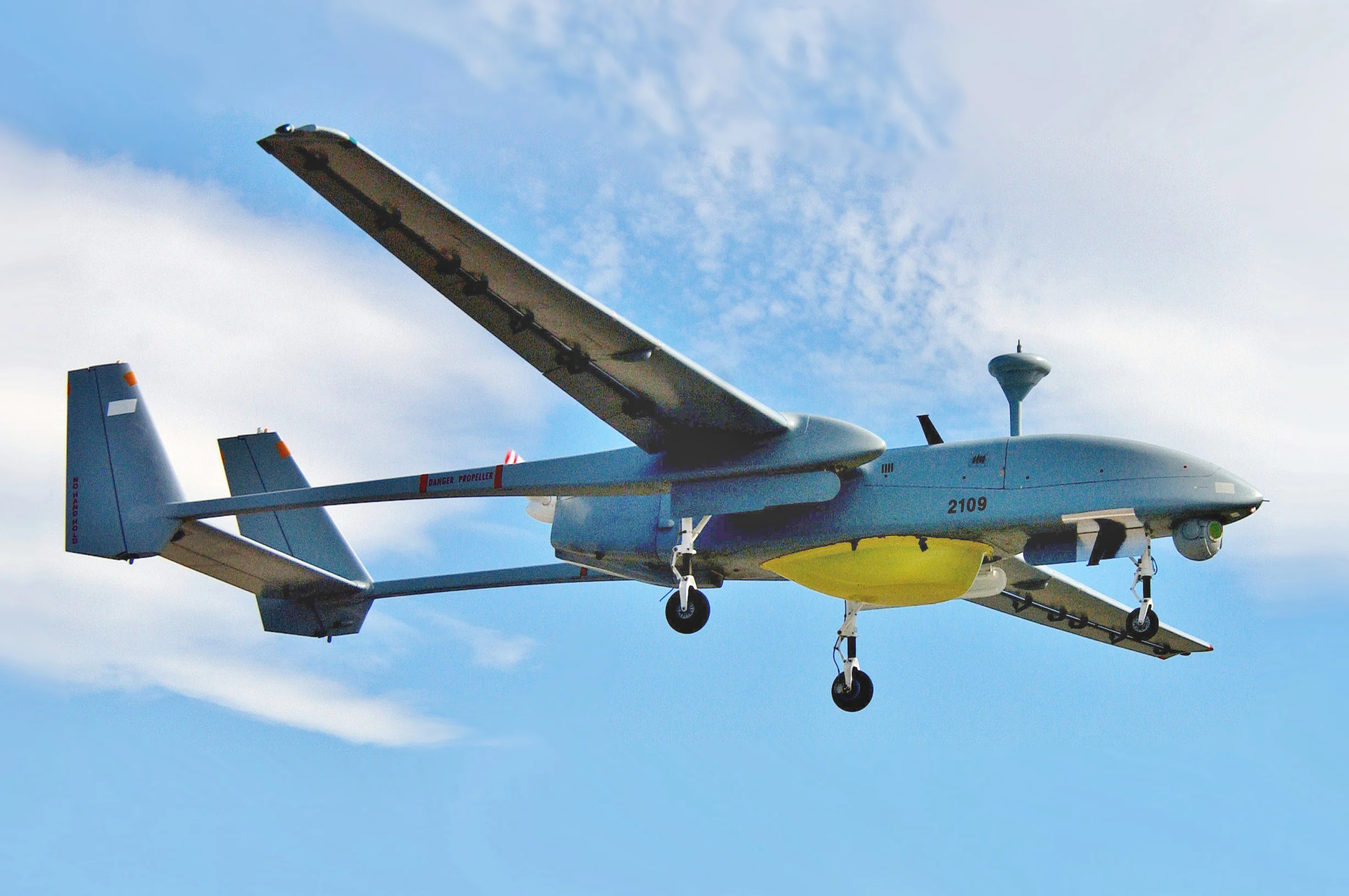
Heron TP (Eitan) — Strategic MALE UAV
IAI’s largest UAV with a 26-meter wingspan, capable of 36-hour continuous flight at 45,000 ft. Payload capacity of 2,700 kg. Used in operational roles since the 2008-2009 Gaza operation.
Heron 1 — Tactical MALE UAV
Operated by 16+ countries including Australia, Brazil, Canada, France, Germany, Greece, India, Singapore, South Korea, Turkey and Vietnam. Endurance: 52 hours, ceiling: 10,500 m, payload: 250 kg. Turkey operates a special ASELSAN-integrated variant with the ASELFLIR-300T thermal imaging system.
Radar Systems (ELTA)
ELM-2084 — Multi-Mission AESA Radar
One of the world’s most advanced portable multi-mission radar systems capable of simultaneously executing air defense, artillery fire control, drone detection and ballistic missile warning missions. ELTA revenues reached $2.215 billion in 2025, with 75% from exports.
Space Systems
Ofek Spy Satellites: Ofek 19 (SAR satellite) launched September 2025 — provides all-weather, day-night intelligence. IAI signed a $1 billion spy satellite deal with Morocco in 2025.
AMOS Communications Satellites: Commercial communications satellite series operated by Spacecom; latest collaboration with SpaceX for the Dror 1 satellite launched from Cape Canaveral.
Loitering Munitions
- Harpy: Anti-radiation loitering weapon homing on radar emissions; 2.5 kg warhead; 9-hour endurance
- Mini Harpy: Compact version for smaller formations
- Rotem VTOL: Vertical takeoff and landing loitering munition for urban warfare
Export Analysis
| Country | System | Contract Value | Year |
|---|---|---|---|
| Germany | Arrow 3 | $3.5B + $3.1B expansion | 2023-2026 |
| India | Barak 8/LRSAM, Heron, Harop | $1.6B (Barak 8) | 2010s-2025 |
| Thailand | Barak MX | $107M | 2023 |
| Morocco | Ofek spy satellite | $1B | 2025 |
| Turkey | Heron 1 UAV | $183M | 2005 |
| Azerbaijan | Harop, Barak 8 | Classified | 2016-2024 |
| Finland | Gabriel V | Classified | 2020+ |
Competitors
- Rafael Advanced Defense Systems (Israel): Iron Dome, Spike ATGM, Trophy APS
- Elbit Systems (Israel): Hermes UAV, PULS rocket system
- Raytheon (US): Patriot, THAAD, Tomahawk
- MBDA (Europe): Meteor, Aster, Mistral air defense missiles
- Thales (France): Electronic warfare, radar, C2 systems
- Northrop Grumman (US): Global Hawk UAV, radar systems
Envanter Media Assessment
IAI occupies a genuinely unique position in global defense technology. Geographic constraints and existential security pressures have historically forced Israel to develop innovation out of necessity — a dynamic that has made IAI one of the most technology-intensive defense companies in the world.
The Arrow 3 sale to Germany is not merely an export deal; it represents a NATO member entrusting its strategic ballistic missile defense to Israeli technology, providing concrete proof of IAI’s global credibility. The Harop’s effectiveness in the India-Pakistan conflict and Heron’s continued use in Frontex Mediterranean patrols demonstrate these systems deliver in real operational environments, not just export catalogs.
From a Turkish defense industry perspective: Bayraktar TB2 and TB3 have become genuine global alternatives to the Heron family with a significantly broader export footprint. ROKETSAN’s SIPER system is pursuing Arrow 3’s exo-atmospheric capability. The HISAR family and ATMACA are competitive in their respective range bands against Barak and Gabriel.
Nevertheless, IAI’s $28.75 billion order backlog and record 2025 revenues signal just how powerfully technological superiority translates to market share. Turkey’s growing share of this landscape remains a realistic near-term objective.