Arrow 3 (Hetz 3): Israel’s Exo-Atmospheric Shield That Destroys Missiles in Space

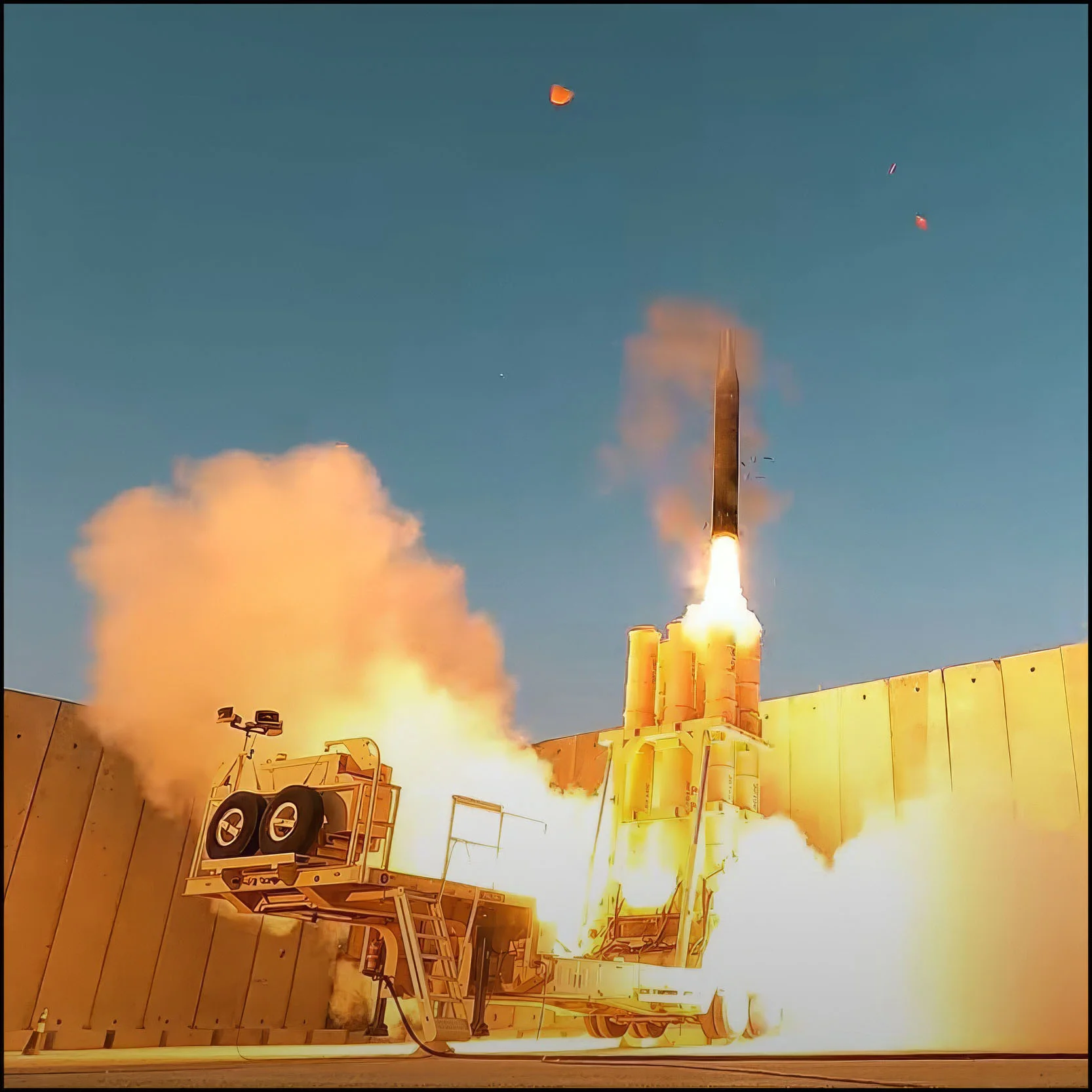
Arrow 3 (Hebrew: Hetz 3) is an exo-atmospheric ballistic missile defense system designed to intercept long-range ballistic missiles at the edge of space — above 100 km altitude. Jointly developed by Israel Aerospace Industries (IAI) and Boeing, it became the first exo-atmospheric missile defense system exported to Europe when Germany received its first battery in December 2025.
Interest in the system goes beyond its technical specifications. Following two major Iranian ballistic missile barrages against Israel in 2024, Arrow 3 became one of the rare systems in modern history to be tested in actual combat and documented in near-real time by global media.
What Is It? What Does It Do?
While most air defense systems intercept threats inside the atmosphere — tens of kilometers above the ground — Arrow 3 engages targets far higher, at 100 km and beyond, at the boundary where the atmosphere ends and space begins. This exo-atmospheric intercept approach delivers several critical advantages:
- Wide area coverage: Intercept at a higher and earlier point means a single battery protects a much larger geographic area.
- Pre-separation intercept: Ballistic missiles can deploy multiple independently targetable warheads (MaRV/MIRV) after atmospheric entry. Arrow 3 intercepts before this dispersal phase.
- Minimal debris risk: Destruction above the atmosphere means most debris burns up on re-entry, dramatically reducing collateral damage compared to intercepts over cities.
- Hit-to-kill technology: Arrow 3 uses no explosives; it destroys incoming missiles through kinetic impact at hypersonic velocities, making it effective against decoys as well.
Technical Specifications
| Parameter | Value |
|---|---|
| Manufacturer | IAI (Israel Aerospace Industries) + Boeing |
| Country | Israel / USA (joint) |
| Intercept type | Exo-atmospheric kinetic kill vehicle (KKV) |
| Propulsion | Two-stage solid-fuel + separating kill vehicle |
| Intercept altitude | 100 km+ (exo-atmospheric) |
| Defense footprint | 2,400 km |
| Speed | Hypersonic (Mach 9+) |
| Battery salvo capacity | 5+ ballistic missiles in 30 seconds |
| Radar | ELTA Super Green Pine (L-band AESA) |
| Radar detection range | 500+ km |
| Cost per interceptor | ~$3 million USD (approx. 1/4 of THAAD) |
| Estimated battery cost | ~$170 million USD |
| Target types | Long-range ballistic missiles, MRBM, ICBM-class |
Development History
The Arrow program was a direct consequence of the 1991 Gulf War, when Iraqi Scud missiles struck Israel. The US and Israel launched a joint ballistic missile defense development program immediately after; Boeing joined the partnership while IAI took the prime contractor role, with substantial US Missile Defense Agency (MDA) funding.
Arrow 1 prototypes were tested in the early 1990s. Arrow 2 focused on extended early warning and atmospheric intercept. Arrow 3 was conceived as an entirely new design targeting exo-atmospheric intercept and entered development in 2008, with its first successful test in 2013 and delivery to the Israeli Air Force in 2017.
The US contribution is foundational: IAI designed all the combat systems while Boeing handled support structures and integration. The US also retains ultimate authority over export licenses, meaning no buyer — including Germany — can acquire the system without Washington’s approval.
Combat Record
November 2023 — First Combat Use
Arrow 3 had its debut combat engagement when Houthi forces in Yemen fired Iranian-origin ballistic missiles toward Israel following the October 7 Hamas attack. Arrow 3 intercepted the threat above the Red Sea in exo-atmospheric space.
April 2024 — Iran’s Direct Strike
On April 13-14, 2024, Iran launched its largest-ever direct attack on Israel: 120 ballistic missiles, 30+ cruise missiles and 170+ drones. Arrow 3 destroyed the vast majority of long-range ballistic missiles outside the atmosphere, in coordination with US, UK and Jordanian assets. Israeli and US officials stated 99% of the barrage was neutralized before reaching Israeli territory.
October 2024 — Second Major Barrage
On October 1, 2024, Iran fired 180 ballistic missiles. Arrow 3 performance was more mixed, with some missiles striking the evacuated Nevatim and Tel Nof air bases. Israeli officials later suggested some intercepts were intentionally withheld once those bases were cleared of personnel and aircraft — a claim that, if accurate, means “system failure” is not the correct characterization.
June 2025 — Twelve-Day Israel-Iran Conflict
In the 12-day conflict, Arrow 3 intercepted more than 90% of targeted long-range ballistic threats from Iran. Over 34 interceptors were expended. The performance resolved doubts raised by October 2024 and significantly accelerated foreign military interest in acquiring the system.
User Countries
| Country | Status | Notes |
|---|---|---|
| Israel | Operational | Primary operator since 2017 |
| Germany | Operational (first battery) | Holzdorf Air Base, activated December 3, 2025 |
Export History and Contracts
Germany — $6.5 Billion Historic Deal
- August 2023: First contract signed, $3.5 billion, following US export authorization — Israel’s largest-ever single defense export contract at the time.
- December 2025: First battery delivered and activated at Holzdorf Air Base in Germany.
- January 2026: Germany signs a second $3.1 billion expansion contract.
- Total: $6.5 billion. Germany is also exploring co-development partnership for Arrow 4.
Germany’s investment is a direct product of Russia’s invasion of Ukraine and the resulting “Zeitenwende” (turning point) German defense transformation. A NATO member entrusting its strategic ballistic missile defense to Israeli technology represents a significant validation milestone for the system.
Other Potential Buyers
Netherlands, Poland and Japan are reported to have expressed serious interest. Ongoing Greece-Israel negotiations include Arrow 3 as part of a reported $3.5 billion multilayered defense package.
Advantages
- Exo-atmospheric intercept: Destruction in space, not above cities; near-zero debris risk.
- Wide area defense: Single battery covers hundreds of kilometers.
- Combat proven: One of the few systems with a real-world engagement record against active barrages.
- Low interceptor cost: Approximately one-quarter of THAAD’s per-interceptor cost for exo-atmospheric kill.
- Salvo capability: Engages 5+ ballistic threats simultaneously in 30 seconds.
- Layered integration: Works alongside Arrow 2, David’s Sling and Iron Dome for comprehensive coverage.
Disadvantages
- Export dependency: US approval required for all sales, creating policy-risk for buyers during periods of US-Israel friction.
- Israel-centric design: Optimized for Israel’s threat environment; integration in other geographies requires significant adaptation.
- Infrastructure footprint: Super Green Pine radar and logistics require substantial fixed installation.
- Hypersonic glide vehicle limitation: Highly effective against linear ballistic trajectories; performance against maneuvering HGVs remains less demonstrated.
- October 2024 questions: Bases struck by missiles generated credibility questions, even if Israel’s “intentional pass-through” explanation is accepted.
Competitor Systems
| System | Country | Intercept Altitude | Range | Cost / Interceptor | Combat Proven |
|---|---|---|---|---|---|
| Arrow 3 | Israel/USA | 100 km+ (exo) | 2,400 km | ~$3M | Yes (2023-2025) |
| THAAD | USA | 40-150 km | 200 km | ~$12.7M | Limited |
| SM-3 Block IIA | USA/Japan | 500 km+ (exo) | 1,200 km | ~$10-20M | Limited |
| S-400 | Russia | 30-56 km (endo) | 400 km | ~$300K-1M | Ukraine/Syria |
| S-500 Prometei | Russia | 200 km (exo) | 600 km | Undisclosed | None yet |
The THAAD comparison is most instructive. THAAD intercepts in the terminal phase (post-atmospheric re-entry) at 40-150 km altitude. Arrow 3 intercepts earlier in the midcourse/exo-atmospheric phase, before warhead deployment. Both systems are therefore complementary rather than competing — THAAD’s AN/TPY-2 radar provides 1,800 km detection range versus Arrow 3’s Super Green Pine at 500 km, making THAAD the earlier warning layer and Arrow 3 the higher intercept layer.
Turkish Equivalent — SİPER Analysis
Turkey’s answer to long-range ballistic missile defense is the SİPER system, jointly developed by ROKETSAN, ASELSAN and TÜBİTAK SAGE. SİPER is also Turkey’s practical response to the S-400 crisis and its exclusion from the F-35 program — a push to develop a NATO-compatible, domestically-produced long-range air defense capability.
| Parameter | Arrow 3 | SİPER Block 1 | SİPER Block 2 | SİPER Block 3 (dev.) |
|---|---|---|---|---|
| Range | 2,400 km coverage | 100 km | 150 km | 180+ km |
| Intercept altitude | 100 km+ (exo) | Endoatmospheric | Endoatmospheric | Ballistic missile target |
| Inventory entry | 2017 (Israel) | October 2024 | Testing phase | Development |
| Combat proven | Yes | No | No | — |
SİPER Block 3 explicitly targets the same exo-atmospheric intercept category as Arrow 3 — but this remains a longer-term ambition. Block 1 and 2, now in inventory, address current threat tiers. A critical difference is that SİPER requires no US export license, which gives it a strategic long-term export advantage in markets where Arrow 3’s American approval chain creates political complications.
In April 2026, SİPER-1 was fully integrated into Turkey’s Steel Dome integrated air defense network. This milestone marked the system’s full operational status — a significant achievement for Turkish domestic defense capability.
Envanter Media Assessment
Arrow 3 is not a theoretical system — it is one of the only active missile defense systems in the world to have engaged real barrages in real conflict conditions between 2023 and 2025. That muharebe sicili (combat record) separates it from virtually every competing platform currently on the export market.
Germany’s $6.5 billion commitment is more than a procurement decision; it is a geopolitical signal. The largest economy in Europe trusting its strategic ballistic missile defense to Israeli technology — not US THAAD, not European alternatives — marks a new chapter in both Israeli defense industry credibility and European security architecture.
For Turkey, the honest assessment is: SİPER today does not match Arrow 3’s exo-atmospheric capability or its combat record. But the Block 3 roadmap is funded, the industrial base is established, and Turkey’s threat environment makes ballistic missile defense a genuine operational necessity rather than an academic exercise. Whether Block 3 delivers on schedule will determine whether SİPER becomes a credible export alternative in the category Arrow 3 currently dominates.