Harop Loitering Munition: IAI’s Radar Hunter and Azerbaijan’s War-Winner

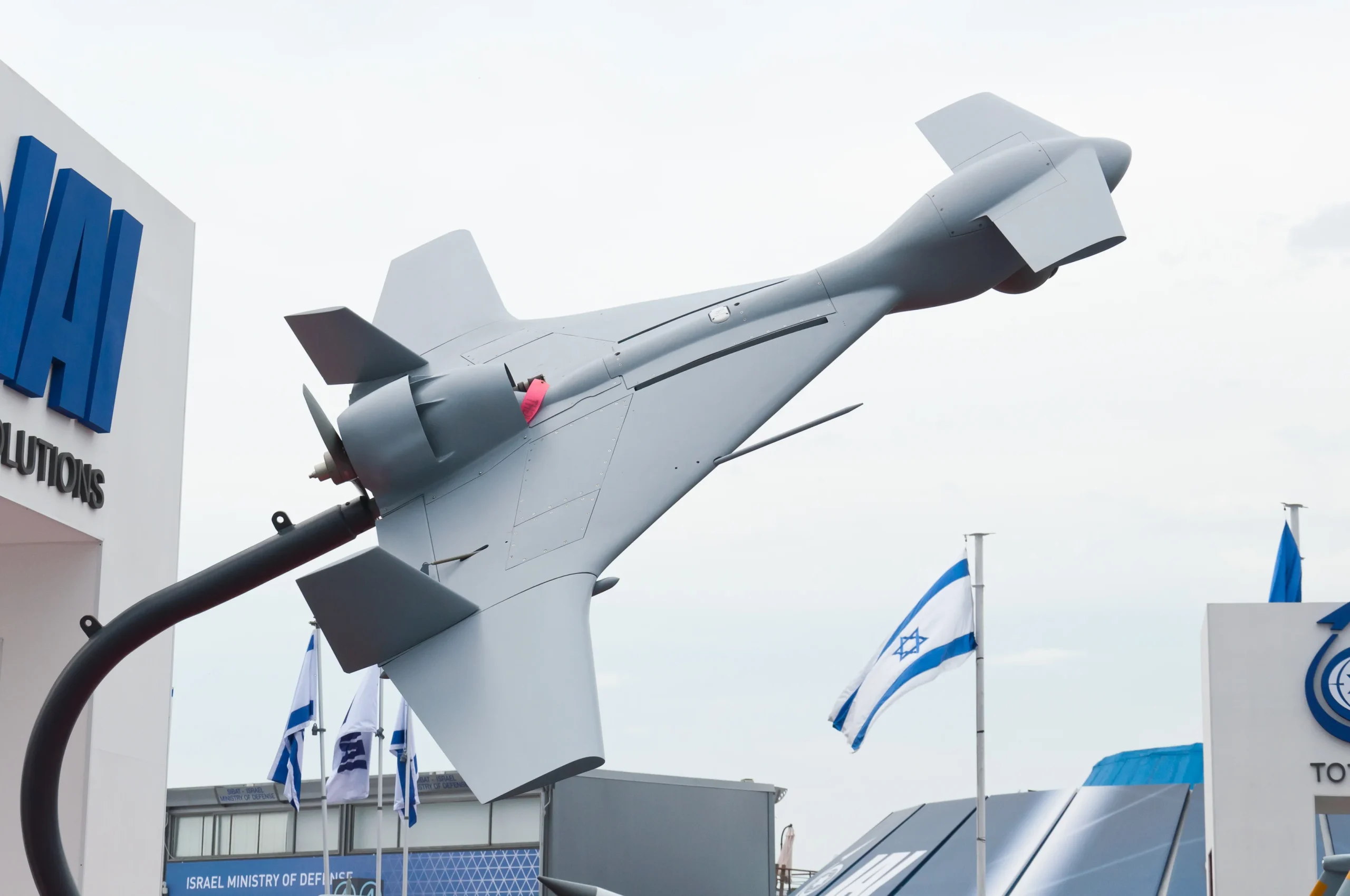
Harop is IAI’s second-generation loitering munition, capable of hovering over a target area for up to nine hours before conducting a terminal dive attack. Unlike the earlier Harpy, which homed only on radar emissions, Harop adds an electro-optical/infrared camera and a two-way encrypted datalink — enabling operator-in-the-loop target selection or cancellation up to the final moment. Its operational debut in the 2020 Nagorno-Karabakh War — where it systematically destroyed Armenian S-300, BUK M1, and Tor air defense systems — transformed global military thinking about loitering munitions.
Technical Specifications
| Parameter | Value |
|---|---|
| Wingspan | 2.3 m |
| Length | 2.5 m |
| Launch weight | 135 kg |
| Warhead | 23 kg HE (fragmentation + penetration) |
| Propulsion | Electric motor (low acoustic signature) |
| Maximum speed | 417 km/h |
| Service ceiling | 4,500 m |
| Maximum loiter time | 6–9 hours |
| Operational range | 200+ km coverage area |
| Guidance | Passive radar homing + EO/IR camera + GPS/INS |
| Launch method | Container-based catapult or vehicle-mounted |
Combat Record
2020 Nagorno-Karabakh War
Azerbaijan deployed Harop extensively during the 44-day war of September-November 2020. Armenian S-300, BUK M1, OSA, and Tor air defense systems were destroyed by Harop strikes before Azerbaijani forces advanced. In combination with BAYKAR Bayraktar TB2 drones, Harop systematically dismantled Armenia’s layered air defense architecture. Defense analysts widely regard this campaign as the defining demonstration of loitering munition effectiveness in peer-level conventional warfare.
2023 Karabakh Operation
During Azerbaijan’s 24-hour operation in September 2023, Harop again performed anti-armor and air defense suppression roles, contributing to the rapid collapse of remaining Armenian positions in the region.
User Countries
| Country | Use | Status |
|---|---|---|
| Azerbaijan | Army (anti-armor + anti-radar) | Operational; combat-proven |
| India | Air Force + Army | Operational; additional order 2023 |
| Israel | IDF (domestic) | Operational |
Turkish Equivalent
Turkey’s loitering munition portfolio includes STM Kargu-2 (rotary-wing, ~7 kg, autonomous AI targeting) and ROKETSAN Alpagu (fixed-wing micro). For longer-endurance precision strike, the Bayraktar TB2/TB3 with MAM-L munitions fills a different but partially overlapping role. No Turkish system currently matches Harop’s specific combination of 6-9 hour loiter time with passive anti-radar homing. Larger-format loitering munition programs under development by TUSAŞ and ROKETSAN aim to address this gap.
Envanter Media Assessment
Harop’s defining characteristic — and the source of its strategic uniqueness — is the combination of long loiter with passive anti-radar homing. A cruise missile knows its target and flies to it; Harop waits until the target reveals itself. This reverses the defender’s traditional advantage: switching off a radar to survive exposes ground forces to other threats. As AI-enabled counter-drone and jamming systems mature, Harop’s advantage will depend on IAI’s ability to maintain datalink resilience and autonomous terminal guidance against sophisticated air defenses. The 2020 Karabakh record remains its strongest sales argument.