





From Licensed M109 to K9 Thunder: South Korea’s Howitzer Shift

From Imported to Indigenous series · File 8 · Sarp Güçlü
Class D — Licensed Production to Indigenous Design: First licensed/co-production, later an independent design capability.
Status today: Being phased in gradually — the K9 Thunder is now South Korea’s standard self-propelled howitzer, while part of the older licensed K55 (M109A2) fleet remains in service after modernisation.
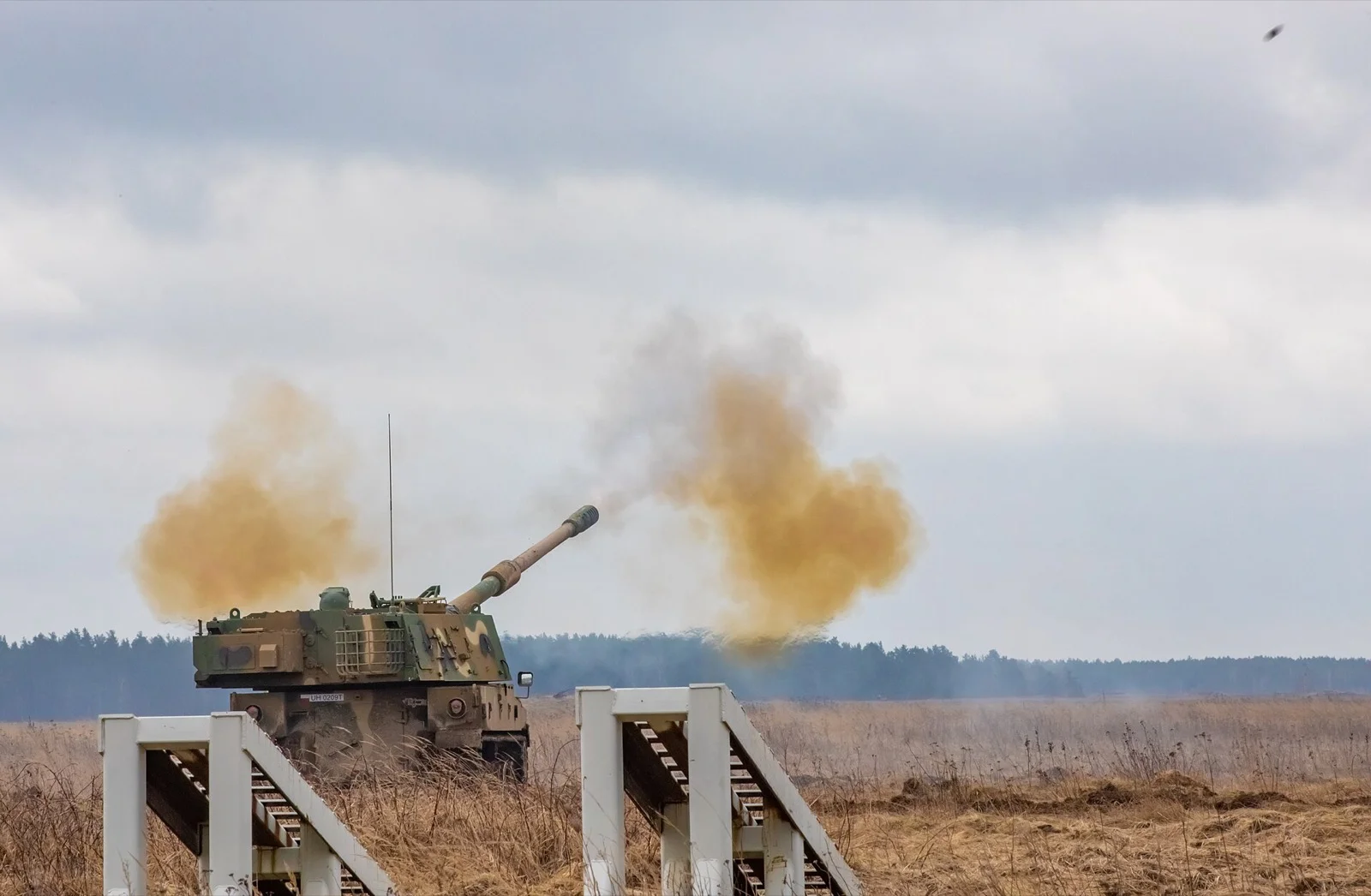
When South Korea’s licence-built M109A2 howitzer fell short against North Korea’s longer-ranged artillery, Seoul chose to design its own. Three decades on, the K9 Thunder has become one of the world’s most widely exported self-propelled howitzers — though its engine only partly shed foreign dependence, and only in 2024.
1. What was the old system?
Through the 1980s, South Korea’s artillery backbone rested on the locally built M109A2, produced under a licence from the US firm United Defense (today BAE Systems Land & Armaments) by Samsung Aerospace Industries — later Samsung Techwin, now Hanwha Aerospace. Known locally as the K55, 1,040 units were delivered from the mid-1980s through 1997. Separately, the fully indigenous KH179 towed 155mm howitzer, built by Kia Machine Tool (today Hyundai WIA), entered service in 1983 — South Korea’s first real experience with artillery design rather than assembly. The K55’s hull and drivetrain came directly from the US M109 family; the local contribution was mostly assembly and spare parts, not design.
2. Why was an indigenous system needed?
By the late 1980s, North Korea’s M-1978 Koksan 170mm self-propelled gun markedly outranged the K55/M109A2 family, and the Army treated that gap as a strategic risk. ADD’s proposal to upgrade the K55 was rejected by the Army in 1988 as insufficient; a clean-sheet programme was approved instead. The documented driver is the range/capability gap — no embargo or supply-restriction rationale appears in the sources. The approaching end of K55 licensed production (closing at 1,040 units in 1997) added an industrial-policy incentive: building design capability instead of continuing to pay for a licence.
3. How was the indigenous system developed?
The K9 Thunder programme began in 1989 under ADD as lead designer, with Samsung Techwin (now Hanwha Aerospace) as prime contractor/manufacturer and Kia Machine Tool producing the main gun. Sources disagree on the first prototype date — some cite 1996, others describe testing continuing to 1999 — and this has not been confirmed by an official ADD/DAPA statement, so it should be read cautiously. In brief: 1988-89, the K55 upgrade is rejected and the new programme launches; 1996, the first prototype is tested; 1997, K55 licensed production closes at 1,040 units; 1999, the Army takes its first K9s into service; 2001, Türkiye licenses the technology for its own T-155 Fırtına; November 2010, K9 batteries fire during North Korea’s Yeonpyeong Island bombardment — first combat use; 2014, the first major export deal is signed with Poland; 2017-18, Norway and Finland order the system as the fleet begins upgrading to K9A1; November 2020, DAPA announces deliveries to the Army and Marine Corps complete; 2021-24, DAPA and the Ministry of Trade, Industry and Energy (MOTIE) develop a fully domestic engine, rolled out at STX Engine’s Changwon plant in September 2024; February 2025, that engine completes durability testing in Egypt.
| Feature | K55 (licensed M109A2) | K9 Thunder |
|---|---|---|
| Design/production | United Defense (US) licence — built by Samsung Aerospace Industries | ADD design — built by Hanwha Aerospace (Samsung Techwin), gun by Kia Machine Tool |
| Entered service | 1980s; 1,040 units, deliveries complete by 1997 | 1999 |
| Main gun | 155mm/39 calibre | 155mm/52 calibre (ADD-designed barrel) |
| Range | Not disclosed (M109A2 family typically ~18km) | ~18km with standard NATO rounds; up to 40km with extended-range rounds per the manufacturer (Shephard Media/Army Recognition — a manufacturer claim, not independently verified) |
| Crew | 6 | 5 |
| Engine | Detroit Diesel (US-licensed, standard across the M109 family) | MTU MT 881 Ka-500 (German licence, built by STX Engine); a domestic 1,000hp engine has been phased in since 2024 |
| Deliveries (ROK) | 1,040 units | Completed in 2020 per DAPA; Janes estimates ~1,300 units (no exact figure released) |
| Exports | None | Over 10 countries (Türkiye, Poland, Norway, Estonia, Finland, India, Egypt, Australia, Romania, Vietnam); global production estimates range from 1,700 to 1,900+ depending on the source |
4. How much is indigenous?
- Design: The hull, chassis, 155mm/52 gun and autoloader were developed by ADD — indigenous.
- Production: Hanwha Aerospace (formerly Samsung Techwin/Hanwha Defense) is the prime contractor; Kia Machine Tool (today Hyundai WIA) builds the main gun — domestic.
- Engine: Until 2024, entirely the German-licensed MTU MT 881 Ka-500, built by STX Engine. A 2021-24 DAPA–MOTIE programme localised roughly 500 core components into a fully domestic engine of the same 1,000hp output, about 5% more fuel-efficient, which passed a 10,000km Egypt durability trial in February 2025. STX Engine keeps the MTU licence running in parallel — dependence has eased, not ended.
- Transmission: Sources list an Allison X1100-5A3 (US origin); its domestic/licensed share is not officially confirmed — not disclosed.
- Munitions: Gun and autoloader are indigenous; the ammunition supply chain’s domestic/foreign split is not clearly documented — not disclosed.
5. Has it really replaced the old system?
Being phased in gradually. Since 1999 the K9 Thunder has become South Korea’s standard self-propelled howitzer. Citing DAPA, Janes reported on 13 November 2020 that deliveries to the Army and Marine Corps were complete; DAPA gave no exact figure, so Janes put the total at roughly 1,300 units. GlobalSecurity’s undated inventory table suggests about 1,136 K9s in Army service as of 2020, holding through 2030 — treat that cautiously given the missing date. The K55 family has not fully retired: Hanwha supplied DAPA with additional K55A1 modernisation howitzers in 2019, so part of the licensed M109A2-derived fleet remains in service, upgraded rather than withdrawn. The K9 fleet itself is also mid-upgrade to the K9A1 standard since 2018. Together, these point to “gradually replacing,” not “fully replaced.”
6. Parallels elsewhere
The licensed-to-indigenous pattern recurs across this series: Kazakhstan’s shift from the BTR-70/80 to the ARLAN sits in the same Class D — see From BTR-70/80 to ARLAN: Kazakhstan’s Licensed-to-Local Production Shift. The K9 has fed other countries’ own localisation chains too: Türkiye used licensed K9 technology from the early 2000s to build its T-155 Fırtına, and Poland’s first 2014 contract was partly built locally through HSW. See our archive piece What Is Hanwha Aerospace? for its export footprint.
7. Strategic and industrial outcome
The K9 Thunder is one of South Korea’s clearest defence-export successes: Shephard Media called it the world’s “best-selling” 155mm self-propelled artillery system in 2023, with sales to Türkiye, Poland, Norway, Estonia, Finland, India, Egypt, Australia, Romania and Vietnam. As of late 2021, roughly 600 units had gone to six of those buyers (Türkiye, Poland, India, Norway, Finland, Estonia); that predates the later Egypt, Romania and Vietnam orders, so the current total is likely higher, but no single up-to-date figure is available — not disclosed. The real industrial gain sits with the engine: K9 exports long required re-export approval tied to the German MTU licence, reportedly a constraint on some Middle Eastern sales. The 2021-24 domestic-engine programme eased that, giving DAPA and MOTIE an export capability that no longer needs third-country sign-off — a shift linked to the roughly ₩2 trillion Egypt K9 package reported in Korean media (approximate; the exact contract value is not disclosed). Still, STX Engine keeping the MTU licence running in parallel shows this is a gradual sovereignty gain, not a clean break.
8. Frequently asked questions
What did the K9 Thunder replace?
It was built to take over the self-propelled role of South Korea’s licence-built M109A2, locally known as the K55. The towed KH179 was a separate system and was not replaced by the K9.
What is the K9 Thunder’s range?
About 18km with standard NATO rounds; up to 40km with extended-range/rocket-assisted rounds according to the manufacturer. That upper figure comes from the manufacturer and has not been independently verified.
Is the K9’s engine still foreign?
Entirely German-licensed until 2024. A domestic 1,000hp engine built by STX Engine has been phasing in since 2024, but the MTU licence continues in parallel — dependence has eased, not ended.
Which countries have bought the K9 Thunder?
Over 10 countries, including Türkiye, Poland, Norway, Estonia, Finland, India, Egypt, Australia, Romania and Vietnam; global production estimates range from 1,700 to 1,900+ units depending on the source.
Are the old K55 howitzers still in use?
Some are. Hanwha supplied DAPA with additional K55A1 modernisation howitzers in 2019, showing part of the K55 family remains in service, upgraded rather than retired.
When did the K9 Thunder first see combat?
In November 2010, during North Korea’s bombardment of Yeonpyeong Island, when K9 batteries returned fire.
9. Sources
- Janes, “Hanwha Defense completes K9 SPH deliveries to South Korean military,” 13 Nov 2020.
- Shephard Media, “AUSA 2023: Hanwha K9 Thunder becomes ‘best-selling’ 155mm SP artillery system,” 2023.
- Army Recognition / DefenseMirror, “Hanwha to supply K55A1 howitzers to South Korea’s DAPA,” 2019.
- Segye.com / Hankyung.com, coverage of the MOTIE-DAPA domestic K9 engine rollout, 27 Sept 2024.
- Hanwha Aerospace, statement on the domestic engine’s Egypt durability testing, Feb 2025.
- Defense News, “South Korea to export K-9 howitzers to Poland,” 16 Dec 2014; “Norway orders K9 howitzers,” 20 Dec 2017.
- GlobalSecurity.org, “Republic of Korea Army Equipment” (undated — used cautiously).
- Envanter Medya archive: What Is Hanwha Aerospace?
More files in the From Imported to Indigenous series
- From G3 to MPT-76: Türkiye’s Indigenous Rifle Transition
- From BTR-70/80 to ARLAN: Kazakhstan’s Licensed-to-Local Production Shift
- From Cobra to ATAK: Türkiye’s Attack Helicopter Transition
- From MiG-21 to Tejas: Where India’s Fighter Replacement Stands
- From Harpoon to Atmaca: Türkiye’s Naval Missile Transition
- From Strela-2 and Igla to Piorun: Poland’s MANPADS Transition