What Is Hanwha Aerospace? Products, Revenue and Export Footprint
- 07 Oct 2026 10:30
- Updated: 07 Oct 2026

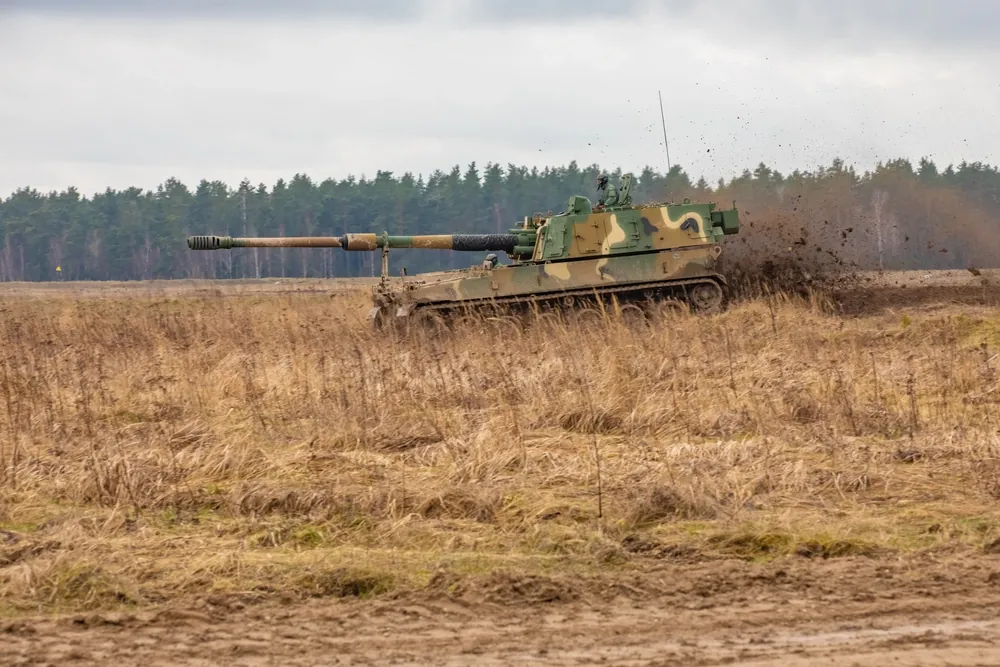
Hanwha Aerospace is the defence, aero-engine and space arm of South Korea’s Hanwha Group. Its lineage goes back to Samsung Precision, founded in 1977; the business passed to Hanwha in 2015, took its current name in 2018 and absorbed the group’s land systems and munitions units in 2022-2023. The K9 Thunder howitzer, the K239 Chunmoo rocket launcher and the AS21 Redback infantry fighting vehicle are its best-known products. Contracts with Poland, Australia, Romania and Egypt have made it one of the largest exporters of land systems worldwide. Hanwha Ocean (formerly DSME) and Hanwha Systems are the group’s naval and electronics arms.
Who Is Hanwha Aerospace? A Short History
Hanwha Aerospace brings together the defence, aircraft-engine and space businesses of Hanwha Group, one of South Korea’s largest conglomerates. The company traces its roots to Samsung Precision, founded in 1977. It began with cameras, optics and precision machinery, then moved into defence in the 1980s by licence-building and overhauling jet engines for the Republic of Korea Air Force. It was renamed Samsung Techwin in 2000. In 2015 Samsung sold its defence and chemicals businesses to Hanwha, and the company became Hanwha Techwin. The present name, Hanwha Aerospace, was adopted in April 2018.
Between late 2022 and 2023 the group merged Hanwha Defense, its land-systems maker, and the munitions and guided-weapons division of Hanwha Corporation into Hanwha Aerospace. That put the K9 Thunder, the K239 Chunmoo, armoured vehicles and ammunition under one company. In 2023 the group also completed the acquisition of Daewoo Shipbuilding & Marine Engineering (DSME), renamed Hanwha Ocean; Hanwha Aerospace is its largest shareholder. Hanwha Systems, which develops radars, avionics and command-and-control systems, is a majority-owned subsidiary.
The company’s main plant and registered headquarters are in Changwon, with corporate offices in Seoul. Hanwha Group ranks among the top 30 arms producers in SIPRI’s Top 100 list. Consolidated revenue reached roughly ₩11.2 trillion in 2024. According to company statements, more than half of that came from defence, and the export share rose sharply on the back of the Polish contracts.
Business Divisions: Land, Engines, Space, Electronics and Shipbuilding
Hanwha Aerospace operates through three in-house divisions and two major subsidiaries. The land systems division builds howitzers, rocket launchers, armoured vehicles and ammunition and generates the largest share of revenue. The aero-engine division assembles and overhauls engines for the F-15K, KF-16, T-50 and KF-21 under General Electric and Pratt & Whitney licences and supplies parts for commercial engines. The space division built the engines for the Nuri (KSLV-II) launcher and became system integrator for its follow-on launches.
Among the subsidiaries, Hanwha Systems develops radars, electro-optics, avionics, C4I and satellite systems; the AESA radar for the KF-21 fighter is produced there. Hanwha Ocean builds submarines, destroyers and commercial vessels such as LNG carriers. The group presents this structure as a land-air-sea-space portfolio; the table below summarises it.
| Division | Company | Main products and services |
|---|---|---|
| Land systems | Hanwha Aerospace | K9 Thunder, K10, K239 Chunmoo, AS21 Redback, K21, ammunition |
| Aero engines | Hanwha Aerospace | Licensed F414, F404, F100 production; engine MRO; commercial engine parts |
| Space | Hanwha Aerospace | Nuri (KSLV-II) engines and system integration; satellite platforms |
| Defence electronics | Hanwha Systems | AESA radar, Cheongung multi-function radar, avionics, C4I, satellites |
| Shipbuilding | Hanwha Ocean | KSS-III submarines, KDX destroyers, LNG carriers, Philly Shipyard (US) |
Defence Products: From K9 Thunder to Redback
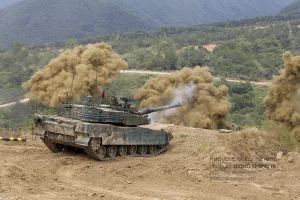
The flagship product is the K9 Thunder, a 155 mm/52-calibre self-propelled howitzer. It entered service with the Republic of Korea Army in 1999, reaches about 40 km with standard projectiles and fires six to eight rounds per minute. With more than a thousand built, it is among the most widely used Western-type 155 mm self-propelled howitzers. The family includes the K10 automated ammunition resupply vehicle and the upgraded K9A2.
The K239 Chunmoo is a multiple rocket launcher firing 239 mm guided rockets and 130 mm rockets to ranges in the 80 km class; Poland fields it as Homar-K. The AS21 Redback is a 42-tonne-class tracked infantry fighting vehicle derived from the Korean Army’s K21 and developed for Australia. The K30 Biho is a twin 30 mm short-range air-defence system; the Hybrid Biho adds Shingung missiles. The KAAV amphibious assault vehicle is also a Hanwha product.
In medium-range air defence, LIG Nex1 is prime contractor for the Cheongung (KM-SAM) system; Hanwha Systems supplies its multi-function radar and Hanwha Aerospace the launcher vehicles. On the engine side, the company licence-builds GE F414 engines for the KF-21 and F100 engines for the F-15K and KF-16. The table below lists the main defence products and their users.
| Product | Category | Main users |
|---|---|---|
| K9 Thunder / K9A1 | 155 mm self-propelled howitzer | South Korea, Poland, India, Finland, Norway, Estonia, Egypt, Romania |
| K10 | Automated ammunition resupply vehicle | South Korea, Norway, Romania, Australia (AS10) |
| K239 Chunmoo | Multiple rocket launcher | South Korea, Poland (Homar-K), Croatia (on order) |
| AS21 Redback | Tracked infantry fighting vehicle | Australia (on order) |
| K21 | Infantry fighting vehicle | South Korea |
| AS9 Huntsman | 155 mm howitzer (K9 derivative) | Australia (on order) |
| K30 Biho / Hybrid Biho | Short-range air defence | South Korea |
| KAAV | Amphibious assault vehicle | South Korea, Philippines |
| Cheongung launcher and radar | Medium-range air-defence component | South Korea, UAE, Saudi Arabia (prime: LIG Nex1) |
| F414 / F100 engines | Aircraft engines (licensed) | Republic of Korea Air Force (KF-21, F-15K, KF-16) |
Export Footprint and the Polish Contracts
Poland marked the turning point in Hanwha Aerospace’s exports. A framework agreement signed in August 2022 covers 672 K9 howitzers; the first executive contract ordered 212 K9A1s, and the first vehicles arrived at Gdynia in December that year. A second executive contract for 152 K9s followed in December 2023. For rocket artillery, Poland signed a 2022 framework for 288 Chunmoo launchers; a first contract for 218 launchers was followed in 2024 by a second for 72. The Polish version, Homar-K, is built on a Jelcz chassis with the Polish Topaz fire-control system.
Australia ordered 30 AS9 Huntsman howitzers and 15 AS10 resupply vehicles in 2021, then 129 AS21 Redbacks in December 2023; both will be built at a new plant in Geelong. Romania signed for 54 K9s and 36 K10s in July 2024. Egypt concluded a K9A1 deal in 2022 that includes local production. India took 100 K9 Vajra howitzers through Larsen & Toubro and agreed a follow-on order in 2025. Finland, Norway and Estonia also operate the K9.
The relationship with Türkiye is older. A 2001 technology-transfer agreement licensed the K9 design to Türkiye, where the Turkish defence industry produced the T-155 Fırtına domestically. The Fırtına is derived from K9 technology but is a Turkish-built system with Turkish turret, fire-control and communications subsystems; the Fırtına II version further raised the domestic content. The programme was the first licensed production of K9 technology outside Korea.
Space and Aero Engines
Hanwha Aerospace built the 75-tonne and 7-tonne liquid-fuel engines of Nuri (KSLV-II), South Korea’s national launch vehicle. Nuri reached orbit with a payload for the first time in 2022. That year the Korea Aerospace Research Institute (KARI) selected the company as system integrator for the follow-on launches planned through 2027, with the aim of transferring launch operations from the state to the private sector. The fourth launch, in late 2025, was the first conducted under this arrangement. The group is expanding into satellites through Hanwha Systems and imaging partnerships.
The engine division has delivered about 10,000 aircraft engines since 1979. It licence-assembles F100 engines for the Korean Air Force’s F-15K and KF-16, the F404 for the T-50 trainer and the F414 for the KF-21, and provides maintenance, repair and overhaul for them. On the commercial side it supplies parts for GE and Pratt & Whitney wide-body engines. The Hanwha Aerospace Engine Vietnam plant near Hanoi, opened in 2019, produces a large share of those parts. The company also takes part in South Korea’s programme to develop an indigenous fighter engine.
Market Position and Debates
Hanwha Aerospace’s European strategy rests on localisation. It established Hanwha Aerospace Europe in Warsaw and is negotiating local production and maintenance partnerships for the K9 and Chunmoo in Poland. A production facility has also been announced for Romania. In Australia, the Geelong plant opened in 2024 and is preparing to build the AS9 and AS21. The company points to short delivery times and local partnerships as its answer to Europe’s post-2022 demand, competing with German and French suppliers in the same markets.
At sea, Hanwha Ocean entered the US shipbuilding market by acquiring Philly Shipyard in December 2024 and has won maintenance work on US Navy support ships. It is bidding with the KSS-III class in the Canadian and Polish submarine competitions, and the group applied to take a stake in Australia’s Austal.
There are points of debate. A ₩3.6 trillion rights issue announced in early 2025 was questioned by minority shareholders and the regulator and later cut to about ₩2.3 trillion. Financing for the Polish contracts became an issue in 2023-2024 because of the lending limits of Korean export-credit agencies, which the National Assembly subsequently raised. The company presents its order backlog (above ~₩30 trillion at end-2024) as its main strength.
Frequently Asked Questions
Which country does Hanwha Aerospace belong to?
It is a South Korean company and part of Hanwha Group. Its headquarters are in Changwon, with corporate offices in Seoul. The company traces its lineage to Samsung Precision, founded in 1977, and became part of Hanwha in 2015.
What does Hanwha Aerospace make?
It makes the K9 Thunder howitzer, the K239 Chunmoo rocket launcher, the AS21 Redback and K21 armoured vehicles, air-defence systems, ammunition, licensed jet engines and the engines of the Nuri launcher. Its subsidiaries work in radars and shipbuilding.
How is Hanwha Aerospace related to Hanwha Ocean?
Hanwha Ocean is the former DSME shipyard acquired in 2023. Hanwha Aerospace is its largest shareholder. The yard builds submarines, destroyers and commercial ships and bought Philly Shipyard in the United States in 2024.
Is the Turkish Fırtına a Hanwha product?
No. The T-155 Fırtına is a Turkish-built howitzer produced in Türkiye by the Turkish defence industry under a 2001 technology-transfer agreement based on the K9 design, with Turkish-made subsystems.
How much revenue does Hanwha Aerospace generate?
Consolidated revenue for 2024 was reported at about ₩11.2 trillion. More than half came from defence, and the export share rose sharply with the Polish contracts.
Sources
- Hanwha Aerospace official website
- Hanwha Ocean official website
- Hanwha Systems official website
- SIPRI Arms Industry Database