





Does the BTR-4 make sense for Middle Eastern armies?

What does the country actually need?
The regional requirement for wheeled 8×8 armour is not in dispute. Long road marches, low fuel burn and rapid deployment across desert road networks favour wheels over tracks, and border security and internal security tasks do not justify the maintenance burden of a tracked fleet. What has changed is the firepower baseline: a 12.7 mm remote weapon station is no longer accepted as sufficient, and a 30 mm cannon with thermal sights and ATGM integration has become the regional standard.
The second element is industrial. Gulf states no longer structure large land-systems buys as straight imports. The Emirati Rabdan programme, run through the Al Jasoor joint venture with Otokar and covering 400 vehicles ordered in 2017, is the clearest example: the contract bought a production line as much as a vehicle. Any supplier that cannot offer localisation is competing for a shrinking share of the market.
What is the system?
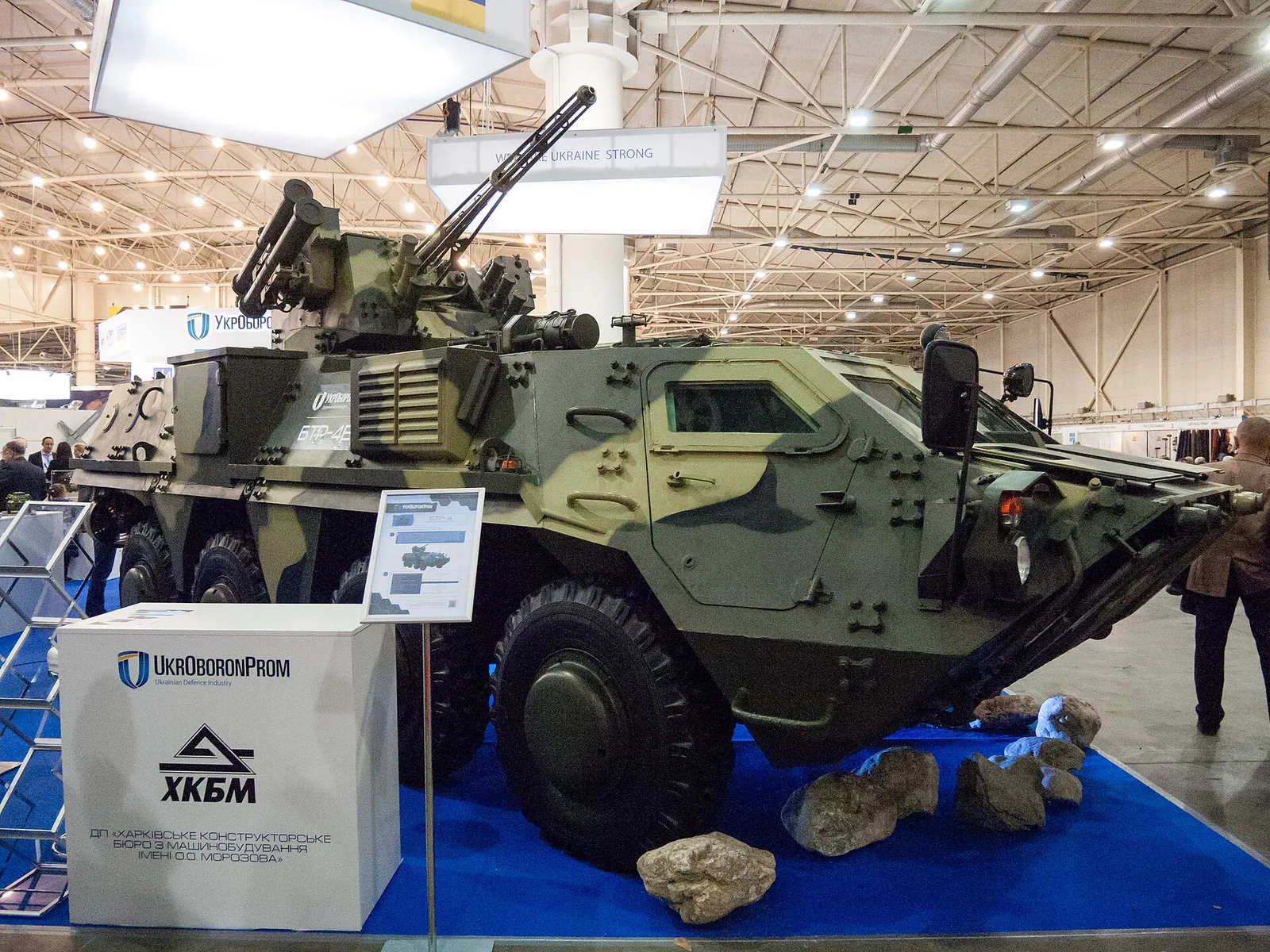
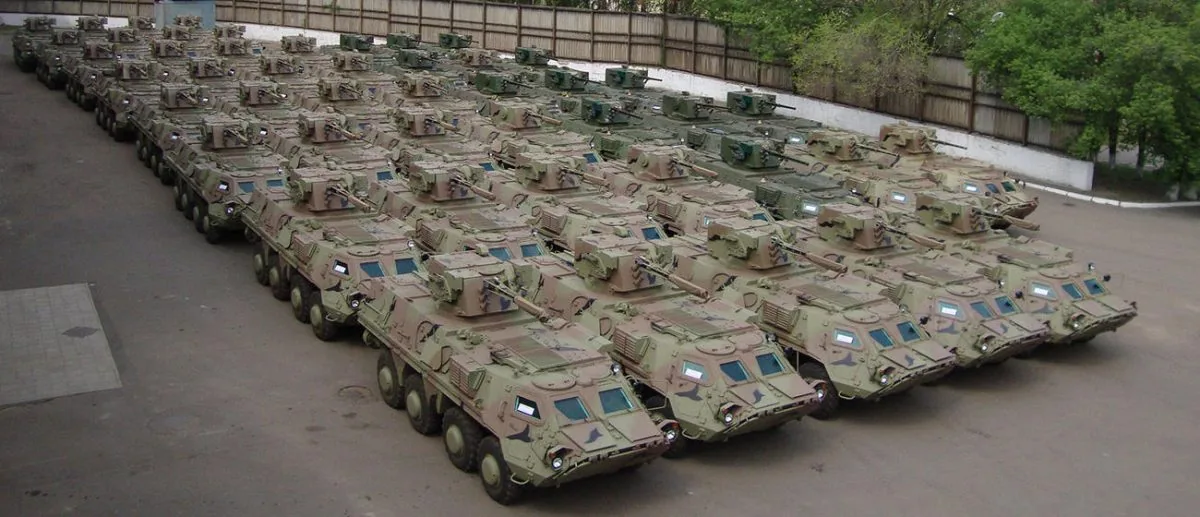
The BTR-4 Bucephalus is an 8×8 amphibious armoured fighting vehicle developed by the Kharkiv Morozov Machine Building Design Bureau. It departs from the classic BTR layout by moving the powerpack forward and adding a rear troop ramp, a genuine ergonomic improvement for operators of the BTR-70 and BTR-80.
Combat weight runs from 17.5 tonnes in the base protection configuration to over 25 tonnes with add-on armour. The primary armament is the 2A72 30 mm cannon in the Parus or Grom station, with a 7.62 mm coaxial machine gun, a 30 mm grenade launcher and up to four anti-tank missiles. The manufacturer states an operating envelope of -40 C to +55 C. Export history is short: Iraq, Indonesia, which ordered 55 BTR-4M for its Marine Corps with the first five delivered in January 2017, and Nigeria, which received between ten and fifteen vehicles in 2014.
| Technical data | |
|---|---|
| Manufacturer | KMDB, Kharkiv Morozov Design Bureau, Ukraine |
| Class | 8×8 wheeled amphibious armoured fighting vehicle |
| Combat weight | 17.5 t base, over 25 t with add-on armour |
| Dimensions | 7.76 m x 2.93 m x 3.02 m |
| Crew and dismounts | 3 + 8 |
| Main armament | 2A72 30 mm cannon, 7.62 mm coaxial, up to four ATGMs |
| Powerpack | 3TD diesel 489 hp or Deutz Euro III 598 hp |
| Speed | 110 km/h road, 10 km/h afloat |
| Range | at least 690 km |
| Stated temperature envelope | -40 C to +55 C |
| Known export operators | Iraq, Indonesia, Nigeria |
Geography and climate fit
Desert operations impose three distinct engineering problems: dust ingestion, sustained high ambient temperature and long road marches. The 8×8 layout answers the third convincingly; 690 km of range and 110 km/h road speed are adequate for regional distances. Amphibious capability, by contrast, is close to irrelevant outside the Basra marshes and the Shatt al-Arab corridor.
Temperature is where the argument is decided. A stated +55 C ceiling covers Gulf summer conditions on paper, but a declared envelope and a demonstrated availability rate are different things. Competing platforms are offered to Gulf customers in a validated hot-climate configuration; achieving the same for the BTR-4 would require a dedicated engineering and qualification programme that a wartime manufacturer is not positioned to run for an export customer.
Existing fleet, munitions and logistics
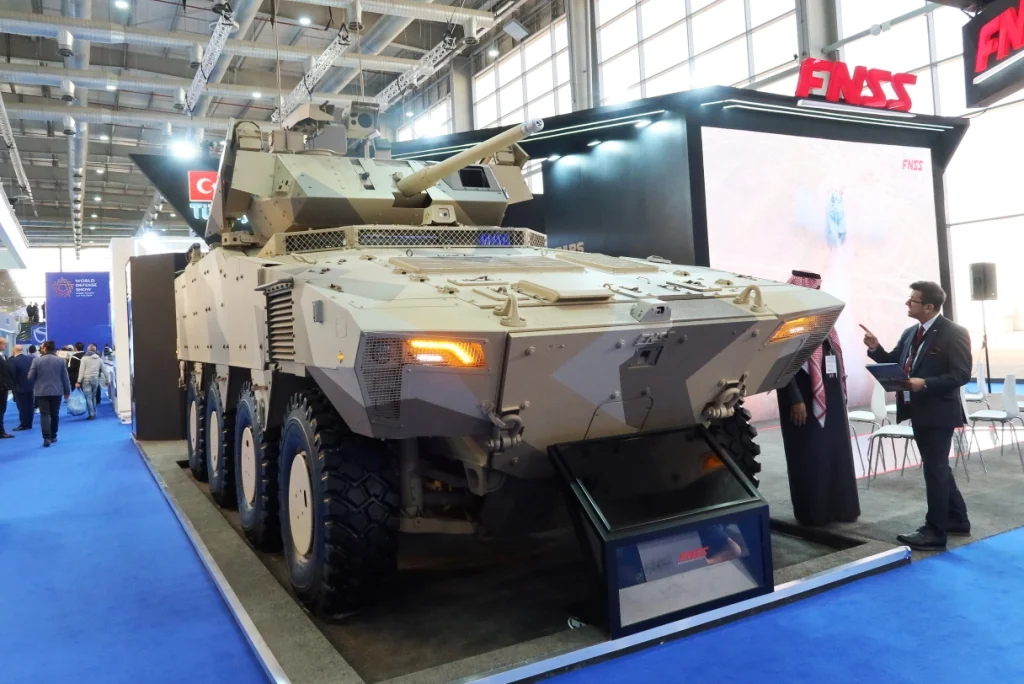
Regional 8×8 fleets are now overwhelmingly Western or Turkish. The UAE operates Rabdan, Oman took 172 FNSS PARS vehicles in 6×6 and 8×8 configurations with first delivery in July 2017 and the last in August 2020, and Bahrain has fielded the Otokar ARMA family. Introducing the BTR-4 means creating a spare-parts, training and maintenance island that connects to nothing already in service.
The same applies to ammunition. The 2A72 fires 30×165 mm, which is not a problem for an army that has stayed on Soviet standards but is a second logistics chain for one that has not. The integrated anti-tank missiles are Ukrainian and are not held in regional stockpiles. Over a 25 to 30 year service life these are not secondary issues; they are the programme.
Cost and value for money
No verified unit price for the BTR-4 has been published. The Iraqi contract was a package covering vehicles, training, spares, ammunition and logistics; dividing a package value by vehicle count produces a number that means nothing. Open sources place the BTR-4 well below Western 8×8 pricing, but that is a market assessment rather than contract data.
Purchase price is also the wrong metric in isolation. What matters is how many days a vehicle spends mission-capable across its life. Reporting that a large share of Iraq’s BTR-4 fleet was non-operational by late 2013 because of technical condition is the clearest illustration of how a low acquisition cost can be erased by availability losses.
Comparison table
- The 8×8 layout delivers a clear fuel and maintenance advantage over tracks on long road marches.
- The 2A72 cannon with ATGM integration meets the regional firepower baseline.
- Amphibious capability is usable in the Basra marshes and river-crossing scenarios.
- Forward powerpack and rear ramp are a real ergonomic gain for BTR-70 and BTR-80 operators.
- Acquisition cost is positioned below Western 8×8 competitors.
- Production has been committed to Ukraine’s own forces since 2022; no export delivery schedule is credible.
- The Iraqi programme halted at 88 vehicles over cracked hull steel and welding defects.
- 30×165 mm ammunition and Ukrainian ATGMs are not held in the region.
- A 25 to 30 year sustainment commitment cannot be underwritten in current conditions.
- No local production or technology transfer package is on offer.
- The hot-climate envelope is declared rather than demonstrated in regional service.
Alternatives
Turkish alternatives. Three options address the same requirement. The FNSS PARS 8×8 has a proven regional reference in Oman’s 172-vehicle programme and beats the BTR-4 on the two attributes the Ukrainian vehicle leads with, range and amphibious capability. The Otokar ARMA 8×8 with the Mizrak 30 mm turret covers the firepower requirement and has an early Gulf reference in Bahrain. Rabdan, the heavier UAE derivative of the Otokar design built by Al Jasoor, is the model the region now prefers: a vehicle plus a domestic production line.
Western alternatives. Patria AMV and Rheinmetall Boxer occupy the upper segment for armies prioritising protection and modularity. They cost materially more than the BTR-4, which usually translates into fewer vehicles, but they offer NATO-standard ammunition, a broad user base and predictable lifecycle support.
Russian and Chinese alternatives. The BTR-82A remains the lowest-transition-cost option for Soviet-pattern armies, though sanctions exposure and payment channels are now a risk line of their own. The Chinese VN-1, the export derivative of the ZBL-09, competes on price and delivery speed and is the most realistic rival in exactly the market segment the BTR-4 targets.
When it makes sense, when it does not
Scenarios where it works
- The army already operates Soviet-pattern equipment with matching ammunition and training infrastructure.
- The requirement is short-term and limited in quantity, and 25-year sustainment is not the deciding criterion.
- Budget pressure makes acquisition cost more important than availability rate.
- Amphibious capability is genuinely used in the operating area.
Scenarios where it does not
- The army is on, or moving to, NATO standards and will not open a second ammunition chain.
- Local production, technology transfer and domestic employment are expected in the package.
- A binding delivery schedule and guaranteed lifecycle support are contract preconditions.
- High fleet availability targets make technical-condition risk unacceptable.
- Deployment areas routinely exceed 45 C and validated hot-climate qualification is required.
Frequently asked questions
Can the BTR-4 operate in desert conditions?
What happened to Iraq’s BTR-4 order?
Is the BTR-4 available for export today?
BTR-4 or ARMA 8×8?
Sources
- Army Technology, BTR-4 Armoured Personnel Carrier
- Defense Express on Nigerian BTR-4 service
- KMDB product documentation; FNSS and Otokar product pages and published export records
- Wikipedia entries for BTR-4, FNSS Pars and Otokar Arma, used as secondary verification of specifications and operator lists