Is Pakistan a Nuclear Power? History, Arsenal and Doctrine (2026)

Short answer: Yes — Pakistan is a nuclear-armed state. It tested openly on 28 and 30 May 1998 (Chagai-I and Chagai-II) and is one of nine countries with nuclear weapons. Islamabad has never published a warhead count; SIPRI Yearbook 2026 estimates roughly 170 warheads (January 2026), and FAS assessed in September 2025 that the stockpile could reach about 200 by the late 2020s. Delivery systems range from the 70 km Nasr to the 2,750 km Shaheen-III, under a doctrine the National Command Authority calls “Full Spectrum Deterrence”. Pakistan is not a party to the NPT.
Last updated: 17 September 2026
Pakistan Defence Hub: Pakistan Military Power → Army → Air Force → Navy → Defence Industry → Türkiye–Pakistan
Is Pakistan a nuclear power? The short version
Pakistan is a declared nuclear-weapon possessor outside the NPT (Nuclear Non-Proliferation Treaty), alongside India and Israel. It has never accepted a treaty ceiling on its arsenal and, unlike India, has never announced a no-first-use pledge. What it has made public is a command structure, a doctrine and the missiles that carry the deterrent; everything else, including the warhead count, comes from independent estimates.
This guide stays at the open-source level: the public history, the SIPRI and FAS estimates, the delivery systems ISPR (Inter-Services Public Relations, the military’s media wing) has announced with their ranges, and the doctrine as Pakistani institutions describe it. For the conventional picture see the Pakistan military inventory 2026 pillar.
When did Pakistan become a nuclear power? The public history
The programme is usually dated to the aftermath of the 1971 war. In January 1972 Prime Minister Zulfikar Ali Bhutto convened scientists in Multan and set a weapons capability as the goal; India’s first test at Pokhran in May 1974 made it an urgent priority. Two tracks emerged: the Pakistan Atomic Energy Commission (PAEC), responsible for weapon design and the eventual tests, and the Kahuta enrichment project begun in 1976, later renamed Khan Research Laboratories (KRL) after Dr Abdul Qadeer Khan.
The programme stayed undeclared until 28 May 1998 when, two weeks after India’s Pokhran-II series, PAEC conducted the Chagai-I test in the Ras Koh Hills of Balochistan, followed by Chagai-II on 30 May. In 2000 Pakistan created the National Command Authority (NCA), chaired by the prime minister, as the apex body for nuclear policy, with the Strategic Plans Division as its secretariat.
Who built Pakistan’s atomic bomb?
It was an institutional effort, not one person’s work. PAEC under Munir Ahmad Khan designed the device and ran the 1998 tests; KRL under A.Q. Khan mastered enrichment. A.Q. Khan became the programme’s public face, but his fame abroad rests on his 2004 televised admission that he ran a proliferation network supplying enrichment technology abroad, after which he was removed from any official role.
How many nuclear weapons does Pakistan have in 2026?
No official number exists. Pakistan, like India, treats its stockpile as classified, so every figure is an independent estimate built from fissile-material production, delivery-system counts and public statements. Two sources dominate, and they broadly agree:
- SIPRI Yearbook 2026 (Stockholm International Peace Research Institute) estimates roughly 170 warheads as of January 2026 and lists Pakistan among the states still expanding their arsenals.
- FAS / Bulletin of the Atomic Scientists (Nuclear Notebook, September 2025) also estimates about 170 warheads and assesses that at current production rates the stockpile could reach around 200 by the late 2020s.
The estimates should be read as a range, not a census: a difference of ten or twenty warheads between publications reflects methodology, not a verified change. The reliable takeaways are the direction (growing), the order of magnitude (under 200 today) and the fact that Pakistan has confirmed none of it — hence the figure is always quoted here with year and source.
Reading the numbers correctly. “~170 warheads” estimates the total stockpile, not weapons mounted on missiles and ready to fire. Neither SIPRI nor FAS claims to know how many are deployed, and Pakistan does not say. Any article giving an exact figure without a source is guessing.
Pakistan’s nuclear delivery systems: missiles and their stated ranges
The visible half of the deterrent is the missile force, developed largely by NESCOM (National Engineering and Scientific Commission), formed in 2000; the liquid-fuelled Ghauri comes from KRL. ISPR announces most tests with a stated range — the only official numbers available. The table lists the systems ISPR and independent analysts associate with the strategic force; which units field which system is not disclosed.
| System | Type | Range stated by ISPR | Source |
|---|---|---|---|
| Nasr (Hatf-9) | Solid-fuel ballistic, battlefield range | 60–70 km | ISPR; CSIS |
| Abdali | Solid-fuel ballistic, short range | 450 km (May 2025 test) | ISPR |
| Ghauri | Liquid-fuel ballistic (KRL), medium range | 1,300 km (readiness test Oct 2023) | ISPR; Defense News |
| Shaheen-I / IA | Solid-fuel ballistic, short–medium range | 650–750 km / 900 km | ISPR (figures vary by test) |
| Shaheen-II | Solid-fuel ballistic, medium range | 1,500–2,000 km | ISPR (figures vary by test) |
| Shaheen-III | Solid-fuel ballistic, medium range | 2,750 km (test 9 Apr 2022) | ISPR; Dawn |
| Ababeel | Solid-fuel ballistic with MIRV | 2,200 km (tests Jan 2017, Oct 2023) | ISPR; IISS |
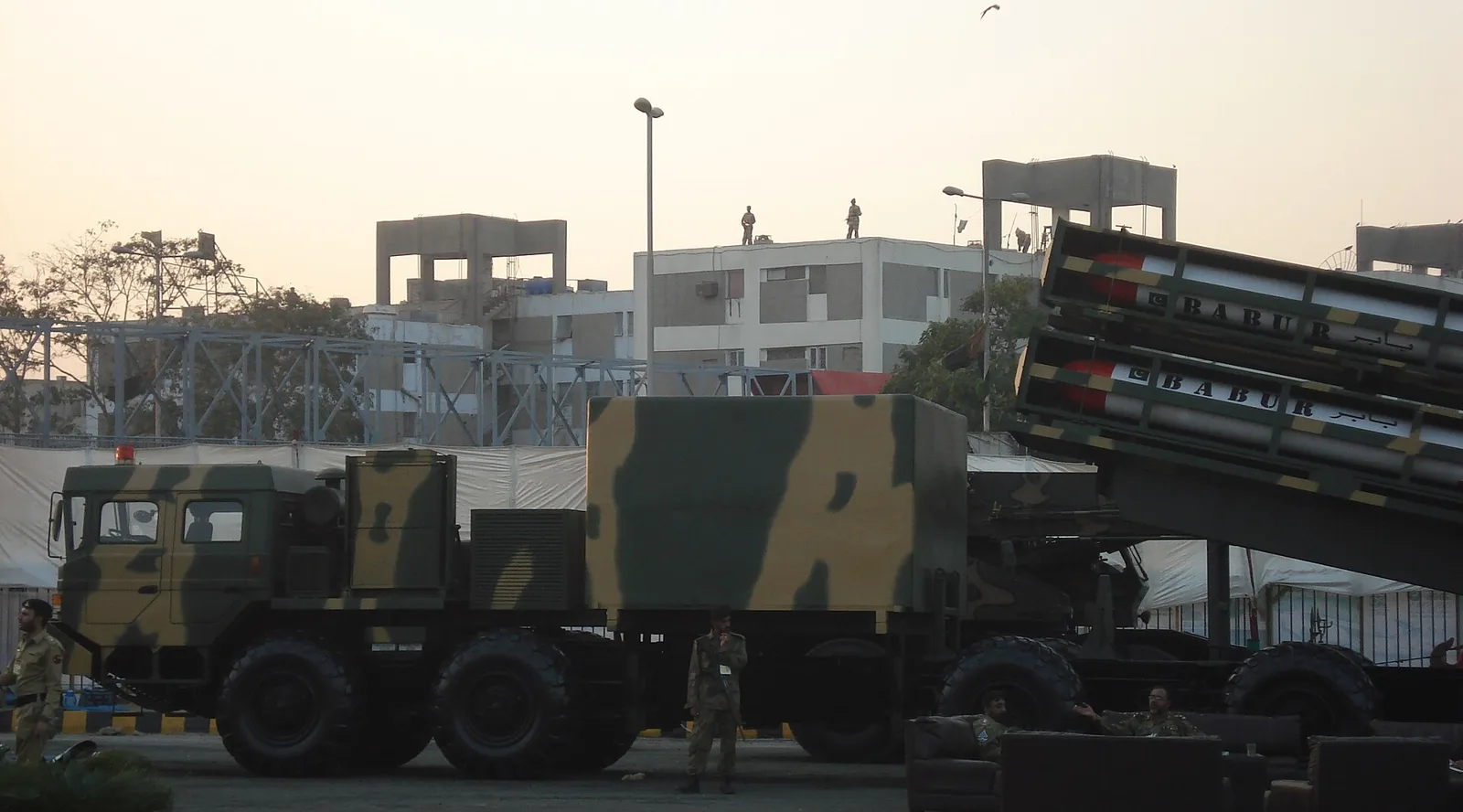
| Babur-1B | Ground-launched cruise missile (GLCM) | 900 km (test 21 Dec 2021) | ISPR; Dawn |
| Babur-2 | Ground-launched cruise missile | ~700 km class | ISPR |
| Babur-3 | Submarine-launched cruise missile (SLCM) | 450 km (test Jan 2017) | ISPR |
| Ra’ad-I / Ra’ad-II | Air-launched cruise missile (ALCM) | 350 km / 600 km (test 18 Feb 2020) | ISPR |
Three systems define the posture. The Nasr, a 60–70 km solid-fuel rocket first tested in 2011, is the battlefield-range expression of “full spectrum”. The Ababeel, tested in January 2017 and on 18 October 2023, is described by ISPR as MIRV-capable (multiple independently targetable re-entry vehicles: one missile, several warheads); the IISS assessed the 2023 test as confirming that ambition, while a July 2025 test reported as failed is unconfirmed officially. The Babur-3 submarine-launched cruise missile (450 km, January 2017) is the announced basis for a sea-based leg on conventional submarines.

See our explainers on SRBM vs MRBM vs IRBM vs ICBM and what a cruise missile is; the full inventory, conventional systems included, is in Pakistan missiles list and ranges.
Conventional systems often confused with the nuclear force
Not every Pakistani missile is a nuclear system. The Fatah-1 (140 km), Fatah-2 (400 km, tested 28 April 2026) and Fatah-4 cruise missile (750 km, inducted September 2025) belong to the Army Rocket Force Command and are described by ISPR as conventional precision-strike weapons, as is the Taimoor air-launched cruise missile. Conflating the categories inflates every online answer.
Pakistan’s nuclear doctrine: Full Spectrum Deterrence explained
Pakistan’s official formulation, reaffirmed by the NCA in December 2017, is “Full Spectrum Deterrence” within “credible minimum deterrence”. “Credible minimum” signals that Pakistan is not seeking parity with larger powers or an open-ended race. “Full spectrum” signals that the deterrent must cover every level of conflict, from a limited conventional incursion to a strategic exchange — hence a force stretching from the 70 km Nasr to the 2,750 km Shaheen-III, with air-, ground- and sea-launched cruise missiles.
The Islamabad think tank ISSI explains the logic as a response to Indian concepts of rapid, limited offensives below the nuclear threshold: short-range systems are meant to make even a limited war unattractive. Critics say the posture lowers the threshold; Pakistani officials say it closes the space for conventional adventurism.
Pakistan vs India: the nuclear balance in SIPRI’s estimates
SIPRI Yearbook 2026 places both arsenals in the same order of magnitude and describes both as expanding. Envanter Medya’s verified fact file carries only the Pakistani figure (~170), so the table compares structure, doctrine and public milestones rather than asserting an Indian number we have not sourced. Neither government publishes a count.
| Criterion | Pakistan | India | Year / source |
|---|---|---|---|
| First test | 28–30 May 1998 (Chagai-I/II) | May 1974 (Pokhran-I); May 1998 (Pokhran-II) | Public history |
| Estimated warheads | ~170 (Jan 2026 estimate) | Same order of magnitude; figure not in our fact file | SIPRI Yearbook 2026 |
| Trend | Growing; FAS sees ~200 possible by late 2020s | Growing | SIPRI 2026 / FAS 2025 |
| Declared doctrine | Full Spectrum Deterrence; no no-first-use pledge | Declared no-first-use policy (with stated caveats) | Dawn 2017 / ISSI; public statements |
| Longest ISPR-stated ballistic range | 2,750 km (Shaheen-III) | Not covered in this guide | ISPR / Dawn 2022 |
| MIRV test | Ababeel, Jan 2017 and Oct 2023 | Not covered in this guide | IISS 2023 |
| NPT status | Non-signatory | Non-signatory | Public record |
| Apex authority | National Command Authority (NCA), est. 2000 | Nuclear Command Authority | Dawn / ISSI; public record |
The May 2025 crisis showed deterrence holding at the strategic level while conventional strikes, drones and missiles were used below it; the Abdali test that month and the Army Rocket Force Command raised in August 2025 are Pakistan’s visible responses. A conventional comparison is in India vs Pakistan military strength 2026; India’s own inventory is in India’s military strength 2026.
Pakistan and the NPT: why it stays outside
Pakistan has never signed the NPT; its stated position is that it will not join as a non-nuclear-weapon state while India remains outside. It has not signed the Comprehensive Nuclear-Test-Ban Treaty either, though it has observed a testing moratorium since 1998, and it blocks a Fissile Material Cut-off Treaty, arguing a freeze would lock in an asymmetry. These positions have held for two decades; the arsenal therefore grows outside any treaty ceiling.
Nuclear spending is not itemised in the federal budget; see Pakistan defence budget 2026-27 for the published lines and Pakistan Navy ships and submarines 2026 for the fleet behind the sea-based leg.
What this guide does not cover. Storage sites, deployment, warhead designs, alert levels and targeting are not publicly verifiable and are outside the scope of an open-source guide. Online claims about them are speculation unless attributed to SIPRI, FAS, IISS or an official Pakistani statement.
Frequently Asked Questions
Is Pakistan a nuclear power?
Yes. Pakistan is one of nine nuclear-armed states, tested openly on 28 and 30 May 1998 (Chagai-I and II), and is not an NPT party.
When did Pakistan become a nuclear power?
Publicly on 28 May 1998 with the Chagai-I test in Balochistan, followed by Chagai-II on 30 May. The programme dates to a 1972 political decision after the 1971 war.
How many nuclear weapons does Pakistan have in 2026?
No official figure exists. SIPRI Yearbook 2026 estimates roughly 170 warheads (January 2026); FAS put it at about 170 in September 2025 and sees around 200 possible by the late 2020s.
Who built Pakistan’s atomic bomb?
A state programme: PAEC designed the device and ran the 1998 tests; Khan Research Laboratories under Dr A.Q. Khan handled enrichment. In 2004 A.Q. Khan publicly admitted running a proliferation network and was removed.
What is Pakistan’s nuclear doctrine?
The National Command Authority calls it ‘Full Spectrum Deterrence’ within ‘credible minimum deterrence’ (reaffirmed December 2017): delivery systems from the 70 km Nasr to the 2,750 km Shaheen-III, no announced ceiling, no no-first-use pledge.
Related Envanter Medya guides
- Pakistan Military Power 2026: Army, Air Force, Navy, Weapons and Defence Industry
- Pakistan Missiles List and Ranges 2026
- India vs Pakistan Military Strength 2026
- Pakistan Defence Budget 2026-27 Explained
- Pakistan Navy Ships and Submarines 2026
- SRBM vs MRBM vs IRBM vs ICBM — Missile Range Explained
Sources
- SIPRI Yearbook 2026 — world nuclear forces press release (Jan 2026 estimates)
- Bulletin of the Atomic Scientists / FAS — Pakistan nuclear weapons, 2025
- FAS — Pakistan nuclear weapons, 2023 (PDF)
- Dawn — NCA reaffirms Full Spectrum Deterrence (Dec 2017)
- ISSI — Pakistan’s Full Spectrum Deterrence
- IISS — Ababeel test confirms MIRV ambitions (Oct 2023)
- Dawn — Shaheen-III test (Apr 2022)
- Dawn — Babur-1B test (Dec 2021)
- Defense News — Ghauri readiness test (Oct 2023)
- CSIS Missile Threat — Hatf-9 / Nasr