Myanmar’s Military Strength: How Many Tanks, Fighter Jets and Missiles? (2026)

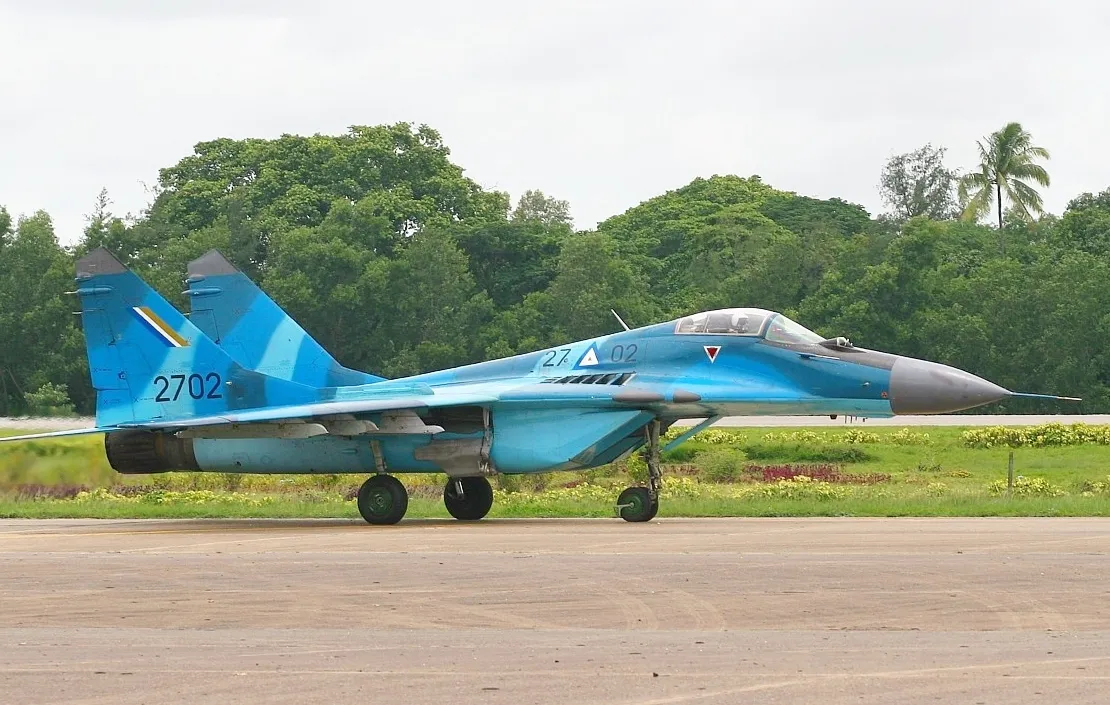
The Myanmar military inventory covers one of the least-reported yet numerically heaviest force structures in Southeast Asia. Global Firepower’s 2026 data places the country 35th among 145 militaries, with 228,000 active personnel, 1,040 main battle tanks, 11,576 armoured vehicles, 331 military aircraft and 239 naval assets. The defence budget is given as US$2.815 billion. Three features separate this inventory from the others in the series. The first is the breadth of the supply base: tanks, aircraft and missiles from China; fighters and helicopters from Russia; the T-72S and an armoured vehicle licence from Ukraine; a submarine and tank transfer from India; patrol boats and a rifle licence from Israel; self-propelled howitzers from Serbia. The second is domestic production: the Directorate of Defence Industries runs a line stretching from ammunition to air-defence missiles and from armoured vehicles to frigates across 20-25 factories, and in March 2026 it commissioned the 3,500-tonne UMS King Thalun. The third, and the most consequential, is that the civil war which began after the 2021 coup has made it unclear how much of this inventory can actually be used. This article sets out the Tatmadaw’s land, air, missile and naval inventory in tables based on open sources, then turns to the Türkiye connection.
At a Glance
- Active personnel: ≈ 228,000 active troops, ≈ 19,000 reservists and ≈ 55,000 paramilitary personnel; ≈ 302,000 in total
- Global ranking: 35th of 145 countries in the 2026 Global Firepower list (power index 0.6265) — one of the highest placements in this series
- Main battle tanks: ≈ 1,040 hulls (572 of them serviceable); the Chinese Type 59D, Type 69-II and MBT-2000 lines sit alongside the T-72S obtained through Ukraine
- Combat aircraft: 70 fighters and 20 attack aircraft; the MiG-29, Su-30SME, JF-17, Chengdu F-7M and Nanchang A-5C lines share one fleet
- Multiple rocket launchers: ≈ 1,520 launchers — the largest rocket artillery park recorded in this series so far
- Air defence: A layered structure built on six sector operations centres; the KS-1M, 2K12 Kub, Pechora-2M and Tor-M1 lines are used together
- Navy: 239 naval assets (146 of them in the patrol class), 6 frigates, 3 corvettes and 3 submarines; it defends 1,930 kilometres of coast and 12,800 kilometres of inland waterway together
- Domestic defence industry: The Directorate of Defence Industries (Ka Pa Sa) runs a production line stretching from ammunition to frigates across 20-25 factories
- Turkish-built systems: There is no platform-level procurement relationship; the recorded transfers are limited to commercial small arms and ammunition
- Defence budget: ≈ US$2.815 billion (2026 estimate)
Note: The inventory figures below are approximate values drawn from open sources such as Global Firepower, the IISS Military Balance and SIPRI.
About the Myanmar Armed Forces
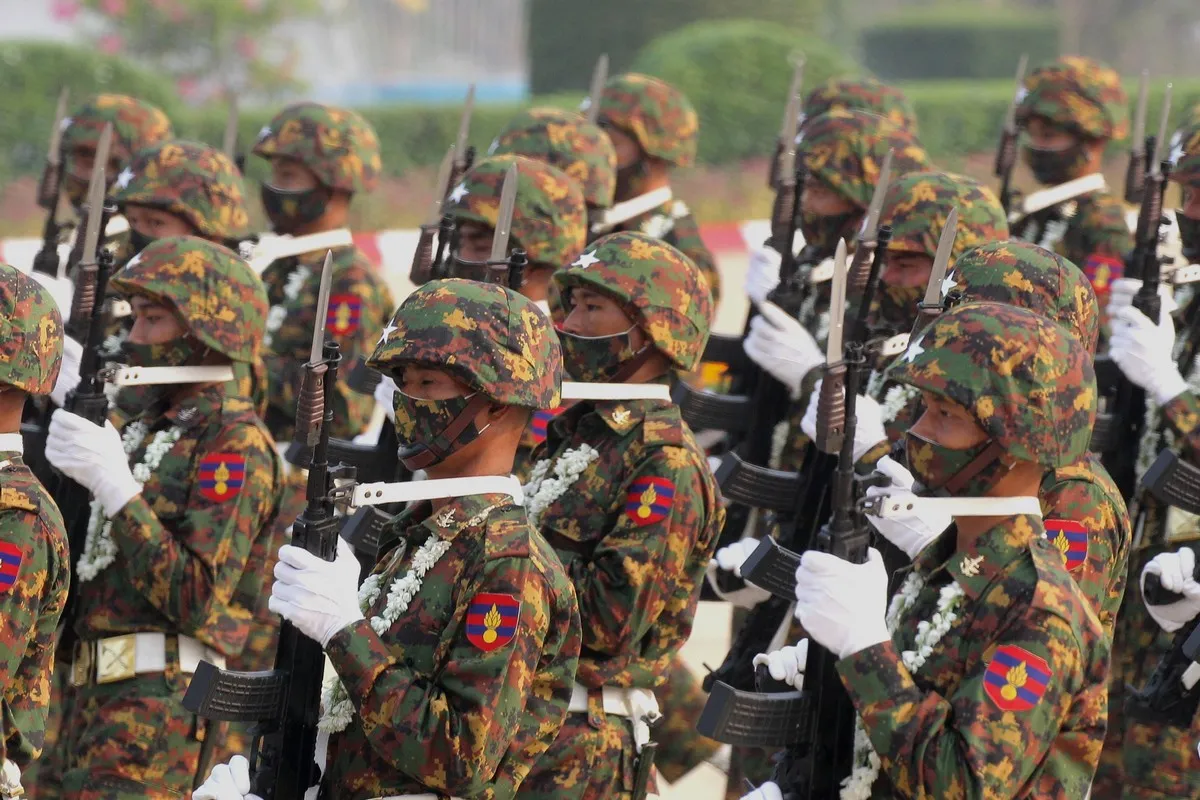
The Myanmar Armed Forces are known domestically as the Tatmadaw and comprise the army, air force and navy plus the border guard forces. Global Firepower’s 2026 data shows 228,000 active personnel, 19,000 reservists and 55,000 paramilitary personnel, for a total of around 302,000. The population is 57.5 million. The centre of gravity of the force structure lies with the army: with 1,040 tanks, 11,576 armoured vehicles, 1,680 towed guns and 1,520 rocket launchers, it holds the largest rocket artillery park among the militaries examined in this series so far. The same list notes that 182 of the 331 aircraft and 572 of the 1,040 tanks are serviceable — meaning roughly half the recorded inventory is actually usable.
The second factor shaping the inventory is the procurement structure. Myanmar has been under Western embargo since 1988, the European Union arms embargo has been in force since 1996, and sanctions by the United States, the United Kingdom and Canada were added to it. There is no binding embargo at UN Security Council level; the General Assembly issued a non-binding call in 2021. That picture pushed procurement towards non-Western channels. China is the primary source: Type 59D, Type 69-II and MBT-2000 tanks, ZSL-92 and ZSD-85 armoured vehicles, PTL-02 tank destroyers, Chengdu F-7M and Nanchang A-5C aircraft, K-8W trainers, CH-3A and CH-4 unmanned aerial vehicles, KS-1M air-defence missiles and C-802 anti-ship missiles. Russia is the second source: MiG-29, Su-30SME, Yak-130, Mi-17 and Mi-35P, Pechora-2M and Tor-M1. To these are added Ukraine (T-72S, the BTR-3U licence, the R-2 Bar’yer), India (the Kilo-class submarine transfer, MPV armoured vehicles), Israel (Super Dvora patrol boats, the Galil licence), Pakistan (JF-17 joint production) and Serbia (Nora B-52 howitzers).
The third factor is domestic industry. Established in the 1950s, the Directorate of Defence Industries is known locally as Ka Pa Sa and is estimated to have operated 20-25 factories as of 2022. It produces 60 million rounds of small arms ammunition a year; the MA-series rifles derived from the Israeli Galil design, the BA series stemming from a German G3 licence, 60-120 mm mortars, MAM-01 and MAM-02 rocket launchers, BTR-3U armoured vehicles assembled with Ukrainian components and SA-16 shoulder-launched missiles produced under licence since 2004 all come off this line. That the KS-1M air-defence missile, based on Chinese HQ-12 technology, is built inside the country is the most notable localisation item in the inventory. On the naval side, the Thanlyin dockyard near Yangon builds the Aung Zeya, Kyan Sittha and Thalun-class frigates. This structure is one of the examples that can be cited for militaries forced into localisation under Western embargo; the organisation was placed on the US sanctions list in 2008 and the EU list in 2023.
The fourth and most decisive factor is the current state of the war. The armed resistance that spread across the country after the February 2021 coup entered a different phase in October 2023 with the Three Brotherhood Alliance’s major northern offensive; the Tatmadaw lost territory, bases and equipment across wide areas. The military brought a conscription law into force in 2024, expanded its paramilitary formations and began using unmanned aerial vehicles extensively. Reports indicate that over 2025-2026 it achieved a partial recovery in the central regions and parts of northern Shan State, while control changed hands to a large extent in Rakhine in particular. The tables below give the recorded inventory; field serviceability and the extent of territorial control are separate matters.
Land Forces Inventory
| System type | Est. quantity |
|---|---|
| Main battle tanks (T-72S; procured through the Ukrainian channel between 2000 and 2008) | ≈ 300 |
| Main battle tanks (Type 59D, China) | ≈ 250 |
| Main battle tanks (MBT-2000 / Type 90-II; a Chinese-Pakistani joint design of which Myanmar is the principal export operator) | ≈ 200 |
| Main battle tanks (Type 69-II, China) | ≈ 130 |
| Main battle tanks (T-55; transferred by India in 2006) | A limited number |
| Total main battle tanks (Global Firepower classification; serviceable hulls given as 572) | ≈ 1.040 |
| Light tanks (Type 63 amphibious; about 60 of them serviceable) | ≈ 150 |
| Infantry fighting vehicles (BTR-3U; a Ukrainian design with hulls assembled inside the country) | 500+ |
| Armoured personnel carriers (ZSL-92 / WZ-551, China) | 450+ |
| Armoured personnel carriers (MT-LB and MT-LBMSh family hulls) | 350+ |
| Armoured personnel carriers (ZSD-85 / Type 85, China) | ≈ 350 |
| Mine-protected vehicles (the Indian-origin MPV line) | 250+ |
| Armoured personnel carriers (ZSD-90, China) | ≈ 200 |
| Wheeled tank destroyers (PTL-02, 100 mm; China) | 150+ |
| Total armoured vehicles (Global Firepower classification; 6,367 of them serviceable) | ≈ 11.576 |
| Self-propelled howitzers (Serbian-built Nora B-52, 155 mm 8×8 wheeled) | ≈ 30 |
| Total self-propelled howitzers (Global Firepower classification; 124 of them serviceable) | ≈ 225 |
| Towed artillery (Global Firepower classification; 924 of them serviceable) | ≈ 1.680 |
| Multiple rocket launchers (the Chinese-origin 107 mm and 122 mm lines plus the domestic MAM-01 122 mm and MAM-02 240 mm systems; 836 of them serviceable) | ≈ 1.520 |
| Anti-tank missiles (R-2 Bar’yer, Ukraine) | ≈ 300 |
| Recoilless rifles (M40, 106 mm) | 1.000+ |
Air Force Inventory
| Platform | Est. quantity |
|---|---|
| Total military aircraft (including helicopters; 182 of them serviceable) | 331 |
| Fighters (≈ 38 MiG-29 SM/SMT, 36+ Chengdu F-7M and FT-7, 11+ JF-17 Block II, 6 Su-30SME; 39 of them serviceable) | 70 |
| Attack aircraft (Nanchang A-5C, China; 11 of them serviceable) | 20 |
| Trainers and advanced trainers (60+ Hongdu K-8W, 24 Yak-130, 24 Grob G 120TP, 12 FTC-2000G, 26 Pilatus PC-7 and PC-9; 66 of them serviceable) | 120 |
| Total helicopters (Global Firepower classification; 47 of them serviceable) | 86 |
| Attack helicopters (Mil Mi-24 and Mi-35P; 5 of them serviceable) | 9 |
| Utility and transport helicopters (25+ Mil Mi-17, 22 Mi-2, 3 Mi-38, 2 Ka-28) | In service |
| Transport aircraft (15 Harbin Y-12, 10 ATR 42 and ATR 72, 8 Shaanxi Y-8, 7 Beechcraft 1900; 18 of them serviceable) | 33 |
| Special mission aircraft (including the Britten-Norman BN-2 maritime patrol airframes; 3 of them serviceable) | 5 |
| Unmanned aerial vehicles (CASC CH-3A and CH-4, China; the CH-4 is produced under licence inside the country) | In service |
| Unmanned aerial vehicles (11 Sky-02, China; 22 domestic Yellow Cat A2) | ≈ 33 |
| Air force personnel (IISS Military Balance) | ≈ 25.000 |
| Main air bases | Mingaladon, Hmawbi, Meiktila, Magway, Myitkyina, Taungoo, Namsang, Pathein, Myeik and Homalin |
Missile and Air-Defence Systems
| System | Type / Note |
|---|---|
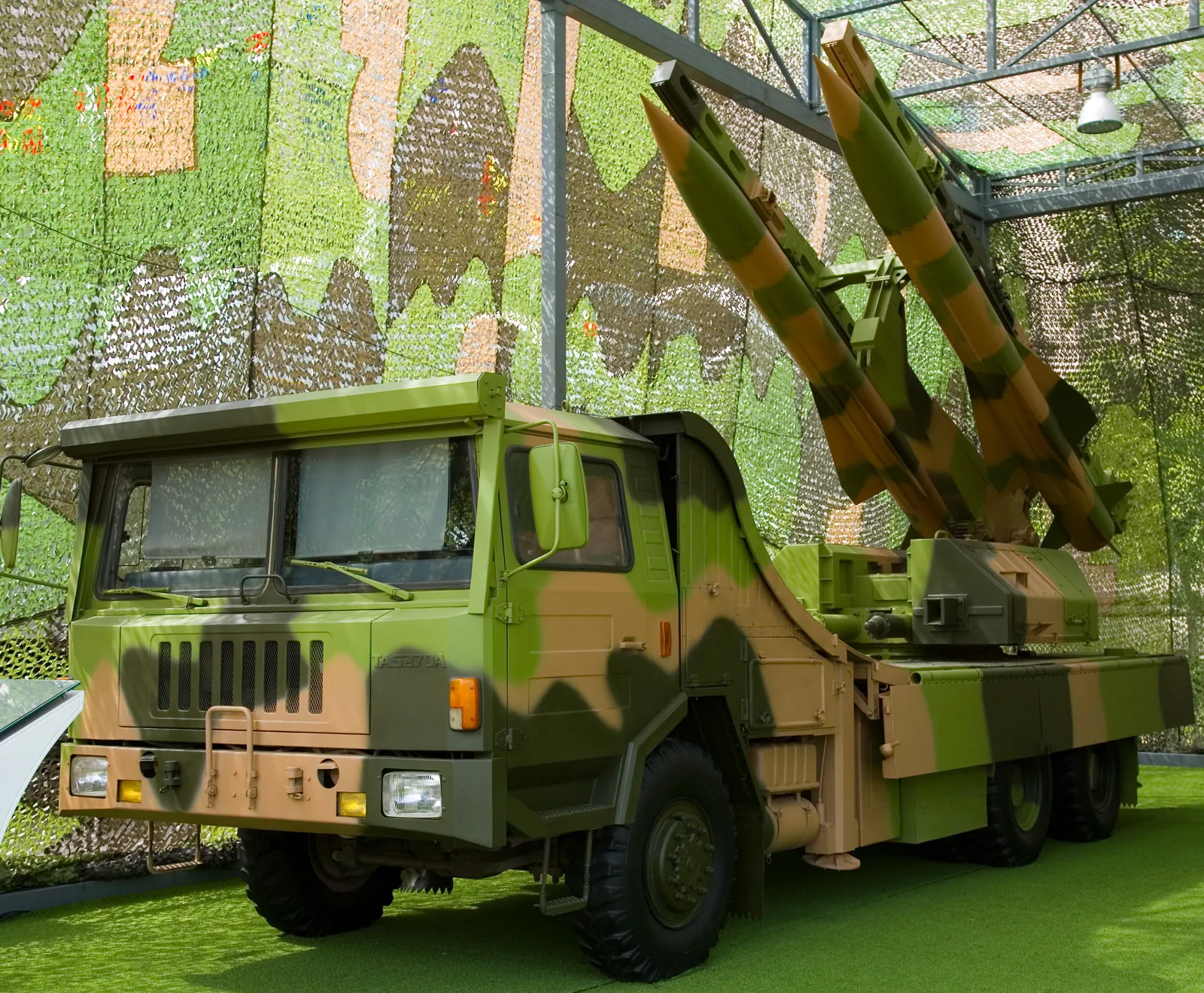
| KS-1M and KS-1B (based on the Chinese HQ-12; produced under licence inside the country) | The backbone of medium-range air defence and the most notable localisation item in the inventory |
| 2K12 Kub and Buk-M1 (Russia) | They form the medium-range area defence belt and are organised at three-battalion level |
| Pechora-2M (an S-125 upgrade) and Tor-M1 (Russia) | Used for point defence of critical facilities such as radar stations, fighter bases and sector operations centres |
| Shoulder-launched air-defence missiles (HN-5 and FN-6, China; the SA-16 Igla, produced under licence since 2004) | Widely distributed |
| Anti-aircraft guns and self-propelled systems (ZSU-23-4 Shilka, 2K22M Tunguska, plus the 37 mm and 40 mm gun lines) | They fill the low-altitude layer |
| Air-defence organisation | Six sector operations centres, each made up of an air-defence division and three tactical operations commands |
| Surface-to-surface and ballistic missiles (SY-400, China; range ≈ 400 km) | According to open sources the first batteries were received in 2020; Myanmar is one of the few Southeast Asian militaries in this class |
| Anti-ship missiles (C-802 and C-802A, China; Kh-35E, Russia) | Carried by frigates, corvettes and missile fast attack craft |
Naval Power
| Class / Type | Est. quantity |
|---|---|
| Submarines (UMS Minye Theinkhathu, a Kilo class transferred by India in 2020 — and UMS Minye Kyaw Htin, a Type 035B Ming class delivered by China in December 2021) | 3 in the Global Firepower classification |
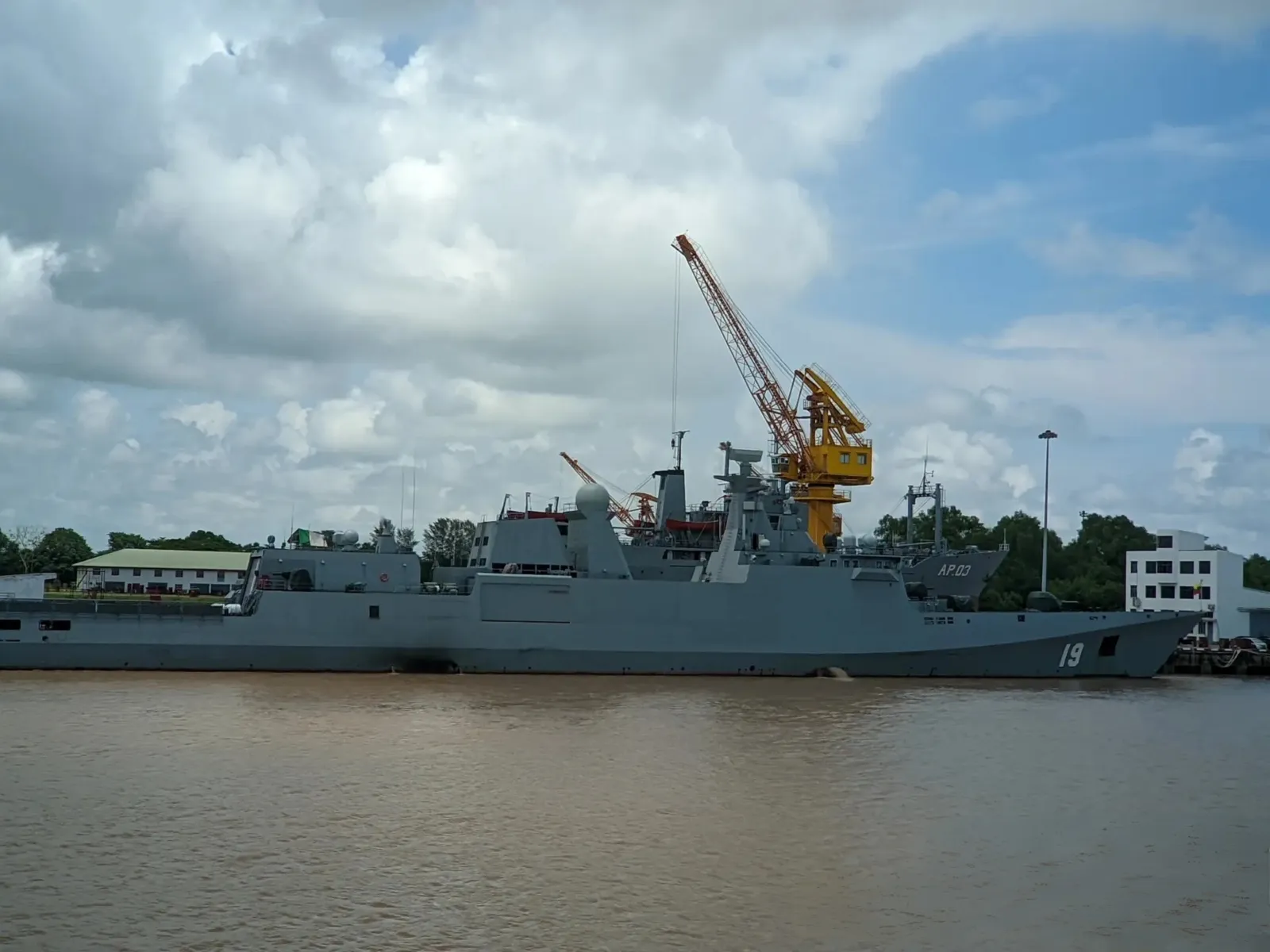
| Frigates (Thalun class, UMS King Thalun F19; at 3,500 tonnes the largest warship built inside the country, commissioned on 9 March 2026) | 1 |
| Frigates (Aung Zeya class F11, the first indigenous frigate commissioned in 2011 — and Kyan Sittha class F12 and F14, the first indigenous design with a reduced radar signature) | 3 |
| Frigates (Type 053H1 Jianghu-II; UMS Mahar Bandoola F21 and UMS Mahar Thiha Thura F23, transferred from the Chinese navy in 2012 and upgraded with the C-802) | 2 |
| Corvettes (Anawrahta class 771 and 772; a 77-metre indigenous design) | 3 |
| Missile fast attack craft (the domestic 5 Series boats and the Chinese-origin Houxin class; they carry the C-802) | In service |
| Offshore patrol vessels and patrol craft (including the Inlay-class OPV and the Super Dvora Mk III boats obtained from Israel between 2015 and 2017) | ≈ 146 |
| Landing platform dock (LPD; built in South Korea and delivered in 2019) | 1 |
| Mine warfare vessels | 2 |
| Total naval assets (Global Firepower classification) | 239 |
| Naval personnel | ≈ 30.000 |
| Regional commands and main shipyard | The Irrawaddy, Danyawaddy, Panmawaddy, Mawyawaddy and Tanintharyi commands; the indigenous frigates are built at the Thanlyin dockyard near Yangon |
| Coastline and inland waterways | ≈ 1,930 kilometres of Bay of Bengal and Andaman Sea coastline plus ≈ 12,800 kilometres of navigable inland waterway |
The Turkey Angle: Turkish Defence Industry
There is no platform-level defence procurement relationship between Türkiye and Myanmar. That differs from most countries in this series and needs to be stated plainly: the Tatmadaw inventory holds no Turkish-built platform in the tank, aircraft, helicopter, ship or unmanned aerial vehicle classes. The only concrete movement on record sits at the level of commercial small arms and ammunition. According to UN Comtrade data, legal arms and ammunition transfers between the two countries took place in 2014, 2015 and 2018; the 2014 transaction was worth roughly US$1.69 million while the 2015 and 2018 transactions stood at US$4,941 and US$3,279 respectively. Analyses of the subject state that the 2014 item most probably consisted of Turkish-made Retay pump-action shotguns and 12-gauge ammunition supplied to the Myanmar Police and the Tatmadaw. That is a commercial sale, not a defence industry contract.
The reason the relationship has stayed at this level is political rather than technical. Türkiye was among the countries that reacted most loudly on the international stage to the 2017 Rohingya crisis in Rakhine and opened a large-scale humanitarian aid channel in response. After the February 2021 coup, the Ministry of Foreign Affairs stated that it condemned the event with deep concern and severity and that Türkiye opposes all coups and military interventions; the same statement expressed the hope that the development would not further worsen the situation of Rohingya Muslims. That political line is the real factor effectively closing off a defence industry relationship with the administration in Naypyidaw. The Western sanctions regime, which narrows financing, insurance and logistics channels, is layered on top of it.
The Turkish defence industry’s footprint in the Bay of Bengal lies on the other side of that border. Bangladesh, Myanmar’s western neighbour, has taken Roketsan-built TRG-300 missile systems and Otokar Cobra armoured vehicles into service, and one of Dhaka’s stated drivers in that procurement is precisely the security pressure on the Myanmar border and the burden created by the Rohingya crisis. In the same region Malaysia brought the FNSS Pars-based AV8 Gempita armoured vehicle into service through local joint production and selected the TUSAŞ ANKA unmanned aerial vehicle in 2023, while the Philippines took delivery of T129 ATAK attack helicopters under a 2020 contract. Turkish industry is therefore genuinely present in Southeast Asia; Myanmar is one of the exceptions absent from that map.
Read through the inventory, the striking point is that the two countries’ defence industry journeys rest on a similar logic. After the arms embargo imposed on it in 1974, Türkiye followed a path that began with licence production and moved on to original platform design; where it stands today is defence exports exceeding US$7 billion in 2024. Myanmar likewise turned to licence production under Western embargo from 1988 onwards and, through Ka Pa Sa, reached the production of ammunition, small arms, rocket launchers and air-defence missiles; it can build a 3,500-tonne frigate at its own dockyard. The difference lies in scale and in the technology base: Turkish industry rests on an integrated supply chain, export capacity and an indigenous engine, electronics and munitions infrastructure, whereas Myanmar’s line remains largely tied to Chinese and Ukrainian licences and to critical components arriving from outside.
What comes next should be read honestly. Myanmar is in the middle of an active civil war, under international sanctions, and governed by an administration against which Türkiye has taken an openly opposed position. Under those conditions the country is not a tendering market for the Turkish defence industry, nor is it expected to become one in any foreseeable timeframe. The real significance of this inventory for Türkiye is analytical rather than commercial: the Tatmadaw case shows where a military forced into localisation under embargo runs into a wall. Reaching the level of ammunition and small arms through licence production is possible, and so is building a ship’s hull; but as long as dependence persists in critical sub-systems such as engines, radars, fire control and guidance, the upper layer of the force structure remains at the supplier’s discretion. That the sub-system layer is precisely where Türkiye has pushed hardest over the past two decades explains why the two stories end up in different places.
Frequently Asked Questions
How many tanks does Myanmar have? Global Firepower’s 2026 data puts the total number of main battle tanks in the Myanmar inventory at around 1,040, of which 572 are given as serviceable. Chinese-origin lines form the backbone: roughly 250 Type 59D, roughly 200 MBT-2000 (Type 90-II) and roughly 130 Type 69-II. To these are added roughly 300 T-72S procured through the Ukrainian channel between 2000 and 2008 and the T-55 hulls transferred by India in 2006. There are also around 150 Type 63 amphibious light tanks, though only about 60 of them are assessed as serviceable. Myanmar is the principal export operator of the MBT-2000, a joint Chinese-Pakistani design.
What fighter aircraft does Myanmar operate? The combat inventory of the Myanmar Air Force consists of 70 fighters and 20 attack aircraft. The most numerous fighter line is roughly 38 MiG-29 SM/SMT, followed by more than 36 Chengdu F-7M and FT-7 and more than 11 JF-17 Block II. The newest airframes in the fleet are 6 Su-30SME obtained from Russia. The attack role is carried by Chinese-built Nanchang A-5C aircraft. The training fleet also holds light attack capability: more than 60 Hongdu K-8W, 24 Yak-130, 12 FTC-2000G and 24 Grob G 120TP. The total aircraft count including helicopters is 331, of which 182 are given as serviceable.
Which Turkish weapon systems are in Myanmar service? There is no Turkish-built system at platform level. The Tatmadaw inventory holds no item of Turkish origin in the tank, aircraft, helicopter, ship or unmanned aerial vehicle classes. The only concrete movement on record sits at the level of commercial small arms and ammunition: according to UN Comtrade data, legal arms and ammunition transfers between the two countries took place in 2014, 2015 and 2018, with the 2014 transaction worth roughly US$1.69 million and the two later transactions standing at US$4,941 and US$3,279. Analyses state that the 2014 item consisted of Retay pump-action shotguns and 12-gauge ammunition supplied to the Myanmar Police and the Tatmadaw. The open political position Türkiye has taken on the Rohingya crisis and the 2021 coup is the real obstacle to any defence industry relationship.
What air-defence systems does Myanmar have? Unlike many of the countries examined in this series, Myanmar fields a layered air-defence structure. The system is built on six sector operations centres, each made up of an air-defence division and three tactical operations commands. The medium-range area defence belt is formed by Russian-built 2K12 Kub and Buk-M1 batteries. Point defence is handled by the Pechora-2M and the Tor-M1, assigned to protecting critical facilities such as radar stations, fighter bases and operations centres. The most notable item in the inventory is the KS-1M and KS-1B: these medium-range missiles, based on Chinese HQ-12 technology, are produced under licence inside the country. The low-altitude layer is filled by HN-5, FN-6 and licence-built SA-16 Igla shoulder-launched missiles together with the ZSU-23-4 Shilka and 2K22M Tunguska.
How strong is Myanmar’s navy, and does it have submarines? Myanmar does have submarines, which makes it one of a limited number of Southeast Asian countries with that capability. The first is the Kilo-class UMS Minye Theinkhathu transferred by India in 2020, the second the Type 035B Ming-class UMS Minye Kyaw Htin delivered by China in December 2021; the Global Firepower classification shows 3 submarines in total. The surface fleet holds 6 frigates and 3 corvettes. Part of the frigate force is of indigenous design: the Aung Zeya class commissioned in 2011, the reduced-signature Kyan Sittha class and the 3,500-tonne UMS King Thalun commissioned on 9 March 2026. Two Type 053H1 frigates were transferred from the Chinese navy in 2012. Total naval assets number 239, of which 146 are in the patrol class. Geography explains that structure: alongside 1,930 kilometres of coastline, 12,800 kilometres of navigable inland waterway have to be defended.
Bottom Line
The Myanmar inventory holds one of the highest placements in this series, yet it is also one of the files that poses most sharply the question of what numbers on their own actually measure. It sits 35th in the 2026 Global Firepower list, with 1,040 tanks, 11,576 armoured vehicles, 1,520 rocket launchers, 331 aircraft and 239 naval assets. The supply structure is extraordinarily broad: Chinese, Russian, Ukrainian, Indian, Israeli, Pakistani and Serbian lines coexist in the same force. Domestic industry has reached a production range running from ammunition to air-defence missiles and from armoured vehicles to a 3,500-tonne frigate. Against that, the same sources show only half the aircraft and roughly half the tanks as serviceable, and the civil war under way since 2021 clouds what this inventory is worth in the field. That the military turned to conscription and unmanned aerial vehicles from 2024 onwards confirms the point: superiority in heavy platforms does not produce results across terrain that cannot be held. What will really shape this inventory in the coming period is not a new tank or a new frigate, but how far dependence in critical sub-systems can be reduced.