




ULAQ AUSV: Turkey’s First Armed Unmanned Surface Vessel, Explained

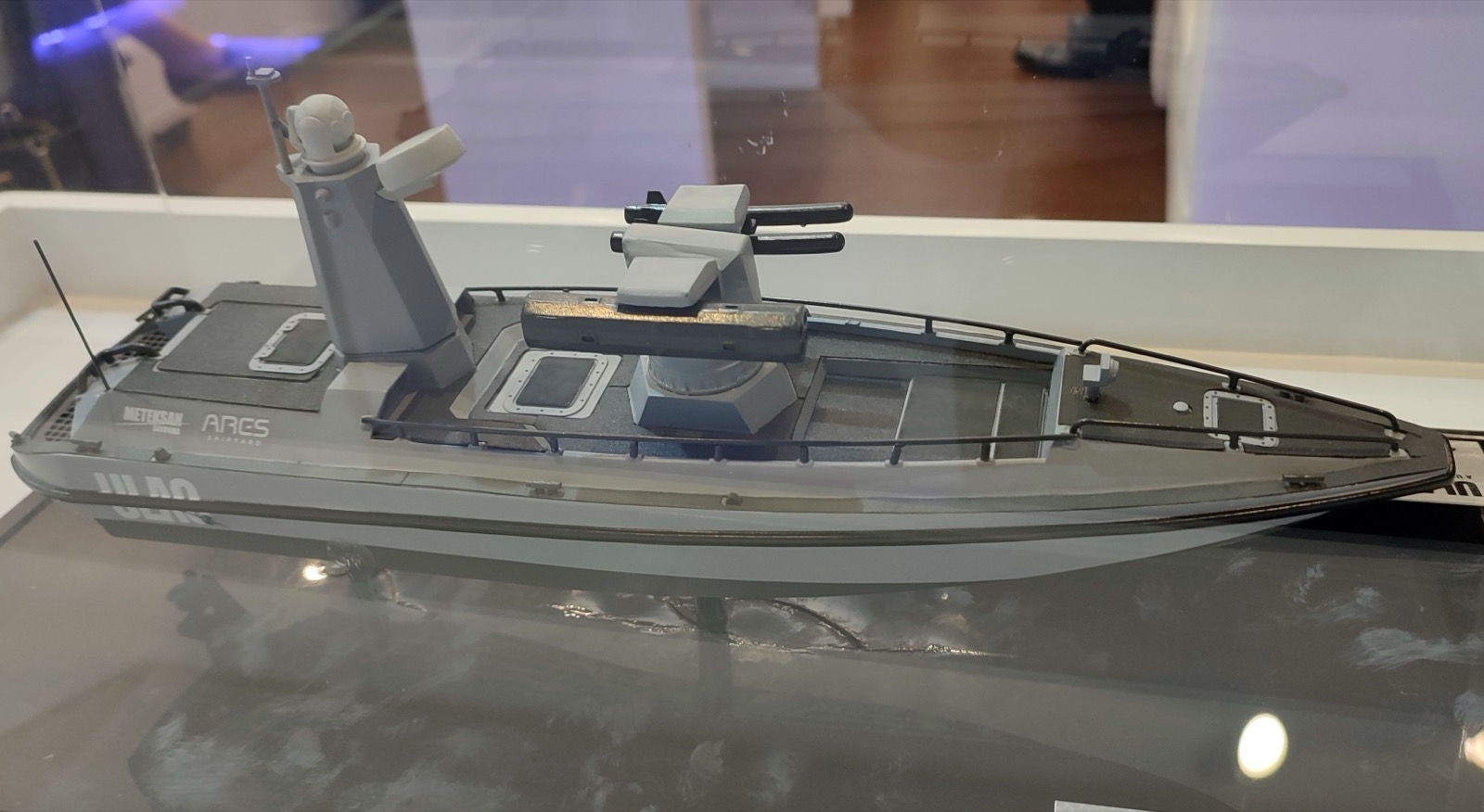
Image: ULAQ armed unmanned surface vehicle on display. Photo by rhk111, Wikimedia Commons, CC BY-SA 4.0.
Turkey spent the last decade exporting unmanned aircraft. The Bayraktar TB2 became a household name from Karabakh to Ukraine; ANKA and AKINCI followed. Less noticed at the time, an equivalent revolution was being prepared on the water. ULAQ — the Turkish word for “envoy” or “messenger” — is Turkey’s first armed unmanned surface vessel: an 11-metre robot boat that carries laser-guided rockets and anti-tank missiles, and answers to a command station hundreds of kilometres away.
ULAQ is a joint product of two companies that complement each other on paper: Ares Shipyard in Antalya — one of Turkey’s most advanced private military boat builders, with a long history of fast patrol craft — and Meteksan Defence in Ankara — a specialist in naval radar, communications and unmanned-systems software. Ares supplies the hull. Meteksan supplies the brain. The result, unveiled on 28 October 2020, is roughly the length of a fast attack craft, but with one critical difference: there is no one on board.
On 27 April 2021, ULAQ fired its first live weapon. Operating under remote command from the shore, the boat launched a ROKETSAN Cirit laser-guided rocket at a target painted by a ground laser designator. The round hit. It was one of the first publicly documented live-fire trials of an armed USV at this size class anywhere outside the United States.
At a Glance
Translated into everyday terms: ULAQ can leave the coast at Marmaris and reach Rhodes in Greek waters and back without refuelling. At its top speed of 80 km/h — roughly half the speed of a conventional fast attack craft — it can slip in to launch range, fire, and turn for home. The two-tonne payload allows for a mix of four UMTAS anti-tank missiles and a salvo of Cirit laser-guided rockets, plus fuel and sensors.
What ULAQ Actually Does
Specifications
| Specification | Value |
|---|---|
| Hull Length | 11 m (roughly the size of a small fast attack craft) |
| Crew | None — fully remote-operated |
| Payload | 2,000 kg (weapons, fuel, sensors) |
| Weapons | UMTAS / L-UMTAS anti-tank missiles, ROKETSAN ÇAKIR cruise missile, Cirit laser-guided rockets |
| Top Speed | 80 km/h (35 knots) |
| Mission Range | 400 km (Antalya to Cyprus and back) |
| Communications | Line-of-sight radio out to 200 km; satellite link beyond |
| Control Method | Shore-based or ship-based command station |
| Public Debut | 28 October 2020 |
| First Live Fire | 27 April 2021 (Cirit laser-guided rocket) |
The Wider Turkish USV Family
ULAQ is the first, not the only one. The Turkish unmanned surface vessel programme is intentionally polycentric — multiple manufacturers pursuing different roles in parallel:
- ULAQ (Ares + Meteksan) — the first, best-known, 11 m, 400 km range.
- SANCAR (HAVELSAN) — 15 m, larger, more payload. Displayed on the deck of TCG Anadolu.
- STM SİDA — STM’s own armed USV, part of its broader unmanned-systems portfolio.
- YAKTU (STM) — a kamikaze single-use unmanned boat for one-way strike missions.
- TENGİZ XLUUV (STM) — ULAQ’s deep-water cousin, an extra-large unmanned underwater vessel.
Why It Matters for Turkey
ULAQ and its sister programmes are part of the Turkish Navy’s Mavi Vatan (“Blue Homeland”) doctrine — the simple fact that Turkey is a maritime country with very long coastlines and overlapping disputed waters in the Black Sea, the Aegean and the eastern Mediterranean. Watching all of that with conventional manned ships, 24 hours a day, is both expensive and dangerous. Unmanned boats spread the coverage cheaply, and absorb the risk if something goes wrong.
The export angle is the second half of the story. ULAQ is NATO-standard, built domestically, and not subject to a foreign export licence. Gulf states, Asia-Pacific navies and African coastal countries have all sent enquiries — exactly the kind of countries that need persistent maritime surveillance and small-target strike capability but cannot easily buy the equivalent American or Israeli system. ULAQ is, in commercial terms, the maritime export Turkey is building to follow the Bayraktar.
The longer thought is doctrinal. If the Bayraktar TB2 was Turkey’s revolution in the air, ULAQ and its siblings are the corresponding revolution on the water. The Ukrainian Navy has already shown what unmanned surface boats can do to a much larger fleet in the Black Sea. Turkey is one of the few countries actively building that capability into its own navy at scale — and selling the same capability to others.
Summary
| Name | ULAQ AUSV (Armed Unmanned Surface Vehicle) |
|---|---|
| Builders | Ares Shipyard (Antalya) + Meteksan Defence (Ankara) |
| Class | Armed unmanned surface vessel (AUSV / USV) |
| Role in Türkiye | First unmanned surface element of the Mavi Vatan (“Blue Homeland”) doctrine. |
| Historic moment | 27 April 2021 — first successful live fire with a Cirit rocket. |
| International peers | US MUSV/LUSV programme, Israel’s Seagull, China’s JARI. |
Sources: