What Is a Ballistic Missile? How It Works (Explained for Beginners)

# What Is a Ballistic Missile? How It Works
Quick answer: A ballistic missile is a giant rocket that throws a bomb very high into the sky — sometimes into space — and lets gravity pull it back down onto the target. After the engine shuts off, it just falls, like a basketball you threw across a court.
If a cruise missile is like an airplane, a ballistic missile is like a baseball pitch. You throw it hard at the start, then it follows a curve in the air and lands far away.
The Three Phases of a Ballistic Missile’s Flight
| Phase | What Happens | Time |
|---|---|---|
| Boost | Rocket engines burn, missile goes up fast | 1–5 minutes |
| Midcourse | Engine off; coasting through space | 5–25 minutes |
| Re-entry | Falls back into the atmosphere at huge speed | 30 seconds–2 minutes |
A long-range ballistic missile (ICBM) can leave the Earth’s atmosphere, travel through space, and come back down on the other side of the planet — all in about 30 minutes.
Why “Ballistic”?
“Ballistic” means moving only under gravity — like a thrown stone, a cannonball, or a free-falling skydiver. Once the missile’s engines stop in the early minutes, it follows a fixed curved path (called a trajectory). Air resistance and gravity are the only forces.
Range Classes — How Far They Fly
The world divides ballistic missiles by range:
| Class | Range | Example |
|---|---|---|
| SRBM (Short-range) | < 1,000 km | Iskander, Scud |
| MRBM (Medium-range) | 1,000–3,000 km | Ghauri, Shahab-3 |
| IRBM (Intermediate) | 3,000–5,500 km | Agni-V, DF-26 |
| ICBM (Intercontinental) | > 5,500 km | Minuteman III, RS-28 Sarmat, DF-41 |
An ICBM can reach any country on Earth in about 30 minutes.
How Fast Are They?
Very, very fast. When a long-range ballistic missile re-enters the atmosphere, it can be traveling at Mach 20+ (24,000 km/h). That’s why they’re so hard to shoot down — you have only seconds.
For comparison:
- A passenger jet: Mach 0.85
- A rifle bullet: Mach 2.5
- A cruise missile: Mach 0.8
- An ICBM warhead during re-entry: Mach 20–24
How They Find Their Target
Older missiles like the Scud used simple math — “fire at this angle with this fuel, land here.” Newer ones use:
- Inertial guidance (gyroscopes track every motion)
- GPS (corrects errors)
- Terminal guidance (radar or camera in the final seconds for high accuracy)
The modern Russian Iskander can hit within 5–7 meters of its target — even after flying 500 km.
Famous Ballistic Missiles
- V-2 (Germany, 1944) — the first one ever. Flew 320 km, killed thousands in London.
- Scud (USSR) — used in many wars, including the Gulf War.
- Minuteman III (USA) — silo-launched ICBM, range 13,000 km.
- Iskander-M (Russia) — modern short-range, hard to intercept.
- DF-41 (China) — newest ICBM, 14,000 km range, multiple warheads.
- Shahab-3 / Fattah (Iran)
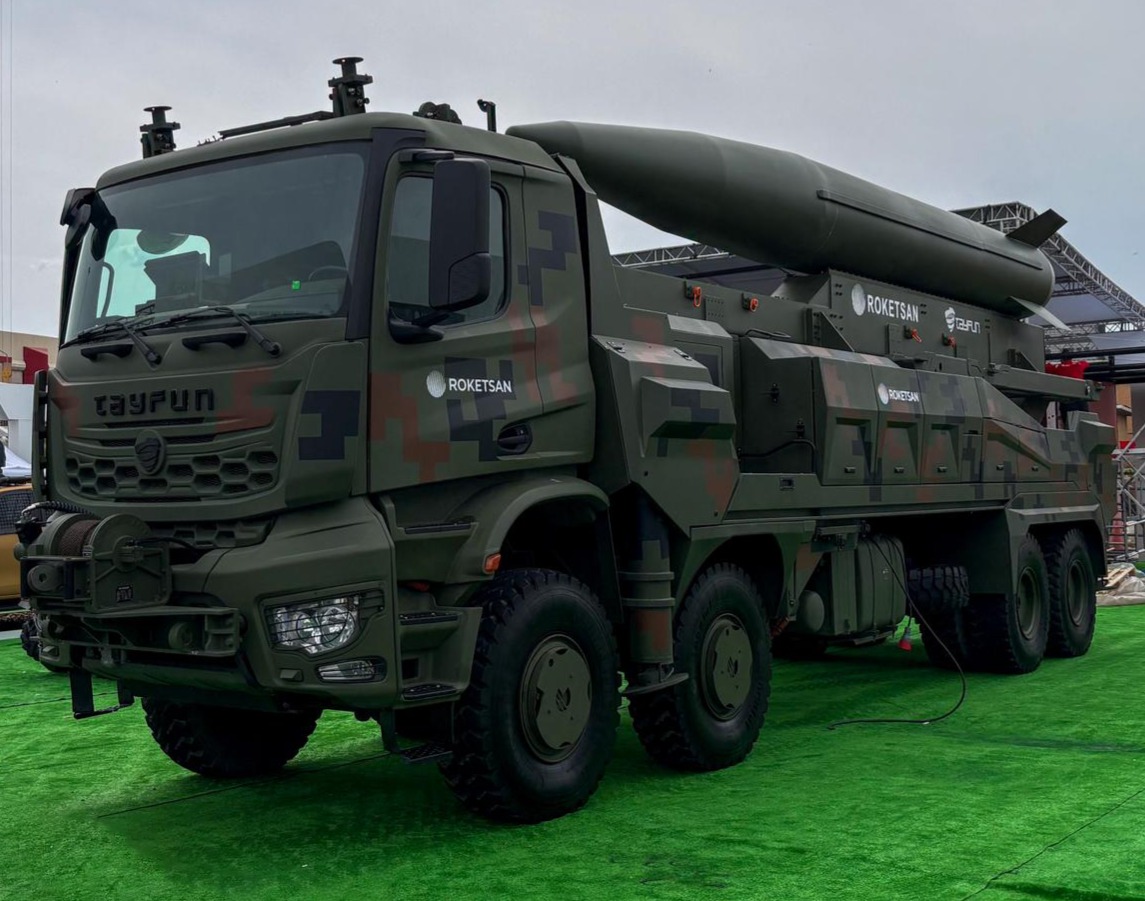
- Tayfun (Türkiye) — domestic SRBM, ~500 km range.
Can They Be Stopped?
Yes, but it’s extremely difficult. Anti-ballistic missile systems include:
- THAAD (USA) — kills missiles during midcourse and terminal phase
- Aegis BMD (USA) — ship-launched SM-3 missiles
- S-400/S-500 (Russia)
- Arrow-3 (Israel)
- HQ-19 (China)
But hitting a missile coming down at Mach 20 is described as “hitting a bullet with a bullet.”
Why It Matters
Ballistic missiles are the main delivery system for nuclear weapons because:
- Almost nothing can stop them in time
- They reach any city in 30 minutes
- They are owned by 9 countries (USA, Russia, China, UK, France, India, Pakistan, North Korea, Israel)
This is why ballistic missile programs cause so much international tension.
Image Suggestions
- 1. Featured: Ballistic missile launch (flame, smoke, vertical climb)
- 2. Trajectory diagram (boost → midcourse in space → re-entry)
- 3. World map showing ICBM range circles from major countries
- 4. Cutaway: rocket motors, fuel, guidance, warhead
- 5. MIRV warhead diagram (multiple bombs from one missile)
Related Articles
- What is a missile? Beginner’s guide
- What is an ICBM? Intercontinental missiles explained
- SRBM vs MRBM vs IRBM vs ICBM — range explained
- What is a hypersonic missile?
- What is missile defense?