HÜRJET Engine: GE F404-104 Turbofan Thrust, Origin and TEI

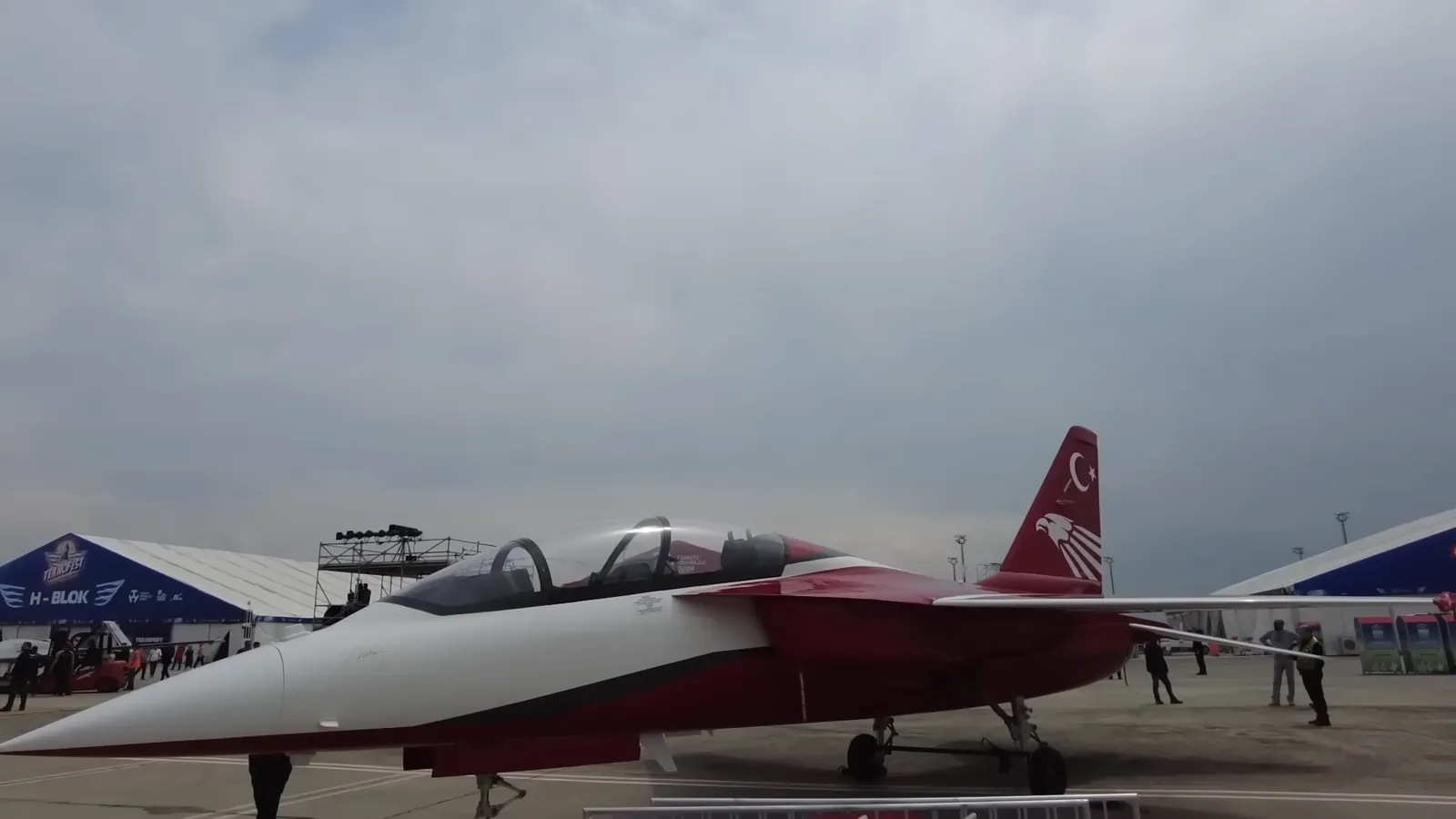
HÜRJET is a single-engine aircraft. It is powered by one General Electric F404-104 afterburning turbofan rated at 17,700 lbf, roughly 78.7 kN. The engine is imported from the United States, and GE Aerospace announced a F404 supply agreement with Turkish Aerospace on 5 May 2026. No indigenous engine has been officially announced for series-production HÜRJET aircraft.
| HÜRJET Powerplant — Data Sheet | |
|---|---|
| Engine model | General Electric F404-104 |
| Engine type | Afterburning, low-bypass, twin-spool turbofan |
| Number of engines | 1 (single-engine aircraft) |
| Thrust | 17,700 lbf with afterburner (approximately 78.7 kN) |
| Origin | Imported; manufactured in the United States by GE Aerospace |
| Maximum speed | Mach 1.4 |
| Service ceiling | 45,000 ft |
| Rate of climb | 48,500 ft/min |
| Payload / range | 7,500 lb (about 3,400 kg) payload; 1,060 nm range (about 1,963 km) |
| Contract status | F404 supply agreement announced 5 May 2026; contract value and engine quantity not officially disclosed |
What engine does the HÜRJET use?
HÜRJET uses one General Electric F404-104 afterburning turbofan. The aircraft is single-engined, and the official Turkish Aerospace product sheet rates the installed engine at 17,700 lbf of thrust with afterburner, roughly 78.7 kN. That powerplant is what underpins the other published performance numbers on the aircraft: a maximum speed of Mach 1.4, a service ceiling of 45,000 ft, a rate of climb of 48,500 ft per minute and a range of 1,060 nautical miles.
The engine is imported. It is built in the United States by GE Aerospace, and HÜRJET is not fitted with a Turkish-designed engine. Readers frequently confuse the two aircraft, so it is worth stating plainly: HÜRJET is not twin-engined, and it does not share a powerplant with KAAN, whose prototype flies on two GE F110 engines. GÖKBEY is a different case again, being a helicopter driven by turboshaft rather than turbofan engines. On 5 May 2026 GE Aerospace announced an F404 turbofan supply agreement with Turkish Aerospace covering current production and future variants of the platform; the contract value and the number of engines have not been officially disclosed.
What kind of engine is the GE F404?
The F404 is a family of afterburning, low-bypass, twin-spool turbofans whose first engine run took place in 1978. Across its variants the family covers a thrust class of roughly 10,500 to 19,000 lbf (47 to 85 kN), which is the reason it appears both in frontline fighters and in supersonic lead-in fighter trainers. The general architecture is a three-stage fan, a seven-stage axial high-pressure compressor, an annular combustor, and a turbine section with one high-pressure and one low-pressure stage. The F404-GE-402 is quoted with a bypass ratio of 0.34:1, and the F404-GE-IN20 with an overall pressure ratio of 28:1.
The F404 is one of the most widely fielded engines in its class. It powers the F/A-18 Hornet, the F-117 Nighthawk, the KAI T-50 Golden Eagle and FA-50, the HAL Tejas, the Boeing/Saab T-7A Red Hawk and the F-20 Tigershark, while the RM12 that powers the Gripen is an F404 derivative. In its release of 5 May 2026 GE Aerospace stated that 16 nations operate or have ordered F404-powered aircraft. That installed base matters for HÜRJET in practical terms, because spares, overhaul intervals and technical data for a widely used engine are easier to source than for a low-volume one.
The table below sets HÜRJET alongside other aircraft in the advanced jet trainer and light attack class, compared on propulsion rather than on airframe. Four of the six are powered by variants of the same GE F404 family, which is why HÜRJET’s engine choice is unremarkable in market terms: it places the aircraft on broadly comparable propulsion with its direct competitors. Status descriptions refer to the engine fitted, not to the maturity of the airframe.
Turkey is developing its own turbofan engines through TEI, but a development programme is not an available product. None of the engines below has been officially announced as the series-production powerplant for HÜRJET, and thrust figures quoted for engines still in development are design targets rather than demonstrated, flight-qualified output. A target engine is not a ready engine, and a first afterburner ignition test is not the same as an engine cleared for flight. The table records the publicly stated status of each programme, nothing more.
TEI’s role in the HÜRJET engine
TEI (TUSAŞ Engine Industries, TUSAŞ Motor Sanayii A.Ş.) is based in Eskişehir and was founded in 1985 as a joint venture between GE Aerospace and Turkish Aerospace. The shareholding is TUSAŞ 50.5 per cent and GE 46.2 per cent. The company today manufactures hundreds of engine components for the global aerospace supply chain, which is the industrial base on which its F404 work rests.
Two separate steps define TEI’s position on the HÜRJET engine, and they should not be merged:
- 23 July 2024 — memorandum of understanding. GE Aerospace, TEI and Turkish Aerospace signed an MoU covering evaluation of F404 integration on new HÜRJET variants, assembly, inspection and testing of F404 engines by TEI, and the provision of maintenance, repair and overhaul (MRO) services, including to global F404 operators.
- 5 May 2026 — supply agreement. GE Aerospace announced an F404 turbofan supply agreement with Turkish Aerospace covering current production and future variants of the platform. The contract value and the number of engines have not been officially disclosed.
A memorandum of understanding is not a signed supply contract, and the two announcements are distinct milestones. Equally important, TEI is not the designer of the F404. Assembly, inspection, testing and MRO work raise domestic content and, more usefully, give Turkey its own sustainment capability for the fleet — but they do not make the engine indigenous. The engine remains a GE Aerospace product built to a United States design.
Will the HÜRJET get an indigenous engine?
No indigenous engine programme for HÜRJET has been officially announced. None of TEI’s turbofan projects has been formally declared as the series-production powerplant of the aircraft, and the engine in the aircraft today is the imported F404-104. Anything beyond that is speculation rather than programme fact.
What has been announced is a step-by-step turbofan roadmap that moves through progressively larger thrust classes:
- TEI-TF6000, 6,000 lbf, run publicly for the first time in a mobile test cell at Teknofest 2025, aimed at the UAV and trainer class.
- TEI-TF10000, 6,000 lbf dry and 10,000 lbf with afterburner, still in development, with a first afterburner ignition test targeted for the end of 2027.
- TEI-TF35000, 35,000 lbf, in development with TRMOTOR under SSB sponsorship, intended for KAAN.
On the disclosed figures, the TF10000’s 10,000 lbf afterburning rating and the F404-104’s 17,700 lbf are not in the same thrust class. That is a straightforward comparison of published numbers, not a claim about any programme. The 6,000 → 10,000 → 35,000 lbf sequence is a deliberate, incremental accumulation of capability: turbofan design, hot-section materials and certification testing are long-cycle disciplines, and each completed step adds design data, test infrastructure and qualified engineers that the next one builds on. TEI’s assembly, test and MRO role on the F404 feeds directly into that accumulation.
HÜRJET is single-engined and its engine is imported. The powerplant is one General Electric F404-104 afterburning turbofan rated at 17,700 lbf, manufactured in the United States. TEI’s planned assembly, inspection, test and MRO role does not make the engine indigenous, and TEI is not its designer. The 23 July 2024 memorandum of understanding and the 5 May 2026 supply agreement are separate steps: an MoU is not a signed supply contract, and the contract value and engine quantity have not been officially disclosed. The stage counts, dry weight of 1,035 kg and dimensions of 391 cm by 89 cm quoted on this page are family-wide and F404-GE-402/IN20 figures; the exact weight and dimensions of the F404-104 have not been published by Turkish Aerospace or GE. No TEI engine has been officially declared as HÜRJET’s series-production powerplant, and a target thrust figure is not a flight-qualified engine. HÜRJET must not be confused with KAAN, whose prototype flies on two GE F110 engines.
Frequently Asked Questions
What engine does the HÜRJET use?
HÜRJET is powered by one General Electric F404-104 afterburning turbofan, rated at 17,700 lbf or roughly 78.7 kN. The engine is imported from the United States. It is the same engine family that powers the KAI T-50, the HAL Tejas and the Boeing/Saab T-7A Red Hawk, which places HÜRJET on broadly comparable propulsion terms with the other supersonic trainers in its class.
How many engines does the HÜRJET have?
One. HÜRJET is a single-engine aircraft with a single F404-104 turbofan and one tail exhaust. This is a common point of confusion, because KAAN, Turkey’s fifth-generation fighter programme, is twin-engined and its prototype flies on two GE F110 engines. The two aircraft are separate programmes with different powerplants, and figures from one should not be applied to the other.
Is the HÜRJET’s engine Turkish-made?
No. The F404-104 is designed and manufactured by GE Aerospace in the United States and is imported. TEI, the Eskişehir-based engine company, is expected to assemble, inspect and test F404 engines and to provide maintenance, repair and overhaul services under the 2024 memorandum of understanding. That work raises domestic content and sustainment capability, but it does not make the engine an indigenous design.
How much thrust does the GE F404 produce?
The F404 family spans roughly 10,500 to 19,000 lbf, or 47 to 85 kN, depending on variant. The F404-104 fitted to HÜRJET is rated at 17,700 lbf with afterburner. For comparison, the F404-GE-402 is quoted at 11,000 lbf dry and 17,700 lbf with afterburner, while the F404-GE-IN20 used on the HAL Tejas is rated at 12,139 lbf dry and 19,000 lbf.
What does TEI do on the HÜRJET engine?
TEI is not the designer of the F404. Under the memorandum of understanding signed on 23 July 2024 by GE Aerospace, TEI and Turkish Aerospace, TEI is expected to assemble, inspect and test F404 engines and to provide maintenance, repair and overhaul services, potentially including support to global F404 operators. TEI was founded in 1985 as a GE and Turkish Aerospace joint venture, with TUSAŞ holding 50.5 per cent and GE 46.2 per cent.
Will the HÜRJET get an indigenous engine?
This has not been officially announced. No TEI engine has been formally declared as HÜRJET’s series-production powerplant. Turkey’s turbofan roadmap runs from the 6,000 lbf TEI-TF6000, publicly run at Teknofest 2025, to the TF10000 at 10,000 lbf with afterburner, whose first afterburner ignition test is targeted for late 2027, and the 35,000 lbf TF35000 intended for KAAN. Each step builds design and test capability for the next.
Do the HÜRJET and KAAN use the same engine?
No. HÜRJET has one GE F404-104 rated at 17,700 lbf. The KAAN prototype is twin-engined, flying on two GE F110 engines, and the stated indigenous target for its series production is the TEI TF35000 at 35,000 lbf, which remains in development. The two aircraft sit in different weight and thrust classes, so engine specifications, thrust figures and programme timelines should never be transferred between them.
Sources
- Turkish Aerospace (TUSAŞ/TAI) — official HÜRJET product page, tusas.com (engine, thrust and performance data)
- GE Aerospace — press release of 5 May 2026 on the F404 turbofan supply agreement with Turkish Aerospace
- GE Aerospace / TEI / Turkish Aerospace — memorandum of understanding of 23 July 2024, announced at Farnborough
- TEI (TUSAŞ Engine Industries) — official product pages for TEI-TF6000, TEI-TF10000 and TEI-TF35000, tei.com.tr
- Presidency of Defence Industries (SSB) — indigenous engine programme statements
- Wikipedia — General Electric F404 (family architecture, variants and applications)