US Collaborative Combat Aircraft Fly in Formation for the First Time

For the first time, the US Air Force’s Collaborative Combat Aircraft (CCA) flew together in formation and ran through air combat maneuvers, during an exercise on October 26, Defense News reported on November 10. The milestone marks a shift from flying these drones as isolated test articles to operating them as a coordinated flight.
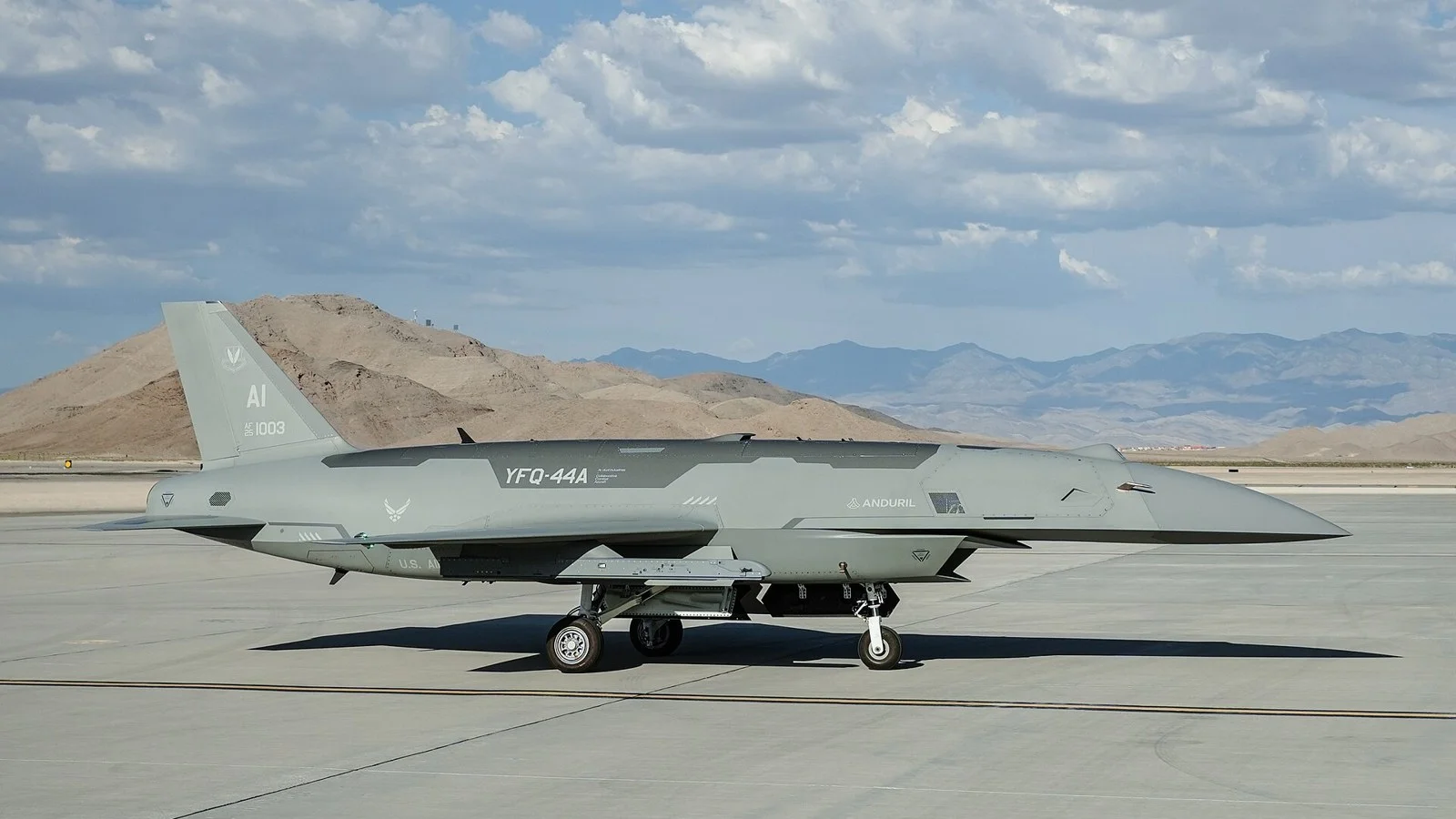
The formation flight and beyond-visual-range counter-air tactics were made possible by Hivemind, the autonomy software built by Shield AI. The company did not disclose how many aircraft took part, but imagery accompanying the report showed Anduril’s YFQ-44A Fury at a test site in California.
The CCA effort rests on two airframes under what the Air Force calls Increment 1: General Atomics’ YFQ-42A and Anduril’s YFQ-44A Fury. Both have moved from basic test flights toward armed and autonomous mission trials over the past year, and this formation flight is the latest step in that progression.
Todd Wesley, Shield AI’s vice president of Hivemind engineering, said the level of integration between the airframes and mission systems now shows what the software is capable of. He added that the service is approaching a point where it can fly a sortie, push a software update overnight, and fly again the next day — with each flight’s data feeding directly into the next release.
The test follows a separate milestone last month, when an F-22 Raptor flew as an airborne “quarterback,” issuing high-level direction to a YFQ-44A in flight. In the same stretch, Shield AI announced it would acquire radar maker Echodyne in a $5.3 billion deal, a move the company framed as expanding its drone-warfare portfolio.
The scale the Air Force is planning for is substantial. The service wants 500 combat-ready, semi-autonomous CCAs fielded by 2032 as part of a wider 1,000-aircraft fleet. The fiscal 2027 budget request sets aside $2.37 billion for the program: $996.5 million in procurement, $150 million in advance procurement for the following year, and $1.37 billion for continued research and development.
What formation flight actually changes is the operating concept. A CCA that can only fly solo is a test article; one that can hold formation, share tactical data and execute coordinated beyond-visual-range maneuvers starts to function as a genuine wingman for crewed fighters. Because the autonomy is software-defined, the Air Force can push behavioral updates from test data on a weekly cycle rather than the multi-year timelines typical of manned fighter development.
For NATO air forces and other services pursuing loyal-wingman concepts of their own, the significance lies less in the specific hardware than in the demonstrated jump from single-aircraft testing to multi-ship tactics — the step that will determine how quickly manned-unmanned teaming can be folded into allied air combat doctrine.
Sources:
Defense News, “First-ever Collaborative Combat Aircraft fly in formation, demonstrate air combat maneuvers,” Cristina Stassis, November 10, 2026, link — primary source for quotes and program figures.