South Africa’s Military Strength 2026: Personnel, Budget and Equipment


South Africa’s Military Strength 2026: Personnel, Budget and Equipment
South Africa fields roughly 65,000 active personnel and a R57.6 billion ($3.1 billion) defence budget for the 2026/27 financial year, but the South African National Defence Force (SANDF) is running well below its own readiness targets: the Air Force had flown only around a fifth of its planned flight hours by mid-year, and the Navy a similar share of planned sea hours, largely due to maintenance backlogs. This guide sets out the SANDF’s personnel, budget and equipment picture for 2026, why readiness has fallen, and where Turkish and other foreign suppliers fit into the country’s rebuilding effort.
Contents
- South Africa’s military at a glance
- Personnel and structure
- Defence budget and readiness crisis
- Army equipment
- Air Force
- Navy
- Domestic industry and foreign suppliers
- Where South Africa ranks in Africa
- FAQ
- Sources
South Africa’s military at a glance (2026)
| Metric | Figure |
|---|---|
| Active personnel | ~65,350 |
| Reserve personnel | ~15,050 |
| Defence budget (2026/27) | R57.6 billion (≈ $3.1 billion, Sept 2026 rate) |
| Share of budget on salaries | over 60% |
| Main battle tanks | ~70 (Olifant Mk1B/2, most in storage) |
| Combat aircraft | ~25 (Gripen C/D, Hawk Mk120 LIFT) |
| Navy frigates | 4 (Valour-class) |
| Navy submarines | 3 (Heroine-class) |
| Africa rank (Global Firepower) | 4th, behind Egypt, Algeria and Nigeria |
Global Firepower (GFP) is an index built from equipment counts and other weighted factors, not an official military assessment, and its Africa ranking should be read alongside sources closer to the ground, such as South Africa’s own Department of Defence annual reports and DefenceWeb reporting. Where GFP and other trackers disagree on totals — common with reserve stocks and grounded airframes — this guide flags it.
Personnel and structure
The SANDF comprises the South African Army, South African Air Force (SAAF), South African Navy and South African Military Health Service, under a joint headquarters structure. Active strength is estimated at around 65,000, split roughly: Army the largest branch by headcount, followed by the Air Force, Navy and Military Health Service. Reserve forces add roughly 15,000 more, though reserve call-up and training funding has itself been constrained by the same budget pressure affecting the regular force.
SANDF personnel have carried an unusually heavy operational load in 2026: border safeguarding under Operation Corona, domestic deployments supporting the police, and a continuing peacekeeping and stabilisation commitment in the Democratic Republic of Congo (DRC) under the Southern African Development Community Mission (SAMIDRC), which the 2025/26 budget separately allocated roughly R5 billion for.
Defence budget and the readiness crisis
South Africa’s defence budget has been effectively flat to declining in real terms for over a decade, currently around 0.7% of GDP — well below the 2% NATO-style benchmark South Africa’s own defence review has cited as a floor for a force this size. The 2026/27 allocation of R57.6 billion is actually a decrease from the R59 billion budgeted for 2025/26, before projected increases to R59.8 billion in 2027/28 and R61.7 billion in 2028/29.
With more than 60% of the budget consumed by salaries, capital spending on equipment, spares and maintenance is squeezed into a shrinking remainder. The consequences are documented in the Department of Defence’s own reporting to Parliament: by mid-2026 the Air Force had flown roughly 2,411 of a planned 12,000 flight hours for the year, and the Navy had logged around 2,377 of a planned 8,000 sea hours, in both cases well short of target because aircraft and ships were unavailable for maintenance reasons. SADC standby-force readiness for South African-contributed units was reported at 79%, below the 100% target, for the same reason.
This is a fleet-availability problem more than a fleet-size problem — South Africa still owns a broad equipment inventory on paper, discussed below, but a shrinking share of it is flight- or sail-ready at any given time.
Army equipment
| Type | Notes |
|---|---|
| Olifant Mk1B / Mk2 main battle tank | Locally upgraded Centurion-derived design; the bulk of the roughly 70 tanks in the inventory are held in reserve storage rather than active units |
| Ratel / Rooikat | Wheeled infantry fighting vehicles and armoured cars, South African-designed and built |
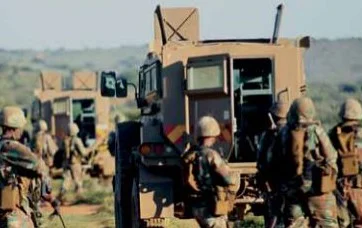
| Mamba / Casspir | Mine-resistant patrol vehicles, widely used for border and internal deployments and exported for decades |
| G6 Rhino / G5 | Self-propelled and towed 155mm artillery, Denel-designed |
Air Force
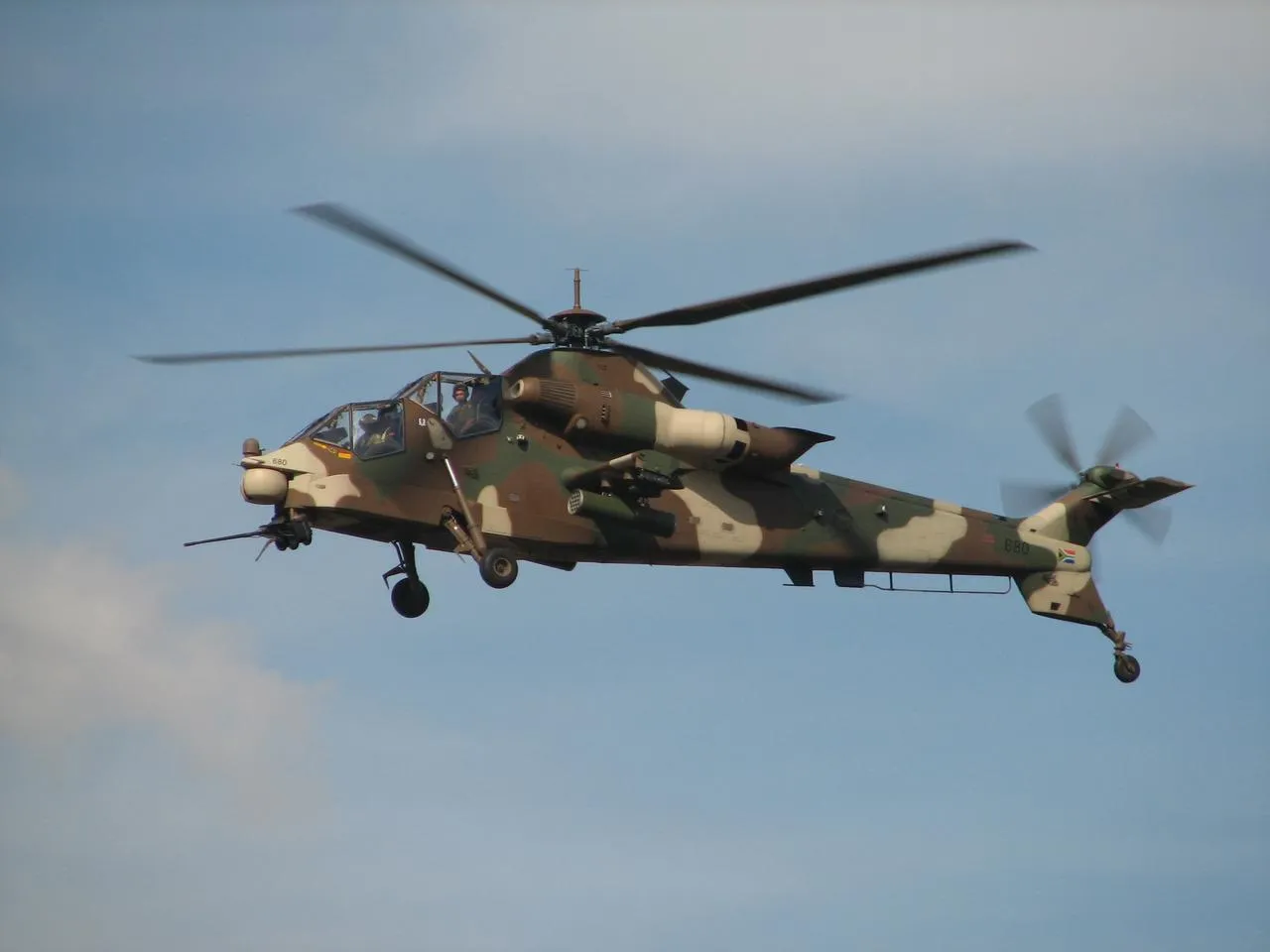
The SAAF’s combat element centres on around 25 Saab Gripen C/D multirole fighters and BAE Hawk Mk120 lead-in fighter trainers, supplemented by a helicopter fleet that includes the locally built Denel AH-2 Rooivalk attack helicopter, Oryx medium transport helicopters (a licence-derived Puma variant) and Agusta A109 light helicopters. Total aircraft, including transport and training types, is put at close to 190 by independent trackers, but South African media reporting throughout 2025-2026 — citing the Air Force’s own flight-hour figures — describes a large share of that fleet as grounded for want of spares and maintenance funding, to the point where readiness of combat squadrons has been publicly questioned by South African defence analysts and parliamentary committees.
Navy
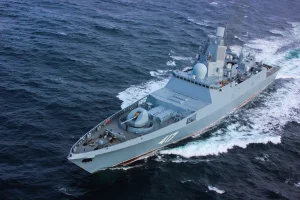
The South African Navy operates four Valour-class (MEKO A-200) frigates built with German assistance, three Heroine-class (Type 209) submarines, and a mix of offshore and inshore patrol vessels, including newer Multi-Mission Inshore Patrol Vessels delivered to replace ageing strike craft. It has no aircraft carriers, destroyers or corvettes, and — like the Air Force — has reported sea-hours well below plan in 2026 due to vessels awaiting maintenance.
Domestic industry and where Turkish suppliers fit
South Africa has Africa’s most established indigenous defence-industrial base, led by state-owned Denel and private group Paramount, both legacies of apartheid-era self-sufficiency built under sanctions. That domestic-first tradition shapes how foreign suppliers, including Turkish companies, engage with Pretoria: rather than large platform sales, the pattern so far has been exhibition presence and partnership exploration. ASELSAN presented its multi-domain defence portfolio at the AAD 2026 exposition in South Africa, one of 287 exhibiting companies from 33 countries, and Paramount has separately pushed back on aspects of foreign procurement policy as Pretoria weighs how far to open local programmes to overseas suppliers.
This is a different picture from further north and east on the continent, where Turkish armoured vehicles and the Otokar Cobra and ARMA families have found buyers — no confirmed South African order for Turkish armoured vehicles or drones exists as of this writing, and any future acquisition should be treated as unconfirmed until an official contract or delivery is announced.
Where South Africa ranks in Africa
Global Firepower’s 2026 Africa listing places South Africa 4th on the continent, behind Egypt, Algeria and Nigeria — a fall from 3rd in 2024, reflecting both the readiness issues above and faster equipment growth elsewhere in Africa. For continent-wide context, see Africa’s Strongest Militaries 2026: Full Country Ranking and Africa’s 10 Biggest Defence Budgets in 2026.
FAQ
How many soldiers does South Africa have?
Around 65,350 active personnel plus roughly 15,050 reserves, according to Global Firepower’s 2026 estimate; official SANDF figures are published in the Department of Defence’s annual report.
What is South Africa’s defence budget for 2026?
R57.6 billion for the 2026/27 financial year (roughly $3.1 billion at September 2026 exchange rates), down slightly from R59 billion the previous year.
Does South Africa use Turkish military equipment?
Not as a confirmed operator of major Turkish platforms. Turkish industry engagement so far consists of exhibition participation, such as ASELSAN at AAD 2026, rather than confirmed sales of drones or armoured vehicles.
Why is SANDF readiness described as low despite a large equipment inventory?
Department of Defence reporting attributes it to maintenance backlogs and budget allocation, with salaries consuming over 60% of the budget and leaving less for spares, fuel and flight/sea hours — not a lack of platforms on paper.
Does South Africa have an aircraft carrier?
No. The Navy’s largest surface combatants are four Valour-class frigates.
Sources
- Global Firepower, 2026 South Africa Military Strength profile
- DefenceWeb, defence budget and readiness reporting (2025-2026)
- SAnews.gov.za, Department of Defence budget vote coverage
- South African National Defence Force / Department of Defence annual report
Last updated: 25 September 2026.