Saab Puts a Body on Its Loyal Wingman: A3-001 Steps Out at the Swedish Air Force Centenary

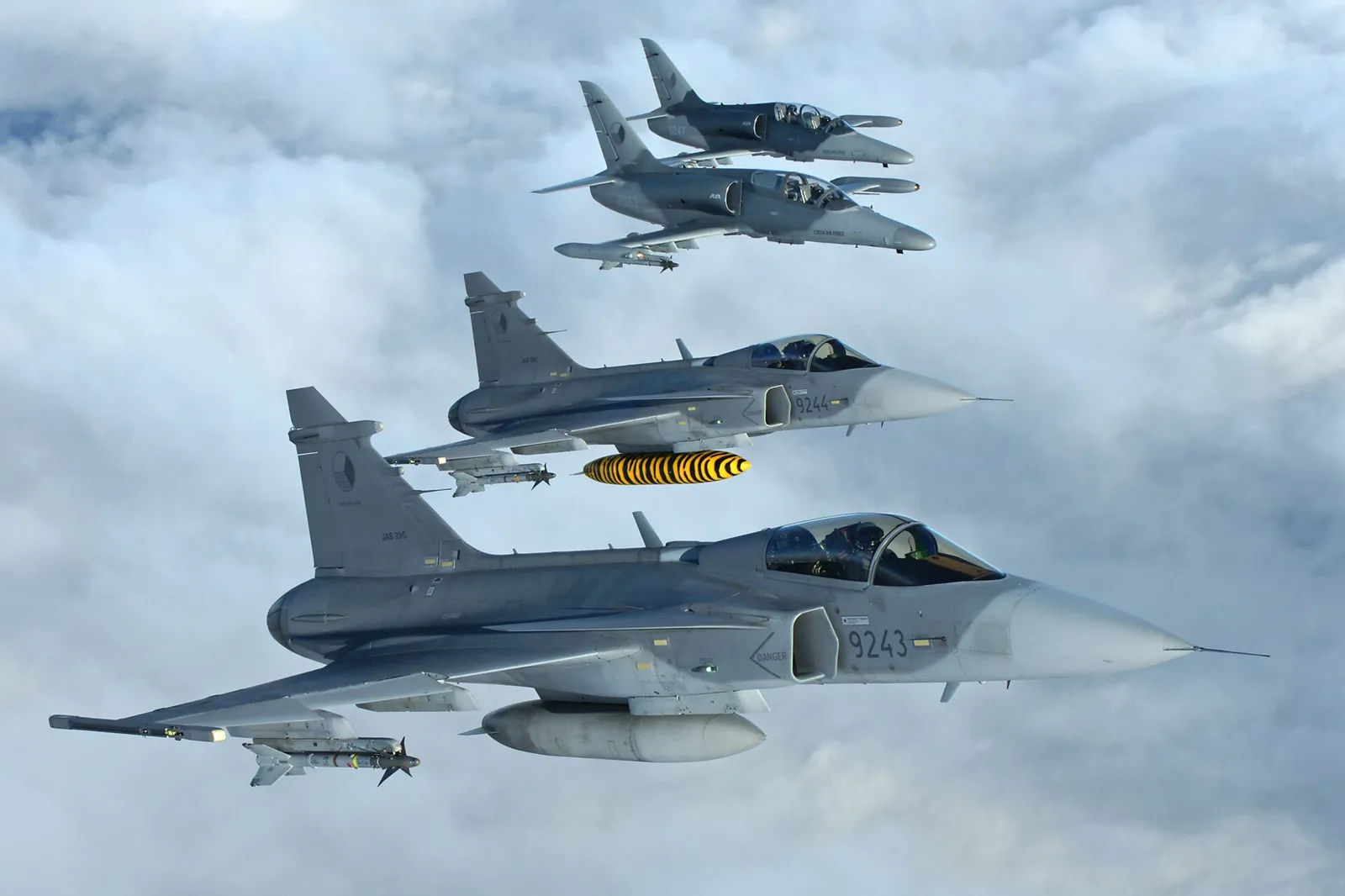
Sweden has been talking about uncrewed combat aircraft in the conditional tense for years. At Malmen Air Base near Linkoping on 22 August 2026, at the Jubilee Air Show marking the Swedish Air Force’s centenary, Saab finally put a full-scale airframe in front of the cameras and gave it a designation: A3-001. Two days later the company filled in the roadmap around it.
Three airframes, one architecture
Saab groups the work under the heading Autonomous Collaborative Platforms, and it runs through three successive vehicles:
- A1 — a supersonic demonstrator built around the General Electric F414, the same engine family that powers the Gripen E/F. Saab wants it airborne within 15 months.
- A2 — adds an internal weapons bay, meaning ordnance can be carried without breaking the signature.
- A3-001 — the production candidate and the aircraft Saab intends to offer the Swedish Air Force. This is the full-scale model shown at Malmen.
A1 and A2 are expected to fly within four years. A3 could enter service within a decade, subject to a government decision that has not been taken. Peter Nilsson, who heads Saab’s Advanced Programs business unit, set the marker: fly uncrewed demonstrators with fighter-like characteristics before 2030.
The mission set: give the dangerous work to the machine
Saab’s own description of the A3-001 is narrow and revealing — electronic warfare, suppression of enemy air defences, and precision strike in contested airspace. Those are precisely the missions where a crewed aircraft is most likely not to come home. Low observability, high autonomy and multi-domain operation are the three attributes the company puts forward.
Swedish Defence Minister Pal Jonson called the concept a natural evolution of the Gripen system: an uncrewed wingman able to conduct deep operations alongside the mother platform. That framing matters. This is not being sold as an independent combat aircraft, but as a force multiplier that extends the reach and survivability of the crewed fleet.
The number that will decide the programme
Saab estimates the A3 will cost roughly a third of a Gripen E on a lifecycle basis. That ratio is the entire commercial argument for loyal wingmen worldwide — an aircraft cheap enough to be bought in numbers and, if necessary, lost. Losing one is a tactical setback, not a casualty.
Funding, however, remains undecided. The Riksdag is expected to rule on Sweden’s post-2040 combat air capability somewhere between 2028 and 2030. Showing a full-scale model now, ahead of that decision, is a positioning move as much as an engineering milestone.
The hard part is not the airframe
In loyal wingman programmes the airframe is rarely the obstacle. The obstacle is decision software: maintaining a jam-resistant data link with the crewed aircraft, continuing the mission when that link drops, and generating engagement decisions that stay inside the rules. Saab’s stated intent to run an AI-enabled flight and engine management architecture on the A1 suggests it wants that layer under test early, while the airframe integration — familiar territory for Swedish industry — proceeds in parallel.
A crowded European field
A3-001 does not arrive in an empty room. Airbus is developing Wingman, GCAP carries an uncrewed component, FCAS has its remote carrier family, and Turkey is flying ANKA-3 and Kizilelma today. In the United States, the Air Force’s CCA programme is furthest along, with Anduril and General Atomics airframes already in flight test.
Saab’s advantage is not the airframe but the ecosystem around it. Gripen, the GlobalEye airborne early warning aircraft and Sweden’s networked data-link infrastructure all come from the same company. The system-of-systems language in Saab’s release is not marketing filler — it is the argument that the A3-001 plugs into something that already works.
Is the timeline credible?
Fifteen months to first flight for A1 implies a design already well down the maturity curve, and probably work that has been running quietly for some time. A decade to service entry for A3 is the softer number: if the Swedish budget decision slips toward 2030, that date slips with it.
Sources
- Saab press release: “Saab showcases full-scale uncrewed aircraft concept,” 22 August 2026
- Swedish Ministry of Defence remarks, Jubilee Air Show, Malmen
- Breaking Defense, 24 August 2026