How Fast Are 155mm Shells Being Consumed in Modern War?

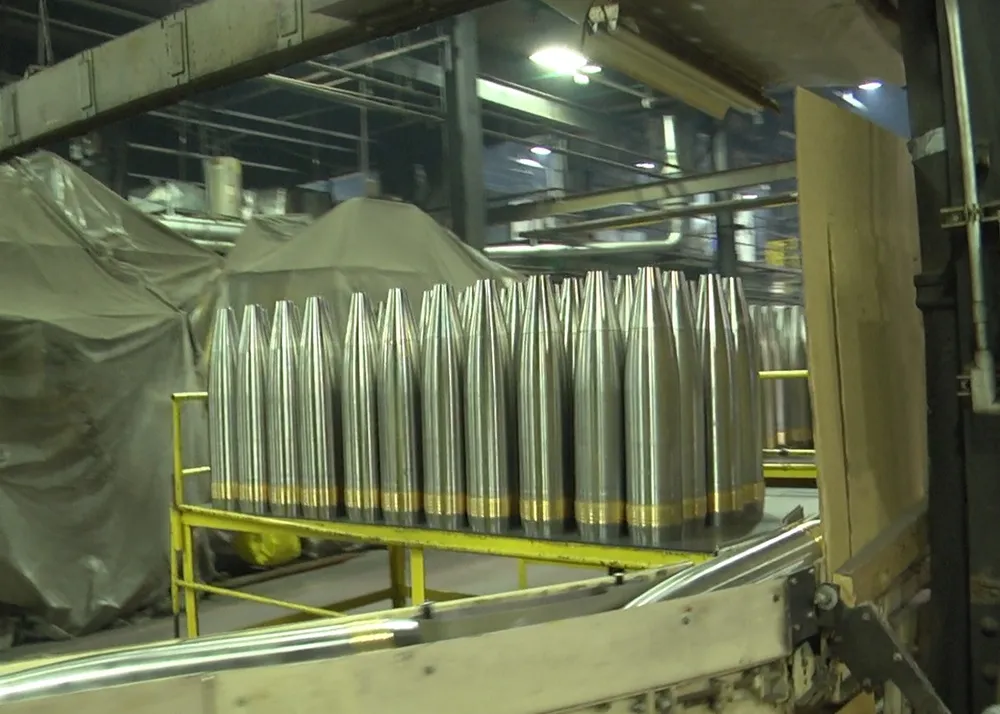
A high-intensity artillery war burns through 155mm rounds far faster than peacetime factories were ever built to replace them. In Ukraine, daily 155mm expenditure has ranged from roughly 2,000 to 7,000 rounds depending on the phase of fighting, while combined US and European annual output stood at a few hundred thousand rounds as recently as 2022. That mismatch is why NATO governments have spent the past three years on the largest peacetime-to-wartime ammunition ramp-up since the Cold War. Here is what the numbers actually show, and how close the alliance is to closing the gap.
How fast are shells being fired at the front?
NATO Secretary General Jens Stoltenberg told reporters in February 2023 that Ukrainian forces were firing roughly 6,000-7,000 155mm rounds a day, about a third of Russia’s daily rate at the time. He added that Ukraine’s rate of ammunition expenditure was “many times higher” than the alliance’s production rate, and that wait times for large-caliber ammunition orders had stretched from 12 to 28 months. By 2024-2025, open-source estimates suggest Ukrainian daily consumption moderated to roughly 2,000-4,000 rounds as the front stabilized and stocks were husbanded more carefully. None of these figures are official Ukrainian General Staff releases — they are Western estimates and defense-press reporting, so treat the range, not a single number, as the takeaway.
Why the stockpiles emptied so fast
Before 2022, most NATO members had wound artillery-shell production down to near-minimum levels. US annual 155mm output stood at roughly 93,000 rounds in early 2022 — a volume that a sustained high-intensity fight could burn through in weeks, not years. European lines were in a similar state: mostly single-shift, order-driven, low-capacity production. The forging capacity for shell bodies and the explosives/propellant supply chains had shrunk over three decades, so converting factories to continuous, multi-shift wartime output took years rather than months once the war began.
How far behind is peacetime production?
The numbers illustrate the gap. The US Army raised M795-type 155mm output from about 14,000 rounds a month in 2022 to roughly 36,000 a month by March 2026 — more than double, but still only about a third of the Pentagon’s original October 2025 target of 100,000 rounds a month. A 2026 Defense Department Inspector General report identified metal-parts production at the Mesquite, Texas facility as the key bottleneck holding back further gains.
The EU’s Act in Support of Ammunition Production (ASAP) set an official target of 2 million rounds a year of European capacity by the end of 2025. Press reporting indicates actual capacity reached closer to 1.2-1.3 million rounds a year by that point. Germany’s Rheinmetall has confirmed annual output of roughly 700,000 rounds in 2025, with a stated target of 1.5 million a year by 2027.
What is happening on the other side of the line
Russia’s production picture looks different. Estonia’s Foreign Intelligence Service (EFIS), in its February 2026 annual assessment, reported that Russian large-caliber munitions output — including artillery, mortar, and rocket rounds — rose from roughly 400,000 units in 2021 to about 7 million in 2025, a seventeen-fold increase. It’s worth noting most of that volume is not 155mm: Russia’s own artillery fleet is built around 152mm and 122mm calibers, so the figure is not a direct apples-to-apples comparison with NATO’s 155mm output. Still, it indicates Moscow restructured its industrial base for sustained wartime output faster than expected, replenishing both front-line stocks and strategic reserves simultaneously.
Consumption versus production, side by side
| Actor | Figure | Period | Note |
|---|---|---|---|
| Ukrainian forces (155mm consumption, estimated) | ~2,000-7,000 rounds/day depending on phase | 2022-2025 | Unconfirmed officially; Western estimate range |
| US Army (M795 production) | ~36,000 rounds/month actual | March 2026 | Target was 100,000/month, delayed |
| European Union (ASAP target) | 2M/year target vs ~1.2-1.3M actual | End of 2025 | EU Commission target vs press-reported outcome |
| Rheinmetall (Germany) | 700,000/year (2025) → 1.5M target (2027) | 2025-2027 | Manufacturer’s own statement |
| Russia (all large-caliber munitions) | ~7M/year (17x increase since 2021) | 2025 | Includes 152/122mm, not 155mm-specific |
Note: orders, production capacity, and actual deliveries are distinct figures collected through different methodologies. They should not be summed as if directly comparable.
Closing the gap: new plants and third-party suppliers
The US Army is modernizing facilities in Iowa, Kansas, and Arkansas with a goal of loading, assembling, and packing 140,000 155mm rounds a month by the end of 2027. In Europe, Rheinmetall’s expansion across Germany, Lithuania, and South Africa is being joined by Poland’s state-backed PGZ group, which has received funding to add roughly 150,000 rounds a year of new capacity by 2027. Once UK and Ukrainian production are folded in, combined European-Ukrainian 155mm capacity is projected to approach 2.8-3 million rounds a year by 2026.
The persistent shortfall has also pushed European buyers toward diversified, fast-delivery suppliers outside the traditional big-five manufacturers — a dynamic that has raised interest in producers such as Turkey’s state-owned MKE, which has scaled up 155mm output and export offers during the same period.
Bottom line
Three years into the ramp-up, the pattern is consistent: sustained high-intensity artillery combat consumes rounds at a multiple of what peacetime industrial bases were sized for, and rebuilding forging capacity, propellant supply, and skilled labor takes years, not quarters. Both Washington and Brussels remain behind their own stated targets even as absolute output has grown several-fold, which is why allied inventories stay tight and third-party and allied suppliers keep gaining ground.
Frequently asked questions
How many 155mm shells does Ukraine fire per day?
There is no official confirmed figure. Western estimates put daily use at roughly 2,000 to 7,000 rounds depending on the intensity of fighting, with the higher end associated with 2022-2023 and the lower end with 2024-2025.
Did the US hit its 155mm production target?
No. The original October 2025 target of 100,000 rounds a month was missed; actual output was about 36,000 a month as of March 2026, with the goal pushed to mid-2026 and beyond.
Did the EU reach its 2 million shell target?
The EU’s ASAP program set an end-2025 target of 2 million rounds a year in European capacity. Reported actual capacity came in lower, around 1.2-1.3 million.
Is Russia’s ammunition production comparable to NATO’s 155mm figures?
Not directly. Russia’s artillery is built mainly around 152mm and 122mm calibers, so its reported large-caliber production total is not a like-for-like match with NATO 155mm output.
How is the shortfall being addressed?
Through new and modernized US plants (Iowa, Kansas, Arkansas), expanded European lines led by Rheinmetall and Poland’s PGZ, and growing interest in diversified suppliers such as Turkey’s MKE.
Sources
- The Defense Post, “Ukraine Using More Munitions Than NATO Producing: Stoltenberg”, February 2023 — thedefensepost.com
- Defense News, “Manufacturing woes hamper US 155-mm ammo production”, July 2026 — defensenews.com
- National Defense Magazine, “Army Falls Short of 155mm Production Goal”, August 2025 — nationaldefensemagazine.org
- European Commission, Act in Support of Ammunition Production (ASAP) — ec.europa.eu
- Rheinmetall, official press release, July 2025 — rheinmetall.com
- Euromaidan Press, citing Estonian Foreign Intelligence Service (EFIS), February 2026 — euromaidanpress.com
Last updated: September 9, 2026