DASAL PUHU-C75 Cargo Drone: 75 kg Payload, 40 Minutes, Explained

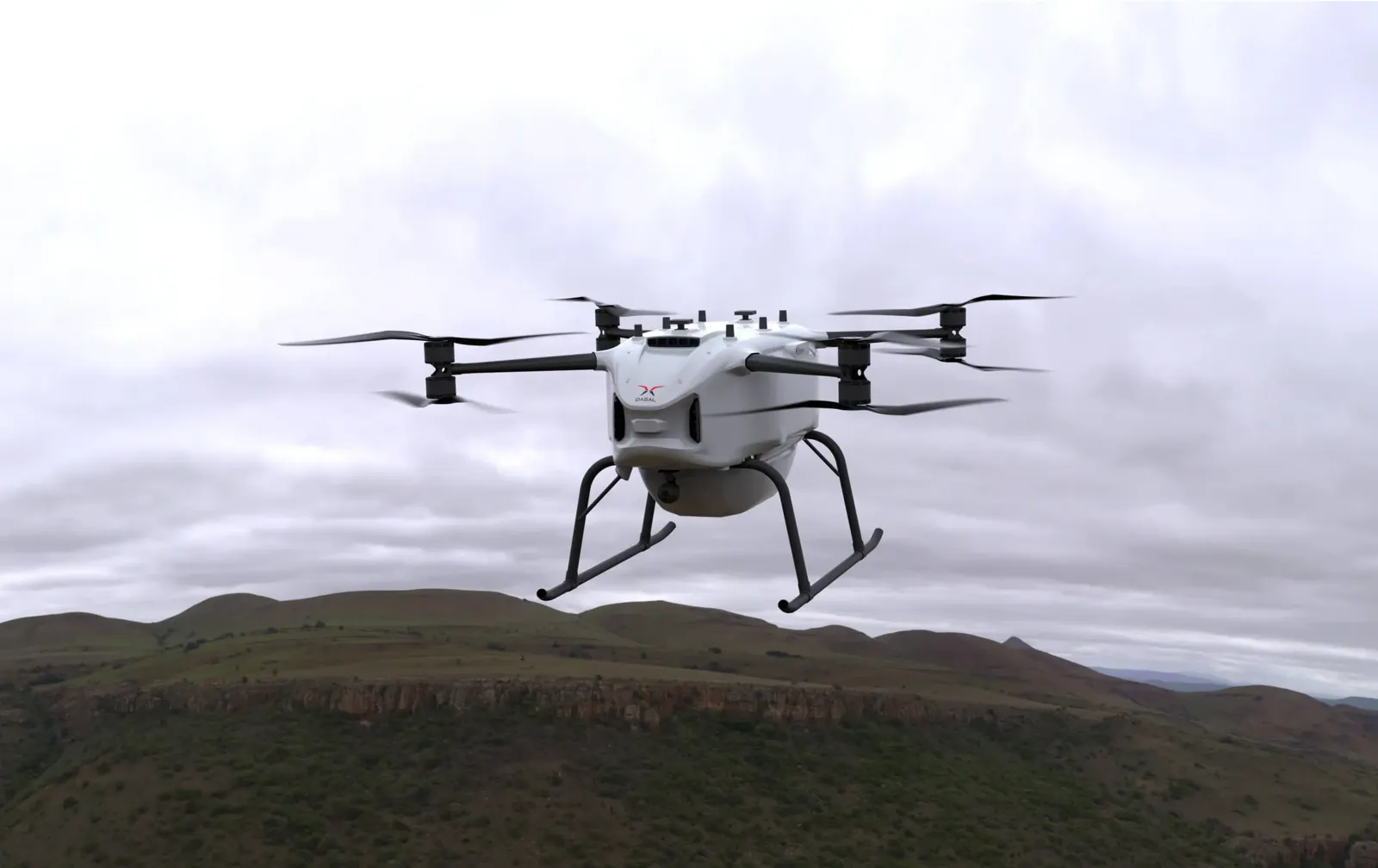
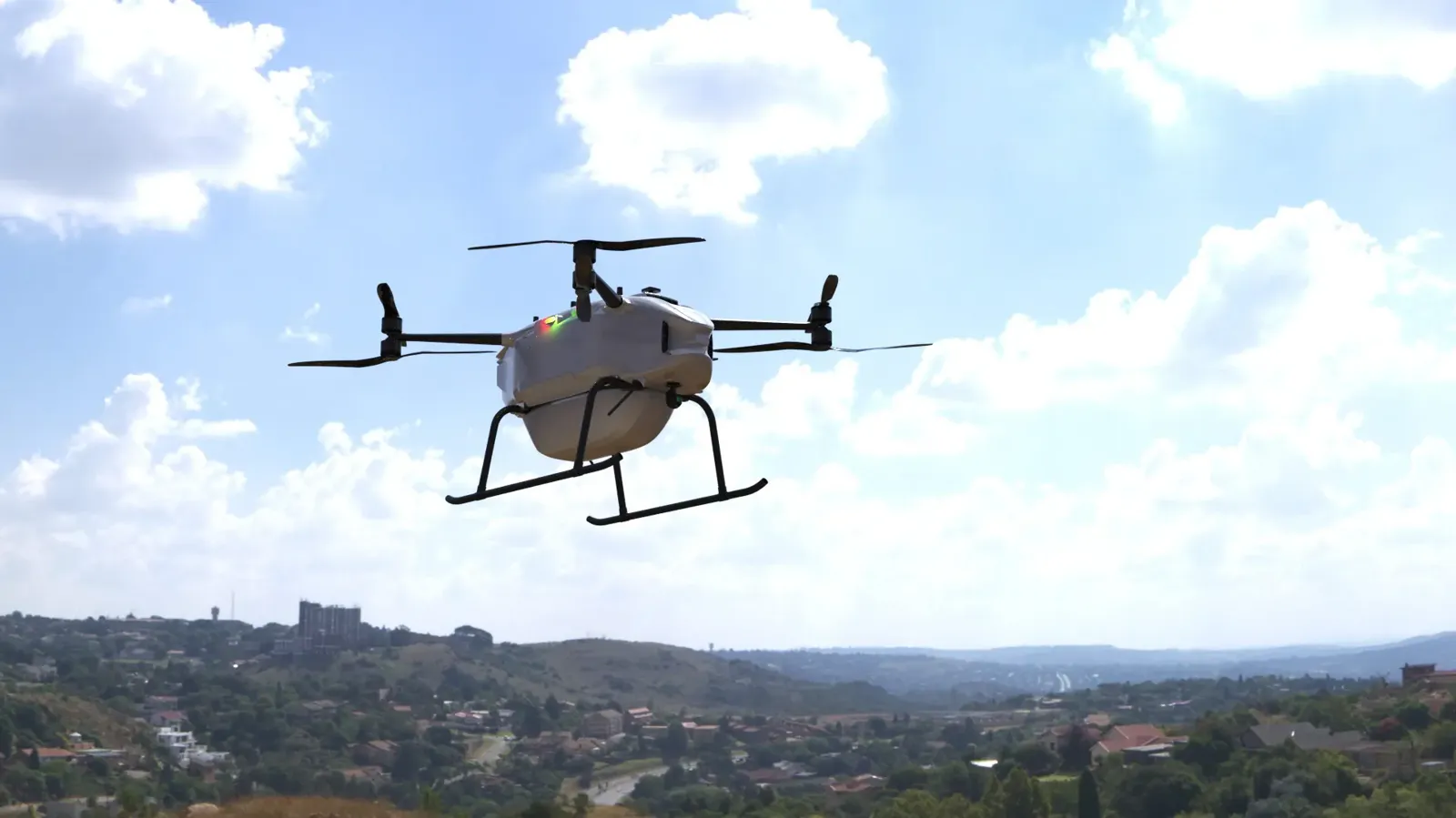
Getting water, batteries and ammunition up to a hilltop observation post has traditionally meant a mule, a soldier’s back or a utility helicopter. PUHU-C75, a rotary-wing cargo drone built by DASAL Havacılık Teknolojileri, a wholly owned subsidiary of Borsa Istanbul-listed Altınay Savunma, adds a fourth option: 75 kg lifted vertically, flown up to 10 km and set down without a runway or a pilot on board. This explainer sets out what the published figures mean, where the aircraft is used and what has not been disclosed.
What PUHU-C75 is for: the last kilometre of tactical logistics
In military logistics the most expensive distance is often the shortest one. Lorries can reach a battalion headquarters; the final stretch to a ridge-line position is where supply slows down. PUHU-C75 is designed for that gap. It is not a replacement for helicopters but for the many small, frequent deliveries that are not worth risking a crewed aircraft on. Seventy-five kilograms roughly matches a daily package of water, rations, batteries, ammunition and medical items for a small infantry team.
Because it takes off and lands vertically, the drone needs no prepared strip: a patch of level ground, a mountain slope or a ship’s deck is enough. The price is reach. With 40 minutes of flight and a 10 km operation distance, PUHU-C75 is a tactical tool that works inside a battalion’s area, not a long-haul freighter. DASAL itself is profiled in our DASAL and TAAC file.
How much can it carry? Payload versus take-off weight
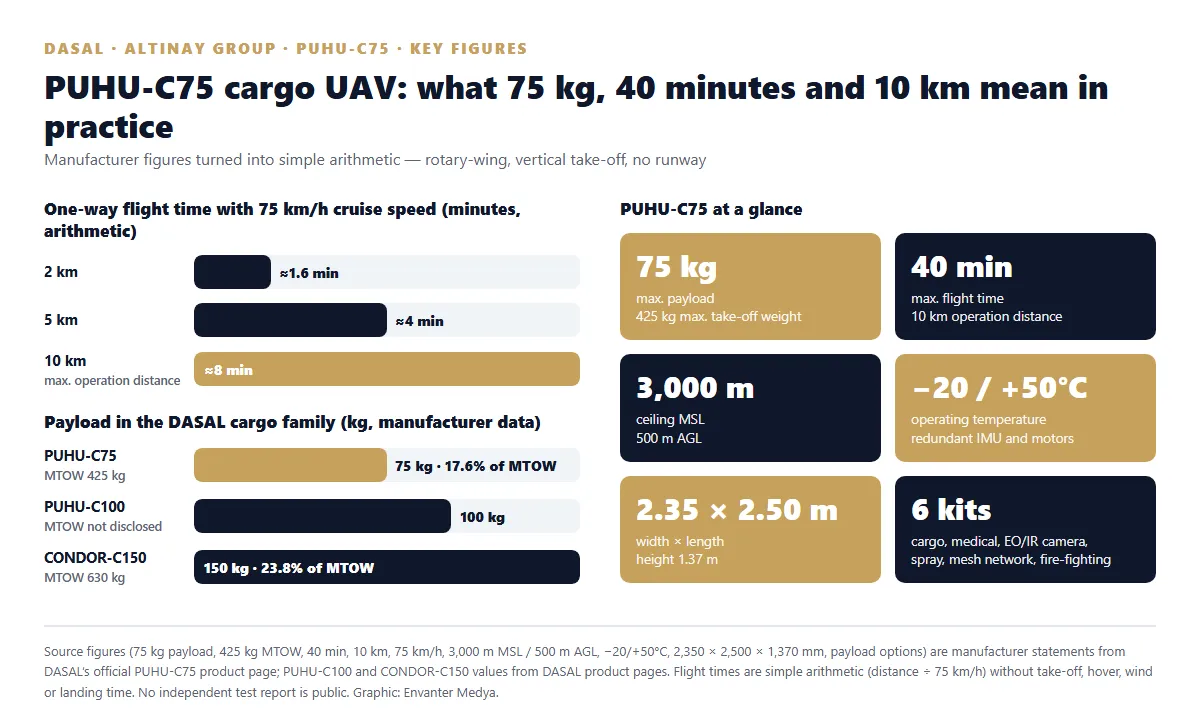
Two numbers are often confused in reporting on the PUHU family: 75 and 425. The first is payload; the second is maximum take-off weight, the sum of airframe, batteries and cargo. Payload is therefore about 17.6% of MTOW. The larger CONDOR-C150 lifts 150 kg at a 630 kg MTOW, or about 23.8%. For electric multirotors of this size, batteries take a large share of the weight, which is why the ratio stays in this range.
Simple arithmetic shows what the speed figure means: at 75 km/h the aircraft covers 2 km in about 1.6 minutes, 5 km in about 4 minutes and the full 10 km in about 8 minutes. These are cruise-only values without take-off, hover, wind or landing time. The graphic below summarises them.
Technical specifications
All values come from DASAL’s official product page. No independent test report has been published.
| Parameter | Value |
|---|---|
| Max. payload | 75 kg |
| Max. take-off weight (MTOW) | 425 kg |
| Max. flight time | 40 min |
| Max. operation distance | 10 km |
| Horizontal speed | 75 km/h |
| Ceiling | 3,000 m MSL / 500 m AGL |
| Operating temperature | −20 °C to +50 °C |
| Dimensions (W × L × H) | 2,350 × 2,500 × 1,370 mm |
| Redundancy | Redundant IMU and motors |
| Mission kits | Cargo module, medical module, 3-axis 30x EO/IR camera, agricultural spray, mesh network module, fire-fighting ball and extinguisher rocket launcher |
PUHU-C75, PUHU-C100 and CONDOR-C150 compared
DASAL presents its cargo drones as steps in one family rather than rivals. PUHU-C100, unveiled at IDEF 2025, raises payload to 100 kg and speed to 90 km/h and extends one-way range beyond 30 km. Its standout feature is an autonomous hook unit that can release cargo at the destination without landing; this was shown in an autonomous resupply demonstration at EFES-2026 in front of delegations from around 50 countries.
| Model | Payload | MTOW | Endurance | Distance | Speed | Status |
|---|---|---|---|---|---|---|
| PUHU-C75 | 75 kg | 425 kg | 40 min | 10 km | 75 km/h | Delivered to Turkish forces; used in exercises |
| PUHU-C100 | 100 kg | Not disclosed | Not disclosed | 30 km+ one-way / 15 km+ round trip | 90 km/h | Launched at IDEF 2025; EFES-2026 demonstration |
| CONDOR-C150 | 150 kg | 630 kg | 30 min | 20 km | 75 km/h | On product list; first flight 2021 |
Who uses it: delivery to Turkish forces and exercises
DASAL has announced that PUHU-C75 was delivered to the Turkish Armed Forces; the quantity has not been made public. The aircraft was shown to the Land Forces Commander and foreign delegations during the Erciyes 2025 air assault exercise and took part in EFES-2024 and EFES-2026. That moves the system out of the prototype category and into the “in inventory, limited numbers” category. Envanter Medya describes exercise use as exactly that, and does not label it combat-proven until operational use is announced.
On 8 May 2026, at the SAHA 2026 exhibition, DASAL signed a framework supply, local assembly and conditional technology cooperation agreement with Nigeria-based NIGUS International Investment. Altınay notified it to Borsa Istanbul’s disclosure platform the same day. The scope includes 100,000 MİKON loitering drones, 200 FALCON R556 armed drones and 100 PUHU cargo UAV systems. Contract value and delivery schedule were not disclosed, so the correct status is a framework, not a confirmed order. Altınay’s wider foreign activity is covered in our exports file.
Civil roles: wildfire, disaster relief and agriculture
The least expected line on the product page is fire-fighting. Fitted with a fire-extinguishing ball and an extinguisher rocket launcher, PUHU-C75 can act as a first-response platform for wildfires in the minutes before a fire-fighting helicopter is airborne. The same logic applies after an earthquake: a village cut off by road can receive 75 kg of water and medicine within the 10 km radius in about eight minutes.
Agricultural spraying, a medical-equipment module and a mesh network relay are also listed. Dual civil and military use is part of the Altınay group’s stated strategy, also visible in sensor products such as the Venüs-4 gimbal.
Why it matters for Turkey
Few companies worldwide build electric cargo drones in the 50 to 150 kg class, and many of them are in the United States and China. DASAL’s position is that of a domestic producer with a national user, exercise history and a family that scales from 75 to 150 kg. For the Turkish defence industry this means a locally designed answer to a real logistics need, without dependence on foreign export approvals. DASAL, founded in 2019, has been a 100% Altınay subsidiary since 2024 and develops eight product families at its 10,000 m² facility in Pendik, Istanbul.
| DASAL PUHU-C75 — Fact Box | |
|---|---|
| Product | PUHU-C75 rotary-wing cargo UAV |
| Manufacturer | DASAL Havacılık Teknolojileri (100% Altınay Savunma subsidiary, ALTNY) |
| Class | Electric multirotor, vertical take-off and landing |
| Key figures | 75 kg payload, 425 kg MTOW, 40 min, 10 km, 75 km/h |
| Environment | 3,000 m MSL, −20/+50 °C, redundant IMU and motors |
| Users | Turkish Armed Forces (quantity not disclosed) |
| Export status | Nigeria framework includes 100 PUHU systems; no confirmed order announced |
Frequently Asked Questions
How much can PUHU-C75 carry?
Its maximum payload is 75 kg. Maximum take-off weight, including airframe and batteries, is 425 kg.
What is its range and endurance?
According to DASAL, up to 40 minutes of flight and a 10 km operation distance, at a horizontal speed of 75 km/h.
Does it need a runway?
No. It takes off and lands vertically and can operate from rough ground, slopes or a ship’s deck.
What is the difference between PUHU-C75 and PUHU-C100?
C100 is newer and larger: 100 kg payload, 90 km/h and more than 30 km one-way range, with an autonomous hook that drops cargo without landing.
Is PUHU-C75 used by the Turkish Armed Forces?
Yes. DASAL announced its delivery to Turkish forces; it took part in Erciyes 2025 and EFES exercises. The number delivered has not been disclosed.
Has PUHU been exported?
No confirmed export sale has been announced. The May 2026 framework agreement with Nigeria’s NIGUS includes 100 PUHU cargo UAV systems, but it is a framework, not an order.
Can it fight fires?
DASAL lists a fire-extinguishing ball and an extinguisher rocket launcher kit for early response to wildfires, alongside search-and-rescue and transport roles.
Where does the name come from?
Puhu is the Turkish name for the Eurasian eagle-owl. It is unrelated to ASELSAN’s PUHU electronic support pod.
Sources
- DASAL Havacılık Teknolojileri — PUHU C75 official product page (dasal.com.tr/tr/urunler/puhu-c75)
- DASAL — PUHU C100 official product page and IDEF 2025 launch release (dasal.com.tr)
- DASAL — CONDOR C150 official product page (dasal.com.tr)
- TURDEF — “DASAL Delivers PUHU C75 Cargo Drone to Turkish Forces”
- Altınay Savunma — KAP (Public Disclosure Platform) notice on the DASAL–NIGUS framework agreement, 8 May 2026
- Anadolu Agency — EFES-2026 exercise coverage, May 2026
- Envanter Medya — Altınay and DASAL archive