Missile Defense Agency Opens the Door on FBR-Next, a Mobile Hypersonic Tracking Radar

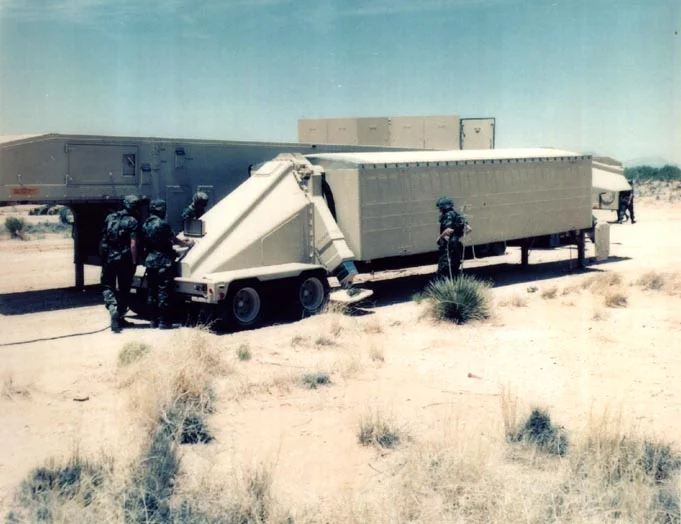
The US Missile Defense Agency has begun preparing the replacement for its forward-deployed radar fleet. Through the Mobile Land-Based Sensors Project Office, the agency posted a pre-solicitation notice on the federal contracting portal sam.gov for a programme called Forward-Based Mode Radar Next, or FBR-Next.
What the agency is asking for
The notice describes a sensor that would “provide early warning, tracking, and discrimination of emerging missile threats” while remaining “highly mobile and rapidly deployable.” Those two requirements pull in opposite directions and define the engineering problem: the radar must approach the sensitivity of a fixed installation while fitting into transportable modules that can be set up in hours.
Discrimination is the harder half of the requirement. Separating a live warhead from spent stages, decoys and debris has always been the central technical challenge of ballistic missile defence. Manoeuvring hypersonic glide vehicles make it worse, because the track itself stops being predictable.
The gap being filled
Today the forward-based mission rests largely on the AN/TPY-2. The X-band radar serves both as the fire-control sensor for THAAD batteries and, in forward-based mode, as a standalone early warning asset. Known deployment sites include Kürecik in Türkiye, Shariki and Kyogamisaki in Japan, and Nevatim in Israel.
That radar was optimised for the ballistic threat profile of an earlier period. The Long Range Discrimination Radar in Alaska and Navy work on Aegis-based hypersonic tracking have strengthened other layers of the architecture; FBR-Next addresses obsolescence in the mobile layer.
Why forward basing still matters
Hypersonic weapons are difficult to counter less because of raw speed than because they fly low and manoeuvre inside the atmosphere, which delays detection until they cross the radar horizon. Pushing the sensor geographically closer to the launch area recovers minutes of decision time that a rear-area radar simply cannot provide.
Alliance implications
FBR-Next has direct consequences for NATO’s missile defence architecture, which depends on forward-deployed sensor data, and Türkiye occupies one of its most geographically significant nodes. A new mobile radar entering service would eventually reshape how sensor coverage is divided among allies.
Read alongside the Golden Dome space-based interceptor effort and DARPA’s recent call for a next-generation hypersonic cruise missile, the notice fits a pattern: Washington is expanding its offensive and defensive hypersonic portfolios at the same time.
Sources
- US Missile Defense Agency pre-solicitation notice, sam.gov, 13 August 2026
- The Defense Post, 13 August 2026