How the US Foreign Military Sales Process Works

Foreign Military Sales, or FMS, is the U.S. government’s program for transferring defense articles, services and training to international partners and international organizations. It is not a commercial storefront, and it is not the same thing as a company selling a weapon directly to a foreign buyer.
The official Foreign Military Sales FAQ published by the Defense Security Cooperation Agency, which administers the program for the Department of Defense, is the baseline for this explainer. Where Congress becomes involved, the same FAQ points to the Arms Export Control Act.
What FMS is, and who may use it
Under FMS, the U.S. government uses the Defense Department’s acquisition system to procure defense articles and services on behalf of a partner. Eligible countries may pay with their own funds or with funds provided through U.S. government-sponsored assistance programs. In certain cases, the FAQ states, defense articles may also be obtained through grants or leases.
The president designates countries and international organizations eligible to participate. The Department of State approves individual programs case by case. DSCA says some 189 countries and international organizations currently participate. The program, according to the same official FAQ, is funded by administrative charges to foreign purchasers and is operated at no cost to U.S. taxpayers — that is DSCA’s official description of how the administrative account is funded, not a claim about the broader U.S. defense budget.
How a case is built: from request to LOA
A partner typically begins with a Letter of Request. The implementing U.S. agency then develops a Letter of Offer and Acceptance, the government-to-government agreement that identifies the articles and services the United States proposes to sell. Official customer-guide material describes three basic types of FMS cases:
- Defined Order — articles or services specified in the request and stated explicitly in the LOA, typically used for major end items and weapon-system sales.
- Blanket Order — a category of items or services up to a dollar ceiling, without a definitive list of exact quantities, often used for follow-on spare and repair parts.
- Cooperative Logistics Supply Support Arrangement (CLSSA) — an arrangement that lets a partner draw frequently used parts from U.S. stocks based on demand rates, using two related FMS cases.
DSCA’s official customer guide also publishes anticipated-offer-date standards measured from receipt of a valid letter of request: 45 days for blanket-order, CLSSA and training LOAs; 100 days for defined-order LOAs and associated amendments and modifications; and 150 days for defined-order cases treated as “purchaser-unique,” such as a first-time purchase of a given article. Those are official processing standards, not a promise that every case will close on that calendar.
FMS is not the only path: Direct Commercial Sales
Partners may also obtain U.S. defense articles and services through Direct Commercial Sales, or DCS. Under DCS, U.S. companies obtain commercial export licenses from the Department of State and negotiate directly with the partner. The official FAQ is explicit that FMS and DCS are not in competition, and that unless an item has been designated “FMS only,” the Defense Department is generally neutral as to which path a purchaser uses. If a purchaser asks for FMS data after soliciting contractor bids, it must show that commercial acquisition efforts have ceased before FMS data will be provided.
The FAQ also warns that cost comparisons between FMS and DCS are often not possible because the contracts are not identical. FMS uses a “total package approach,” which means a major-system buy includes training, spare parts and other support for the first few years. A DCS contract may or may not include that support in the initial price.
When Congress is notified
Section 36 of the Arms Export Control Act requires congressional notification when a proposed FMS or DCS sale is expected to meet or exceed official thresholds. For NATO members, South Korea, Australia, Japan, Israel and New Zealand, those thresholds are major defense equipment of $25 million or more, any defense articles or services of $100 million or more, or design and construction services of $300 million or more, with a 15-day statutory notification period. For all other countries, the thresholds are $14 million, $50 million and $200 million, respectively, with a 30-day statutory period.
A congressional notification is not, by itself, a completed sale. It is a statutory step that may precede a letter of offer. Reporting a notification as if the aircraft or ship had already been delivered is a common error and should be avoided.
Nonrecurring costs
The official FAQ explains nonrecurring costs as one-time research, development or production costs already incurred on certain major defense equipment for U.S. forces — “sunk costs.” The Arms Export Control Act requires the Defense Department to recover those costs on some FMS sales of major defense equipment, unless they are waived under specified conditions, such as advancing standardization with NATO or certain treaty allies, avoiding the loss of a sale, or reducing the unit cost of the same item being bought by the United States. A waived charge is not the same thing as a free system.
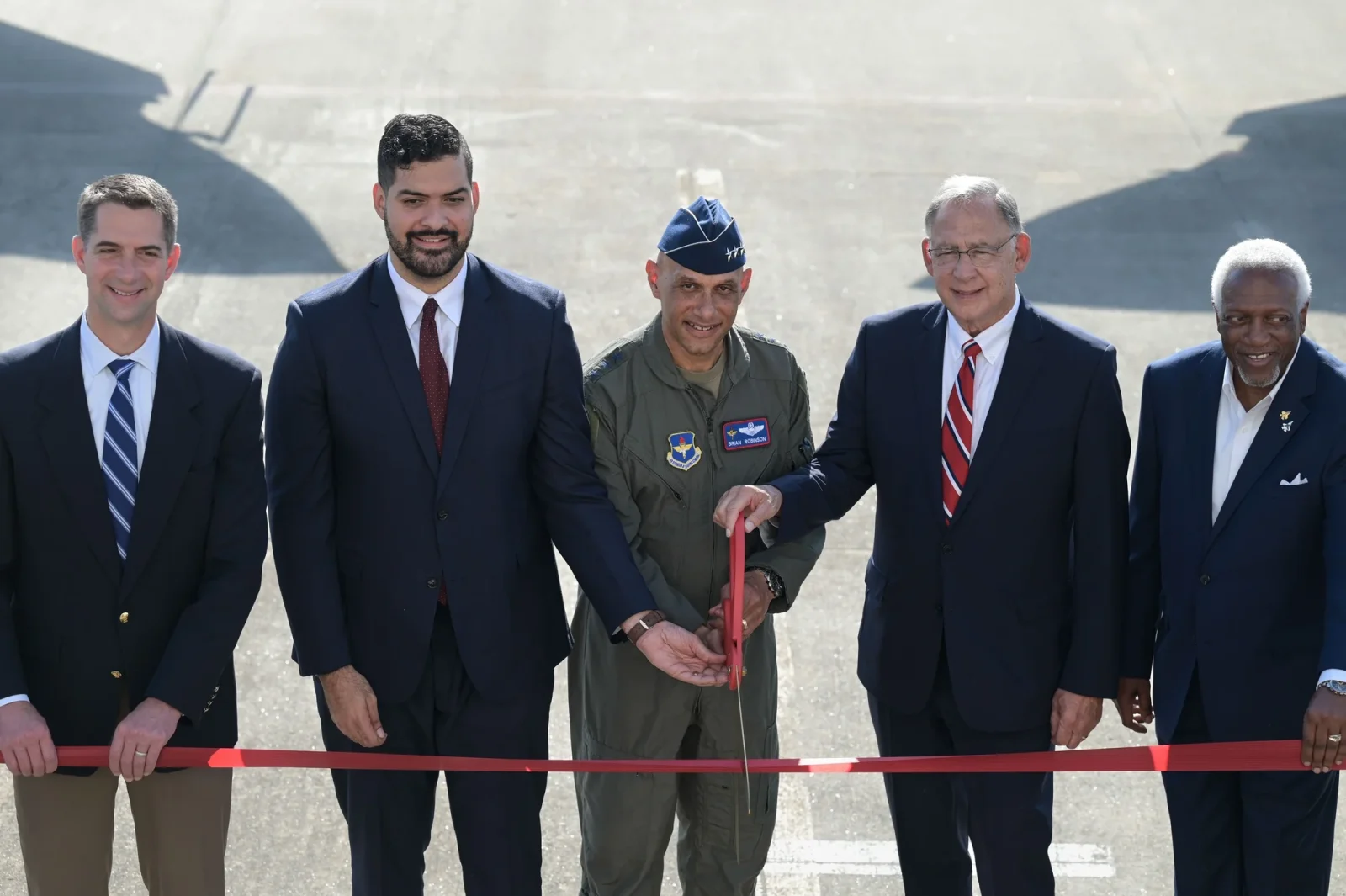
Featured image: U.S. Air Force photograph by Senior Airman Abigail Duell, via DVIDS, public domain. Ribbon-cutting for Foreign Military Sales training and support facilities at Ebbing Air National Guard Base, Arkansas, Sept. 20, 2024. VIRIN 240920-F-BB093-1268. No Turkish text (visually checked before scheduling).
Sources
- Defense Security Cooperation Agency, “Foreign Military Sales FAQ,” https://www.dsca.mil/Resources/Foreign-Military-Sales-FAQ
- DSCA, “The Letter of Offer and Acceptance (LOA),” official customer guide, https://www.dsca.mil/foreign-customer-guide/letter-offer-and-acceptance-loa
- DSCA, “Foreign Military Sales (FMS)” program page, https://www.dsca.mil/Programs/Defense-Trade-and-Arms-Transfers/Foreign-Military-Sales