CAKIR vs NSM: Turkish and Norwegian strike missiles compared

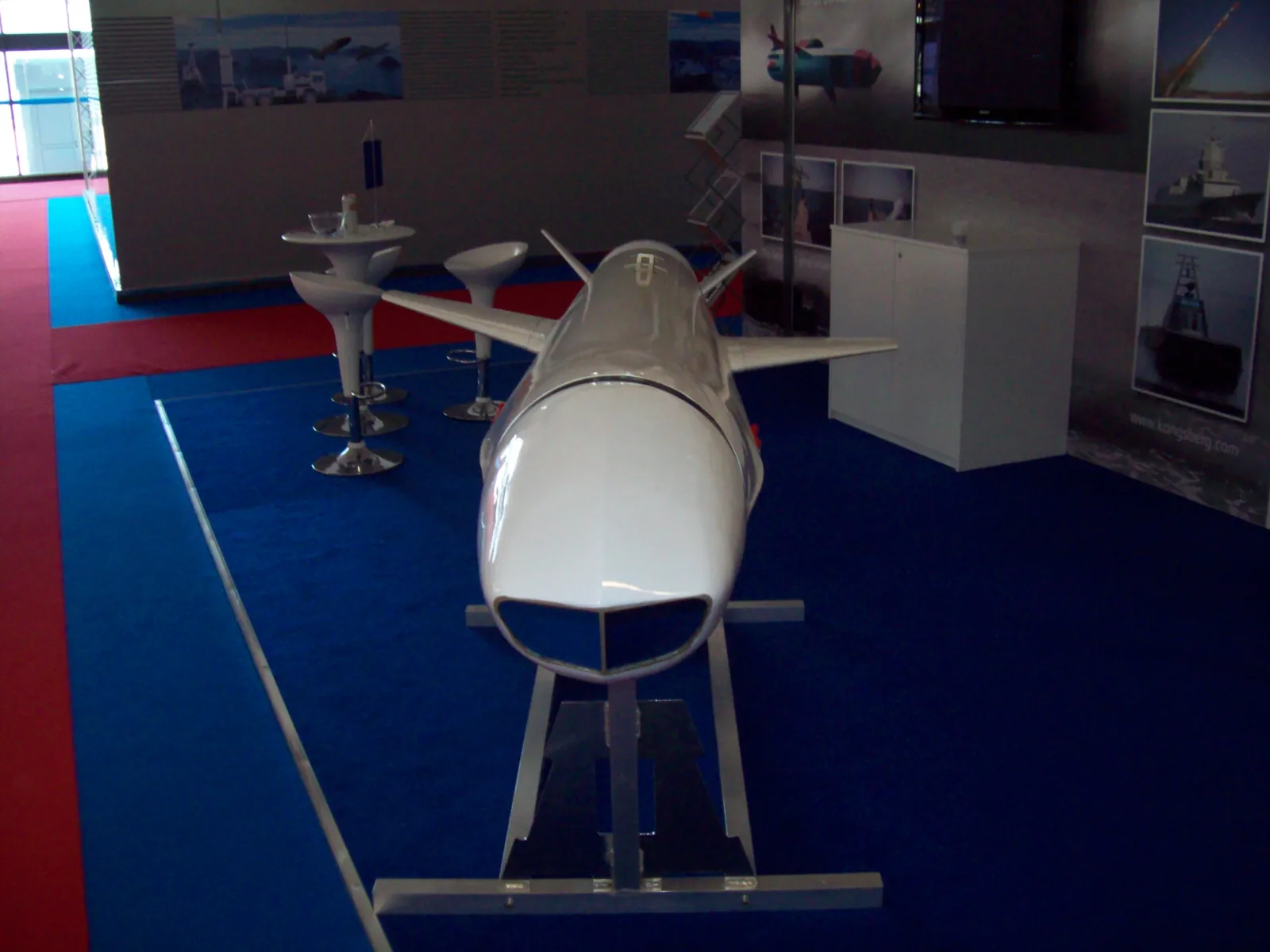
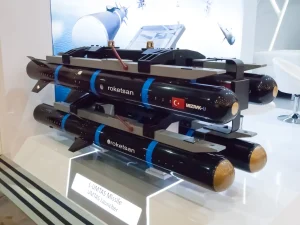
CAKIR (ROKETSAN, Türkiye) and the NSM — Naval Strike Missile (Kongsberg, Norway) are two of the most discussed subsonic strike missiles in modern naval warfare. The NSM sits in the medium class with a 185+ km range and a ~125 kg warhead, while CAKIR is a compact-class weapon with 150+ km range and a ~70 kg warhead. This article compares both on open-source data, stating the class difference honestly.
| CAKIR and NSM — At a Glance | |
|---|---|
| CAKIR — developer | ROKETSAN (Türkiye), serial production announced 9 July 2024 |
| NSM — developer | Kongsberg Defence & Aerospace (Norway), in service since 2012 |
| CAKIR — class | Compact multi-platform cruise missile (land/sea/air) |
| NSM — class | Medium-class anti-ship / naval strike missile |
| CAKIR — range | 150+ km (surface), 175+ km (air-launched, sources vary) |
| NSM — range | 185+ km (some sources cite over 200 km) |
| CAKIR — warhead | ~70 kg (fragmentation / semi-armour-piercing / thermobaric options) |
| NSM — warhead | ~125 kg HE blast-fragmentation with programmable fuze |
| Common ground | Subsonic speed, turbojet propulsion, sea-skimming flight, IIR seeker |
What are CAKIR and NSM?
CAKIR is a compact, multi-platform cruise missile family developed by Türkiye’s ROKETSAN. Unveiled on 31 March 2022, it entered serial production per an announcement of 9 July 2024. It is designed to be fired from land vehicles, naval platforms and aircraft, with integration on the Bayraktar Akıncı unmanned aircraft planned. The surface-launched version has a stated range of 150+ km; some sources credit the air-launched version with 175+ km. Propulsion comes from the indigenous Kale KTJ-1750 turbojet, with a solid-fuel booster added on surface-launched rounds.
The NSM (Naval Strike Missile) is an anti-ship and naval strike missile developed by Norway’s Kongsberg Defence & Aerospace. In service with the Royal Norwegian Navy since 2012, it has since been adopted by a long list of NATO and allied users, including the US Navy and US Marine Corps. Open sources give its range as 185+ km, its launch weight as roughly 407 kg and its warhead as about 125 kg. Its composite airframe and fully passive terminal guidance — an imaging infrared seeker with autonomous target recognition — give it a low-observable attack profile.
Both missiles are subsonic, approach their targets in a sea-skimming profile and rely on turbojet propulsion. They nonetheless belong to different weight classes, and any comparison has to keep that distinction in view.
The class difference: compact versus medium
An honest comparison starts by acknowledging the class gap. The NSM is the larger and heavier weapon: roughly 407 kg at launch against CAKIR’s ~275-350 kg, and a ~125 kg warhead against ~70 kg. That translates into greater single-shot destructive potential against larger combatants such as frigates and above.
CAKIR’s design philosophy is different: compactness and multi-platform commonality. Its lighter airframe allows integration on fast attack craft, land vehicles and, notably, unmanned aerial vehicles — and using one munition across three services simplifies logistics. The two missiles are therefore less direct rivals than solutions from adjacent classes with partially overlapping missions; in open sources CAKIR is most often grouped with the MBDA Marte series and Kongsberg’s own air-launched JSM.
The table below compares the two missiles using official manufacturer data and open sources. NSM figures draw on Kongsberg and US Navy material, CAKIR figures on ROKETSAN statements; approximate values are marked with a tilde (~).
Guidance and warhead: two approaches
Both weapons navigate on INS+GPS and close on their targets with an imaging infrared (IIR) seeker — a passive approach that is resistant to radar jamming. The NSM’s signature feature is the combination of that seeker with autonomous target recognition and an entirely passive terminal phase: the missile emits no radar signal on its attack run, which complicates detection and countermeasures. CAKIR counters with flexibility — depending on configuration it can carry an RF seeker instead of IIR, offering an alternative for different target sets and weather conditions.
On warheads, the NSM’s ~125 kg HE blast-fragmentation charge works with a programmable fuze. CAKIR’s ~70 kg warhead comes in fragmentation, semi-armour-piercing and thermobaric options, reflecting a multi-role design intended for land targets as well as ships. Against major surface combatants the NSM’s heavier warhead is the advantage; where light launch platforms and multi-role use matter, CAKIR’s compact warhead trades weight for versatility.
Platforms, users and maturity
The NSM’s strongest card is its proven user base. After Norway came Poland’s coastal defence squadrons, the US Navy’s littoral combat ships and Constellation-class frigates, the US Marine Corps’ unmanned NMESIS launcher, and orders or selections from Malaysia, Romania, Germany, Canada, Australia and others. More than a decade in service brings integration and logistics maturity that no newcomer can claim.
CAKIR is at the opposite end of its life cycle: serial production was announced in 2024 and its first user is the Turkish Armed Forces. Its export status has not been officially announced; so far the missile has featured mainly at international defence exhibitions. On the other hand, CAKIR aims to cover land, naval, air and UAV launch within a single family — a breadth the NSM ecosystem achieves only with two separate products (NSM for ships and coastal batteries, JSM for aircraft).
Verdict: which one comes out ahead?
The data describes two answers to two different requirements. A user seeking longer range, a heavier warhead and a proven NATO service record will find the NSM the more mature choice today. A user needing a multi-role missile that light platforms and UAVs can carry, likely at a lower cost class, will find CAKIR’s compact approach compelling. For Türkiye, CAKIR’s real value lies in its indigenous turbojet and guidance chain, delivering a capability across three services free of export-licence dependency. A definitive performance verdict will have to wait until operational data on CAKIR accumulates.
This comparison relies on open-source data. Several CAKIR figures (exact range brackets, CEP, cost) have not been officially disclosed; NSM figures are compiled from Kongsberg and US Navy material and may vary by variant. The two missiles belong to different weight classes — the table does not claim one-to-one equivalence.
Frequently Asked Questions
Which has the longer range, CAKIR or NSM?
Open sources credit the NSM with 185+ km, ahead of CAKIR’s 150+ km in the surface-launched version and 175+ km air-launched according to some sources.
Are CAKIR and NSM in the same class?
No. The NSM is a medium-class anti-ship missile of about 407 kg launch weight; CAKIR is a compact-class weapon of roughly 275-350 kg. CAKIR’s closer peers are the MBDA Marte series and the JSM.
Which missile carries the bigger warhead?
The NSM carries a warhead of about 125 kg versus roughly 70 kg for CAKIR. CAKIR offsets this with fragmentation, semi-armour-piercing and thermobaric warhead options.
How do the guidance systems differ?
Both use INS+GPS and a terminal IIR seeker. The NSM adds autonomous target recognition and a fully passive attack profile; CAKIR offers an RF seeker option in place of IIR depending on configuration.
Who operates the NSM?
Norway has fielded it since 2012; Poland, the United States (Navy and Marine Corps), Malaysia, Romania, Germany, Canada and Australia are among the countries that have adopted or ordered it.
Has CAKIR been exported?
No export contract for CAKIR has been officially announced. The missile is newly entering Turkish service and has so far been promoted at international defence exhibitions.
Sources
- ROKETSAN official — roketsan.com.tr
- Kongsberg Defence & Aerospace official — kongsberg.com (Naval Strike Missile)
- US Navy and US Marine Corps (NMESIS) open-source releases
- Naval News, Janes and other open-source defence publications
- ROKETSAN serial production announcement for CAKIR (9 July 2024)