What Is ROKETSAN? Turkey’s Missile Maker Explained


ROKETSAN is Turkey’s leading missile and rocket manufacturer, founded on 14 June 1988 in Ankara. Owned mainly by the Turkish Armed Forces Foundation, it designs and builds anti-ship missiles, air-defence systems, ballistic missiles, anti-tank weapons and precision munitions. It ranked 71st on the Defense News Top 100 in 2025.
| ROKETSAN — At a Glance | |
|---|---|
| Full name | ROKETSAN Roket Sanayii ve Ticaret A.Ş. |
| Founded | 14 June 1988, Ankara |
| Headquarters | Ankara (Elmadağ; Lalahan, Kırıkkale) |
| CEO/GM | Murat İkinci |
| Core business | Missiles, rockets, air defence, munitions |
| Employees | ~5,000 (~2,000 in R&D) |
| Ownership | TSKGV foundation — not publicly traded |
| 2024 defence revenue | ~$1.55B (Defense News 2025) |
What is ROKETSAN?
ROKETSAN (Roket Sanayii ve Ticaret A.Ş.) is a Turkish defence company that develops and manufactures missiles and rockets. It was established on 14 June 1988 in Ankara following a decision by Turkey’s Defence Industry Executive Committee, with the specific aim of creating the country’s first indigenous designer, developer and producer of rocket and missile systems.
For much of the 20th century Turkey relied heavily on imported munitions and foreign licences, which left its armed forces exposed to supplier restrictions and export embargoes. ROKETSAN was set up to close that gap by building a national capability to conceive, engineer and mass-produce guided weapons at home. Over more than three decades the company has grown from a single-purpose rocket producer into one of the anchors of the national defence-industrial base, with in-house expertise in solid- and liquid-propellant propulsion, seeker and guidance electronics, warhead design and system integration.
The company is controlled by the Turkish Armed Forces Foundation (TSKGV), a state-linked foundation created to strengthen the country’s military capacity. Because of that structure ROKETSAN is state-linked rather than a conventional private business, and it is not listed on any stock exchange — it has no publicly traded shares that ordinary investors can buy. Its headquarters are in Ankara, and its principal production and test activities are concentrated at the Elmadağ campus east of the capital.
What does ROKETSAN do?
ROKETSAN operates across almost every category of tactical and strategic missile technology. Its work spans concept design, propulsion, guidance, warhead integration, environmental and flight testing, and serial production, and it derives essentially all of its revenue from defence sales rather than any civilian line of business. The company both equips the Turkish military and exports to a widening list of international customers. Its main product families include:
- Anti-ship and cruise missiles — the ATMACA anti-ship missile, its Land ATMACA variant and the ÇAKIR cruise missile.
- Ballistic missiles — TAYFUN, BORA, CENK and the earlier J-600T Yıldırım.
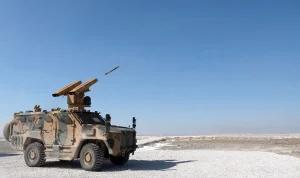
- Air-defence systems — the HİSAR family (short- to medium-range), the long-range SİPER, the SUNGUR man-portable air-defence system (MANPADS) and the naval LEVENT.
- Anti-tank guided missiles — the long-range UMTAS, medium-range OMTAS and the shoulder-launched KARAOK.
- Guided rockets — CİRİT (2.75-inch laser-guided), the TRG-122, TRG-230 and laser-guided TRLG-230, and the TRG-300 KAPLAN.
- Precision munitions and other systems — the MAM family of smart micro-munitions widely used on armed drones, the AKYA heavy torpedo and the ALKA directed-energy weapon.
Beyond finished weapons, ROKETSAN also invests in enabling technologies such as composite structures, advanced propulsion and space applications, including sounding rockets and micro-satellite launch research. Exact ranges and performance figures for many of these systems are not officially disclosed, and where public sources conflict this article treats such values as undisclosed.
ROKETSAN is a private joint-stock company whose controlling shareholder is a state foundation, so it does not publish market-facing quarterly results the way a listed firm would. The figures below draw on the Defense News Top 100 ranking and public statements by the company’s management, and they should be read as indicative rather than audited annual accounts.

ROKETSAN exports
Exports have become central to ROKETSAN’s strategy. Management has said it wants export revenue to rise above 50% of total turnover in the medium term, a target that reflects both commercial ambition and the political logic of building long-term partnerships abroad. The company’s growing order book — reported at around $10 billion once new contracts are counted — is increasingly driven by international demand rather than domestic procurement alone.
The ATMACA anti-ship missile, HİSAR air-defence systems and CİRİT guided rockets are among the products most frequently cited in export discussions, and ROKETSAN’s precision munitions have gained visibility through their integration onto widely exported Turkish drones. To support this expansion, ROKETSAN is opening new facilities at Lalahan (missile integration) and Kırıkkale (propellant production), scheduled for April 2026. The combined investment exceeds $1 billion and is intended to raise the company’s missile-production capacity by roughly fivefold, easing a key bottleneck as order volumes climb. Turkish officials have repeatedly framed missile exports as an instrument of foreign policy as well as trade, and ROKETSAN’s expanding footprint in the Middle East, Asia and beyond reflects that dual role.
Place in Turkey’s defence industry
ROKETSAN sits alongside ASELSAN and Turkish Aerospace Industries (TUSAŞ/TAI) at the top of Turkey’s defence sector. In the 2025 Defense News Top 100, five Turkish companies made the list: ASELSAN (43rd), TUSAŞ/TAI (47th), ROKETSAN (71st), ASFAT (78th) and MKE (80th). ROKETSAN’s defence revenue of about $1.55 billion for 2024 held it at the same rank as the prior year, underscoring the sector’s steady rise in the global rankings.
Because ASELSAN and MKE are themselves shareholders in ROKETSAN, the company is tightly woven into Turkey’s defence-industrial network rather than competing with it. It supplies the missiles and rockets that arm platforms built by other Turkish firms — from naval vessels and land vehicles to armed drones — which makes it a critical node in the country’s broader push toward defence self-sufficiency. That integrated model, combining state backing, cross-shareholdings and heavy reinvestment in research and development, is a large part of why ROKETSAN has been able to field a portfolio spanning short-range guided rockets all the way up to long-range ballistic missiles within a single organisation.
The 2025 turnover figure ($2B+) is based on a statement by the general manager and will be updated when audited annual results are published. Certain product specifications, such as exact ranges, are not officially disclosed and are described as such throughout this article.
Frequently Asked Questions
What does ROKETSAN do?
ROKETSAN designs, develops and manufactures missiles and rockets for the Turkish military and export customers. Its portfolio covers anti-ship and cruise missiles, ballistic missiles, air-defence systems, anti-tank guided missiles, guided rockets and precision munitions.
Is ROKETSAN state-owned?
ROKETSAN is controlled by the Turkish Armed Forces Foundation (TSKGV), a state-linked foundation that holds 55% of its shares. It is not directly a government ministry, but it is state-linked and is not publicly traded.
Who owns ROKETSAN?
Its shareholders are the Turkish Armed Forces Foundation (55%), ASELSAN (15%), MKE (15%), VakıfBank (10%) and other holders (5%). It has no shares listed on any stock exchange.
When was ROKETSAN founded?
ROKETSAN was founded on 14 June 1988 in Ankara, following a decision by Turkey’s Defence Industry Executive Committee to create the country’s first indigenous missile and rocket producer. The move was part of a broader national effort in the late 1980s to reduce dependence on imported weapons and build a self-sufficient defence-industrial base.
Where is ROKETSAN headquartered?
ROKETSAN is headquartered in Ankara, Turkey. Its main production and test facilities are at Elmadağ, with additional plants at Lalahan and Kırıkkale.
What are ROKETSAN’s main products?
Flagship products include the ATMACA anti-ship missile, the ÇAKIR cruise missile, HİSAR and SİPER air-defence systems, the TAYFUN and BORA ballistic missiles, UMTAS and OMTAS anti-tank guided missiles, CİRİT guided rockets and the MAM family of smart munitions carried by armed drones. The company also builds the AKYA heavy torpedo and the ALKA directed-energy weapon.
Sources
- ROKETSAN official — roketsan.com.tr
- Turkish Armed Forces Foundation (TSKGV) — tskgv.org.tr
- Defense News Top 100, 2025 edition
- Wikipedia (English) — ROKETSAN
- Anadolu Agency and Daily Sabah reporting (2026)