Switzerland Buys a Place in the Queue: Federal Council Seeks CHF 970 Million to Prepay for Air Defence
At its session on 19 August 2026, the Swiss Federal Council decided to ask parliament for a supplementary credit of CHF 970 million (about EUR 1.04 billion) to accelerate the air defence acquisitions set out in the 2026 Army Message. The reasoning behind the request is unusual: the money is not for a new capability but to let already-approved purchases join the queue.
Where the money goes
- Short-range air defence: CHF 250 million
- Medium-range air defence: CHF 650 million
- Mobile medium-range radar: CHF 60 million
- Counter-mini-drone capability: CHF 10 million
A further CHF 100 million is earmarked over the coming years to strengthen physical security at more than 60 military sites.
Why prepay at all?
The Federal Council’s justification is blunt. Demand on the international arms market has surged, production capacity is booked years in advance, and manufacturers are asking for substantial advance payments before they will commit a slot. Without those payments, the statement says, urgently needed acquisitions could be delayed by years.
This describes a norm that has settled quietly over European procurement. Under the classical model, payment tracked delivery: the buyer paid as milestones were met. Bottlenecks in raw materials, propulsion sections and defence electronics have inverted that. The manufacturer now wants capital up front in order to reserve a line, and whoever pays early is delivered early.
Which systems
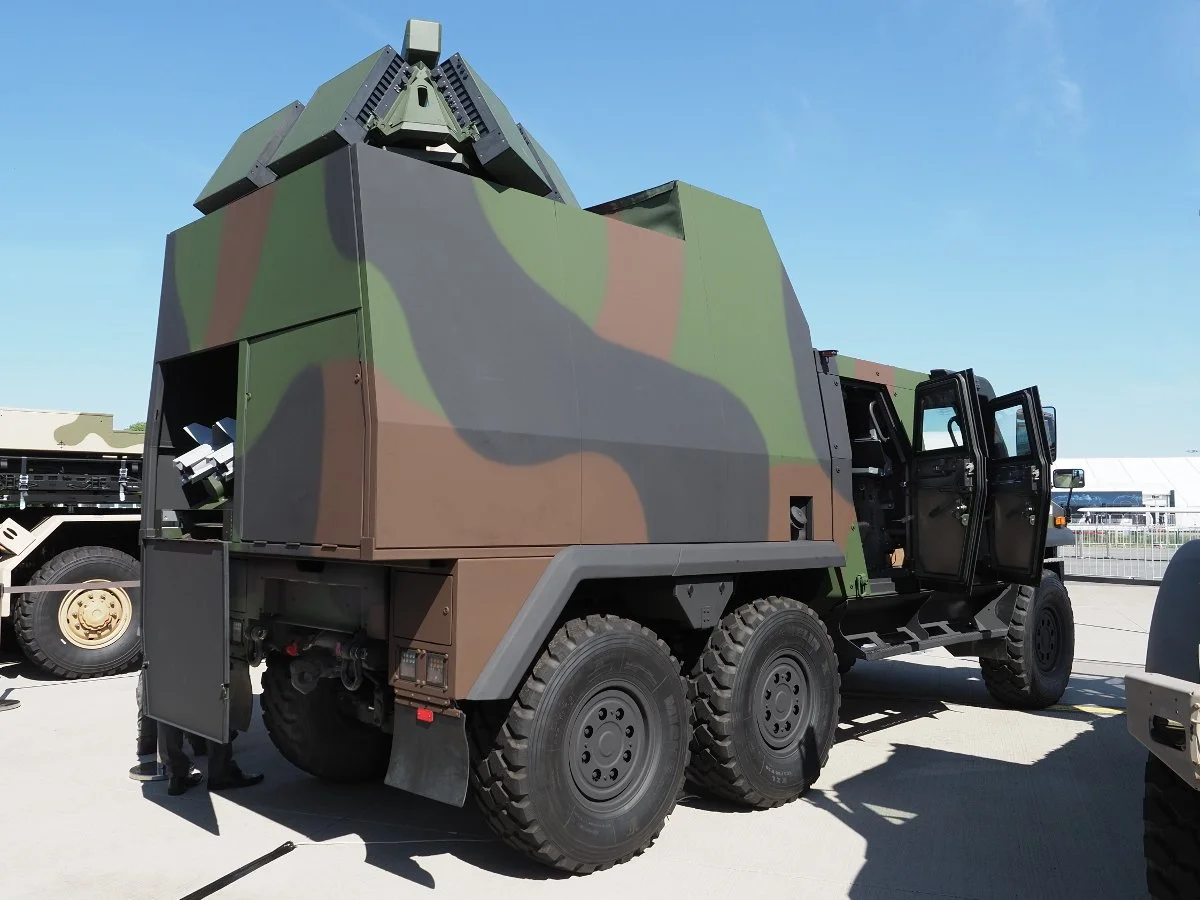
For the short-range layer, Switzerland plans to field a Rheinmetall 35 mm anti-aircraft gun system mounted on a truck chassis, with eight fire units intended to be operational by 2028. The medium-range layer rests on IRIS-T SLM systems from Diehl Defence, ordered previously.
Together these form the backbone of the air defence renewal Switzerland launched in the early 2020s, alongside its F-35A fighter purchase — a programme that has generated its own domestic argument over fixed pricing and cost growth.
Alpine geography shapes the problem in specific ways. Narrow valleys shorten radar horizons, mountain masses give low-flying targets natural cover, and the country measures only a few hundred kilometres east to west. That places a premium on mobile systems that can reposition quickly, which is the logic behind the mobile radar line item.
How layered air defence works
Modern air defence is built from complementary range bands rather than a single system. The short-range layer, generally under 10 kilometres, uses guns and short-range missiles against drones, helicopters and low-altitude precision munitions. The medium layer, in the 30 to 40 kilometre band, engages aircraft and cruise missiles. IRIS-T SLM sits in that second category.
Combat experience in Ukraine sharpened one lesson in particular: spending expensive medium-range interceptors on cheap drones is not sustainable. A single interceptor can cost many times more than the aircraft it destroys. That is why a separate budget line for counter-mini-drone capability, and CHF 250 million for a gun-based short-range layer, are not incidental details.
The technical weight of the smallest line
The CHF 60 million for mobile medium-range radar is the smallest item on the list and arguably the most architecturally significant. The effectiveness of a fire unit depends on the quality of the sensor picture feeding it. Fixed radar sites can be located in advance and struck in a first wave, which has made mobility a direct component of survivability rather than a convenience.
Who carries the risk
Advance payment carries a cost that does not appear in the budget line: transferred risk. Money paid years before delivery sits with the buyer if the programme slips, costs rise or the specification changes. Under milestone payments that risk stayed largely with the manufacturer. Under the new model the buyer is effectively financing the production capacity.
Switzerland is not alone. Germany, Poland and the Nordic states have all pulled payment schedules forward over the past two years to lock in slots. The aggregate effect is self-defeating for latecomers: when everyone tries to move up the queue, the queue does not get shorter — the entry ticket simply gets more expensive.
Regional implications
Switzerland is not a NATO member and maintains permanent neutrality. Its procurement squeeze is nonetheless identical to that of alliance members, which makes a wider point: when global production capacity is the constraint, neutrality does not move a country up the list.
That reality highlights the strategic value of a domestic air defence industrial base. Turkey’s decision to build a layered national architecture through the HİSAR and SİPER families is paying off precisely in this environment, because a country with access to its own production line does not face the prepayment problem in the same form.
The supplementary credit still requires parliamentary approval. The Federal Council has authorised the defence ministry (VBS) to submit the request as part of the 2026 Budget Message II.
Sources
- Swiss Federal Council session decision, 19 August 2026
- Swiss Federal Department of Defence (VBS), 2026 Army Message