The Country With More Tanks Than Any Army on Earth — 2026 World Rankings

The Country With More Tanks Than Any Army on Earth — 2026 World Rankings

Yazı Özetini Göster

Armor still decides ground wars. From the plains of Central Asia to the Korean peninsula, the size and sophistication of a nation’s tank fleet remains the single most watched metric in land-power calculations. This year’s GlobalFirepower data reveals a top 10 that spans every major geopolitical fault line — and the gap between #1 and the rest is bigger than most strategists would admit.

#10

ISRAEL

1,300 main battle tanks

Israel’s armored doctrine is built for speed and lethality, not mass. The Israel Defense Forces operate one of the most battle-tested tank fleets on Earth — a mix of indigenous Merkava variants and upgraded legacy platforms. The Merkava Mk IV, with its distinctive forward-engine layout designed to protect the crew, exemplifies Israel’s philosophy: every tank is also a weapon system calibrated for urban combat and high-threat anti-armor environments.

Following the Gaza operations, the IDF has accelerated integration of the Trophy active protection system (APS) across the fleet, making Israeli armor arguably the best-protected in the world pound-for-pound. Recent conflict experience has also driven rapid adaptations in crew compartment design and drone-countermeasure packages. Neighboring Egypt and Jordan maintain sizable fleets, but neither matches the technological density of the IDF’s armored brigades. With an order for Merkava Mk V reportedly in late development, Israel’s tank modernization cycle is continuous rather than episodic.

CategoryDetail
Rank#10 globally
Tank count (GFP 2026)1,300
Key platformMerkava Mk IV / Trophy APS
Doctrine focusUrban warfare, crew survivability
At #9, a Middle Eastern giant fields 300 more tanks and relies on an entirely different strategic logic — sheer numerical depth.

#9

EGYPT

1,600 main battle tanks

Egypt’s armored force reflects a classic layered procurement strategy: a large base of American-supplied M1A1 Abrams tanks supplemented by Soviet-era T-62s and domestically co-produced M1A1s under the Arab Organization for Industrialization (AOI) framework. Cairo is one of the few countries outside the United States that manufactures M1 series tanks under license, giving it both a supply-chain advantage and a maintenance ecosystem that other African and Middle Eastern operators lack entirely.

Geopolitically, Egypt’s tank mass is sized for two potential scenarios: a conventional deterrent against any sub-Saharan escalation threat and, more critically, a force capable of credible desert warfare in the Sinai buffer zone. The 2024 regional tensions along the Gaza-Egypt border underscored the strategic sensitivity of Egyptian armor positioning. Cairo has also begun exploring Turkish-made armored vehicles for supplementary roles, adding a diplomatic dimension to its procurement calculus. The fleet’s average age is a concern, however — significant numbers of legacy platforms require mid-life upgrades that budget constraints have delayed.

CategoryDetail
Rank#9 globally
Tank count (GFP 2026)1,600
Key platformM1A1 Abrams (co-produced)
Doctrine focusDeterrence depth, Sinai buffer
At #8, an East Asian industrial powerhouse fields nearly 700 more tanks and has transformed its armored force into a precision-strike machine the U.S. watches very closely.

#8

SOUTH KOREA

2,290 main battle tanks

South Korea’s armored force is a product of one of the most intense geographic threat environments on the planet. The Korean Peninsula compresses what would otherwise be a large-scale mechanized confrontation into relatively narrow corridors, meaning tank quality and anti-armor density matter more than in open-terrain theaters. Seoul fields the indigenous K2 Black Panther — consistently rated among the world’s top two or three main battle tanks in independent assessments — alongside large numbers of K1 and K1A2 platforms.

The K2’s autoloader, hunter-killer capability, and active protection systems give South Korean armor a strong technological edge over the North Korean fleet, despite North Korea holding more tanks numerically. Poland’s massive K2 procurement contract — one of the largest tank deals in NATO history — has transformed South Korea into a global armored vehicle exporter practically overnight, with the ROK defense industry now competing directly with Germany’s Leopard 2 franchise. Domestically, the ROK Army continues integrating AI-assisted targeting and networked battlefield management into the K2 fleet, a modernization program with no clear ceiling date.

CategoryDetail
Rank#8 globally
Tank count (GFP 2026)2,290
Key platformK2 Black Panther, K1A2
Doctrine focusPeninsula defense, export leverage
Moving west across Asia to #7, a South Asian nuclear power fields nearly 400 more tanks — and faces a two-front armored threat that shapes every procurement decision it makes.

#7

PAKISTAN

2,688 main battle tanks

Pakistan’s armored order of battle is shaped by a single strategic reality: the possibility of simultaneous pressure from both India to the east and, historically, instability to the west along the Afghan border. Islamabad fields the Al-Khalid (MBT-2000), developed jointly with China and considered a capable third-generation platform, alongside large numbers of older Chinese Type-59 and T-80UD tanks procured from Ukraine. The diversity of platforms creates maintenance complexity, but also procurement flexibility that mono-supplier nations lack.

The Al-Khalid II upgrade program, incorporating improved composite armor and fire control systems, has been proceeding slowly due to funding cycles but represents Pakistan’s clearest signal of long-term armored self-sufficiency ambitions. In practical terms, Pakistan’s tank fleet is optimized for the Rajasthan and Punjab desert corridors — the most likely mechanized axes in any India-Pakistan conventional scenario. The size of the fleet relative to India’s is telling: Islamabad has historically maintained a rough numerical ratio designed to prevent rapid armored breakthrough in those corridors without triggering nuclear thresholds.

CategoryDetail
Rank#7 globally
Tank count (GFP 2026)2,688
Key platformAl-Khalid MBT-2000, Type-59
Doctrine focusIndia deterrence, desert corridor defense
At #6, a NATO member and rising defense-industrial power enters the list — one that is currently fielding its first domestically designed main battle tank in history.

#6

TURKEY

3,022 main battle tanks

Turkish Defense Industry Spotlight

  • Altay MBT — first indigenous Turkish main battle tank, serial production underway
  • T-155 Firtina — 155mm self-propelled howitzer, combat-proven in Syria and Iraq
  • KIRPI MRAP — exported to 20+ countries, protecting armored logistics
  • KAAN — fifth-generation fighter jet, reshaping air-land integration doctrine
  • MILGEM — corvette class, demonstrating indigenous naval-land power projection

Turkey’s position at #6 in the global tank ranking understates its strategic trajectory. While the numerical count of 3,022 includes a significant legacy base of M60T Sabra tanks and various Leopard 1 and Leopard 2 variants, the operational picture is changing fast. The Altay main battle tank — years in development and now in serial production — represents a fundamental shift in Ankara’s armor philosophy, from a nation that buys tanks to one that makes and exports them.

Turkey has drawn sharp operational lessons from its own combat operations in Syria and from the 2020 Nagorno-Karabakh war — conflicts in which Turkish-supplied Bayraktar TB2 drones proved devastatingly effective against conventional armor. That experience is now being systematically incorporated into how the Turkish Land Forces conceive of armored operations: tanks as nodes in a combined-arms kill chain, not standalone heavy platforms. The Altay’s development includes provisions for drone-integration and active protection systems, reflecting this post-Karabakh doctrinal shift. Turkey’s land border with Syria, Iraq, and its proximity to the Caucasus mean its armored force has more operational justification per tank than almost any other force on this list.

CategoryDetail
Rank#6 globally
Tank count (GFP 2026)3,022
Key platformAltay MBT (indigenous), Leopard 2A4, M60T
Doctrine focusMulti-front combined arms, drone integration
Industrial milestoneFirst domestic MBT serial production
At #5, the world’s most populous democracy fields nearly 900 more tanks — and it is spending more on armor modernization than any other country in the developing world.

#5

INDIA

3,913 main battle tanks

India fields the fifth-largest tank force in the world, and its modernization challenges are as large as the fleet itself. The core of the Indian Army’s armor consists of T-90S Bhishma tanks procured and now manufactured under license from Russia, supplemented by indigenous Arjun Mk1A tanks and a still-operational but aging T-72 base. The T-90 fleet is the workhorse: numerically dominant, reasonably capable against Pakistani armor, but increasingly questioned against the Chinese PLA’s third-generation platforms that have been deployed to the Sino-Indian border following the 2020 Galwan Valley standoff.

That standoff reoriented Indian armor procurement decisively toward the northern Himalayan theater — a radically different operational environment from the flat Punjab plains where Indian armor doctrine was traditionally calibrated. High-altitude tank operations above 4,000 meters place extreme demands on engines, fire control systems, and crew endurance. India’s decision to fast-track the Arjun Mk2 program and accelerate T-90 upgrades is partly a direct response to PLA armor deployments in Tibet. India’s Arjun program, though criticized for delays, is producing increasingly capable vehicles and feeding a domestic defense-industrial ecosystem that Delhi is determined to expand under its Atmanirbhar Bharat self-reliance initiative.

CategoryDetail
Rank#5 globally
Tank count (GFP 2026)3,913
Key platformT-90S Bhishma, Arjun Mk1A
Doctrine focusTwo-front deterrence, high-altitude ops
At #4, the Western world’s most powerful military enters the countdown — and its tank count may surprise you given its global reputation for air power.

#4

UNITED STATES

4,666 main battle tanks

The United States Army’s M1A2 Abrams — in its SEPv3 and emerging SEPv4 configurations — is widely considered the gold standard of Western main battle tank design, even as its weight (72 tons for the SEPv4 variant) draws criticism from logistics planners who must deploy it globally. American armor doctrine is built around combined arms team integration: Abrams tanks operating in close coordination with Bradley infantry fighting vehicles, Apache attack helicopters, and close air support — a system that proved overwhelmingly effective in both Gulf Wars.

What the raw count of 4,666 does not reveal is the enormous qualitative gap between the M1A2 SEPv3 and most of the platforms on this list, or the fact that the United States funds an active protection system program at brigade scale. The ongoing war in Ukraine has prompted the U.S. Army to revisit its armor logistics model: pre-positioned equipment in Europe has been quietly reinforced, and the M1A2’s survivability in drone-saturated environments — a real question raised by Abrams losses in the Ukraine theater — is driving the SEPv4 development timeline. America’s armor is qualitatively dominant; numerically, it cannot match what the top three on this list can field simultaneously.

CategoryDetail
Rank#4 globally
Tank count (GFP 2026)4,666
Key platformM1A2 SEPv3 / SEPv4 Abrams
Doctrine focusCombined arms, global power projection
The top three are in a different category entirely — starting with a reclusive state whose tank fleet is the largest in Asia and arguably the least understood by Western intelligence agencies.

#3

NORTH KOREA

4,895 main battle tanks

North Korea’s tank fleet is the most numerically significant intelligence black box in the world. The DPRK claims to field over 4,895 main battle tanks — a figure that Western analysts accept with significant uncertainty, given the opacity of Kim Jong-un’s military reporting. The backbone consists of Soviet-derived Chonma-ho and Pokpung-ho tanks, the latter representing a domestic development that Pyongyang claims incorporates gun-launched anti-tank missiles and explosive reactive armor. Independent verification is, by definition, impossible.

What is not in doubt is the strategic purpose of this fleet. North Korea’s armored force is not designed for power projection — it is designed for one specific scenario: a mass armored assault through the narrow corridors of the Korean DMZ toward Seoul, which sits just 55 kilometers from the border. The plan would rely on overwhelming volume to saturate South Korean and American anti-tank defenses before advanced systems could be brought to bear. Against the K2 Black Panther and American-supplied anti-tank assets, DPRK tanks would suffer appalling losses — but North Korea has historically treated mass attrition as a feature rather than a bug. The fleet’s technological gap versus ROK and U.S. armor is enormous, but its sheer size keeps it on every contingency planner’s spreadsheet.

CategoryDetail
Rank#3 globally
Tank count (GFP 2026)4,895
Key platformPokpung-ho (claimed), Chonma-ho
Doctrine focusMass DMZ assault, political deterrence
At #2, the war in Ukraine has rewritten everything analysts thought they knew about this nation’s armored doctrine — and the losses tell only part of the story.

#2

RUSSIA

5,630 main battle tanks

Russia’s armored force has been stress-tested in the most consequential land war in Europe since 1945 — and the results have been instructive in ways that neither Moscow nor Western capitals fully anticipated. Since February 2022, Russia has lost more tanks in combat than any military since World War II, with open-source tracking organizations documenting over 3,000 confirmed tank losses through 2025. Yet Russia continues to field 5,630 tanks in GFP’s 2026 estimate, sustained largely by drawing down massive Cold War-era storage depots containing thousands of T-62s, T-72s, and older T-80s that were never scrapped.

The T-90M Proryv, Russia’s most advanced production tank, has performed better than the older platforms but has still suffered losses to Ukrainian anti-tank guided missiles, drones, and captured Western systems. Russia has adapted: improvised drone-protection frames welded over turrets became a recognized battlefield modification, and the Russian defense industry has ramped production of explosive reactive armor kits to levels not seen since the Cold War. The deeper strategic question raised by Russia’s armor experience is whether any tank fleet, however large, can survive in a battlefield saturated with cheap first-person-view drones and precision anti-tank guided missiles. Russia’s experience is rewriting doctrine worldwide — including at #1.

CategoryDetail
Rank#2 globally
Tank count (GFP 2026)5,630
Key platformT-90M Proryv, T-80BVM, T-72B3
Doctrine focusMass armored assault, storage-pool replenishment
And at #1 — with more tanks than Russia, a fleet that has been watching the Ukraine war closely and spending accordingly — stands the nation that now fields the largest armored force on Earth.

#1

CHINA

5,870 main battle tanks — the largest armored force in the world

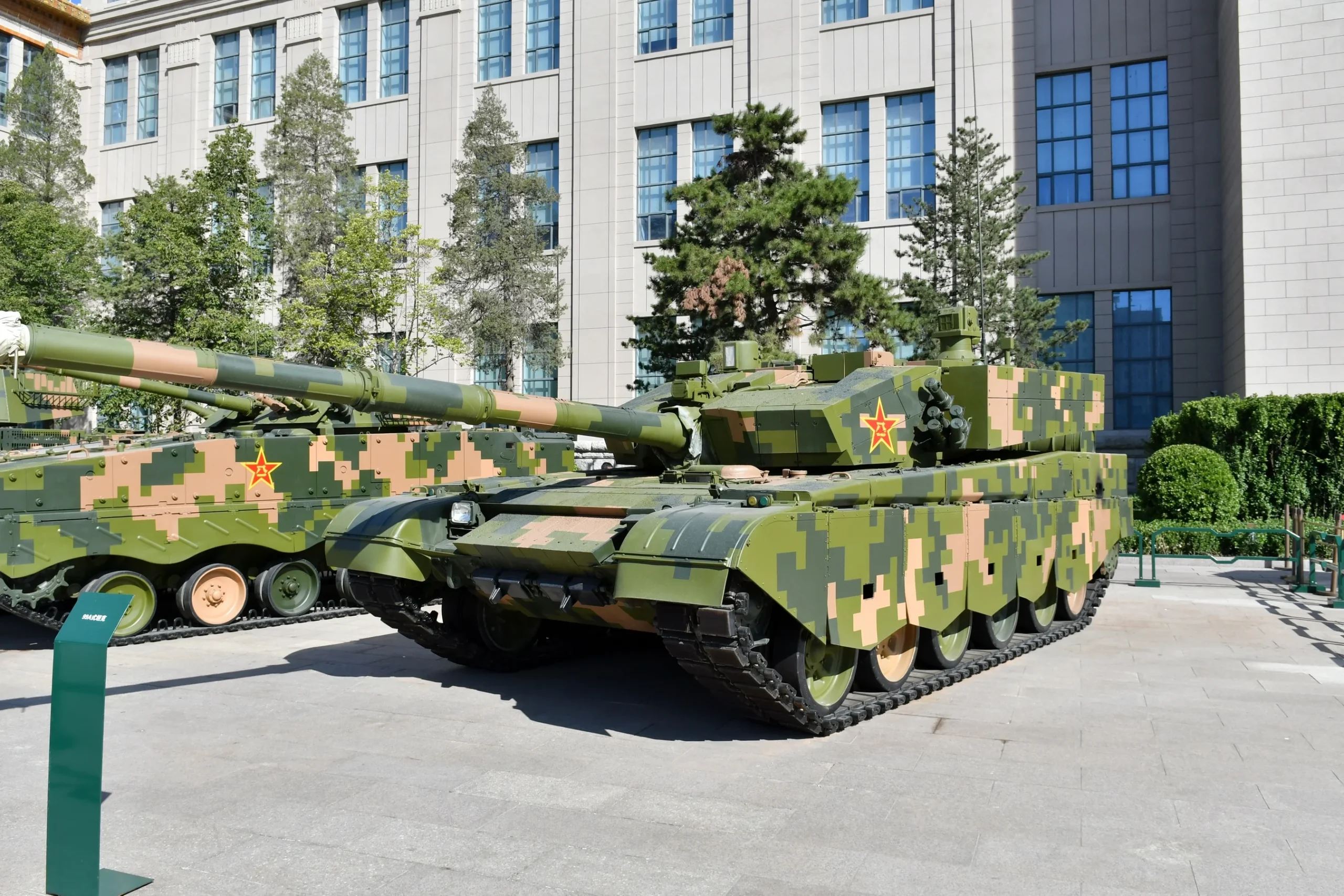
China’s People’s Liberation Army Ground Force fields 5,870 main battle tanks in 2026 — the single largest armored fleet on the planet. The gap above Russia is relatively modest (240 tanks), but the composition gap is vast. Where Russia has burned through Cold War stockpiles refilling combat losses, China’s fleet is trending younger and more capable with each passing year, centered on the formidable Type 99A and the lighter, export-oriented Type 96B.

The Type 99A is China’s answer to the Leopard 2A7 and M1A2 SEPv3: a 58-ton platform with a 125mm smoothbore autoloaded gun, laser dazzler defensive systems, composite armor, and fire control capabilities that Western assessments now rate as genuinely competitive with front-line NATO armor. China has studied the Ukraine war as intently as any military on Earth, and the PLA’s rapid acceleration of active protection system programs for its tank fleet is a direct doctrinal response to what FPV drones did to Russian T-90s.

Geographically, China’s armor mass is sized for multiple simultaneous operational requirements: the Taiwan Strait scenario, the Sino-Indian Himalayan border where ZTQ-15 light tanks were designed specifically for high-altitude operations, the Korean Peninsula contingency, and deterring any Central Asian instability from spilling toward Xinjiang. No other military on Earth faces this breadth of armored operational requirement simultaneously.

China’s defense industry is now producing main battle tanks at a rate that Western intelligence agencies have publicly described as extraordinary. Combined with the PLA’s investments in drone swarms, artillery rocket systems, and hypersonic missiles, the armored force is not a legacy capability being preserved — it is a modern combined-arms centerpiece being actively expanded. At 5,870 tanks, and growing, the PLA Ground Force is not just #1 today. It is accelerating.

CategoryDetail
Rank#1 globally
Tank count (GFP 2026)5,870
Key platformType 99A, Type 96B, ZTQ-15 (light)
Doctrine focusMulti-theater deterrence, Taiwan contingency, Himalayan border
Production rateFastest in the world (2024-2026 estimates)

What the numbers actually mean: a strategic assessment

Raw tank counts are a starting point, not a conclusion. The 2026 GlobalFirepower data reveals a world in which three distinct armored-power philosophies compete — and none of them is winning the argument cleanly.

The first philosophy is mass. China and North Korea sit at the top of this ranking partly because of sheer volume — the logic being that enough tanks will saturate any defensive screen. Russia pursued this doctrine aggressively in Ukraine, and the results have been mixed at best: mass armor proved more vulnerable to precision anti-tank systems and FPV drones than any pre-2022 war game had suggested. The lesson has been absorbed. China’s Type 99A fleet is receiving active protection systems at scale, and the PLA Ground Force is rewriting its combined-arms doctrine to ensure armor is never unescorted by air defense, electronic warfare, and drone assets. Mass is still a core principle — but mass plus protection plus networking is the 2026 model.

The second philosophy is quality over quantity. South Korea and Israel represent this pole most purely. Israel fields 1,300 tanks, ranking #10 — yet its Merkava Mk IV with Trophy APS is arguably the most survivable tank in any conflict environment. South Korea’s K2 Black Panther consistently outranks much larger fleets in independent technical assessments. Neither country can afford to absorb the kind of attrition Russia has accepted; both have invested accordingly in protection systems, network integration, and crew survivability.

The third philosophy — and the most interesting from a long-term perspective — is the transition country. Turkey is the clearest example. Ankara fields a large fleet at #6 globally and is simultaneously fielding its first indigenous main battle tank, integrating drone technology that has already proven itself in real operational environments, and exporting armored vehicles to a client base that now spans from Africa to Central Asia. Turkey is not a mass-armor power and is not a purely high-tech boutique force. It is building a third model: a medium-sized, highly capable, domestically produced armored force backed by a defense-industrial complex that is growing faster than almost any comparable NATO member.

The Ukraine variable hangs over all of this. Every military on this list has studied the Kherson, Kharkiv, and Zaporizhzhia battles in detail. The conclusion — that armor unescorted by active protection, electronic warfare, and drone countermeasures is enormously vulnerable — is being operationalized at different speeds by different militaries. The countries at the top of the GFP 2026 tank ranking are not just counting platforms. They are racing to answer the question that the war in Ukraine has made unavoidable: what does a survivable tank look like in the drone age? The answer, emerging from procurement decisions from Beijing to Ankara to Seoul, looks remarkably similar: lighter active protection, hunter-killer optics, network connectivity, and a smaller thermal and acoustic signature. The tank is not dying. It is evolving — and the 2026 ranking is a snapshot of that evolution in progress.

Complete 2026 world tank strength ranking

RankCountryTanks (GFP 2026)Key platformPrimary threat axis
#1China5,870Type 99ATaiwan, India, Korea
#2Russia5,630T-90M ProryvEurope, NATO flanks
#3North Korea4,895Pokpung-hoKorean Peninsula
#4United States4,666M1A2 SEPv3Global power projection
#5India3,913T-90S BhishmaPakistan, China (LAC)
#6Turkey3,022Altay MBT (indigenous)Syria, Iraq, Caucasus
#7Pakistan2,688Al-Khalid MBT-2000India (Punjab/Rajasthan)
#8South Korea2,290K2 Black PantherNorth Korea
#9Egypt1,600M1A1 Abrams (co-produced)Regional deterrence
#10Israel1,300Merkava Mk IVGaza, Lebanon, Iran proxy

Track every development in global defense power

Envantermedya covers defense industry, military procurement, and strategic balance — in Turkish, English, and Arabic.

Explore the defense atlas

Frequently asked questions

Which country has the most tanks in the world in 2026?

China leads the GlobalFirepower 2026 ranking with 5,870 main battle tanks, surpassing Russia (5,630) to hold the top position. China’s PLA Ground Force fields the world’s largest armored fleet, centered on the Type 99A and Type 96B platforms.

How does Turkey’s tank fleet compare to its NATO allies?

Turkey ranks #6 globally with 3,022 tanks — higher than any other NATO member except the United States. Crucially, Turkey is the only NATO member currently fielding a domestically designed and produced main battle tank: the Altay MBT. No other European NATO ally manufactures its own MBT at scale.

Has the war in Ukraine changed tank doctrine globally?

Yes, significantly. The Ukraine conflict demonstrated that armor operating without active protection systems, drone countermeasures, and electronic warfare support suffers catastrophic losses from relatively inexpensive FPV drones and anti-tank guided missiles. Every military on this top-10 list has adjusted procurement and doctrine accordingly since 2022.

Which country has the best tanks, as opposed to the most?

Independent assessments consistently rate the South Korean K2 Black Panther, the American M1A2 SEPv3, and the Israeli Merkava Mk IV with Trophy APS as the world’s most capable main battle tanks. China’s Type 99A is now included in that top tier by most Western analysts. Tank quality encompasses fire control, crew survivability, protection systems, and network integration — not just firepower.

What is Turkey’s Altay tank and when will it enter full service?

The Altay is Turkey’s first indigenous main battle tank, developed by BMC and Roketsan with design inputs from Hyundai Rotem. Serial production began after years of development delays related to the engine procurement. The Altay features composite armor, a 120mm smoothbore gun, and provisions for active protection integration. It is intended to replace Turkey’s aging Leopard 1 fleet and eventually supplement its Leopard 2 and M60T Sabra platforms.

Data source: GlobalFirepower 2026 Military Strength Rankings. Tank counts reflect GFP methodology and may differ from official government figures. Analysis by Envantermedya editorial team.
Leave a Comment

Your email address will not be published. Required fields are marked *

Related Posts