RAF Rivet Joint Deploys to Norway: Signals Intelligence and F-35A Integration at Ørland
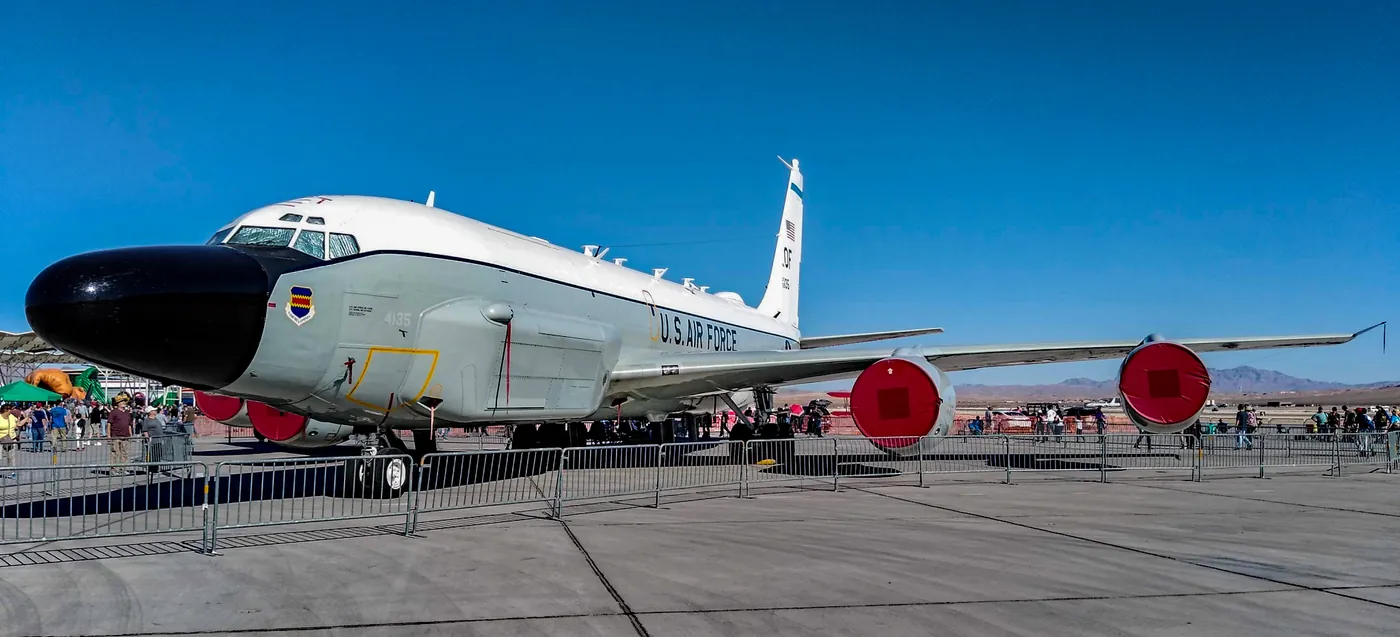
The Royal Air Force has deployed a Rivet Joint signals intelligence aircraft to Ørland air base in Norway for Exercise Arctic Stone. Over the week-long deployment the focus was integration with the Royal Norwegian Air Force’s F-35A fighters.
Shape of the deployment
51 Squadron, which operates the aircraft, forms the core of the RAF’s intelligence, surveillance, target acquisition and reconnaissance force. Processing and analysis of the collected material is handled by No. 54 Signals Unit. A single aircraft took part.
According to the RAF, the deployment had a second purpose: demonstrating that the squadron can generate sorties from an allied base with minimal support, away from its home infrastructure and with limited personnel. That is a practical test of the distributed operations concept NATO has emphasised in recent years.
What Rivet Joint does
Rivet Joint — designated RC-135W and known in British service as Airseeker — is a signals intelligence platform. Its Boeing 707-derived airframe carries receivers that sweep the electromagnetic spectrum and operator consoles that process what they find.
The aircraft carries no weapons; its output is information. Loitering for hours, it detects radar emissions, radio traffic and other electronic signatures, locates their sources and passes that picture to commanders in real time. In practice that means mapping where an area’s air defence radars sit, what frequencies they use, and when they switch on and off.
Why pair it with the F-35A
The pairing is deliberate. The F-35 is itself a capable sensor platform, with apertures distributed across the airframe that detect electromagnetic activity around it. But a fighter’s endurance is limited and its capacity to exploit what it gathers is bounded by the cockpit.
Rivet Joint offers the inverse: hours on station and a cabin full of analysts, but no low-observable characteristics and no ability to enter defended airspace. Working together, one collects from forward positions while the other exploits in depth.
The real obstacle to that integration is procedural rather than technical. Two nations’ aircraft, data links operating at different classification levels and different national rules on intelligence sharing all have to line up. The value of an exercise like Arctic Stone lies in running those procedures before a crisis and finding where they break.
NATO’s northern flank
The High North has gained weight in alliance planning for several concrete reasons.
Geography comes first: a significant part of Russia’s strategic submarine force is based on the Kola Peninsula, and the route those boats take to the Atlantic runs along the Norwegian coast. Second, Finland and Sweden joining the alliance substantially extended NATO’s northern land border and planning area. Third, the reinforcement routes between Europe and North America cross the North Atlantic, and their security is a founding assumption of the alliance’s collective defence arithmetic.
Norway sits at the centre of that equation. Ørland is the main operating base for its F-35A fleet and an important node in the sensor network that produces NATO’s northern air picture.
What Arctic Stone rehearses
The name may be new but the logic belongs to an established series. The alliance runs complementary exercises in the North Atlantic and Norwegian Sea each year — some focused on maritime and anti-submarine warfare, some on air defence, and some, like this month’s Northern Viking, on moving reinforcements into the region.
Rivet Joint’s role in that picture is to see the scenario rather than to generate it. What matters in an air defence exercise is not only how many intercepts occurred, but which emission was detected when, how long a radar took to geolocate, and how much delay there was before that reached a fighter pilot. Those measurements test whether the timing assumptions used in crisis planning are realistic.
Keeping the deployment to a week is equally deliberate. The aim is not a sustained presence but confirmation that the squadron can move at short notice and operate from an allied base. Short, repeated deployments of this kind are cheaper than permanent basing and politically more flexible.
Technical significance
An ISTAR force that can work away from home with a light logistics footprint multiplies deployment options in a crisis. A capability tied to a single fixed and predictable base is a target that can be neutralised in a first wave; one that can disperse forces a planner to account for several locations at once.
Regional implications
Seen from Turkey, the same logic runs along the alliance’s southern flank. In the Black Sea and Eastern Mediterranean, continuously refreshing the electromagnetic picture in peacetime is what underpins air defence and electronic warfare planning in a crisis.
Turkey has been developing that capability domestically for some time, with electronic support and signals intelligence systems integrated onto air platforms built around nationally produced receiver and processor architectures. The operational payoff of a national SIGINT capability is the ability to build one’s own threat library without depending on allied intelligence flows. In electronic warfare, the side without a library loses fastest.
Sources
- Royal Air Force official announcement, August 2026
- Royal Norwegian Air Force (Luftforsvaret) statements