Germany and Netherlands Expand Boxer RCT30 Order to 291 Vehicles

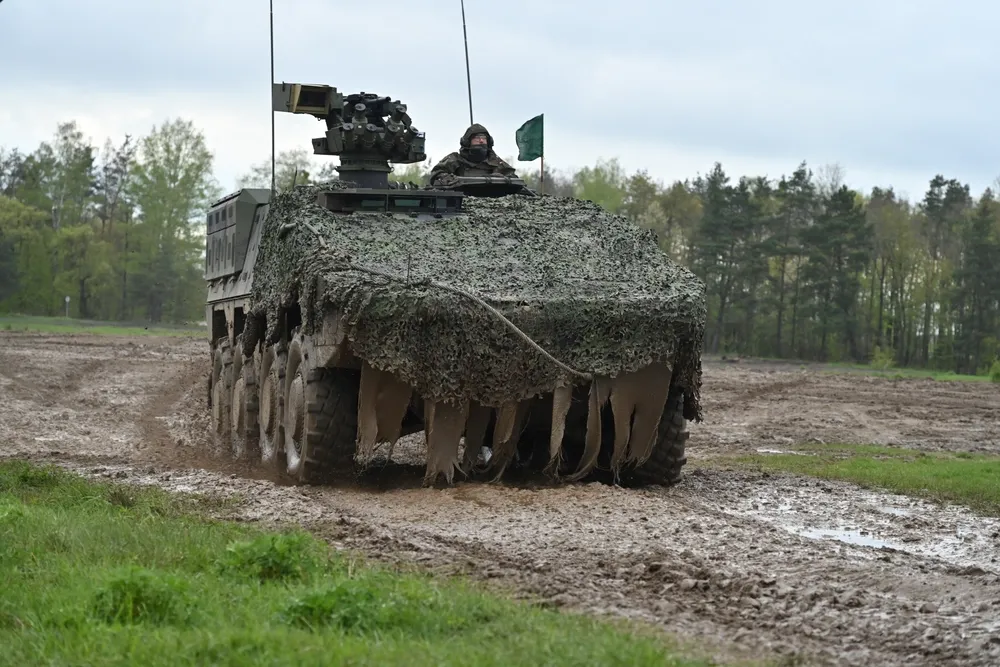
Germany and the Netherlands have exercised an option for 69 more Boxer RCT30 wheeled infantry fighting vehicles, known as Schakal in German service, through OCCAR. The Bundeswehr gets 35 and the Royal Netherlands Army 34, bringing the joint total to 291 vehicles. The builder is ARTEC, the joint venture of Rheinmetall and KNDS Deutschland. OCCAR and KNDS announced the option on 7 August 2026. These are contracted vehicles, not deliveries.
Last updated: 29 October 2026
What was ordered
The 69 vehicles come from an option in the October 2025 contract for 222 vehicles, which covered 150 for Germany and 72 for the Netherlands. After the option, Germany stands at 185 and the Netherlands at 106. ESUT reports that the Bundestag budget committee cleared the base buy in October 2025 and the option on 24 June 2026.
| Country | Base contract (Oct 2025) | New option | Total |
|---|---|---|---|
| Germany | 150 | 35 | 185 |
| Netherlands | 72 | 34 | 106 |
| Total | 222 | 69 | 291 |
No value was disclosed for the option. For the base contract, sources give different figures: EUR 3.41 billion gross in reporting based on Rheinmetall’s October 2025 release, and EUR 4.7 billion in Breaking Defense. Because the scope of either number (options, taxes, logistics package) is not broken down, no per-vehicle cost can be derived. OCCAR says new investment in the Boxer programme reached roughly EUR 6.5 billion over the past twelve months.
What the Schakal is
The Schakal pairs the 8×8 Boxer chassis with the unmanned turret of the tracked Puma IFV. Janes lists the main gun as Rheinmetall’s MK 30-2/ABM 30 mm cannon, which fires airburst ammunition; Rheinmetall’s release adds a 5.56 mm HK MG4 as secondary weapon. It carries six dismounted soldiers, and Rheinmetall gives a crew of three. Breaking Defense reports the turret is fitted with the Eurospike MELLS guided missile, usable against main battle tanks, and can engage drones.
The logic is mobility plus firepower: a wheeled hull that moves fast over long distances with a lighter logistics tail, carrying a turret from the tracked IFV class. Germany describes the Schakal as the backbone of its new “Medium Forces”, positioned between light infantry and heavy armour. According to Janes, the German vehicles go to that force and the Dutch ones to the 13th Light Brigade.
Delivery timeline
Order and delivery are separate here. ESUT reports the first Schakal is expected at the end of 2027, with series production ramping up from mid-2028 to mid-2031 and the newly ordered vehicles following that window unless faster output is agreed. Janes gives 2027-2031 for Germany and Q4 2028 for the Netherlands. The official announcement carries no delivery date specific to the 69 vehicles, and no series vehicle has been delivered yet.
What the option package includes
ESUT lists extra protection against anti-tank weapons, bomblets and drones, hit detection and identification, A400M air transportability and an MG5 upgrade for the turret machine gun among the option items. Breaking Defense adds that Hensoldt reportedly won a contract worth about EUR 290 million from KNDS for 288 digital optronics sets for Schakal.
Competitors and context
In the same 8×8 class sit other programmes, including Turkey’s; see our explainer on the FNSS PARS ALPHA-based 8×8 YNA and the 35 mm-turreted ALTUĞ. We do not draw a numeric comparison because we lack sourced specifications for a like-for-like table, and Germany has no direct Turkish link in this order. For the Dutch side, see Netherlands military strength. Germany is also preparing a far larger Boxer buy of about 1,800 vehicles under the Arminius programme.
FAQ
Is Schakal the same as Boxer RCT30?
Yes. RCT30 is the product designation and Schakal is the name in Bundeswehr service.
How many Schakals have been ordered in total?
291 for Germany and the Netherlands: 185 and 106. The October 2025 contract also holds an option for up to 248 more vehicles, of which 69 have now been exercised.
Have any been delivered?
No. The first vehicle is expected at the end of 2027.