Elbit’s Swedish arm unveils THMS: a 25-metre mast that goes up in five minutes
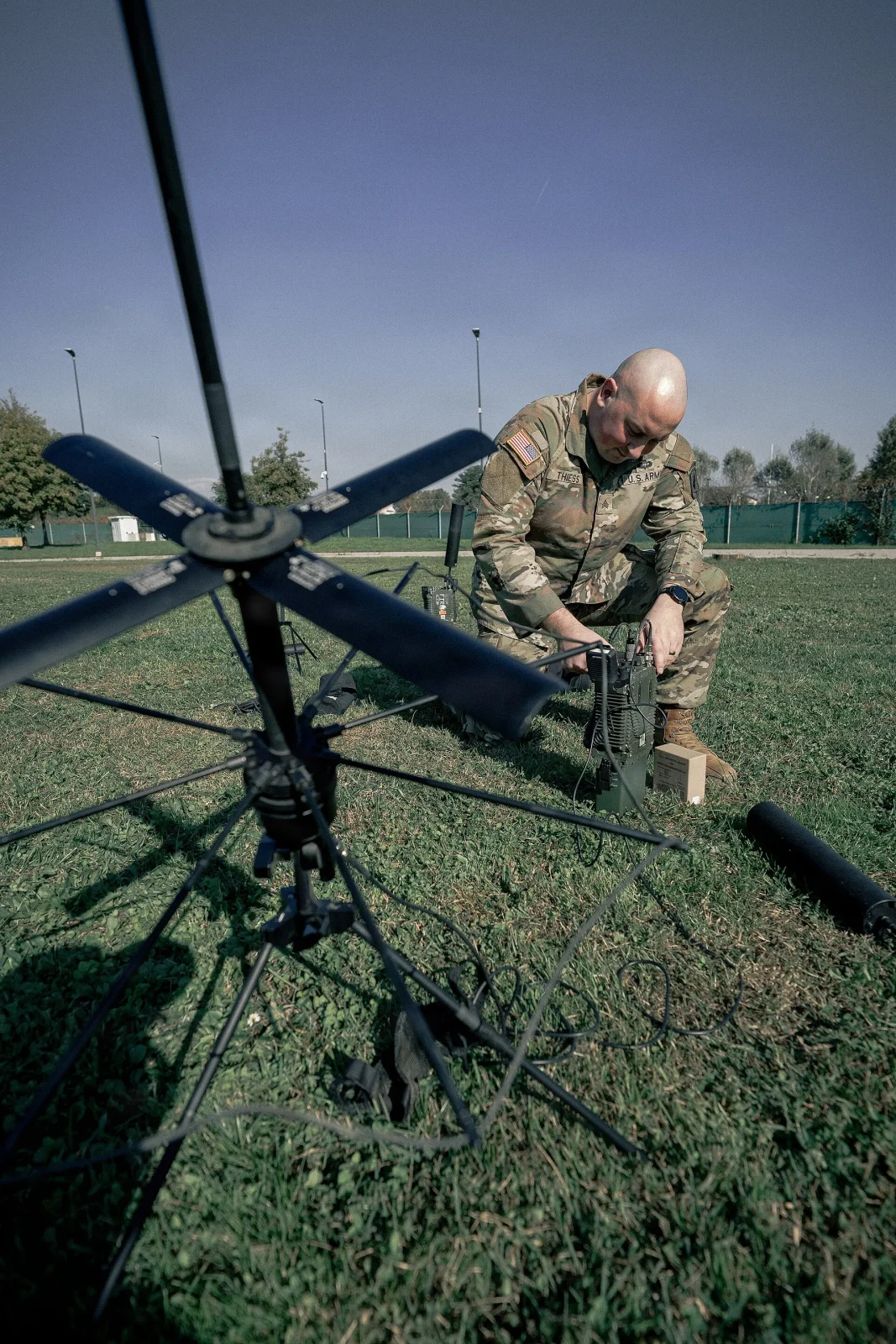
Land forces are spreading out. Ukraine taught every European army the same lesson: concentrated headquarters die, and the antenna farm that gives a command post its reach is also what gives away its position. The problem is that dispersion costs connectivity — and connectivity is what makes dispersed forces useful rather than merely scattered.
Elbit Systems Sweden brought its answer to Herning this week. The Tactical High Mobility Shelter, or THMS, was launched at DALO Industry Days 2026, the Danish defence procurement agency’s industry exhibition held on 19 and 20 August.
What it is
THMS is built around a telescopic mast that extends to 25 metres and carries payloads of up to 100 kilograms. An automatic deployment mechanism and guying system erect the mast in under five minutes — a figure that matters more than it sounds, because in an environment saturated with loitering munitions and counter-battery sensors, setup time is survival time.
The shelter carries its own power generation and runs autonomously for up to 24 hours, independent of the host vehicle. That decoupling is deliberate: the truck can leave, be tasked elsewhere, or be dispersed for concealment, and the node keeps working.
A carrier, not a product
The payload list is where the design philosophy shows. THMS accommodates tactical radios, electronic warfare suites, surveillance and observation systems, electro-optical and infrared sensors, satellite communications terminals, tactical 5G, and high-power laser effectors.
That range means the shelter is not a communications vehicle that happens to accept other equipment. It is a standardised carrier that becomes whatever the mission requires — a relay node in one unit, an electronic support station in another, a counter-drone sensor tower in a third. For a procurement agency, that translates into one logistics chain, one training pipeline, and one spares inventory instead of three.
Why height still wins
The oldest constraint in ground communications is the curvature of the earth. Line-of-sight radio range scales with antenna height, and a few extra metres can add kilometres of reach. Twenty-five metres lets dispersed sub-units stay linked to each other terrestrially, without loading traffic onto satellite capacity that is contested, expensive, and increasingly targeted.
The same geometry governs detection. Small drones flying at low altitude are masked by terrain from ground-level sensors and are often detected only at short range. Raising the sensor extends detection range, and detection range is reaction time — the difference between engaging a quadcopter and being hit by one.
The Nordic calculation
The venue was not incidental. Denmark has moved quickly on land communications and counter-drone capability, and awarded a contract this month for a nationwide counter-drone command and control system. Copenhagen is buying the connective tissue of a modern land force, not just its platforms.
Elbit’s decision to front its Swedish subsidiary reflects a different pressure. European Union defence industrial programmes reward supply chains that stay inside Europe, and procurement politics in the Nordics increasingly favour local industrial content. Presenting through a Scandinavian entity is how an Israeli-headquartered group stays inside that frame.
The Turkish parallel
Turkey’s equivalent capability sits with ASELSAN’s tactical area communications systems and mobile command vehicles, built around the TAFICS backbone and software-defined radio families aimed at the same goal: keeping dispersed units networked. The mast-mounted multi-payload approach appears in Turkish industry chiefly in counter-drone systems, where sensor elevation drives performance directly.
The convergence is the point. Across quite different industrial bases, the same conclusion is being reached — that the single-purpose vehicle is a poor investment, and that the durable asset is a standard carrier able to accept whatever payload the next decade demands.
Sources
- Elbit Systems official product announcement, August 2026
- DALO Industry Days 2026 exhibition programme, Herning, Denmark