UMTAS Long-Range Anti-Tank Missile: Range and Specs
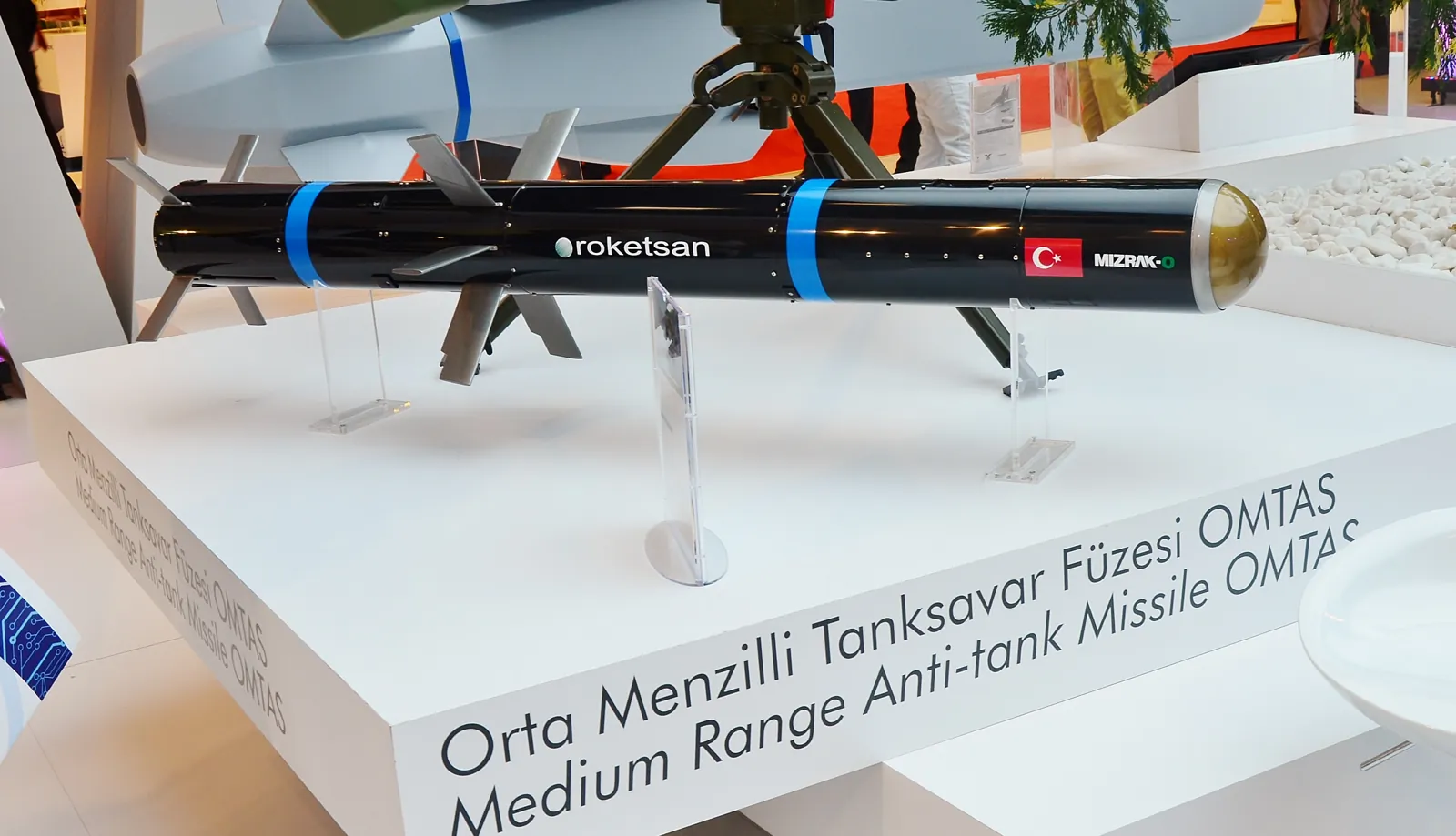
UMTAS (Long-Range Anti-Tank Missile System) is a long-range anti-tank guided missile (ATGM) developed by ROKETSAN and used primarily in the air-to-ground role. The base variant has a range of 0.5-8 km and a missile weight of about 37.5 kg. Guided by an imaging infrared (IIR) seeker plus an RF data link, it is fielded chiefly on the T129 ATAK attack helicopter and unmanned aerial vehicles such as the Bayraktar TB2. Serial production began in 2017.
| UMTAS — At a Glance | |
|---|---|
| Category | Long-range anti-tank missile (ATGM) |
| Developer | ROKETSAN (IIR seeker: ASELSAN) |
| Serial production | 2017 |
| Range | 0.5-8 km (base variant) |
| Weight | ~37.5 kg (missile) |
| Length / diameter | 1.8 m / 160 mm |
| Warhead | Tandem HEAT / fragmentation / thermobaric |
| Guidance | IIR + RF data link; L-UMTAS laser |
| Propulsion | HTPB solid fuel |
| Platforms | T129 ATAK, TB2, vehicles, naval helicopters |
| Operator | Turkish Armed Forces |
What is UMTAS?
UMTAS — the Long-Range Anti-Tank Missile System — is an indigenous anti-tank guided missile (ATGM) designed and produced by ROKETSAN. As its name suggests, it is the longest-range member of ROKETSAN’s anti-tank family, completing a three-tier range spread alongside the medium-range OMTAS and the shoulder-launched, short-range KARAOK. UMTAS is optimised for the air-to-ground role, meaning its primary use is being fired from helicopters and unmanned aerial vehicles against modern main battle tanks and armoured targets.
The missile was developed to give the Turkish Armed Forces’ attack helicopters and unmanned aerial vehicles an indigenous, long-range, modern anti-tank capability. After years of reliance on foreign systems for this mission, UMTAS was positioned as the main anti-tank munition of the T129 ATAK attack helicopter. Entering serial production in 2017, it also became part of the anti-tank arsenal of armed drones such as the Bayraktar TB2.
UMTAS can operate on a lock-on and fire-and-forget principle, but thanks to its RF data link it can also receive updates after launch. This flexibility lets the missile use both direct-attack and top-attack modes, enabling it to strike the upper armour that is the weakest point of a modern tank.
Technical specifications and how it works
The base variant of UMTAS has a range of 0.5 to 8 km. The missile weighs about 37.5 kg, is 1.8 m long and 160 mm in diameter. These dimensions set it apart from shoulder-launched light systems: UMTAS is designed to be fired from a platform — a helicopter, unmanned aerial vehicle or vehicle.
Its guidance system is the most distinctive feature. The standard variant uses a combination of an imaging infrared (IIR) seeker and an RF data link. The IIR seeker locks onto a target by reading its heat signature and provides fire-and-forget capability; the RF data link lets the operator redirect the missile to a new target or update it in flight. There is also a laser-guided variant called L-UMTAS, which relies on the target being marked by a laser and offers particular flexibility when integrated with unmanned aerial vehicles.
The warhead is selectable against different target types: tandem HEAT (dual shaped-charge) to defeat the reactive armour of modern tanks, fragmentation for soft targets and positions, and a thermobaric option for enclosed spaces and fortifications. The exact warhead weight has not been officially disclosed. Propulsion is provided by an HTPB-based solid-fuel rocket motor. The missile supports both direct-attack and top-attack modes.
- Range: 0.5-8 km (base variant).
- Guidance: IIR seeker + RF data link; plus the L-UMTAS laser variant.
- Warhead: tandem HEAT / fragmentation / thermobaric (selectable); weight not disclosed.
- Attack mode: direct and top-attack.
- Propulsion: HTPB solid fuel.
UMTAS is compared on the international market with long-range air-to-ground anti-tank missiles in the same class. The table below summarises UMTAS and its leading counterparts by country of origin.
Platforms, operators and exports
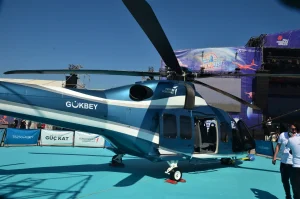
UMTAS’s primary platform is the T129 ATAK attack helicopter, on which the missile is integrated as the main anti-tank munition. It can also be fired from armed unmanned aerial vehicles, above all the Bayraktar TB2. UMTAS is additionally designed to be integrated on land vehicles and naval helicopters, making it a multi-platform system.
The known operator is the Turkish Armed Forces. UMTAS has been used in Türkiye’s cross-border operations and internal-security missions via ATAK helicopters and unmanned aerial vehicles. The buyer countries for any exports have not been officially disclosed; because defence exports are a sensitive area, specific customer nations and contract details are usually kept out of public records.
Secondary sources cite much higher ranges of 16-50 km for an enhanced version referred to as UMTAS-GM. However, these figures rest on secondary sources alone and had not been confirmed by ROKETSAN with a single official number as of the verification date of this article. For that reason, these high ranges are presented here not as confirmed data but with caution and as a range.
Its place in Turkish defence industry: advantages and limits
UMTAS is one of the most important steps in the localisation of Türkiye’s anti-tank missile capability. Together with OMTAS (medium range) and KARAOK (short range, shoulder-launched), it forms a three-tier family that answers different range and platform needs. UMTAS’s clearest advantage is that it offers an indigenous, long-range anti-tank option for helicopters and unmanned aerial vehicles, thereby reducing dependence on imports for this mission. Its IIR, RF data link and laser-guidance options make the missile adaptable to different scenarios, while the tandem HEAT warhead targets effectiveness against the reactive armour of modern tanks.
Some limits should be underlined, however. Certain technical values — such as the exact warhead weight — have not been officially disclosed; this article relies only on stated, verifiable data. The high-range claims for UMTAS-GM still await official confirmation. In the export context, which countries the missile has been sold to is likewise absent from official records. These uncertainties stem less from the product’s capability than from the secrecy practices inherent to the defence industry, and will be updated as official statements are published.
Overall, UMTAS sits at the centre of ROKETSAN’s air-to-ground precision-munition portfolio, positioned as a powered, long-range complement to gliding munitions such as the MAM family. Its integration with high-export-potential platforms like the T129 ATAK and TB2 will be decisive for the missile’s future performance on foreign markets.
UMTAS’s base range (0.5-8 km), weight (~37.5 kg) and platforms (T129 ATAK, TB2) rest on official and open sources. The warhead weight has not been officially disclosed. The 16-50 km range cited for UMTAS-GM rests on secondary sources alone and has not been confirmed with a single official figure; it is therefore presented as a range and with caution. Buyer countries for exports have not been officially disclosed.
Frequently Asked Questions
What is the range of UMTAS?
The base variant of UMTAS has a range of 0.5 to 8 km. Secondary sources cite much higher ranges of 16-50 km for an enhanced version called UMTAS-GM, but these have not been confirmed with a single official figure and should be treated with caution.
Who uses UMTAS?
The known operator is the Turkish Armed Forces. The missile is used mainly via T129 ATAK attack helicopters and unmanned aerial vehicles such as the Bayraktar TB2. The buyer countries for any exports have not been officially disclosed.
Which platforms fire UMTAS?
The primary platform is the T129 ATAK attack helicopter. It is also designed to be used from armed unmanned aerial vehicles such as the Bayraktar TB2, as well as land vehicles and naval helicopters.
What is the difference between L-UMTAS and UMTAS?
The standard UMTAS is guided by an imaging infrared (IIR) seeker and an RF data link. L-UMTAS is a laser-guided variant that relies on the target being marked by a laser, offering particular flexibility for integration with unmanned aerial vehicles.
What are UMTAS’s counterparts?
As a class, UMTAS is compared with Israel’s Spike-LR/ER family and the US Hellfire (AGM-114) air-to-ground missile. These are long-range anti-tank missiles aimed at helicopter and unmanned aerial vehicle platforms.
When did UMTAS enter service?
Serial production of UMTAS began in 2017. The missile was integrated on the T129 ATAK helicopter and unmanned aerial vehicles as the main product of ROKETSAN’s long-range anti-tank missile family.
Sources
- ROKETSAN official — roketsan.com.tr
- Wikipedia (EN) — UMTAS / L-UMTAS entry
- Defence-industry publications and open-source (OSINT) records
- UMTAS-GM high-range values: secondary sources (official confirmation pending)
- Data verified 22 July 2026