Spike NLOS: 32 km Non-Line-of-Sight Guided Missile — Technical Analysis and Turkish UMTAS Comparison
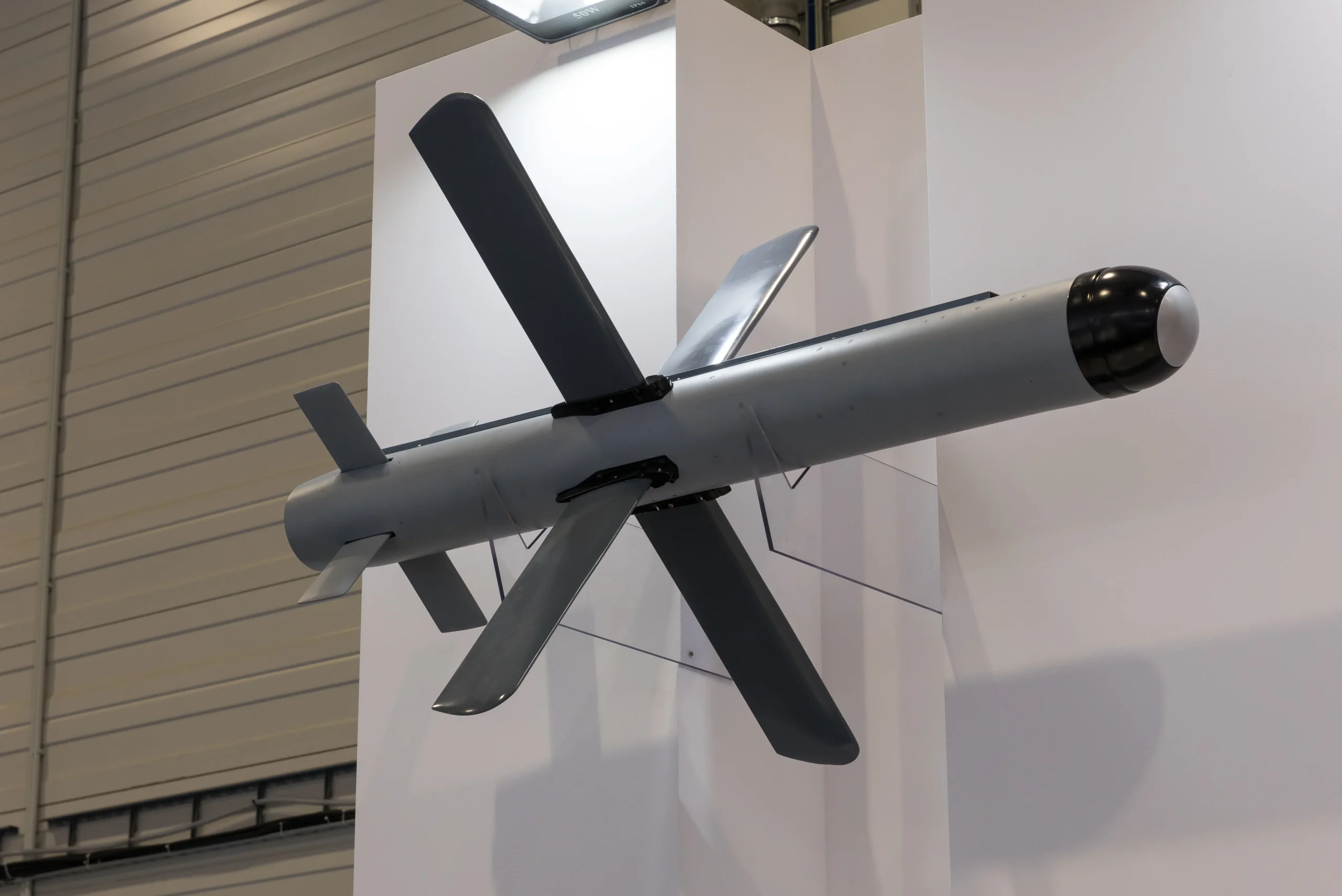
Spike NLOS (Non-Line-of-Sight) is the longest-range member of Rafael Advanced Defense Systems’ Spike guided missile family, designed for engagement of tanks, armored vehicles, ships, coastal installations, and hardened structures at ranges up to 32 kilometres — well beyond the visual horizon of the launching platform. Its defining technical feature is a fiber optic datalink (FOPLOF) that transmits real-time EO/IR imagery from the missile to the operator throughout the flight, enabling target change and abort up to impact. This man-in-the-loop architecture distinguishes Spike NLOS from fire-and-forget systems and gives it particular utility in complex target environments where late-stage identification matters.
Spike Family Context
| Variant | Range | Category |
|---|---|---|
| Spike SR | ~1.5 km | Short range; man-portable |
| Spike MR | ~2.5 km | Medium range |
| Spike LR | ~4 km | Standard long range |
| Spike LR2 | ~5.5 km | Second-generation long range |
| Spike ER | ~8 km | Extended range |
| Spike ER2 | ~16 km | Extended range 2nd gen |
| Spike NLOS | ~25–32 km | Non-line-of-sight; helicopter/ship/ground |
The Fiber Optic Datalink — What Makes NLOS Different
Spike NLOS trails a thin fiber optic cable behind it throughout flight, establishing a high-bandwidth bidirectional link between the missile and the launch station. This enables three operationally critical capabilities:
- Real-time video feed: The operator sees what the missile’s EO/IR seeker sees, in real time, at 32 km range. This provides intelligence about the target area that no other ground sensor could match from a safe standoff position.
- In-flight target update: If the primary target moves, is misidentified, or a higher-priority target appears, the operator can redirect the missile to a different aim point during flight.
- Abort capability: If civilians enter the target area, identification is uncertain, or the engagement is called off, the operator can abort the missile at any point up to impact. In urban operations — where target identification and civilian presence are dynamic — this capability has direct operational and legal significance under international humanitarian law rules of engagement.
Technical Specifications
| Parameter | Value |
|---|---|
| Developer | Rafael Advanced Defense Systems (Israel) |
| Type | Non-line-of-sight ground/helicopter/naval guided missile |
| Range | ~25–32 km (ground platform; varies by altitude for helicopter) |
| Guidance | EO/IIR terminal + fiber optic datalink; GPS mid-course (newer variants) |
| Warhead | Tandem HEAT + multipurpose; armor-piercing + blast-fragmentation |
| NLOS capability | Full; no line-of-sight to target required |
| Man-in-the-loop | Yes; target change and abort throughout flight |
| Platforms | Ground vehicles (HMMWV, Stryker), helicopters (AH-64, AH-1Z), ships |
| Launch mode | Cold launch; low thermal signature |
| Missile weight | ~71 kg |
| Warhead weight | ~30 kg |
| CEP | <1 metre |
Combat History
2006 Lebanon War: Spike NLOS first used extensively by Israel against Hezbollah infrastructure. Demonstrated long-range precision strike capability in real combat conditions.
2020 Nagorno-Karabakh: Azerbaijan deployed Spike NLOS against Armenian armored vehicles and fixed positions. Published video documentation — available publicly at the time — showed engagements at extreme range against tanks and APCs. The conflict generated the most comprehensive open-source documentation of Spike NLOS performance in conventional warfare conditions.
Ukraine (2022–2024): Germany and other European Spike operators provided NLOS-capable variants to Ukraine. The system’s standoff range allowed engagements of Russian vehicle concentrations and fixed positions without exposing launching platforms. Ukrainian operators cited the abort capability as operationally significant in mixed civilian-military contact zones.
Israeli naval integration: Spike NLOS integrated on Saar-6 corvettes and other Israeli naval platforms for coastal and maritime target engagement. Represents an extension of the original ground-attack mission profile into anti-surface warfare.
Operator Countries
| Country | Platform | Status |
|---|---|---|
| Israel | Ground vehicles, AH-64, Saar-6 corvette | Operational; large inventory |
| USA | Special Operations platforms | Limited; ongoing evaluation |
| Germany | Tiger helicopter, NH90 | Operational; supplied to Ukraine |
| Singapore | AH-64D, ground vehicles | Operational |
| Spain | Tiger helicopter | Operational |
| Finland | NH90 helicopter | Operational |
| Azerbaijan | Ground vehicles | Combat use (2020 Nagorno-Karabakh) |
Turkish Counterpart: UMTAS and MIZRAK-U
| Attribute | Spike NLOS | UMTAS | MIZRAK-U |
|---|---|---|---|
| Range | ~25–32 km | ~8–10 km | ~8–10 km |
| Guidance | Fiber optic + EO/IIR (NLOS) | IIR terminal (fire-and-forget) | IIR terminal; TV option |
| Man-in-the-loop | Full; throughout flight | No (fire-and-forget) | Partial (TV-guided variant) |
| Platform | Ground/helicopter/ship | UAV (TB2 etc.), helicopter | Helicopter, ground |
| Combat data | Lebanon 2006, Karabakh 2020, Ukraine 2022+ | Libya, Syria, Ukraine (via TB2) | Limited |
The UMTAS and MIZRAK-U are validated systems in the 8-10 km band. The 25-32 km NLOS range with fiber optic man-in-the-loop represents a capability gap in Turkey’s domestic inventory. Whether Turkey bridges this gap through domestic development or alternative procurement is an open strategic question — one that becomes more acute as Turkish doctrine incorporates longer-range precision ground fires across increasingly contested environments.
Competitor Systems
| System | Country | Range | Key Difference |
|---|---|---|---|
| JAGM | USA / Lockheed Martin | ~16 km (helicopter) | Shorter range; tri-mode guidance (laser/RF/IIR); fire-and-forget |
| Brimstone | UK / MBDA | ~12 km | Millimetric wave radar; salvo-of-many; shorter range |
| AGM-114R Hellfire | USA / Lockheed Martin | ~8–11 km | Extensive combat pedigree; shorter range; laser designation required |
Envanter Medya Analysis
Spike NLOS occupies a distinctive position in the anti-armor guided missile landscape: it is the only widely fielded system that combines 30+ km standoff range with real-time man-in-the-loop control via fiber optic datalink. This combination addresses two simultaneous imperatives in modern warfare — survivability (keep the firing platform far enough away to survive) and discrimination (keep the human close enough to make final targeting decisions).
The system’s combat record across four distinct conflict environments (Lebanon 2006, Gaza operations, Nagorno-Karabakh 2020, Ukraine 2022–present) is the most diversified validation profile of any currently fielded precision anti-armor system. Each conflict validated different aspects: Lebanon tested urban target discrimination, Nagorno-Karabakh tested conventional armor engagement at maximum range, Ukraine tested logistics and operator training under high-tempo conditions.
For Turkey: UMTAS and MIZRAK-U are mature domestic systems with validated combat records. The NLOS segment — 25+ km, fiber-optic man-in-the-loop — represents the next layer of the capability stack that Turkish industry has not yet delivered. The demand signal is clear; the development pathway is the remaining question.