Iron Fist: Elbit Systems’ Active Protection System – How It Works, NATO CV90 Contract and Comparison with Turkey’s PULAT
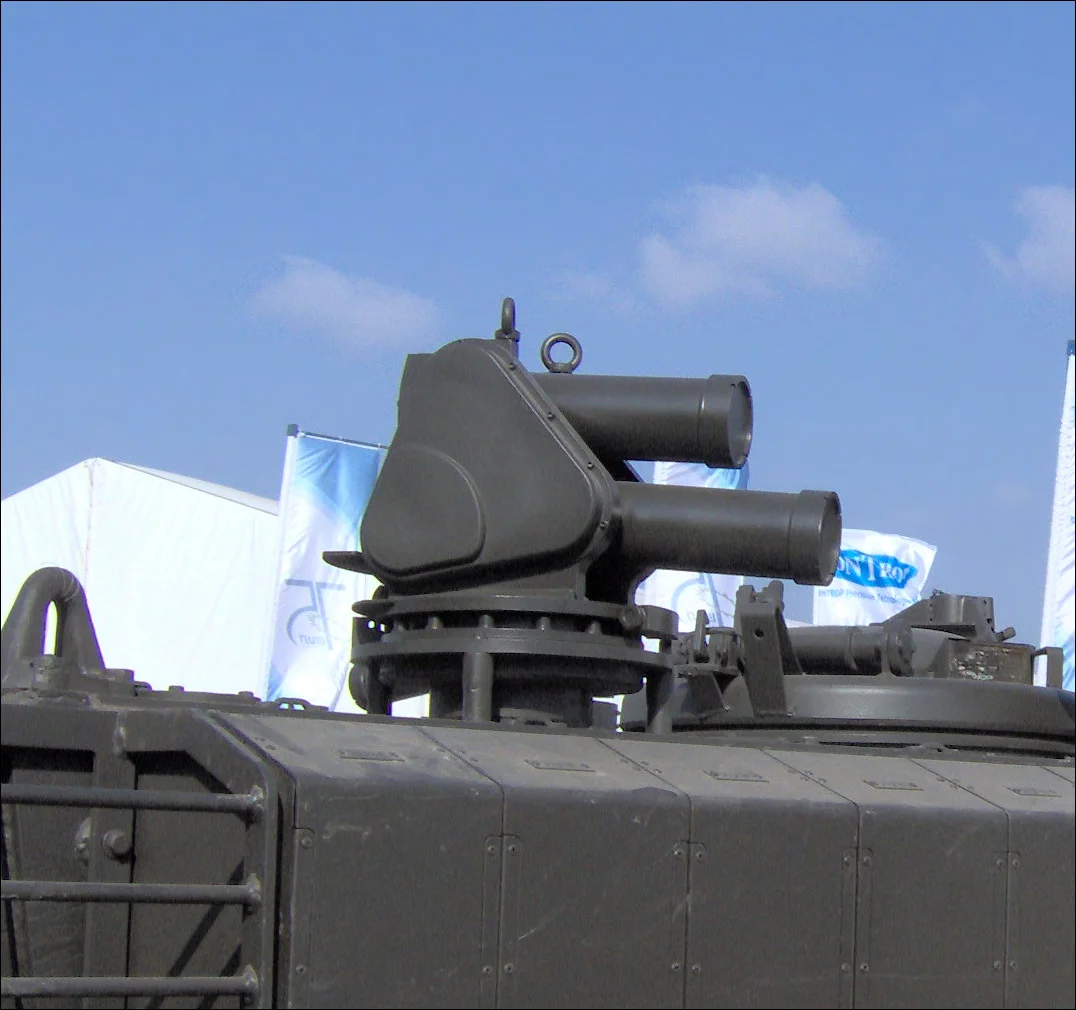
Iron Fist is an active protection system (APS) developed by Elbit Systems — incorporating technology from Israel Military Industries (IMI), which Elbit acquired in 2016 — designed to protect armoured vehicles against rockets, missiles, anti-tank guided munitions (ATGMs) and, uniquely among its peers, certain kinetic energy penetrators. Fielded by the Israel Defense Forces on the Namer heavy infantry fighting vehicle since 2009, and now contracted for NATO’s CV90 IFV fleet, Iron Fist represents one of the most comprehensive active armour solutions commercially available.
Why Active Protection?
Modern anti-tank threats — particularly tandem-warhead RPGs and laser or thermally guided ATGMs — have significantly outpaced the protection offered by conventional passive steel and reactive armour. Adding more passive armour increases vehicle weight and degrades mobility, creating a spiral of diminishing returns. Active protection breaks this spiral by detecting and neutralising threats before they reach the vehicle’s skin. Iron Fist achieves this through a combination of dual-mode sensors and a kinetic countermeasure effector that intercepts threats in flight.
System Variants
IFLK – Iron Fist Light Kinetic
Designed for main battle tanks and heavy IFVs, the IFLK provides the broadest protection envelope of the two variants. Uniquely among fielded APS solutions, IFLK is designed to engage not only shaped-charge (HEAT) threats but also kinetic energy (KE) penetrators — the long-rod penetrators fired by large-calibre tank guns. This capability is particularly relevant against opponents operating T-90 or T-14 type armour whose depleted-uranium or tungsten KE rounds are optimised to defeat passive armour.
IFLD – Iron Fist Light Decoupled
Optimised for light-to-medium IFVs, the IFLD trades KE protection for a lighter, more compact installation. The “decoupled” designation refers to a mechanical isolation mount that reduces vibration and structural loads transferred to the host vehicle — important on lighter platforms where structural integrity margins are tighter. The IFLD covers RPG and ATGM threats comprehensively.
Technical Specifications
| Parameter | IFLK | IFLD |
|---|---|---|
| Threats engaged | RPG, ATGM, some KE rounds | RPG, ATGM |
| Detection range (including UAV) | ~1,500 m | ~1,500 m |
| Sensor suite | AESA radar + LWIR thermal | AESA radar + LWIR thermal |
| Countermeasure type | Kinetic launch effector | Kinetic launch effector |
| Response time | Milliseconds (automatic) | Milliseconds (automatic) |
| Network integration | Yes — broadcasts threat data to formation | Yes |
| UAV/loitering munition detection | Yes (~1,500 m) | Yes |
Key Contracts
Israel – Namer Heavy IFV
The IDF’s Namer heavy IFV — built on the Merkava Mk 4 chassis and among the best-protected infantry vehicles in the world — was fitted with Iron Fist IFLK. The Namer’s role in dense urban operations in Gaza and on the Lebanese border put a premium on close-range protection against tandem-warhead RPGs fired from short distances by dismounted fighters.
NATO – CV90 Integration (USD 150 million)
In January 2026, Elbit Systems announced a USD 150 million contract to integrate Iron Fist onto an unnamed NATO European country’s CV90 fleet. The CV90, manufactured by BAE Systems Sweden, is in service with Norway, Sweden, the Netherlands, Finland, Denmark, Switzerland and Estonia — making it one of the most widely operated IFVs in NATO. The contract validates Iron Fist’s compatibility with non-Israeli platforms and its qualification for NATO-standard procurement processes.
United States – Bradley Evaluation
The US Army evaluated multiple APS candidates for the Bradley IFV, including Iron Fist and Rafael’s Trophy. While Trophy was selected for the M1A2 Abrams as part of the MAPS (Modular Active Protection Systems) programme, Iron Fist remains a competitive candidate for lighter tracked and wheeled platforms in the US inventory.
Competing Systems
| System | Developer | Country | Type | KE Protection |
|---|---|---|---|---|
| Trophy (MV/HV) | Rafael | Israel | Kinetic/radar | Limited |
| Iron Fist IFLK | Elbit/IMI | Israel | Kinetic | Yes |
| Arena-M | KBM | Russia | Kinetic/explosive | No |
| AMAP-ADS | ADS GmbH | Germany | Explosive-suppressed | Limited |
| PULAT AKS | ASELSAN | Turkey | Kinetic | Under development |
Turkish Counterpart – PULAT AKS
Turkey’s answer to the Iron Fist is PULAT AKS, developed by ASELSAN. The system uses a radar-based threat detection suite combined with a kinetic effector — conceptually parallel to Iron Fist IFLD — and is being integrated into the Leopard 2A4 and M60T fleets operated by the Turkish Armed Forces. PULAT has undergone live-fire testing and is in advanced stages of development.
The key distinction between the two systems at this stage is operational maturity: Iron Fist has logged operational use in Israeli urban combat environments and has secured its first NATO export contract. PULAT has not yet achieved combat validation or export sales. This gap is typical for a system at PULAT’s development stage, but Turkey’s defence industry has the technical depth to close it. The critical enabler will be Turkey’s ability to secure a combat deployment or a NATO-affiliated reference customer that independent observers can evaluate.
Advantages
- Dual-sensor detection: Radar plus LWIR combination reduces false alarms and missed detections.
- UAV and loitering munition engagement: Detection at ~1,500 m addresses emerging drone threats.
- Network-centric operation: Shares threat data across a formation, enabling collective protection.
- KE protection (IFLK): Addresses a threat category most competing APS systems cannot engage.
- Platform-agnostic design: Validated integration across multiple vehicle types.
Disadvantages
- Short-range gaps: Kinetic effectors require minimum engagement distance; extremely close-range threats may defeat the response cycle.
- Collateral hazard: Countermeasure launches near dismounted friendly infantry require careful employment doctrine.
- Fratricide risk: In dense multi-vehicle engagements, high-speed friendly vehicles can trigger false threat classifications.
- Vehicle power demand: Requires additional electrical capacity from the host platform.
Inventory Media Assessment
Iron Fist occupies a technically distinctive position in the APS market. Its IFLK variant’s KE protection capability and the system’s UAV detection range set it apart from most competing solutions. The NATO CV90 contract is a significant commercial milestone that moves the system from an Israel-specific platform to a NATO-credentialed product with potential for wider Alliance adoption.
Turkey’s PULAT programme reflects sound strategic thinking: active protection will be essential for armoured vehicles in any peer-level conflict, and dependency on foreign APS introduces both supply chain and operational data risks. The challenge for ASELSAN is accelerating PULAT’s path from development to operational deployment, and from deployment to a credible export proposition. The trajectory is clear; the pace is the variable.