KILIÇ 200: ASELSAN’s Kamikaze Underwater Drone Opens a New Front in the Deep

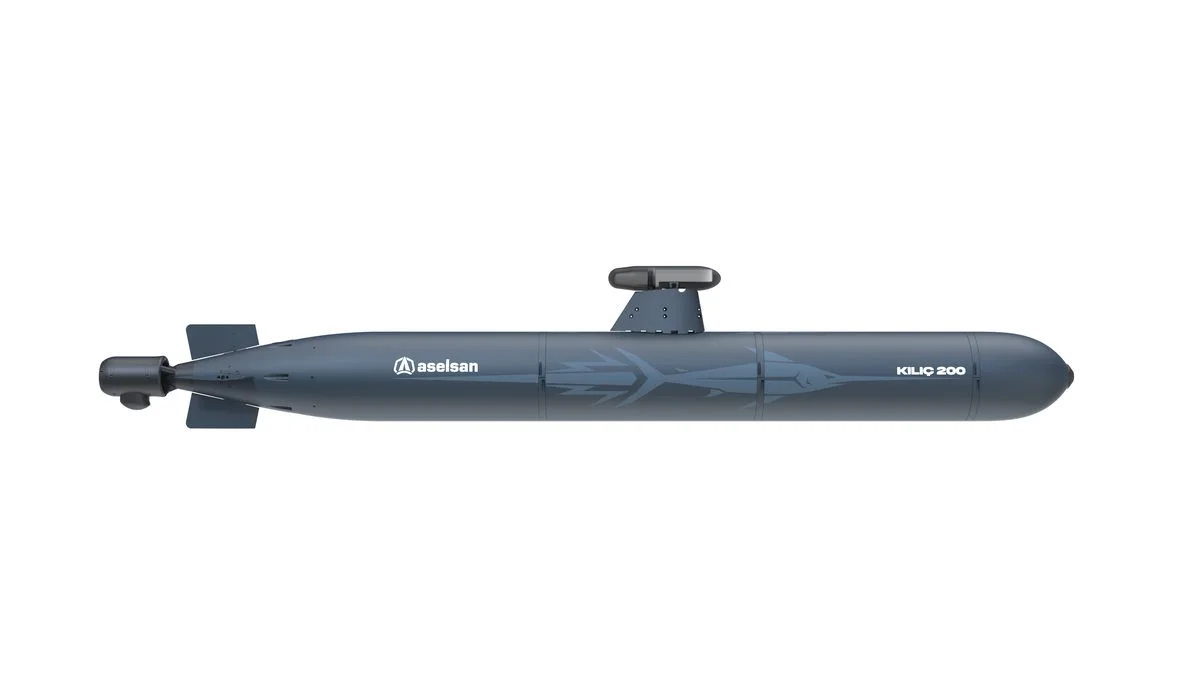
Turkish drones rewrote the rules of war in the air. ASELSAN now wants to do the same beneath the waves. The KILIÇ 200 — “sword” in Turkish — is a kamikaze autonomous underwater vehicle that cruises for hundreds of kilometres submerged, stalks its prey in silence, then detonates an integrated warhead against it. It is Türkiye’s clearest declaration yet that it intends to be a player in the emerging race for expendable undersea weapons.
The KILIÇ 200 belongs to the class of expendable autonomous underwater vehicles (AUVs) — one-way systems, the undersea cousins of loitering munitions. It is designed to detect, track and neutralise maritime targets, whether surface platforms like warships or subsurface ones like submarines. In essence it is a smart, long-range, patient torpedo that marries a submarine’s endurance to a loitering munition’s lethality, waiting in chokepoints for a target rather than being fired at one.
A range that redraws the map
The KILIÇ 200 has a mission range of 100 nautical miles (about 185 km), extending to 200 nautical miles (about 370 km) with an additional battery. The strategic implication is significant: launched from the Turkish coast, the vehicle can cover vast stretches of the Aegean, Eastern Mediterranean and Black Sea without putting a single sailor at risk, loitering in the maritime corridors a hostile fleet must transit and waiting as patiently as a sniper.
Key specifications
| Class | Expendable kamikaze autonomous underwater vehicle (AUV) |
| Mission range | 100 nm, extending to 200 nm with extra battery |
| Length | 350 cm |
| Diameter | 32.4 cm |
| Warhead | Integrated |
| Communication | Satellite |
Satellite link on a submerged weapon
The KILIÇ 200’s most striking feature is its satellite communication capability. The vehicle can surface to transmission depth to exchange data with the operations centre — receiving new target coordinates or an abort command — then dive again and continue. That single feature transforms it from a fire-and-forget projectile into a platform that stays under human control throughout its mission, a rare degree of oversight in an environment where seawater blocks almost every form of communication.
The economics of undersea deterrence
With its relatively simple architecture, the KILIÇ 200 offers a tempting equation: a weapon far cheaper than a heavyweight torpedo or a crewed submarine, yet able to threaten naval assets worth hundreds of millions of dollars. That same asymmetry upended air warfare when cheap Turkish drones met expensive armour. Repeated underwater, it means swarms of low-cost “swords” could force even the most powerful fleets to recalculate the risk of every approach to Turkish waters.
Why it matters
Modern navies understand that the deadliest threat is the one you do not see until impact. By unveiling the KILIÇ 200, ASELSAN signals that Türkiye has chosen to be an actor rather than a spectator in undersea autonomy — a contest still in its infancy worldwide, where early movers can set the terms. A 3.5-metre kamikaze drone may not turn heads at a defence expo, but in the dark of the deep, it is an argument that is hard to answer.