Indra Acquires Dares Technology to Give Tarsis Drones SAR Radar Vision

Spanish defence and technology group Indra has completed the acquisition of 100% of Dares Technology, a synthetic aperture radar (SAR) and image-processing specialist based near Barcelona. Twenty-seven engineers from Dares will join Indra’s Radar Centre of Excellence as part of the deal. Financial terms were not disclosed.
Dares Technology was founded in 2015 in Castelldefels as a deep-tech startup linked to the European Space Agency’s Business Incubation Centre. The company built compact, high-performance SAR sensors paired with proprietary image-processing software capable of generating precise topographic maps from a single flight pass, detecting terrain changes of only a few centimetres.
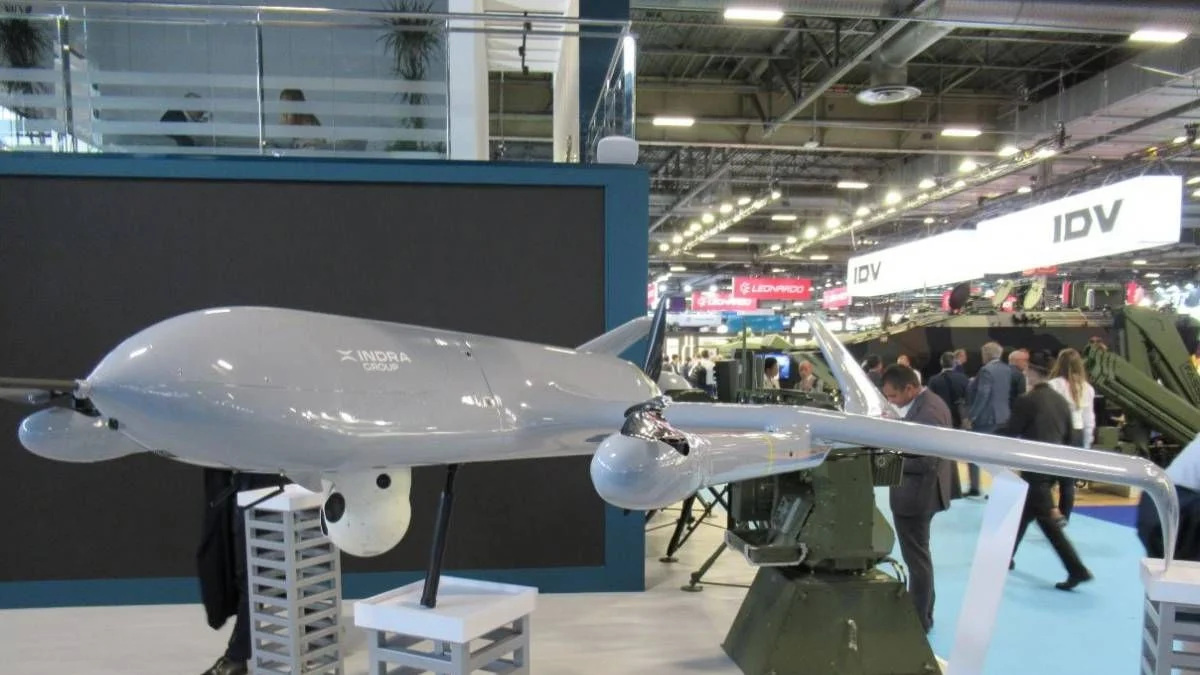
Indra plans to integrate this radar capability directly into its Tarsis unmanned aircraft family. The Tarsis line, a sub-150-kilogram class of tactical drones, comes in two variants: the runway-launched Tarsis-W and the vertical-takeoff Tarsis-VTOL. Indra develops the platforms through Aertec Defence & Aerial Systems, which it acquired in 2025, and is working toward delivering up to 147 Tarsis units to the Spanish Armed Forces.
The core advantage of SAR imaging is its independence from visible light and weather. Unlike electro-optical or infrared sensors, SAR can produce high-resolution imagery at night, through cloud cover and in fog, removing a major operational gap for reconnaissance missions that would otherwise depend on clear conditions.
Once integrated, Tarsis platforms will be able to take on dual-use missions beyond military reconnaissance, including maritime vessel tracking and critical infrastructure monitoring, applications where all-weather, round-the-clock coverage is essential.
The acquisition fits into a broader push across European defence industry to reduce dependence on foreign sensor and platform suppliers. In the mid-size tactical UAS segment, European governments have been weighing options against both US-based General Atomics and Turkish manufacturers such as Baykar and Turkish Aerospace Industries, whose export volumes have grown sharply in recent years. Indra’s SAR investment strengthens the domestic supply chain available to Spain in that competitive landscape.
Dares’ SAR technology had previously been trialled by the Spanish Armed Forces. Folding that track record into Indra’s existing radar design and development capacity supports the company’s ambition to become one of the few global players offering SAR systems of comparable performance.
For Indra, the move is the second major complementary acquisition in the unmanned systems space following last year’s purchase of Aertec DAS. By consolidating sensor, airframe and software development under one roof, the company aims to turn Tarsis into an end-to-end domestically built programme rather than one assembled from imported components.
Spain’s Ministry of Defence has identified tactical drones as a distinct medium-term procurement priority. Until now, the Tarsis family relied mainly on electro-optical and infrared payloads; adding SAR positions it among a small group of European-built tactical drones capable of continuous surveillance regardless of darkness or weather, a factor that strengthens both domestic competitiveness and future export potential.
Sources
- The Defense Post, “Indra Buys Radar Firm to Give Tarsis Drones SAR Vision”, October 5, 2026 — https://thedefensepost.com/2026/10/05/indra-tarsis-sar-radar/ — primary source for acquisition details and timing
- El Español – Observatorio de Defensa, “Indra adquiere Dares Technology para reforzar su liderazgo en radares de drones de defensa”, October 1, 2026 — https://www.elespanol.com/observatorio-defensa/20261001/indra-adquiere-dares-technology-reforzar-liderazgo-radares-drones-defensa/1003744404602_0.html — background on Dares’ founding and imagery source
- defence-industry.eu, “Indra strengthens Spain’s defence autonomy with 147 tactical drones designed and manufactured domestically under the Santam programme” — confirmation of Tarsis/Santam programme context