OMTAS: ROKETSAN’s Medium-Range Anti-Tank Missile

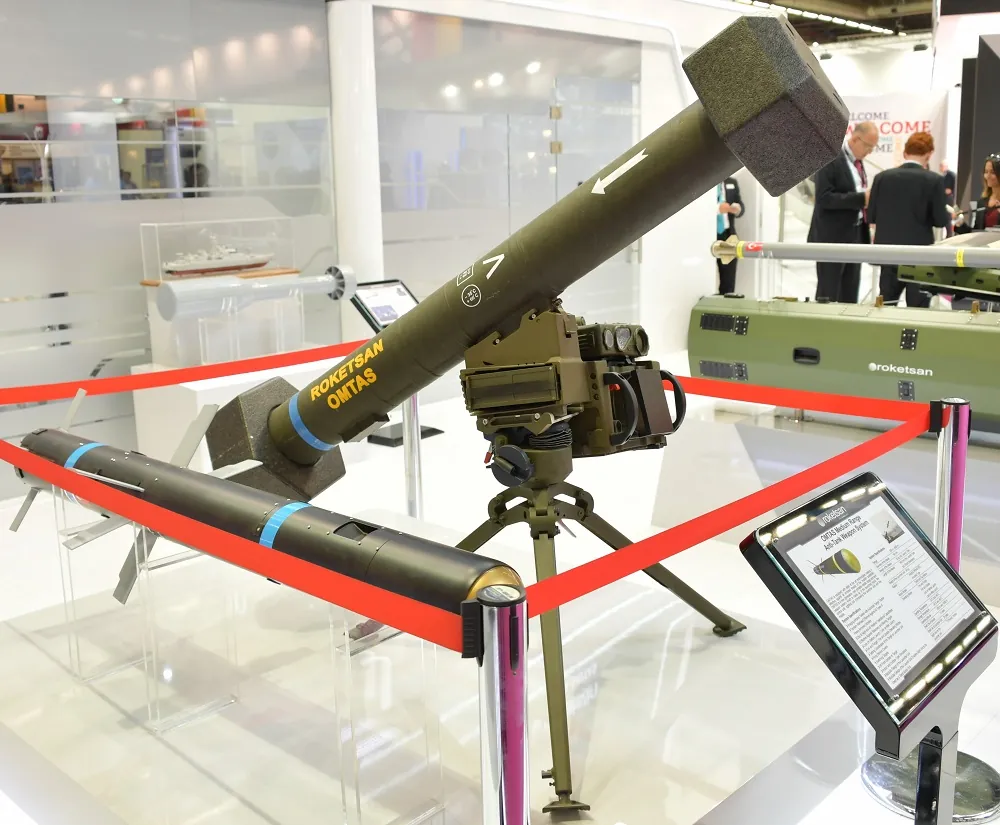
OMTAS (Orta Menzilli Tanksavar Sistemi, or Medium-Range Anti-Tank System) is an indigenous anti-tank guided missile developed by Turkey’s ROKETSAN. In service with the Turkish Armed Forces since 2017, it engages targets at roughly 0.2-4 km. An imaging infrared (IIR) seeker and an RF data link let it operate in both fire-and-forget and fire-and-update modes, striking armour with a tandem HEAT warhead.
| OMTAS — At a Glance | |
|---|---|
| System name | OMTAS — Medium-Range Anti-Tank System |
| Class | Anti-tank guided missile (ATGM) |
| Developer | ROKETSAN (IIR seeker: ASELSAN) |
| In service | 2017 |
| Range | 0.2-4 km (L-OMTAS ~5.5 km) |
| Weight | 35 kg (missile + launch tube) |
| Length / diameter | 1.8 m / 160 mm |
| Warhead | Tandem HEAT / blast-fragmentation / thermobaric (selectable) |
| Guidance | IIR fire-and-forget + RF data link (fire-and-update) |
| Propulsion | Dual-thrust solid-propellant rocket motor |
| Engagement modes | Direct and top-attack |
| Platforms | Tripod, vehicle, remote weapon station (RCWS) |
| Operator | Turkish Armed Forces |
What is OMTAS?
OMTAS is ROKETSAN’s medium-range anti-tank guided missile. Its Turkish name, Orta Menzilli Tanksavar Sistemi, translates as Medium-Range Anti-Tank System. It is designed to defeat main battle tanks, armoured personnel carriers and fortified positions on the modern battlefield. Entering Turkish Armed Forces service in 2017, OMTAS is the backbone of Turkey’s indigenous medium-range anti-armour capability.
Its defining feature is the combination of a fire-and-forget capability, in which the operator locks the target before launch and releases the missile, with a fire-and-update mode that allows the target to be switched or refined after launch. This flexibility lets the gunner reselect the priority threat even while the missile is in flight. The imaging infrared seeker enables the weapon to operate in both day and night conditions.
Technical specifications and how OMTAS works
OMTAS is effective at approximately 0.2 to 4 kilometres, which positions it as the middle tier between the short-range shoulder-launched KARAOK and the long-range UMTAS. The missile and its launch tube together weigh 35 kilograms; the missile is 1.8 metres long with a diameter of 160 millimetres.
The guidance chain relies on an imaging infrared (IIR) seeker in the terminal phase and an RF data link maintained between the gunner unit and the missile throughout flight. This two-layer architecture allows OMTAS to fly either a fully autonomous fire-and-forget profile or an operator-in-the-loop guided shot. To defeat armour fitted with reactive protection it carries a tandem HEAT warhead, while blast-fragmentation and thermobaric options are available for other target types; some of these figures have not been officially disclosed. A dual-thrust rocket motor provides both launch acceleration and sustained velocity across the engagement envelope. Beyond a direct-attack profile, OMTAS can also fly a top-attack trajectory, striking tanks where their armour is thinnest.
OMTAS is frequently benchmarked against Western systems in the same weight class. The table below summarises the medium-range anti-tank missiles OMTAS is most often compared with.
Platforms, operators and exports
OMTAS can be launched from several configurations. Its baseline deployment is the gunner sight unit on a tripod, but the system can also be integrated onto ground vehicles and remote weapon stations (RCWS) to give armoured platforms an anti-tank punch. This modularity allows OMTAS to serve both at the infantry level and within mechanised units.
Its principal operator is the Turkish Armed Forces. On the export side, open sources report a delivery to Kosovo; contract details for any other buyers have not been officially disclosed. An enhanced derivative, L-OMTAS, uses laser guidance to extend range to roughly 5.5 kilometres and is expected to enter serial production in 2026.
Place in Turkey’s defence industry
OMTAS is the middle link in ROKETSAN’s anti-tank triad: the shoulder-launched short-range KARAOK, the medium-range OMTAS and the long-range UMTAS together form a coherent anti-armour architecture that covers different ranges and platforms with domestic systems. This triad is a concrete example of Turkey’s drive to reduce foreign dependency.
The system’s strengths include a flexible guidance architecture that pairs an IIR seeker with an RF data link, a selectable warhead and multi-platform compatibility. On the limitations side, some technical values such as warhead weight remain undisclosed, and the base range is moderate compared with long-range air-to-ground systems. Extending range with L-OMTAS is a step toward addressing that limitation.
The warhead weight and certain performance figures for OMTAS have not been officially released by ROKETSAN; in this article they are treated with a ‘not officially disclosed’ note. The Kosovo export is based on open-source reporting. Range and weight values have been verified against official and open-source intelligence.
Frequently Asked Questions
What is the range of OMTAS?
OMTAS is effective at roughly 0.2 to 4 kilometres. Its laser-guided derivative, L-OMTAS, extends the range to about 5.5 kilometres.
Who makes OMTAS and who operates it?
OMTAS was developed by ROKETSAN, with the imaging infrared seeker supplied by ASELSAN. Its main operator is the Turkish Armed Forces.
Which platforms can launch OMTAS?
The system can be fired from a tripod-mounted gunner unit, from ground vehicles and from remote weapon stations (RCWS).
How is OMTAS guided?
OMTAS uses an imaging infrared (IIR) seeker in the terminal phase and an RF data link throughout flight, supporting both fire-and-forget and post-launch fire-and-update modes.
What are OMTAS’s rival systems?
In its class it is most often compared with the Israeli Spike-MR and the American Javelin.
Has OMTAS been exported?
Open sources report that OMTAS has been supplied to Kosovo. Contract details for any other buyers have not been officially disclosed.
Sources
- ROKETSAN official — roketsan.com.tr
- Presidency of Defence Industries (SSB) — ssb.gov.tr
- Open-source defence publications and export reporting (OSINT)