ASVAB Test: Scores, Line Scores and Military Jobs

The Armed Services Vocational Aptitude Battery, or ASVAB, is the U.S. military’s official multiple-aptitude test. The official ASVAB site describes it as a battery that measures developed abilities and helps predict future academic and occupational success in the military. It is administered annually to more than one million military applicants, high school students and post-secondary students.
People looking up “ASVAB scores” are usually asking two different questions: what the individual subtest scores mean, and what the Armed Forces Qualification Test, or AFQT, score means for enlistment. Those are related, but they are not the same number.
Standard scores on the subtests
The official “Understanding ASVAB Scores” page states that scores on the individual ASVAB subtests are reported as standard scores. Standard scores are defined relative to a national sample of youth aged 18 to 23. About half the population scores at or above a standard score of 50, and about 16 percent of the population scores at or above a standard score of 60.
Those standard scores are used, the official site says, primarily to determine enlistment eligibility, to assign applicants to military jobs, and to aid students in career exploration. A single subtest score is not, by itself, the AFQT.
How the AFQT is calculated
Examinees also receive an AFQT score. Officially, AFQT scores are computed from the standard scores on four subtests: Arithmetic Reasoning (AR), Mathematics Knowledge (MK), Paragraph Comprehension (PC) and Word Knowledge (WK).
AFQT scores are reported as percentiles between 1 and 99. The official site explains that a percentile indicates the percentage of examinees in a reference group who scored at or below that score. For current AFQT scores, that reference group is a sample of 18- to 23-year-old youth who took the ASVAB as part of a national norming study conducted in 1997. An AFQT score of 90 means the examinee scored as well as or better than 90 percent of that nationally representative sample. An AFQT of 50 means the examinee scored as well as or better than 50 percent of that sample.
The 1997 norming date is part of the official definition. It does not mean the questions themselves are unchanged since 1997; it means percentile comparisons are still anchored to that reference group.
Official AFQT categories
The official site divides AFQT scores into categories:
- Category I: 93–99
- Category II: 65–92
- Category IIIA: 50–64
- Category IIIB: 31–49
- Category IVA: 21–30
- Category IVB: 16–20
- Category IVC: 10–15
- Category V: 1–9
Those bands are official category labels, not automatically a statement that a given service will accept a particular score. Each service sets its own enlistment standards and its own rules for which line scores qualify an applicant for a given job. Those standards can change and should be confirmed with an official recruiter or the relevant service recruiting site. This article does not invent a minimum score for any one service.
What the test is — and what it is not
The official site maintains separate information for applicants, recruiters, counselors and researchers, including material on the computerized adaptive test (CAT-ASVAB), the unproctored PiCAT administration, the AFQT Predictor Test, retest policy and the ASVAB Career Exploration Program used in schools. Those are distinct products and should not be confused with one another.
The ASVAB is not a measure of overall intelligence in the popular sense, and it is not a civilian professional-licensing exam. It is a military aptitude battery with a published scoring method. Preparation materials that promise a specific AFQT outcome, or unofficial charts that assign guaranteed jobs to a single score, are not official sources.
Applicants who need official practice information, test locations or retest rules should start from the official ASVAB site rather than from third-party score-to-job tables.
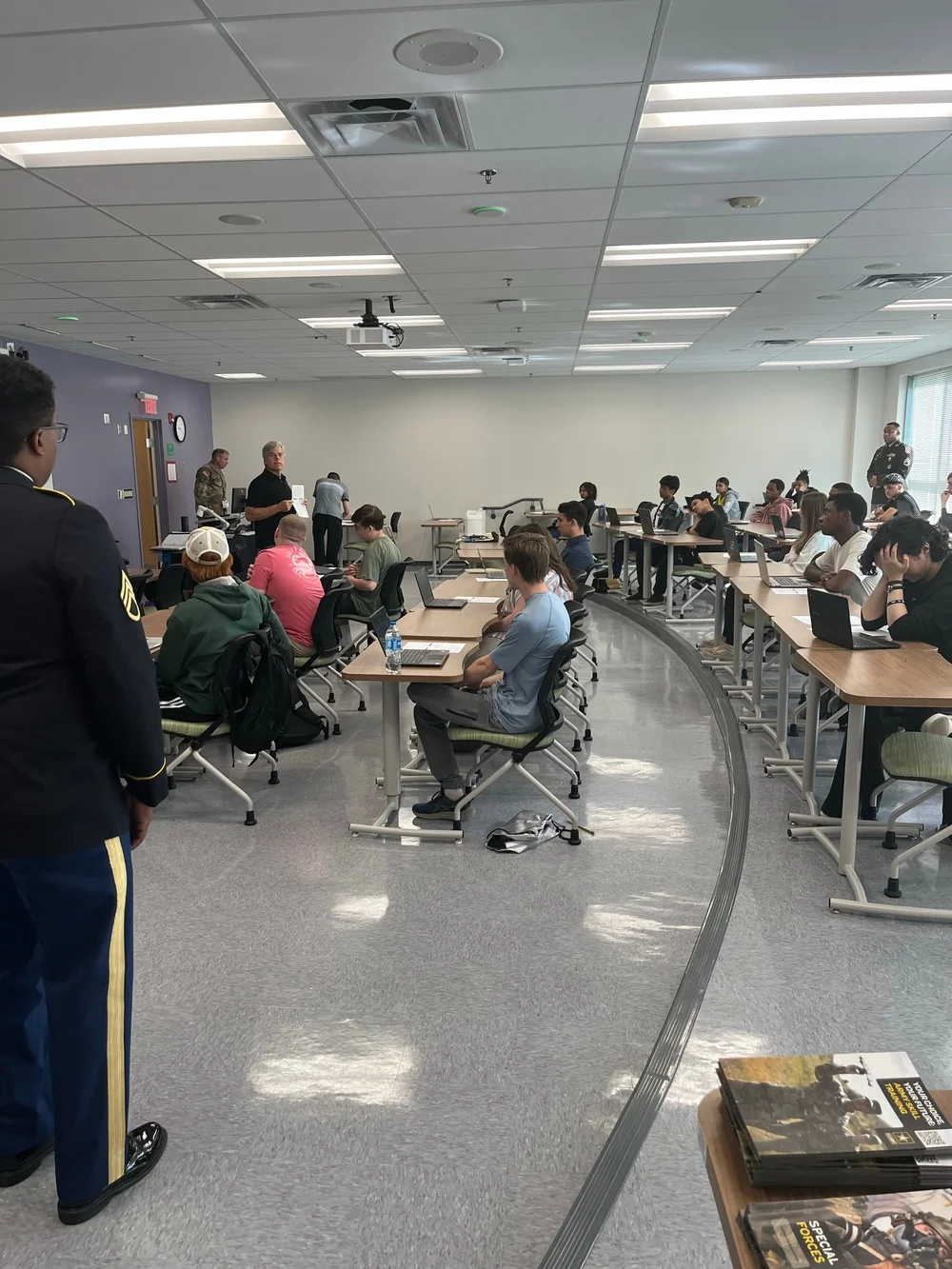
Featured image: U.S. Military Entrance Processing Command photograph via DVIDS, public domain. Home-school students from the National Capital Region receive post-test interpretation after completing the ASVAB, Alexandria, Virginia, June 6, 2024. VIRIN 240606-D-E7460-1113. The image contains English-language printed material and no Turkish text (visually checked before scheduling).
Sources
- Official ASVAB site, “What is the ASVAB?”, https://www.officialasvab.com/
- Official ASVAB site, “Understanding ASVAB Scores,” including the AFQT composition, 1997 reference group and category table, https://www.officialasvab.com/applicants/scores/