İstif Class vs FREMM: Scale, Endurance and Mission Concept Side by Side

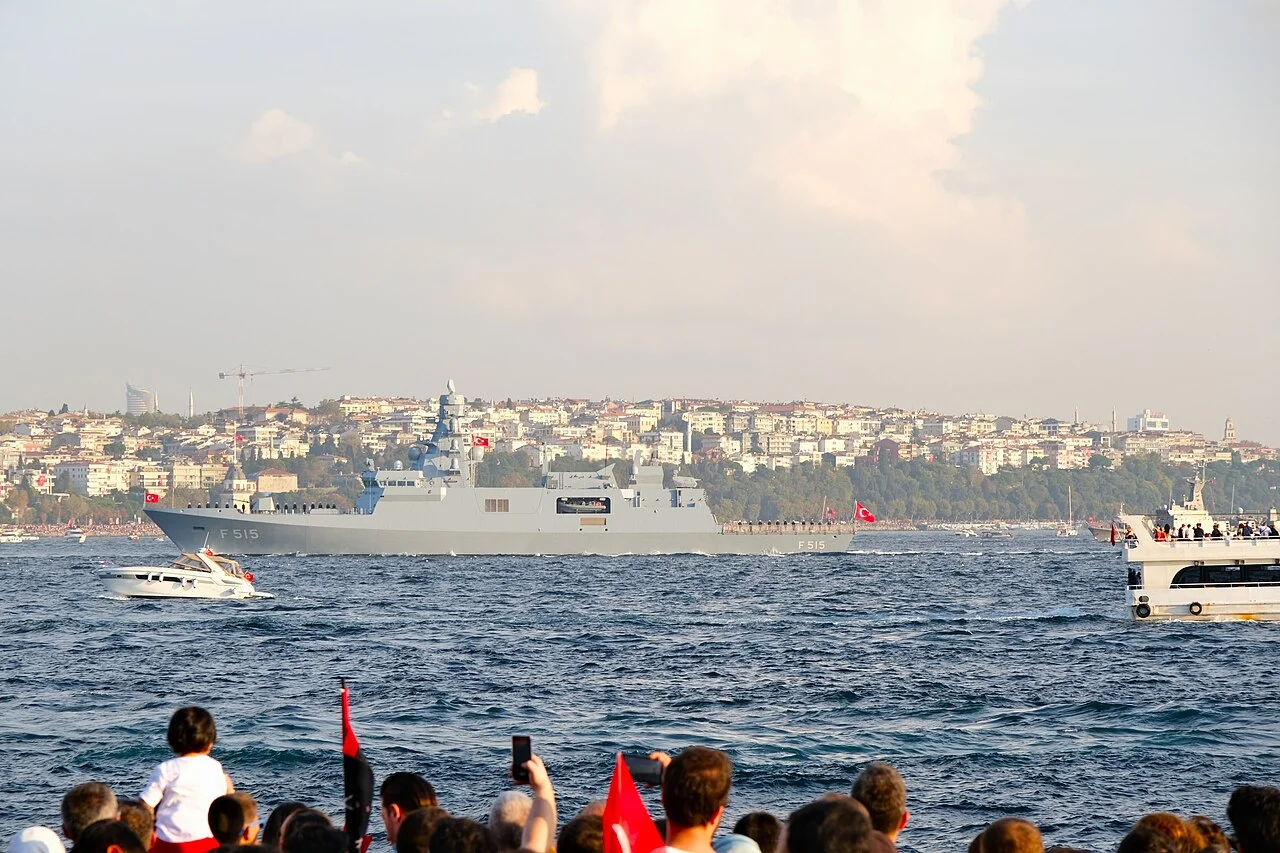
Put the İstif class and the FREMM side by side and the first thing you notice is the gap: 3,150 tonnes against 6,000-6,500; 113 metres against 142-144. It looks like a mismatch. It is not. The two designs were drawn to answer different questions, and the size difference is the answer, not the problem.
FREMM was built as a task group escort for two navies that deploy far from home. Forty-five days of endurance, two helicopter hangars, up to thirty-two vertical launch cells in French service and a land-attack cruise missile follow directly from that requirement. The İstif class was drawn for a navy whose hardest problem is hull count in three semi-enclosed seas: smaller, quicker to build, and — on STM’s own figure — 80 percent domestically sourced.
One development makes the comparison unusually current. Fincantieri confirmed that an implementing arrangement signed in Rome on 8 September 2026 will transfer two Italian Navy FREMMs, Carlo Bergamini and Virginio Fasan, to the Hellenic Navy. The two designs are about to share a sea.
Why compare these two ships
The frigate is the working class of a modern navy. It is cheaper than a destroyer and less tied to the coast than a corvette, and the number a country owns sets how many separate seas it can cover at once. Frigate programmes are therefore arguments about fleet arithmetic as much as about individual ships.
FREMM is the European answer to that arithmetic. Run jointly by France and Italy under OCCAR, it has delivered close to twenty hulls between the two navies and found export customers in Egypt, Morocco and Indonesia — Fincantieri’s 2021 Indonesian contract alone covers six FREMM frigates. In Italy the line now continues as FREMM EVO.
The İstif class is the second phase of Türkiye’s MİLGEM programme. In STM’s own words, TCG İstanbul is the first Turkish frigate designed by Turkish engineers and has a different structure from the Ada-class corvettes: the hull was stretched by ten metres to accommodate changes in the weapon fit, and the defining difference is the ability to carry and launch homing surface-to-air missiles. Ships 5 through 12 are planned as İ class, so this is a class argument rather than a single-ship one.
İstif class: a national system fit compressed into 3,150 tonnes
STM’s data sheet is unusually specific for a warship page: 113.2 m length overall, 105.2 m at the waterline, 14.40 m maximum beam, 4.15 m draught and 3,150 tonnes displacement. Propulsion is CODAG on two shafts with controllable pitch propellers, with four diesel generators for electrical power. Maximum speed is listed at 29+ knots, cruise speed at 14 knots, and endurance at 5,700 nautical miles at that cruise speed. Accommodation is for 123.
What is striking is how much of the weapon and sensor list is Turkish. The main gun is a 76 mm mount, supported by two 25 mm STOP stabilised guns. Close-in defence is handled by ASELSAN’s GÖKDENİZ. The search radar is the CENK-S 3D AESA, fire control runs through AKREP, and the combat management system is HAVELSAN’s ADVENT. The ship also carries an electronic warfare suite, an infrared search and track system, a hull-mounted sonar, torpedo launchers and torpedo countermeasures.
The threshold moment came on 13 March 2024. STM announced that TCG İstanbul had fired a HİSAR-D RF missile from the national MİDLAS vertical launching system — the first time a Turkish air defence missile had been launched from a Turkish launcher aboard a naval platform. The technically interesting part was the chain rather than the missile: ADVENT, the ship’s radars and sensors and the fire control systems all had to work as one engagement loop.
MİDLAS cell count is deliberately left blank in the table below. STM’s data sheet lists the system only as ‘Vertical Launching System (VLS)’, and Roketsan has no public product page for MİDLAS. Cell counts circulating in open sources carry no manufacturer or official signature, so they were not used.
FREMM: one hull, two national doctrines
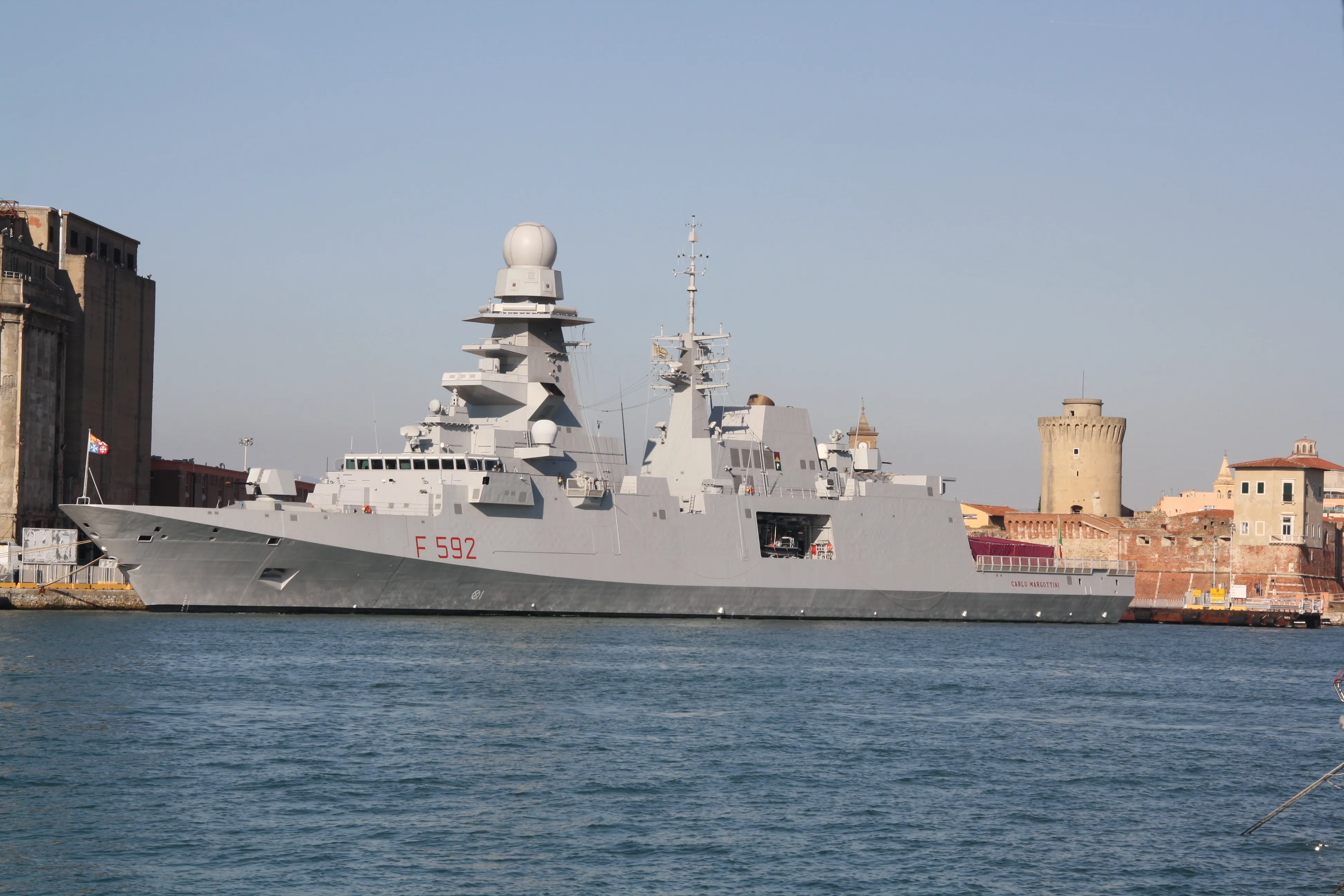
FREMM takes its name from the French frégate européenne multi-mission, and the two partner navies fitted the same hull very differently. Fincantieri gives the Italian Bergamini class as 144.00 m overall, 19.70 m in beam, 5.10 m draft and about 6,500 tonnes. The French Ministry of Armed Forces lists 142 m, 20 m and 6,000 tonnes for its own ships.
The propulsion choice reveals the doctrine. Bergamini runs CODLAG: a single 32 MW gas turbine, two 2.2 MW electric motors and four diesel generators. That layout matters for anti-submarine work, because the ship can run quietly on electric drive up to 16 knots and drop to a much lower acoustic signature at 7 knots on auxiliary propulsion, then bring the gas turbine on line for 27+ knots when it needs to. Range is 6,000 nautical miles at 15 knots with 45 days of endurance.
Armament varies by variant. Fincantieri describes the ASW version as carrying towed sonar and two 76/62 mm Strales guns, while the general purpose version mounts a 127/64 mm gun with the Vulcano system. Air defence on both rests on MBDA’s SAAM-ESD, firing Aster 15 and Aster 30 from two eight-cell Sylver A50 modules. The French fit is broader: a sixteen-cell Sylver A43 plus a sixteen-cell Sylver A70 for the MdCN naval cruise missile, giving the ship a land-attack role no Turkish frigate currently has. Anti-ship work falls to the Teseo/Otomat family in Italian service and Exocet MM40 Block 3C in French service, with MU90 torpedoes for submarines.
Aviation capacity follows the same logic. Fincantieri specifies a flight deck and two hangars for EH101 or NH90 helicopters. The İstif class carries two S-70 Seahawks, but one sits in the hangar and the other on the platform — a practical difference during long deployments, when maintenance space decides how much flying the ship can sustain.
Where the mission concepts diverge
The real split is not in the numbers but in where each ship is expected to work. For the French and Italian navies a frigate escorts a carrier or amphibious group and stays on station for weeks at a time, from the Atlantic to the Indian Ocean. Forty-five days of endurance, 6,000 nautical miles and two hangars are the direct cost of that expectation, and MdCN adds a strategic dimension on top.
STM’s description of the İ class points somewhere else: anti-air warfare and all principal warfare areas, plus surveillance, maritime patrol, EEZ monitoring and naval gunfire support. That is a description of the Aegean, the Eastern Mediterranean and the Black Sea, where transits are short, threat density is high and air defence dominates. In that setting 5,700 nautical miles is sufficient, and the scarce resource is hulls, not range.
Which explains the build model. A smaller hull means shorter construction time, lower unit cost and more yards able to work in parallel. Three frigates are being built simultaneously at Anadolu, Sedef and Sefine under the TAIS joint venture. FREMM concentrates capability per hull and accepts a slower production tempo in exchange.
Where each design concentrates (qualitative)
These bars are a qualitative summary of where each design concentrates, not a measured performance score. No independent benchmark compares the two ships under a common protocol in open sources.
The numbers side by side
| Criterion | İstif class (TCG İstanbul, F-515) | FREMM (Bergamini / Aquitaine) |
|---|---|---|
| Class and role | Multi-mission frigate; STM describes a sensor and weapon fit oriented primarily to anti-air warfare and all principal warfare areas, plus surveillance, maritime patrol, EEZ monitoring and naval gunfire support | Multi-mission frigate; ASW and GP variants in Italy, ASM and air defence (DA) variants in France |
| Builder and origin | STM as prime contractor, İstanbul Shipyard Command and the TAIS joint venture (Anadolu, Sedef, Sefine) / Türkiye | Fincantieri (Italy) and Naval Group (France), managed through OCCAR |
| Length overall | 113.2 m (105.2 m waterline) | Italian Bergamini: 144.00 m (132.50 m between perpendiculars); French FREMM: 142 m |
| Beam | 14.40 m | Italian: 19.70 m; French: 20 m |
| Draught | 4.15 m | Italian: 5.10 m; for the French variant, no verified figure is published in open sources |
| Displacement | 3,150 tonnes | Italian: about 6,500 tonnes; French: 6,000 tonnes |
| Propulsion | CODAG; two shafts with controllable pitch propellers; four diesel generators | CODLAG; one 32 MW gas turbine, two 2.2 MW electric motors, four diesel generators, controllable pitch propellers |
| Maximum speed | 29+ knots (14 knots cruise) | 27+ knots on gas turbine; 16 knots on electric drive; 7 knots on auxiliary propulsion |
| Range and endurance | 5,700 nm at 14 knots | 6,000 nm at 15 knots; 45 days endurance |
| Crew | Accommodation for 123 | 145 crew; accommodation for 200 |
| Main gun | 76 mm main gun; two 25 mm STOP stabilised guns | Italian ASW: two 76/62 mm Strales; Italian GP: 127/64 mm with Vulcano; French: 76 mm Super Rapid and 20 mm guns |
| Vertical launching system | MİDLAS national VLS. No manufacturer or official cell count is published | Italian: two eight-cell Sylver A50 (SAAM-ESD); French: sixteen-cell Sylver A43 plus sixteen-cell Sylver A70 for MdCN |
| Surface-to-air missile | HİSAR-D RF, first fired from MİDLAS on 13 March 2024. For its naval interception range, no verified figure is published in open sources; Roketsan publishes 15+ km for HİSAR-A and 25+ km for HİSAR-O | Aster 15 and Aster 30 (MBDA). The manufacturer publishes no numerical range |
| Anti-ship missile | ATMACA: 250 km range, 220 kg warhead, active RF seeker, target update and re-attack via data link | Italian: Teseo/Otomat family; French: Exocet MM40 Block 3C |
| Land attack | Naval gunfire support with the 76 mm gun. For a ship-launched land attack cruise missile, no verified figure is published in open sources | French FREMM: MdCN naval cruise missile fired from Sylver A70 |
| Close-in weapon system | GÖKDENİZ (ASELSAN) | Italian: 76/62 Strales with DART ammunition; French: 20 mm guns |
| Anti-submarine warfare | Torpedo launchers; hull mounted sonar; torpedo countermeasures | MU90 torpedo; hull and towed sonar (towed array on the Italian ASW variant) |
| Main search radar | CENK-S 3D AESA (ASELSAN). CENK family data sheet: S band, 400 km instrumented range, fighter detection beyond 160 km, 500+ tracks, 30 rpm | Multifunction radar on both national variants; Thales Herakles on the French FREMM DA. For a manufacturer-signed range figure, no verified figure is published in open sources |
| Combat management system | ADVENT (HAVELSAN) | French: SETIS (Naval Group); for the Italian variant, no verified figure is published in open sources |
| Helicopter | Two S-70 Seahawk (one in the hangar, one on the platform) | Italian: flight deck and two hangars for EH101/NH90; French: NH90 NFH |
| In service since | TCG İstanbul (F-515): 19 January 2024 | French Aquitaine: 2012; Italian Carlo Bergamini: May 2013 |
| Class size and programme | Eight ships planned as MİLGEM 5-12; TCG İzmir and TCG İzmit launched, TCG İçel launched at Sefine on 11 September 2025 | Close to twenty ships across the Italian and French navies; the programme continues with FREMM EVO |
| Indigenisation rate | 75 percent target, 80 percent achieved (STM); up to 80 percent for TCG İçel (SSB) | Multinational European programme; no verified figure is published in open sources |
| Operators and customers | Türkiye. No export customer announced for the İ class | Italy, France, Egypt, Morocco; Indonesia (six-ship contract in 2021); Greece (transfer of Carlo Bergamini and Virginio Fasan under the 8 September 2026 arrangement) |
| Unit cost | no verified figure is published in open sources | no verified figure is published in open sources |
Sources: STM I Class Frigate data sheet and TCG İstanbul programme page; Presidency of Defence Industries; ASELSAN CENK data sheet; Roketsan ATMACA and HİSAR product pages; Fincantieri Bergamini class page; French Ministry of Armed Forces FREMM data sheet; Naval Group. Figures without a manufacturer or official signature were left out.
The FREMM column covers two national variants. The Italian Bergamini and French Aquitaine classes were developed under one programme but differ substantially in weapons and sensors, so each line states which navy a given figure belongs to rather than merging them into a single specification.
Operators and current status

FREMM’s operator list is long. Beyond the Italian and French navies, Egypt and Morocco each operate export ships, and Fincantieri signed a contract with Indonesia in 2021 covering six FREMM frigates. The newest entry is Greek: under the implementing arrangement signed in Rome on 8 September 2026, Carlo Bergamini and Virginio Fasan will pass from the Italian Navy to the Hellenic Navy, with Fincantieri leading the transfer and lifecycle support and drawing Greek industry into maintenance and systems integration.
The İstif column is shorter. TCG İstanbul was delivered on 19 January 2024. The contract for ships 6, 7 and 8 followed on 6 April 2023, with the steel-cutting ceremony at Sedef Shipyard on 10 April 2023. TCG İzmir and TCG İzmit have been launched, and TCG İçel entered the water at Sefine on 11 September 2025 — a ship that SSB president Haluk Görgün described as carrying national solutions across radar, sonar, fire control and anti-ship missiles at an indigenisation rate reaching 80 percent.
No export customer has been announced for the İ class. The wider MİLGEM family does have an export record, so the door is not closed, but against FREMM’s two decades of production and sales the Turkish class is still early in its programme.
Where each design stands out
Where the İstif class differs in mission terms
- Supply chain independence: STM’s 80 percent local content figure means the radar, combat management system, vertical launcher, air defence missile and anti-ship missile are all resolved domestically, with no third-country release constraint on the critical path.
- Build tempo: the smaller hull lets three yards work in parallel, which is how fleet depth grows on a short timeline.
- Anti-ship reach: Roketsan publishes 250 km and a 220 kg warhead for ATMACA; the declared reach of the Exocet MM40 Block 3C family sits below that figure.
- Sensor transparency: ASELSAN publishes a manufacturer-signed data sheet for the CENK family; no comparable open manufacturer figures exist for FREMM’s radar performance.
Where FREMM differs in mission terms
- Reach and endurance: 6,000 nautical miles at 15 knots and 45 days on station suit sustained deployments far from home waters.
- Magazine depth: sixteen VLS cells in Italian service and thirty-two in French service, the latter including MdCN for land attack from the sea.
- Quiet running: the CODLAG architecture allows silent electric transit to 16 knots and a much lower acoustic signature on auxiliary drive — a decisive property in anti-submarine warfare.
- Aviation capacity: two hangars change what helicopter maintenance and sortie sustainment look like on a long deployment compared with a single-hangar design.
- Maturity and support network: in service since 2012, with a user base across Egypt, Morocco, Indonesia and now Greece, and an established lifecycle support structure.
Limitations on both sides
The İstif class is constrained by scale. A 3,150-tonne hull cannot carry the fuel, ordnance and crew of a 6,500-tonne one, and 5,700 nautical miles of endurance that works well in semi-enclosed seas becomes limiting on distant deployments. Transparency is the second constraint: there is no published cell count for MİDLAS and no manufacturer figure for the naval HİSAR-D RF’s interception range. The third is maturity — one of eight ships has been delivered, and long-run operational data does not yet exist.
FREMM’s constraints sit elsewhere. Being a multinational programme puts export and configuration decisions through shared approval machinery. The national variants have diverged far enough that ‘FREMM’ no longer describes a single standard; the Italian ASW ship and the French air defence ship differ materially in weapons, sensors and role. And the larger hull carries a larger unit cost and a longer build — part of why the Italian Navy is releasing its two oldest FREMMs as it moves to FREMM EVO.
What this means for Türkiye
The first implication is a planning one. Two FREMMs entering Hellenic Navy service changes the qualitative composition of the platform inventory in the Aegean and Eastern Mediterranean: Carlo Bergamini and Virginio Fasan bring Aster-family air defence and mature anti-submarine capability into the region. That is an input to Turkish operational planning rather than a change in threat definition.
The second is about the İstif class itself. Türkiye has joined the small group of countries able to take a frigate carrying and firing its own air defence missile from design to live firing using domestic industry. The MİDLAS shot of 13 March 2024 is the technical proof: a national launcher, a national missile, a national combat management system and a national radar working in one engagement chain. That is a systems integration credential, not just a capability.
The third is about proportion. The İstif class was not drawn to replace a FREMM, and reading the comparison as a size contest misses the architecture. Türkiye is developing the TF-2000 air defence destroyer in the same period, which indicates a layered fleet design: the İ class for numbers and multi-role work, TF-2000 for area air defence. Taking into account what the operating navies have chosen, the useful question is which fleet architecture answers which requirement.
Assessment
The İstif class and FREMM occupy opposite ends of the frigate definition. FREMM is an ocean-going platform of 6,000-6,500 tonnes with 45 days of endurance and, in French service, thirty-two vertical launch cells. The İstif class is a 3,150-tonne design built around high domestic content and a hull that can be produced quickly enough to grow fleet depth.
On some lines the Turkish ship leads — ATMACA’s declared 250 km reach and ASELSAN’s published CENK data sheet among them. On others FREMM’s scale decides the matter: magazine depth, endurance, quiet running and two hangars. Neither list cancels the other; they record different priorities inside different mission concepts.
For Türkiye the gain is that the comparison can be made at all. A decade ago the Turkish column in a table like this would have been filled largely with imported systems; today the radar, combat management system, vertical launcher, air defence missile and anti-ship missile lines carry domestic names. What the class is worth operationally will be visible once all eight hulls are delivered and long-run data exists.
Are the İstif class and FREMM the same type of ship?
Both are labelled multi-mission frigates, but they sit at opposite ends of that category. STM’s official data sheet gives the İstif class as 113.2 m long and 3,150 tonnes. Fincantieri lists the Bergamini class at 144.00 m and about 6,500 tonnes; the French Ministry of Armed Forces gives 142 m and 6,000 tonnes for its own FREMM. The European design is roughly twice the displacement of the Turkish one, which is a design decision rather than a shortfall.
How far can the İstif class engage aircraft?
No engagement range has been published. What is documented is the architecture: the ship carries the MİDLAS national vertical launching system, and STM announced on 13 March 2024 that TCG İstanbul fired a HİSAR-D RF missile from MİDLAS for the first time. Roketsan’s public HİSAR page gives 15+ km for HİSAR-A and 25+ km for HİSAR-O, but there is no manufacturer figure for the naval HİSAR-D RF. On the FREMM side, MBDA publishes no numerical range for the Aster 15 and Aster 30 either.
How many VLS cells does each ship have?
The Italian Bergamini class uses the MBDA SAAM-ESD system built around two eight-cell Sylver A50 modules, for sixteen cells. French FREMMs add a sixteen-cell Sylver A70 for the MdCN land-attack cruise missile on top of a sixteen-cell Sylver A43, for thirty-two. For MİDLAS, neither STM nor Roketsan publishes a cell count, so this comparison leaves that line blank.
Why is the Turkish frigate so much smaller?
Because it answers a different question. STM describes the İ class as configured primarily for anti-air warfare and all principal warfare areas, plus surveillance, maritime patrol, exclusive economic zone monitoring and naval gunfire support. That mission set is exercised largely in the Aegean, Eastern Mediterranean and Black Sea, where distances are short and the premium is on how many hulls are at sea. FREMM was designed as a task group escort for open-ocean deployments, which is why it carries 45 days of endurance and two helicopter hangars.
Is the 80 percent local content figure real?
It is STM’s own published figure. The company states that the target indigenisation rate for TCG İstanbul was 75 percent and the achieved rate 80 percent, making it the Turkish warship with the highest local content. Türkiye’s Presidency of Defence Industries used the same ‘up to 80 percent’ wording for TCG İçel when the eighth MİLGEM ship was launched on 11 September 2025. The figure is calculated across the ship’s cost, not system by system.
Why does the Greek FREMM deal matter to this comparison?
Because it moves the two designs into the same water. Fincantieri confirmed that an implementing arrangement signed in Rome on 8 September 2026 will transfer two Italian Navy FREMMs — Carlo Bergamini and Virginio Fasan — to the Hellenic Navy, with Fincantieri leading the transfer and full lifecycle support and bringing Greek industry into maintenance and systems integration. For Turkish naval planners the FREMM stops being an abstract benchmark.
How many İstif-class frigates are planned?
Ships 5 through 12 of the MİLGEM programme are planned as İ class, which means eight frigates. The lead ship TCG İstanbul (F-515) was delivered to the Turkish Naval Forces Command on 19 January 2024. The contract for ships 6, 7 and 8 was signed on 6 April 2023 and construction is running in parallel at the Anadolu, Sedef and Sefine yards under the TAIS joint venture. TCG İçel was launched at Sefine on 11 September 2025.
So which is the better frigate?
That framing does not survive contact with the data. FREMM offers more magazine depth, more endurance and a quieter propulsion architecture for anti-submarine work. The İstif class offers a smaller, faster-to-build hull with an unusually high domestic content ratio, which is how a navy grows fleet numbers. Taking into account what the operating navies have chosen, the two designs serve different mission concepts rather than competing for the same slot.
Related reading
Defence comparisons from Envanter Medya
System-by-system comparisons built on manufacturer and official-institution sources, with unverified figures left blank rather than estimated.
Sources and verification note
- STM — I Class Frigate official product page — Length overall 113.2 m, length waterline 105.2 m, beam max 14.40 m, draught 4.15 m, displacement 3,150 tonnes, maximum speed 29+ knots, cruise speed 14 knots, endurance 5,700 nm at 14 knots, CODAG propulsion with two shafts and controllable pitch propellers, four diesel generators, accommodation for 123, capacity for two S-70 Seahawk helicopters; CENK-S 3D search radar, AKREP fire control radar, ADVENT combat management system, MİDLAS vertical launching system, GÖKDENİZ CIWS, 76 mm main gun, two 25 mm STOP stabilised guns
- STM — TCG İstanbul (F-515) programme page — Contract signed with the Defence Industry Agency on 12 April 2019; launch on 23 January 2021; port acceptance tests from May 2022; flag hoisting on 20 June 2023; delivery on 19 January 2024; target indigenisation rate 75 percent and achieved rate 80 percent; 80 subcontractors working on more than 150 systems with 220 firms involved; contract for ships 6, 7 and 8 signed on 6 April 2023 under the STM-TAIS joint venture
- STM — first MİDLAS firing from TCG İstanbul — 13 March 2024: first firing of a HİSAR-D RF missile from the national MİDLAS vertical launching system aboard TCG İstanbul; integration of the ADVENT national combat management system with the ship’s radar, sensor and fire control systems; the MİLGEM ships 5-8 VLS procurement project run under Roketsan as prime contractor
- Presidency of Defence Industries (SSB) — launch of TCG İçel — Launch of the eighth MİLGEM ship TCG İçel at the Sefine Shipyard in Altınova, Yalova on 11 September 2025; statement by SSB president Prof. Dr. Haluk Görgün; indigenisation rate of up to 80 percent and national solutions across radar, sonar, fire control systems and anti-ship missiles; more than 200 institutions and companies involved in the programme
- ASELSAN — CENK long range AESA air and surveillance radar data sheet — S band; 400 km instrumented range; fighter detection range greater than 160 km; 70 degrees elevation coverage (80 degrees while tracking); 360 degrees mechanical and 100 degrees electronic azimuth coverage; 30 rpm antenna rotation; more than 500 air and surface tracks; above deck weight under 1,800 kg; dual axis multi-beam AESA architecture
- Roketsan — ATMACA Anti-Ship Missile product page — Range 250 km; length 4.3-5.2 m; weight under 750 kg; 220 kg high explosive fragmentation and penetration warhead; INS plus GPS with barometric and radar altimeter guidance; active RF seeker; target update, re-attack and mission abort via data link; low radar cross section
- Roketsan — HİSAR Air Defence Missiles product page — Interception range 15+ km for HİSAR-A (low altitude) and 25+ km for HİSAR-O (medium altitude); high explosive blast fragmentation warhead; dual-pulse solid propellant motor; vertical launch with 360 degree effectiveness; thrust vector control; target set of fixed and rotary wing aircraft, cruise missiles, UAVs and air-to-ground missiles
- Fincantieri — Bergamini class (FREMM) official product page — Displacement about 6,500 tonnes; length overall 144.00 m; length between perpendiculars 132.50 m; beam 19.70 m; draft 5.10 m; CODLAG propulsion with one 32 MW gas turbine, two 2.2 MW electric motors, four diesel generators and controllable pitch propellers; 27+ knots on gas turbine, 16 knots electric, 7 knots auxiliary; 6,000 nm at 15 knots and 45 days endurance; 145 crew with accommodation for 200; flight deck and two hangars for EH101/NH90; towed sonar and two 76/62 mm Strales guns on the ASW variant, a 127/64 mm gun with Vulcano on the GP variant
- French Ministry of Armed Forces — multi-mission frigate (FREMM) data sheet — Displacement 6,000 t; length overall 142 m; beam overall 20 m; maximum speed 27 knots; ASTER 15 and ASTER 30 missiles with a 76 mm gun; 20 mm guns and Exocet MM40 Block 3C for surface warfare; MdCN naval cruise missile for land attack; MU90 torpedo; multifunction radar, infrared surveillance, hull and towed sonar; NH90 NFH ASW helicopter; ASW and AAW configurations
- Naval Group — delivery of the FREMM DA Alsace — Alsace described as the first multi-mission frigate with enhanced air defence capabilities; Herakles multifunction radar, Aster 15 and Aster 30, Exocet MM40 missiles and MU90 torpedoes; NH90 Caïman Marine helicopter with the SAMAHE handling system; SETIS combat management system with dedicated air defence functions
- Fincantieri — Italy-Greece naval cooperation and the transfer of two FREMM frigates — Implementing arrangement signed in Rome on 8 September 2026 covering the transfer of Carlo Bergamini and Virginio Fasan, currently in Italian Navy service, to the Hellenic Navy; Fincantieri’s leading role in the transfer and in lifecycle support for both vessels; industrial cooperation bringing Greek industry into maintenance and systems integration; signed by Italy’s General Directorate for Armaments and Greece’s General Directorate of Defence Investments and Armaments
- Fincantieri — eight vessels for Indonesia — Contract signed with the Indonesian Ministry of Defence on 10 June 2021 covering the supply of six FREMM class frigates plus the modernisation and sale of two Maestrale class frigates; Fincantieri as prime contractor for the whole programme in cooperation with the PT-PAL shipyard in Java
This comparison draws on manufacturer sources (STM, Fincantieri, Naval Group, ASELSAN, Roketsan) and official institutional sources (Türkiye’s Presidency of Defence Industries and the French Ministry of Armed Forces). Turkish defence news sites were not used as sources. Displacement, range, cell count and performance values without a manufacturer or official signature were left out of the table and flagged in the relevant rows.
Editor’s note: this article compares the mission concepts of two multi-mission frigate designs; it is not a superiority ranking. The FREMM column covers both the Italian Bergamini and French Aquitaine variants, which share a programme but differ materially in weapons and sensors; each row states which navy a figure belongs to. The İstif class is an eight-ship programme of which only the lead ship had been delivered at the time of publication. Technical data reflects open sources as of publication; configurations and programme status may change.