JF-17 Block III Specifications: Radar, Engine, Price, Operators (2026)

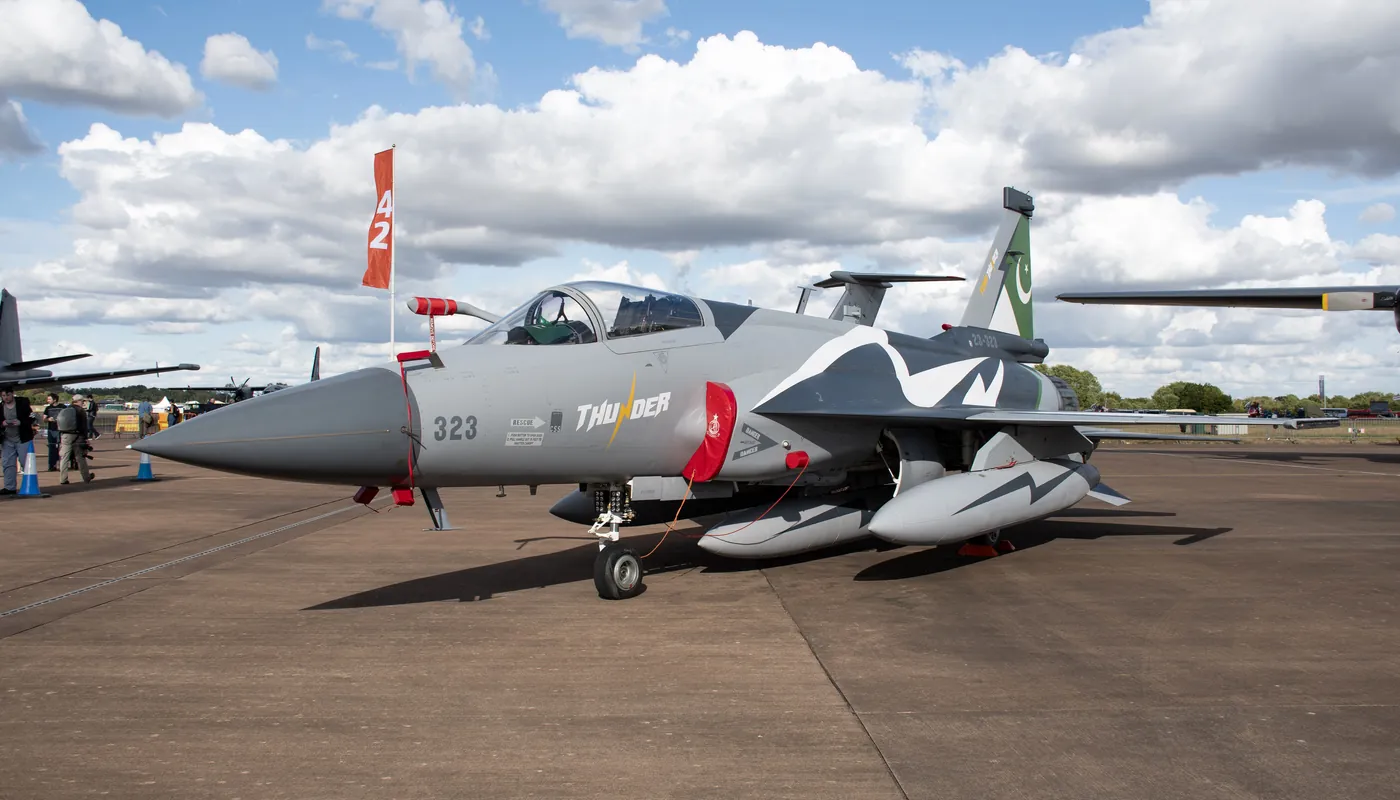
Short answer: The JF-17 Block III (also written JF-17C) is the third and most advanced production standard of the Pakistan-China fighter built by PAC Kamra and CAC Chengdu. It adds the KLJ-7A AESA radar, a helmet-mounted display, an upgraded electronic warfare suite and the PL-15E long-range missile. IISS Military Balance 2025 counts 42 Block III in PAF service; no official unit price exists; Azerbaijan is the only confirmed Block III export customer, with deliveries under way since October 2025.
Last updated: 17 September 2026
Pakistan Defence Hub: Pakistan Military Power → Army → Air Force → Navy → Defence Industry → Türkiye–Pakistan
What is the JF-17 Block III?
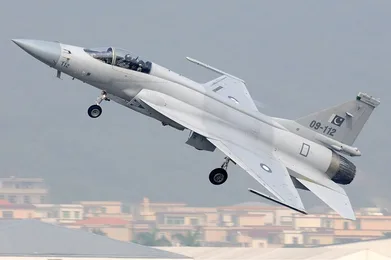
The JF-17 Thunder grew out of the Super-7 and FC-1 projects, was contracted as a joint Pakistan-China development in 1999 and first flew at Chengdu on 25 August 2003. Serial production at Pakistan Aeronautical Complex (PAC) Kamra began on 22 January 2008; the first squadron stood up in February 2010. The Block III prototype flew on 15 December 2019, the first aircraft in Pakistan Air Force (PAF) markings (serial 22-305) was photographed on 23 March 2023, and Janes recorded formal induction in mid-November 2023.
Block III is not a new airframe. It is the same 14.9-metre single-engine light fighter with a new sensor and cockpit package: an active electronically scanned array radar in place of a mechanically scanned set, a wide-angle holographic head-up display, a helmet-mounted display and an upgraded electronic warfare (EW) fit. PAC states that 58 percent of the airframe by work share (front fuselage, wings, vertical stabiliser) is built in Pakistan and 42 percent in China; the engine is Russian and the ejection seats are Martin-Baker.
Block I vs Block II vs Block III: what changed
The three production blocks are three avionics generations on one platform. Fleet numbers below are from IISS 2025; equipment descriptions from the manufacturer and Janes.
| Feature | Block I | Block II | Block III |
|---|---|---|---|
| Radar | KLJ-7 mechanically scanned | KLJ-7 (improved modes) | KLJ-7A AESA, reported ~170 km detection |
| Cockpit | Conventional HUD, MFDs | Conventional HUD, MFDs | Wide-angle holographic HUD, glass cockpit, helmet-mounted display/sight |
| Air-to-air refuelling | No | Yes (IFR probe) | Yes (IFR probe) |
| Electronic warfare | Baseline self-protection | Improved EW | Upgraded EW suite |
| Structure | Metal-dominant | More composites | Further composite use |
| Headline missile | SD-10 / PL-5 | SD-10 / PL-5 | PL-15E (145 km export) and PL-10E |
| IRST | No | No | Reported, not confirmed |
| PAF fleet (IISS 2025) | 50 | 62 (+26 JF-17B two-seat) | 42 |
| Export standard | No | Yes (Myanmar JF-17M, Nigeria) | Yes (Azerbaijan) |
Sensors and weapons: KLJ-7A AESA, HMD, EW, PL-15E and PL-10E
KLJ-7A AESA radar
The KLJ-7A is a Chinese active electronically scanned array (AESA) radar replacing the mechanically scanned KLJ-7. Detection range against a fighter-sized target is reported at around 170 kilometres, an industry figure rather than a PAF or CETC data sheet number. An AESA steers its beam electronically and is far harder to jam; our AESA radar ranking sets the KLJ-7A beside the APG-83 and RBE2-AA.
Helmet-mounted display and holographic HUD
Block III introduces a helmet-mounted display and sight (HMD/S) and a wide-angle holographic HUD in a full glass cockpit. The HMD matters chiefly in close combat, where the seeker of the PL-10E infrared missile is slaved to the pilot’s line of sight.
Electronic warfare
PAC describes an upgraded EW suite with radar warning, missile approach warning and countermeasure dispensers; the jammer’s designation is not published by PAF.
PL-15E and PL-10E
The PL-15E is the export version of China’s active-radar beyond-visual-range missile with a published range of 145 kilometres; the PL-10E is the export imaging-infrared short-range missile with high off-boresight capability. Both are integrated on Block III. The aircraft also carries the CM-400AKG supersonic air-to-surface missile on seven hardpoints and a twin-barrel 23 mm GSh-23-2 cannon. For PL-15E against Meteor and AMRAAM see the Pakistan missiles list.
Engine: RD-93 vs RD-93MA
Every operational JF-17 flies on the Russian Klimov RD-93, an RD-33 derivative with a relocated gearbox: about 49.4 kN dry and about 84 kN with afterburner. The RD-93MA raises afterburning thrust to about 91 kN, roughly 8 percent more; Defense Mirror reported in July 2025 that UEC-Klimov had dispatched RD-93MA engines to Pakistan. Which airframes receive it has not been stated. The Chinese WS-13 has been discussed for two decades, but as of September 2026 no operational JF-17 with a WS-13 is confirmed, and reliance on a Russian engine remains the programme’s most-cited supply-chain risk, one the PFX plan intends to address.
JF-17 Block III performance and dimensions
Figures are from Airforce Technology and PAC brochure data; Block III shares the airframe of earlier blocks, so speed, ceiling and payload are common to all three.
| Parameter | Value | Source / year |
|---|---|---|
| Length / wingspan / height | 14.9 m / 9.45 m / 4.77 m | Airforce Technology, 2025 |
| Empty weight | 6,411 kg | Airforce Technology, 2025 |
| Maximum take-off weight (MTOW) | 12,700 kg | Airforce Technology, 2025 |
| External payload | 3,700 kg on 7 hardpoints | Airforce Technology, 2025 |
| Maximum speed | 2,205 km/h (about Mach 1.6) | Airforce Technology, 2025 |
| Service ceiling | 16,920 m | Airforce Technology, 2025 |
| Ferry range | 3,480 km | Airforce Technology, 2025 |
| Combat radius | 1,352 km (brochure, profile not stated) | PAC brochure via Airforce Technology |
| Engine | RD-93 ~84 kN AB (RD-93MA ~91 kN) | Klimov / Defense Mirror, Jul 2025 |
| Gun | 23 mm GSh-23-2 | Airforce Technology, 2025 |
Two cautions: the 1,352 km combat radius is a brochure maximum with no stated mission profile, and the Mach 1.6 top speed is below the F-16 and Rafale, a consequence of the light-fighter design rather than a Block III shortcoming.
How many JF-17 Block III does Pakistan have?
IISS Military Balance 2025 gives the PAF fleet as 50 Block I, 62 Block II, 26 JF-17B and 42 Block III, about 175 aircraft. Other counts are lower: Al Jazeera wrote “more than 150” in January 2026 and Airforce Technology listed about 156 in 2025. The Block III figure of 42 is the only sourced number; Pakistani media reported a 50th Block III airframe around DSA 2026 without an official confirmation.
Why the totals disagree: IISS counts by block and includes conversion and reserve units; press counts often cite front-line squadrons only or repeat older PAF statements. Envanter Medya therefore states the fleet as 150-175 depending on source and year, and Block III as 42 per IISS 2025 with more reported. The full breakdown is on our PAF inventory 2026 page.
Production is reported at 16-18 aircraft a year against a Kamra capacity of 20-25 (industry figures, not PAC statements); with Azerbaijan’s 40 aircraft in the queue, the Block III share of the PAF fleet will rise gradually.
JF-17 Block III price: what the packages say
There is no official unit price for any JF-17 block. What is public are package totals that bundle training, spares, ground equipment and weapons:
- Azerbaijan, 22 February 2024: $1.6 billion for 16 Block III plus training and ordnance; expanded on 6 June 2025 to 40 aircraft for $4.6 billion (Azerbaijani Prime Minister’s Office).
- Nigeria, 2018: Pakistan’s Economic Coordination Committee approved a $184.3 million sovereign guarantee for three Block II including support and weapons (Express Tribune).
Do not divide these totals by the number of aircraft: a package includes years of support and an unknown weapons load, so the quotient is not a flyaway cost. Media estimates put Block II at $25-30 million and Block III at $30-40 million per aircraft; Envanter Medya labels them as estimates. The same approval-versus-contract gap is explained in our Rafale pricing and F-16 Block 70 pricing pages.
Operators and export status
The table separates delivered aircraft from orders, reports and negotiations; an ordered or discussed aircraft is never counted as in service.
| Country | Standard | Status (2026) | Source / year |
|---|---|---|---|
| Pakistan | Block I / II / IIB / III | In service, ~150-175 | IISS 2025; Al Jazeera Jan 2026 |
| Azerbaijan | Block III | Delivered: first batch Oct 2025; 5 at 8 Nov 2025 parade; 408th Sqn, Nasosnaya AB (MoD video 6 Jul 2026). Contract 40. | Janes, Jul 2026; PMO Baku, Jun 2025 |
| Myanmar | JF-17M (Block II std) | 16 ordered 2016; delivered 2018-21; reported grounded since 2022 | Dawn 2016; Irrawaddy (report) |
| Nigeria | Block II | 3 delivered 21 May 2021; ASELPOD user | Janes |
| Iraq | Block III (reported) | Denied by Iraqi Air Force 2023; interest reported again 2026 | Report only |
| Somalia | Block III (reported) | Negotiation for 24 aircraft, ~$900 million-1 billion, Feb 2026 | Report only |
| Bangladesh | Not specified (reported) | Talks for up to 48 aircraft, Jan 2026 | Al Jazeera, Jan 2026 (report) |
| Saudi Arabia | Not specified (reported) | Reuters via Dawn; no contract | Report only |
| Unnamed buyer | Not specified | Export MoU at Dubai Airshow, Nov 2025 | Dawn, Nov 2025 |
| Uzbekistan, Libya | Not specified (reported) | Interest reported | Report only |
Azerbaijan is the first Block III export, running alongside Baku’s Turkish purchases described in our Azerbaijan inventory. Myanmar’s Block II fleet has been reported grounded since 2022. Pakistan’s own JF-17 deployment to Saudi Arabia in 2026 is covered in this report.
May 2025: what both sides claim about the JF-17
The May 2025 India-Pakistan conflict is the JF-17’s only large-scale combat episode, and its record is contested. Pakistan says its air force downed six Indian aircraft including three Rafales on 7 May 2025, mainly with J-10CE fighters firing PL-15E, and that a JF-17 struck an S-400 element at Adampur with a CM-400AKG. India’s Chief of Defence Staff, General Anil Chauhan, acknowledged “losses” while rejecting the figure of six (ThePrint), and Prime Minister Modi appeared at Adampur before an intact S-400 launcher. India claims 12-13 Pakistani aircraft including JF-17s, later stated as six (Al Jazeera, August 2025); Pakistan denies losing any.
Reuters reported in August 2025 that at least one Rafale was downed by a J-10C using a PL-15. No JF-17 air-to-air kill and no JF-17 loss has been independently verified; the verified claims centre on the J-10CE/PL-15E pairing, not the JF-17 Block III. Our India-Pakistan strength comparison applies the same sourcing standard to both sides.
Turkish content on the JF-17: ASELPOD
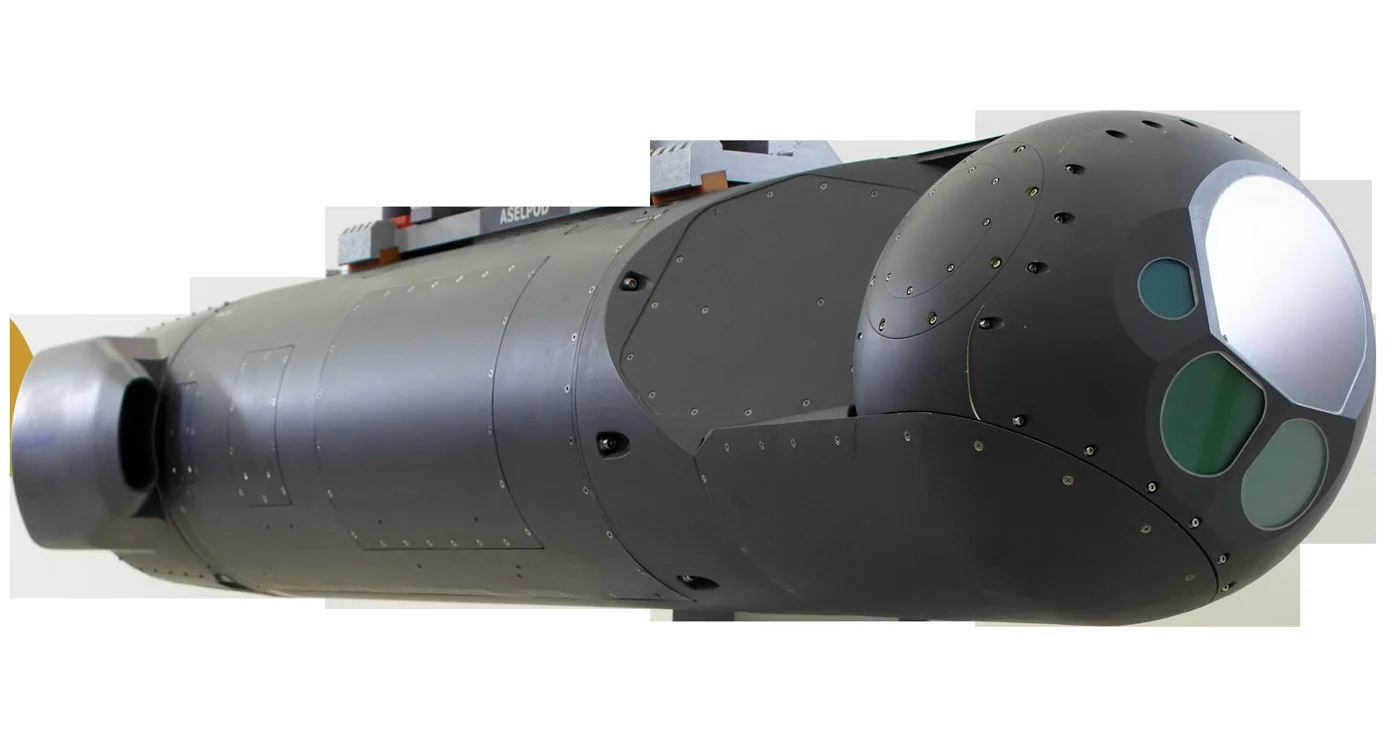
The one confirmed Turkish system on the JF-17 is the ASELSAN ASELPOD targeting pod (laser designation and electro-optical/infrared imaging for precision-guided bombs). Pakistan was the launch export customer: eight pods for about $25 million in 2016, then 16 pods for $24.9 million in May 2017, with firing tests from PAF JF-17s in June 2017 (ASELSAN 2017 annual report via Quwa). Nigeria’s JF-17s also fly with ASELPOD, per Janes. A reported SIPRI register entry for 40 ASELPOD to Azerbaijan (Army Recognition, March 2026) would match the 40-aircraft order but is not an ASELSAN announcement. No other ASELSAN avionics on the JF-17 are officially confirmed. See which Turkish weapons Pakistan uses and the ASELPOD explainer.
PFX: the next step after Block III
At IDEAS in November 2024 Pakistan unveiled the JF-17 PFX (“Block 4” or “PFX-Alpha” in search queries), a PAC-CAC project described as “4.5+ generation” with a locally selected radar and completion targeted “before the end of the decade” (Janes). As of September 2026 no prototype has flown, so Block III remains the definitive JF-17 for the rest of the 2020s.
JF-17 Block III vs Rafale, F-16 Block 70 and Tejas Mk1A
Manufacturer data, same criteria for each; the Rafale and F-16 are a heavier class. HÜRJET is excluded: it is an advanced jet trainer and light attack aircraft, not a JF-17-class fighter.
| Criterion | JF-17 Block III | F-16 Block 70 | Rafale F4 | Tejas Mk1A |
|---|---|---|---|---|
| Engine (afterburner) | RD-93 ~84 kN (MA ~91) | F110-GE-129 ~129 kN | 2×M88 ~2×75 kN | F404-IN20 ~84 kN |
| Maximum speed | Mach 1.6 | >Mach 2 | Mach 1.8 | ~Mach 1.6-1.8 |
| MTOW | 12,700 kg | ~21,770 kg | 24,500 kg | ~13,500 kg |
| Radar | KLJ-7A AESA | APG-83 AESA | RBE2-AA AESA | ELM-2052, Uttam AESA planned |
| Range | Ferry 3,480 km | Ferry >4,200 km with tanks | Ferry 3,700 km | Ferry ~3,000 km |
| First flight | 2003 (Block III 2019) | 1974 (Block 70 2023) | 1986 | 2001 (Mk1A 28 Mar 2024) |
| Official unit price | None | None per unit | None | Package: Rs 62,370 crore for 97 (Sep 2025) |
| Source / year | Airforce Technology 2025 | Lockheed Martin 2026 | Dassault 2026 | Business Today, Sep 2025 |
The JF-17 Block III competes on cost class and sensor generation rather than raw performance. What no table shows is combat effectiveness, which depends on training, tankers, airborne early warning and the network the aircraft flies in.
Frequently Asked Questions
Which generation fighter is the JF-17 Block III?
Generally 4.5-generation: AESA radar, helmet-mounted display, modern EW suite and PL-15E missiles on a non-stealth airframe. PAC and CAC call the follow-on PFX “4.5+ generation”. See our fighter generations guide.
What is the JF-17 Block III price per unit?
No official unit price exists; only package totals are public: Azerbaijan’s $1.6 billion for 16 aircraft (2024), expanded to $4.6 billion for 40 (2025), and Nigeria’s $184.3 million for three Block II with support and weapons. Media estimates of $30-40 million are estimates, and dividing packages by airframe count is misleading.
JF-17 Block III vs Rafale: how do they compare?
The Rafale F4 is a heavier twin-engine aircraft (24,500 kg MTOW, two M88 of about 75 kN, RBE2-AA AESA); the JF-17 Block III is a light single-engine fighter (12,700 kg MTOW, one RD-93 of about 84 kN, KLJ-7A AESA). Different classes; Envanter Medya publishes same-criteria tables, not “who wins” verdicts.
How many JF-17 Block III does Pakistan have?
IISS Military Balance 2025 lists 42 Block III in PAF service within a JF-17 fleet of about 175. Press reports in 2026 mention a 50th Block III airframe, not confirmed by an official Pakistani figure.
Which engine does the JF-17 Block III use?
The Russian Klimov RD-93 (about 84 kN with afterburner). Defense Mirror reported that UEC-Klimov dispatched the improved RD-93MA (about 91 kN) to Pakistan in July 2025; a WS-13 on an operational JF-17 is unconfirmed.
Which countries operate the JF-17?
Pakistan (all blocks), Myanmar (JF-17M), Nigeria (three Block II, delivered May 2021) and Azerbaijan (Block III, deliveries from October 2025). Iraq, Somalia, Bangladesh, Saudi Arabia, Uzbekistan and Libya appear only in reports or negotiations.
Does the JF-17 Block III carry Turkish equipment?
Yes, the ASELSAN ASELPOD targeting pod: Pakistan was the launch export customer (8 pods in 2016, 16 in 2017), with firing tests from PAF JF-17s in June 2017; Nigeria also uses it. No other ASELSAN avionics are officially confirmed.
Related Envanter Medya guides
- Pakistan Air Force aircraft inventory 2026
- Pakistan military inventory 2026
- Which Turkish weapons does Pakistan use?
- Pakistan missiles list and ranges
- Türkiye-Pakistan defence cooperation timeline
- ASELPOD: the Turkish targeting pod on Pakistani fighters
- Fighter jet generations explained
- Azerbaijan’s military strength 2026
Sources
- Janes: PAF inducts JF-17 Block III aircraft (Nov 2023)
- Janes: Pakistan unveils JF-17 PFX fighter (Nov 2024)
- Janes: Azerbaijan confirms JF-17 delivery (Jul 2026)
- Janes: Nigerian Air Force using targeting pod with JF-17
- Airforce Technology: JF-17 Thunder
- Al Jazeera: Why is Pakistan selling its JF-17s (9 Jan 2026)
- Express Tribune: ECC okays JF-17 sale to Nigeria, $184.3m
- Defense Mirror: RD-93MA engines dispatched to Pakistan (Jul 2025)
- ThePrint: CDS Gen Chauhan admits losses, rejects six-fighter claim
- Al Jazeera: India says six Pakistani aircraft shot down (Aug 2025)
- Quwa: ASELSAN confirms ASELPOD integration on Pakistani JF-17