Tron RF distribution products and foreign equivalents

Quick answer: Measured at catalogue level, Tron Elektronik’s RF distribution and switching products sit in the same functional class as their foreign equivalents; but a direct numerical comparison between the two sides is not possible. The reason is simple: Tron Elektronik does not publish performance values such as gain, noise figure, isolation and intermodulation on its public product pages. Manufacturers such as Rohde & Schwarz, TCI International and ETL Systems publish their data sheets openly. Instead of a comparison of numbers, this file offers a neutral, criterion-level frame. The products in question are presented in detail in the multicoupler family file and the product guide.
Why is the comparison limited?
RF distribution and switching units are boxes with a rack size and a port count written on them; their performance shows up in measured electrical values. Judging a multicoupler takes at least five quantities: gain, noise figure, third-order intercept point (IP3), port-to-port isolation and input-output match loss (VSWR). For switching units, insertion loss, switching time and phase matching between channels are added to those.
Tron Elektronik’s archived product pages name these quantities but do not give their values. The pages state that performance is defined by a low noise figure, high intermodulation suppression and port-to-port isolation; no numbers appear. Putting numbers in a table under those conditions would amount to manufacturing data. The table below therefore compares the scope of publicly available information.
| Criterion | Tron Elektronik | Foreign manufacturers compared |
|---|---|---|
| Product class | Multicoupler, RF distribution, antenna switching, preamplifier, filter | Same classes available |
| Frequency coverage (stated) | HF to 6 GHz; 18-40 GHz in power amplifiers (SSB catalogue entry) | Wide range from HF to millimetre wave |
| Published data sheet | No public numerical data sheet found | Open PDF data sheets generally published |
| Remote control | Switch matrix and LNA control over TCP/IP (stated) | SNMP, TCP/IP and web interfaces common |
| Built-in test (BITE) | Network-supported BITE option (stated) | Monitoring and alarm functions common |
| Military environmental standard | MIL-STD-810G; MIL-S-901D Grade B shock statement for naval use | Similar standards in military product lines |
| Quality certificates | AS9100, ISO 9001:2015 (stated) | AS9100 and ISO 9001 widespread in the sector |
| Price | Not officially disclosed. | Mostly quotation-based |
The manufacturers compared and where they stand
The manufacturers below are named because their public catalogues contain the same product classes. The order carries no assessment of superiority.
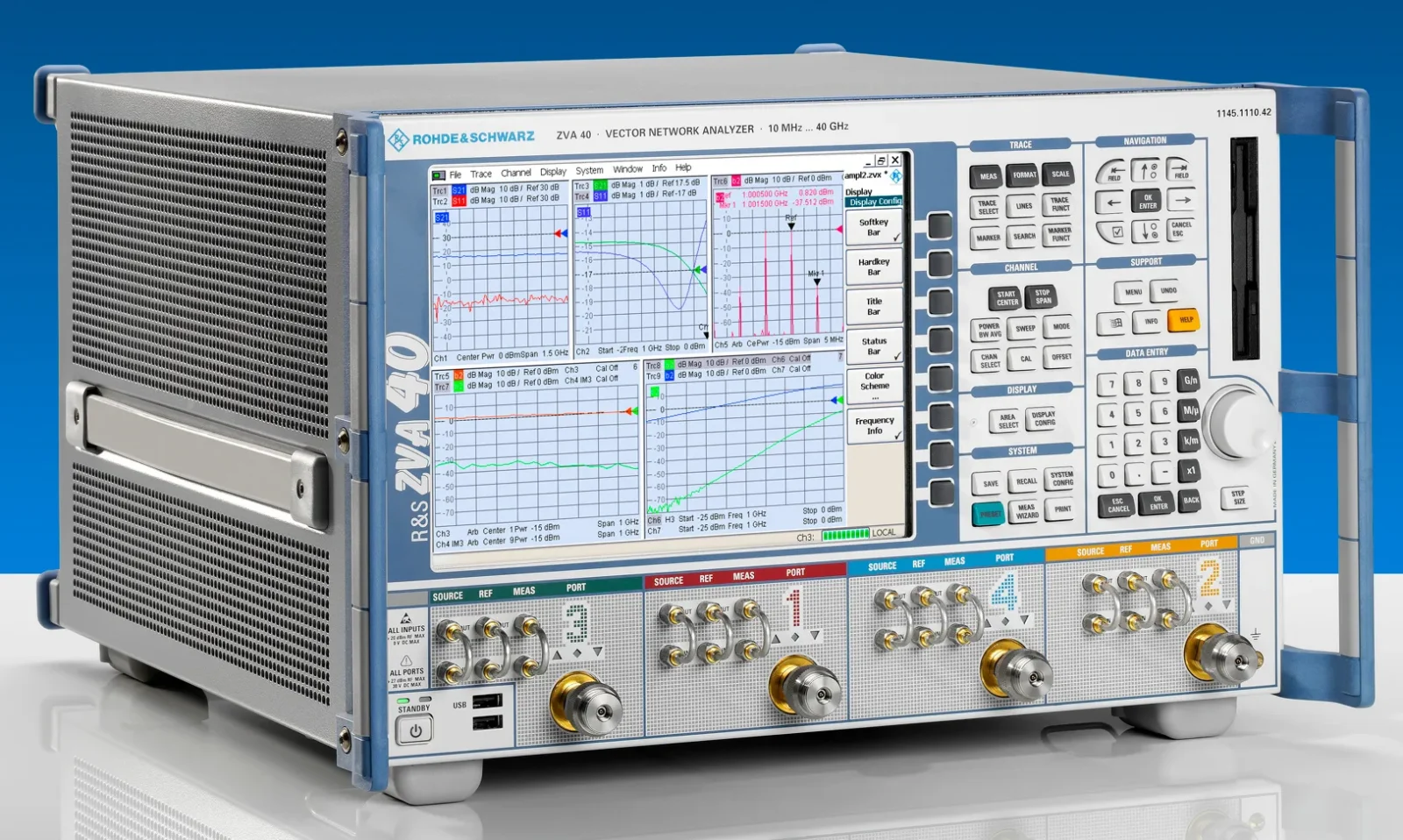
Rohde & Schwarz (Germany): A manufacturer offering integrated solutions from receiver to antenna system in spectrum monitoring and direction finding. Its range covers monitoring receivers, DF systems and the distribution hardware that feeds them. The company’s measuring instruments are used as a sector reference in verifying RF infrastructure products.
TCI International (United States): A manufacturer specialising in HF and VHF/UHF spectrum monitoring and direction finding systems; it offers antenna arrays and the associated distribution hardware.
ETL Systems (United Kingdom): A manufacturer concentrated on RF distribution, switching matrix and amplifier products for satellite ground stations. Its L band distribution products fall in the same functional class as Tron Elektronik’s TRDB and TRBB series.
Pasternack (United States): A supplier of RF components and passive products. The company’s archived timeline carries a record of cooperation with this firm in 2013; the relationship is therefore defined at supply chain level rather than as competition.


Evaluation criteria for the buyer
The headings that have a counterpart in a technical specification when an RF distribution or switching unit is being selected are these:
- Noise figure: The element at the head of the chain determines total noise. Because the multicoupler comes before the receiver, its noise figure sets the ceiling on system sensitivity.
- Intermodulation performance: In an environment with strong transmissions present at the same time, the unit must not create signals that do not exist. In monitoring applications, generating false signals turns directly into an operational error.
- Port-to-port isolation: One receiver must not affect the port next to it.
- Phase matching between channels: In direction finding applications channel differences translate directly into angular error.
- Environmental endurance and enclosure: The platform type — fixed, mobile, airborne, naval — determines the enclosure requirement.
- Maintenance and supply continuity: With domestic supply, the shorter logistics route and the absence of an export licence requirement make a practical difference.
The structural difference in domestic supply
In this product class the difference between domestic and imported supply is not only about price. RF distribution and switching units are often produced with a project-specific port configuration; the variety of input-output counts in Tron Elektronik’s product codes reflects that. Where a custom configuration is requested, access to the designer and revision time become decisive.
The second difference is the export licence. Exporting defense-purpose RF hardware is subject to the permission of the manufacturing country; with domestic supply that step does not arise. The third is access to spare parts and repair over the product’s life. None of these headings amounts on its own to technical superiority; where the specification is not met, ease of supply is not decisive.
Frequently asked questions
Are Tron products better than their foreign equivalents?
This question cannot be answered with public data. Because Tron Elektronik does not publish numerical performance values, no comparative assessment of superiority can be made.
Why is there no numerical comparison in the table?
For a comparison to be meaningful, both sides must publish the same quantities. Those values do not appear on Tron Elektronik’s public product pages.
Which manufacturers are in the same product class?
Rohde & Schwarz, TCI International and ETL Systems are named in this class because their public catalogues contain multicoupler, RF distribution and switching products.
Is Pasternack a competitor or a supplier?
The company’s archived timeline carries a record of cooperation with Pasternack in 2013; the relationship is defined at the level of component supply.
Can prices be compared?
No. These products are generally sold on a quotation basis and Tron Elektronik does not publish prices. Not officially disclosed.
Sources and verification note
No numerical performance comparison between the parties was made in this file, because those values are not published in Tron Elektronik’s public sources. The foreign manufacturers are named only because their public product catalogues contain the same product classes, and no assessment of superiority was made about them. All technical statements concerning Tron Elektronik rest on the company’s own statements. Accessed: August 12, 2026.
- https://tron.com.tr/
- https://web.archive.org/web/2022/https://tron.com.tr/en/product/trfmc-30-8-3
- https://web.archive.org/web/2022/https://tron.com.tr/en/product/trdb-trbb-series
- https://www.rohde-schwarz.com/
- https://www.tcibr.com/
- https://www.etlsystems.com/
- https://www.pasternack.com/
- SSB 2026 Product Catalogue, Tron Elektronik entry