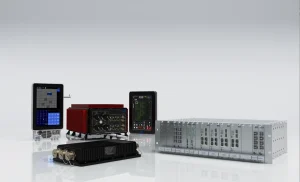
Tron TRFMC multicoupler family: RF distribution units


Quick answer: TRFMC is the name of Tron Elektronik’s RF signal distribution and multicoupling product family. These units take the signal from one or several antennas and feed it to a large number of receivers without the receivers disturbing one another. The family runs from the HF band (TRFMC-30 series) through VHF/UHF and wider bands (TRFMC-3000, TRFMC-6000 and TRFMC-8000 series); models carry between four and 20 receiver outputs and between one and eight antenna inputs. According to the company’s archived product pages, the units offer a switchable low-noise input amplifier (LNA), remote control over TCP/IP and a built-in test (BITE) option. TRFMC is the company’s widest model range on the defense side.
What is a multicoupler and what is it for?
A monitoring or spectrum surveillance site runs many receivers at the same time. Putting up a separate antenna for each of them is not practical: the antenna field grows, the antennas shade one another and costs rise. A multicoupler is an active distribution unit that shares the signal from a single antenna among several receivers.
Splitting the signal with a passive divider alone is not enough. Every split attenuates the signal; in an eight-way divider the theoretical loss is around 9 dB. The multicoupler places a low-noise amplifier at its input to make up that loss. Further up the chain, at the foot of the antenna, sits the preamplifier. The unit also has to stop the receivers interfering with each other: leakage at one receiver input must not corrupt the measurement of the receiver on the neighbouring port. That is why manufacturers quote port-to-port isolation, noise figure and intermodulation suppression together. On its archived product pages Tron Elektronik lists those three headings as its definition of product performance.
The TRFMC family table
The table below summarises the models presented on the company’s archived product pages. Numerical performance values (gain, noise figure, IP3) are not published on those pages and are therefore not included.
| Model | Band | Antenna inputs | Receiver outputs | Highlighted feature |
|---|---|---|---|---|
| TRFMC-30-8-3 | HF | 3 (switch-selectable) | 8 | Switchable LNA, TCP/IP control, BITE |
| TRFMC-30-16-2 | HF | 2 | 16 | High output count HF version |
| TRFMC-3000-4-2 | VHF/UHF | 2 (selectable) | 4 (16 optional) | Wideband, scalable output |
| TRFMC-3000-16-2 | VHF/UHF | 2 | 16 | Wideband, high output count |
| TRFMC-6000-12-8 | VHF/UHF | 8 (multiband) | 12 | For RF monitoring and analysis, BITE |
| TRFMC-6000-16-3 | VHF/UHF | 3 (multiband) | 16 | Multiband input to wideband receiver |
| TRFMC-8000-20-5 | Wideband | 5 | 20 | Highest port count in the family |
| TRFMC-500-8-1 | — | 1 | 8 | Product photograph shows 18-36 VDC, 10 W maximum |
The model naming follows a readable structure: the first number gives the upper frequency limit in MHz, and the two that follow give the port configuration. In the TRFMC-6000-12-8, that means a 6000 MHz upper limit, 12 receiver outputs and eight antenna inputs.

What is BITE and why does it matter?
BITE (Built-in Test Equipment) is an internal test layer that continuously monitors and reports the state of the device itself. Tron Elektronik’s archived product pages state that the networked BITE option allows internal voltages, antenna ports and internal operating temperatures to be monitored remotely.
That function has a practical payoff at fixed monitoring sites. Where the distance between the antenna mast and the operator room is long, tracing a fault on an antenna port on site takes time. Port-level monitoring makes it easier to tell whether the fault lies in the antenna, in the feed line or in the distribution unit. The same logic is applied in the antenna switching units.
The RFAB series: one antenna, many receivers
Alongside the TRFMC family sits a group of RF distribution units gathered under the RFAB name. According to the archived pages, the RFAB-30-512 connects 10 receivers to a single antenna in the VHF band; the RFAB-3000-0210 routes the same 10 receivers to one of two antennas; and the RFAB-512-0110 distributes a single antenna input across 10 outputs. All three models are specified with a switchable low-noise input amplifier and a network-supported BITE option.
The line between RFAB and TRFMC is not rigid; both perform the same function with different port and band configurations. In the SSB 2026 Product Catalogue entry the group appears under the heading “VHF-HF and VHF-UHF RF distribution units”.


Where are they used?
The company’s archived solutions menu positions these products under electronic warfare, spectrum and radio monitoring, direction finding, radio communications, aviation, and test and laboratory. The promotional text for the TRFMC-6000-12-8 gives its purpose directly as “RF monitoring and analysis”.
The company’s other product groups are set out in the product guide, and its general company profile in the hub file. These application areas have civilian counterparts as well. The monitoring stations of regulators policing frequency use, airport radio centres and shipboard communications systems all use the same architecture. Which institutions the company has delivered to, and at what contract values, has not been officially disclosed.
Frequently asked questions
What does TRFMC stand for?
In Tron’s product coding, TRFMC denotes the company’s RF multicoupler family. The first number in the code gives the upper frequency limit in MHz.
What is the difference between a multicoupler and a passive divider?
A passive divider splits the signal, and attenuation occurs at every split. A multicoupler contains an amplifier that makes up that loss and provides isolation between the receiver ports.
What are the gain and noise figure values of TRFMC units?
These numerical values are not published on the company’s public product pages. Not officially disclosed.
Can the units be managed remotely?
The company states that remote control over TCP/IP allows the switch matrix configuration, preamplifier activation and DC feed per antenna port to be set.
How many receivers can one multicoupler feed?
Across the models presented, output counts range from four to 20. The TRFMC-8000-20-5 appears as the model with the highest output count in the archived list.
Sources and verification note
The model list and functional descriptions rest on the promotional text of the company’s archived product pages. Numerical performance values such as gain, noise figure and intermodulation are not published in public sources and are therefore not given. Manufacturer statements are reported with their source. Accessed: August 12, 2026.
- https://tron.com.tr/
- https://web.archive.org/web/2022/https://tron.com.tr/en/product/trfmc-30-8-3
- https://web.archive.org/web/2022/https://tron.com.tr/en/product/trfmc-6000-12-8
- https://web.archive.org/web/2022/https://tron.com.tr/en/product/rfab-30-512
- https://web.archive.org/web/2022/https://tron.com.tr/en/product/rfab-3000-0210
- https://www.sahaistanbul.org.tr/firma/tron-elektronik-sistemleri-san-ve-tic-a-s
- SSB 2026 Product Catalogue, Tron Elektronik entry