Tron TRDF antenna switching units and direction finding


Quick answer: TRDF is the product family of antenna switching units Tron Elektronik builds for direction finding (DF) systems. These units are RF switch matrices that route a large number of antenna inputs to a smaller number of receiver outputs; they can also switch a separate calibration signal onto the output ports. The family includes distinct versions for fixed sites (TRDF-6000 series), land mobile vehicles (TRDFmob) and airborne platforms (TRDFAero). According to the company’s archived product pages, TRDF-6000 models operate over 30-6000 MHz and use customised enclosures compliant with the MIL-STD-810G environmental standard. The SSB 2026 Product Catalogue lists the TRDFAERO-3000-16-6 as an ANKA antenna switching unit.
Why does a direction finding system need antenna switching?
Direction finding is the business of establishing which bearing a transmission arrives from. In the classic method, antennas are laid out in a circular array and the angle of arrival is calculated by comparing the time or phase at which the incoming signal reaches each antenna. Accuracy improves with the number of antennas; at some fixed sites the array runs to dozens of elements.
The practical problem is the cost of attaching a separate receiver to every antenna element. Rather than buying 29 receivers for a 29-antenna array, the antennas are connected in sequence to a small number of receivers through a switch matrix. The antenna switching unit forms that matrix. Its job is to carry the signal with near-zero loss, with predictable delay and without leakage between channels, because in a measurement based on phase comparison any phase error introduced by the switch translates directly into an angular error.
What is the calibration signal for?
The common item across the TRDF product descriptions is a separate calibration signal switched onto the output ports. According to the archived pages, on the TRDF-6000-29-22 the calibration signal can be switched to 22 RF output ports, and on the TRDF-6000-7-28 to seven output ports.
Calibration serves to measure the differences between channels in the direction finding chain. Cable length, connector loss and temperature-dependent phase shift differ slightly from one channel to the next. Injecting a reference signal of known characteristics into the system and measuring each channel’s response identifies those differences so they can be corrected in the calculation. Placing the calibration path inside the switching unit means the reference signal enters at the same point in the measurement chain. The hardware that generates that reference is covered in the file on signal generator units.
The TRDF family table
| Model | Frequency | Inputs | Outputs | Platform / note |
|---|---|---|---|---|
| TRDF-6000-29-22 | 30-6000 MHz | 29 antennas | 8 | Fixed site; calibration to 22 ports; MIL-STD-810G enclosure |
| TRDF-6000-7-28 | 30-6000 MHz | 28 antennas | 7 | Calibration to seven ports; MIL-STD-810G enclosure |
| TRDFAero-3000-16-6 | VHF/UHF | 16 | 6 | Airborne platform; single 3/8 ATR rack enclosure |
| TRDFmob-3000-12-2 | 20-3000 MHz | 12 | 2 | Land mobile; RF-blanking switch matrix |
| TRDF-30-16-8 | HF | 16 | 8 | HF signal switching matrix |
| TRDF-30-8-8 | HF | 8 | 8 | HF signal switching matrix |
Switching losses, isolation values and switching times are not published on the company’s public product pages.

Designs that diverge by platform
The same function is offered in three separate platform versions because, in RF hardware, enclosure and environmental endurance requirements shape the design.
Fixed site (TRDF-6000): High port count, few volume constraints. The archived pages state that the customised ruggedised enclosure of these models is fully compliant with the MIL-STD-810G environmental standard and that it is designed and qualified for airborne applications.
Land mobile (TRDFmob-3000-12-2): By the company’s description, a key component for land mobile direction finding systems; it uses an RF-blanking switch matrix topology with 12 inputs and two outputs over the 20-3000 MHz band. The enclosure is described as compact and ruggedised for mobile use under harsh environmental conditions.
Airborne platform (TRDFAero-3000-16-6): The company describes this model as a wideband VHF/UHF RF switch for direction finding and RF tracking applications, and states that it is housed in a single rugged 3/8 ATR rack enclosure. ATR is the standard rack dimension used in aviation to define avionics box sizes; 3/8 ATR corresponds to a narrow section of a full-width box.

A note on the ANKA link
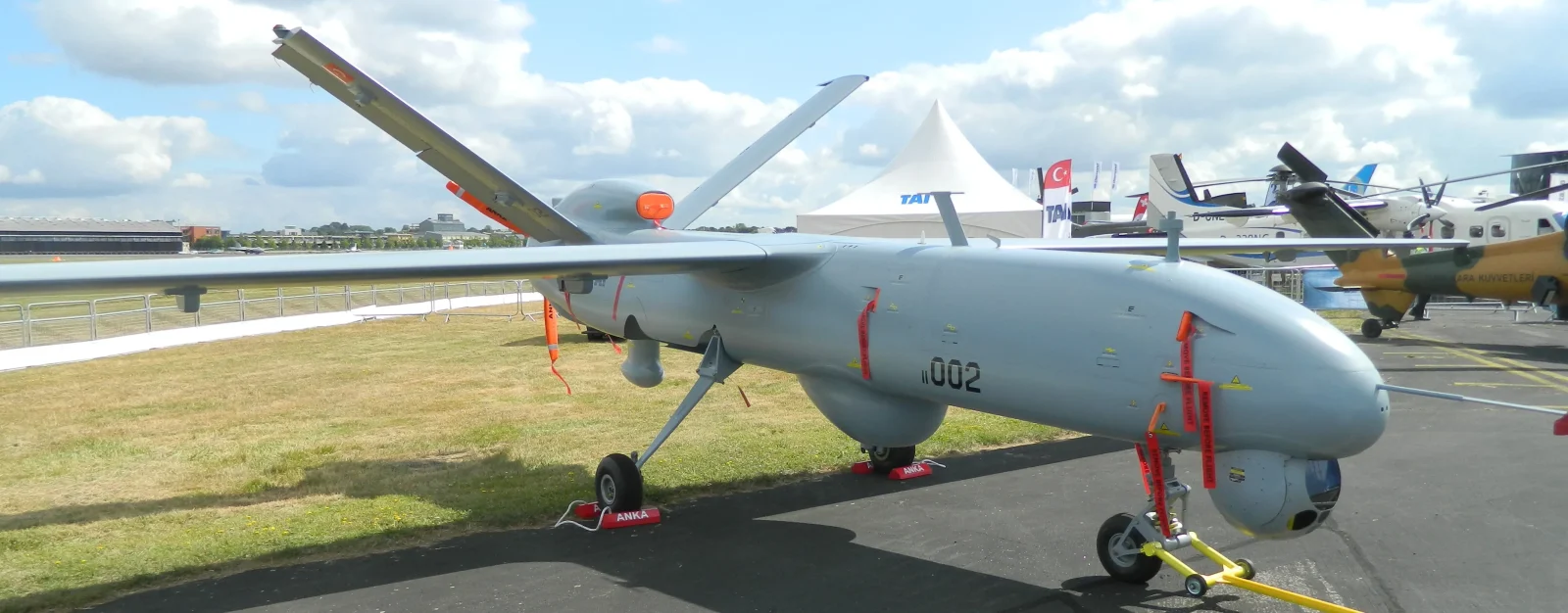
The SSB 2026 Product Catalogue lists the TRDFAERO-3000-16-6 among Tron Elektronik’s products as an ANKA antenna switching unit. That catalogue is the sole source for the link: the ANKA name does not appear on the company’s own product pages or blog announcements, and in the archived pages the model is presented only as a general product for airborne platforms. Delivery quantities, contract date and contract value have not been officially disclosed. The company’s general profile is in the hub file, and the full product portfolio in the product guide.
Frequently asked questions
What does DF mean?
DF stands for direction finding: calculating the bearing a transmission arrives from, using the phase or time difference between the elements of an antenna array.
What is the difference between an antenna switching unit and a multicoupler?
A multicoupler distributes one signal to many receivers. An antenna switching unit selects which of many antenna inputs is connected to which output. The functions can be combined in the distribution products.
What is MIL-STD-810G?
A US defense standard defining the endurance of military equipment to environmental conditions such as temperature, vibration, shock, humidity and altitude. The company states that the TRDF-6000 enclosures are fully compliant with it.
What does a 3/8 ATR enclosure mean?
ATR is the standard rack dimension for avionics boxes in aviation. 3/8 ATR defines a narrow section of a full-width box, close to a third of its width.
Is the TRDFAERO really used on ANKA?
The sole source for this is the product entry in the SSB 2026 Product Catalogue. The company makes no reference to an ANKA link in its own material, and delivery details have not been officially disclosed.
How fast is the switching?
Switching time, insertion loss and isolation values are not published on the public product pages. Not officially disclosed.
Sources and verification note
The model list and technical descriptions rest on the company’s archived product pages. The ANKA link is based solely on the SSB 2026 Product Catalogue entry; because it could not be confirmed against another source, that limit is stated explicitly in the text. Numerical values for switching performance are not published and are therefore not given. Accessed: August 12, 2026.
- https://tron.com.tr/
- https://web.archive.org/web/2022/https://tron.com.tr/en/product/trdf-6000-29-22
- https://web.archive.org/web/2022/https://tron.com.tr/en/product/trdf-6000-7-28
- https://web.archive.org/web/2022/https://tron.com.tr/en/product/trdfaero-3000-16-6
- https://web.archive.org/web/2022/https://tron.com.tr/en/product/trdfmob-3000-12-2
- SSB 2026 Product Catalogue, Tron Elektronik entry