ANALYSIS – Is Russia building new tanks or refurbishing old ones?

Asaf Türk writes defense and security analysis for Envanter Medya.
The tanks Russia sent to the front in 2023 were mostly not new. According to the Centre for European Policy Analysis (CEPA), about 1,500 tanks were delivered to Russian forces that year, and open-source analyses suggest roughly 86 percent of them were refurbished decades-old models, among them T-62s and even T-55s. Three years on, the question is whether Russia has moved beyond that stopgap. Is it building new tanks, or only renewing old ones? The answer matters for the same reason as our look at Russia’s arms factories after the war: it shows how much of the machine is real capacity and how much is a stockpile being spent.
The old line: refurbishment
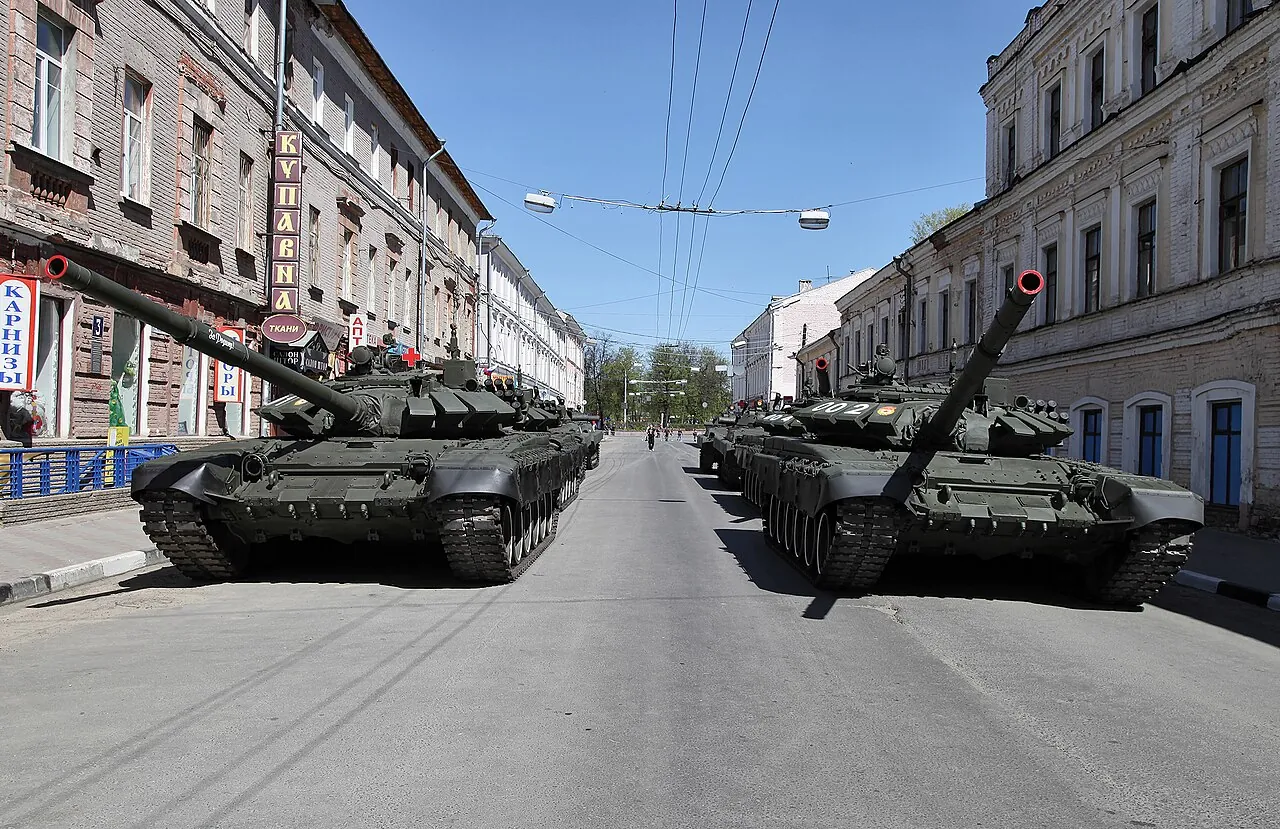
CEPA says older T-62s, T-72s and T-80s are being pulled from deep storage, refurbished and upgraded to replace battlefield losses. The 103rd Armored Repair Plant has concentrated on T-62s, at an estimated 300 to 500 a year. Omsktransmash has overhauled T-80s at more than 300 a year, using up most of the stored hulls. The most abundant stock left is the T-72A, the T-72BK command version and other old variants, and these are converted to T-72B3M at Uralvagonzavod and a handful of smaller repair plants, for an overall output CEPA puts at about 30 tanks a month in 2025. That is roughly 360 a year, and the figure rests on open-source estimates that CEPA itself describes as fragmentary and not conclusive.
The only new tank
New construction is narrower. CEPA calls Uralvagonzavod the sole plant building tanks from scratch, producing T-90M tanks at an estimated 250 to 300 a year by 2024. It also cites leaked state contract documents, obtained by the Ukrainian private analytics firm Frontelligence, that point to an 80 percent expansion, a new T-90M2 variant by 2028, and 765 new T-90M-series tanks between 2027 and 2029, plus 347 more from overhaul, for almost 1,120 in three years. Those are Ukrainian-sourced leaks and a plan on paper, not output, and the same plant has been cutting its civilian side, as we reported in the factories analysis.
The stockpile is the clock
CEPA estimates Russia has pulled nearly 15,000 older armored vehicles from storage, counting tanks, infantry fighting vehicles, personnel carriers and MT-LB tractors. Between 7,500 and 8,200 remain, of which only about 4,790, or 58 to 63 percent, are judged refurbishable, and observers say a large share of the rest is fit only for spare parts. In 2022 Russia had vast stocks; the refurbishment line is living off them. Counting all armored fighting vehicles, CEPA puts 2025 production and refurbishment combined at about 3,700 units, of which only about a third were new builds.
What the tank is now for
The battlefield has changed the tank’s job. CEPA says Russian forces shifted to infantry-centric assaults supported by drones and glide bombs, reduced mechanized attacks through 2024, and replaced many armored vehicles with civilian alternatives such as vans, quad bikes and even electric scooters. Armored vehicles now mostly serve in support roles, firing indirectly to stay out of reach. That is also why drones, not tanks, were the subject of our piece on Russia’s mall drone factories.
Our assessment is that the tank question has two clocks. The refurbishment line runs down as the reserve does, which points to a slow decline in annual deliveries over the next few years even if the war continues. The T-90M line is the state’s bet on the opposite, and whether the 2027–2029 plan is funded will be visible in the defense line of the budget and in Uralvagonzavod’s order book. None of this is a forecast; it is a reading of estimates. Watch four things: reported T-72B3M and T-62 output, T-90M deliveries, any sign of the T-90M2, and how quickly the 4,790 refurbishable vehicles are used up.
Sources
CEPA – Managing Russia’s Military-Industrial Degradation · UNITED24 Media – Russia’s war economy starts to crack