Pakistan Army Tanks 2026: Full List and How Many Tanks Pakistan Has

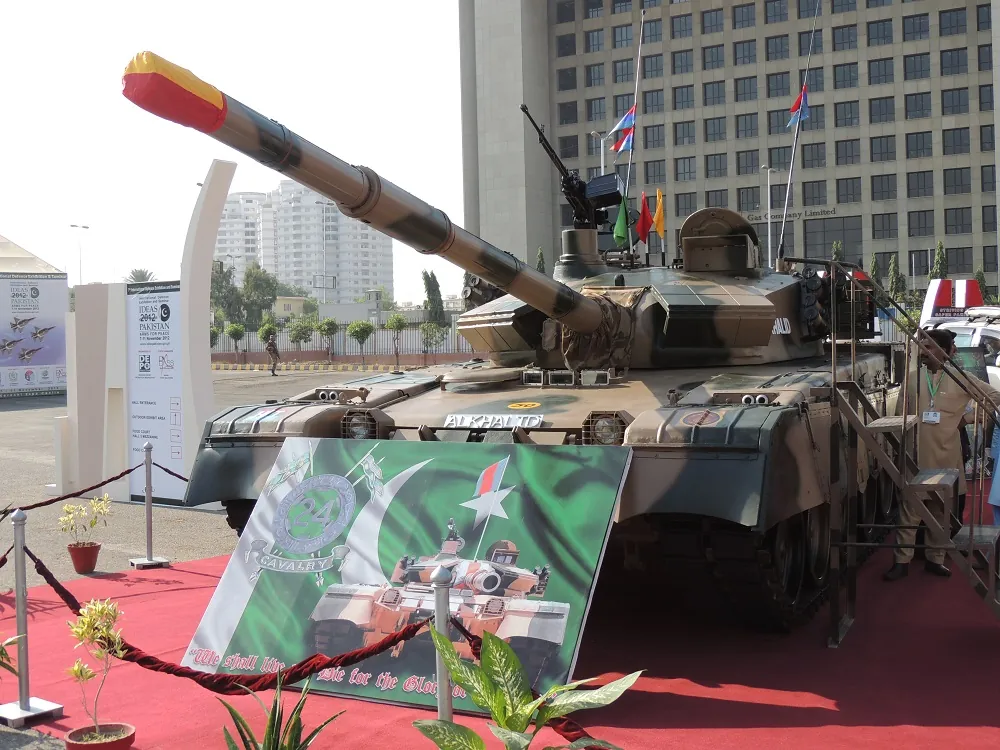
Short answer: Pakistan fields roughly 2,450–2,650 main battle tanks in 2026 (type counts relayed from the IISS Military Balance 2025; Global Firepower 2026 lists 2,627). The fleet mixes HIT-built Al-Khalid and Al-Khalid I, Ukrainian T-80UD, the new Chinese VT-4 and its licence-built Haider version, rebuilt Al-Zarrar, and ageing Type 85-IIAP and Type 69-II tanks. No official inventory is published by the Pakistan Army or ISPR.
Last updated: 17 September 2026
Pakistan Defence Hub: Pakistan Military Power → Army → Air Force → Navy → Defence Industry → Türkiye–Pakistan
How many tanks does Pakistan have in 2026?
The honest answer is a range. Pakistan’s Ministry of Defence and ISPR do not publish equipment tables, so every public tank count is an estimate built from the IISS Military Balance and secondary trackers. The IISS-derived type breakdown puts the Pakistan Army’s main battle tank (MBT) fleet at about 2,467–2,627, while Global Firepower 2026 lists 2,627 tanks and ranks Pakistan 14th of 145 countries overall. Global Firepower is a useful cross-check, not a verified inventory.
Pakistan operates one of the largest tank parks in Asia, but a large share of it consists of 1960s–1980s Chinese designs (Type 69-II, Type 85-IIAP) and rebuilt Type 59 hulls (Al-Zarrar). The modern core is smaller: roughly 380 Al-Khalid/Al-Khalid I, around 315–320 T-80UD, and a growing VT-4/Haider fleet whose exact delivered number has not been officially released.
For the wider picture of manpower, aircraft and ships, see the pillar guide Pakistan’s Military Inventory: How Many Tanks, Jets and Submarines? and the FY2026-27 defence budget that funds the procurement line.
Pakistan Army tanks list 2026: type by type
| Tank | Estimated number | Origin | Entered service | Source |
|---|---|---|---|---|
| Al-Khalid | ~300 | Pakistan (HIT) / China (Norinco MBT-2000) | 2001 (serial production, HIT) | IISS-derived; HIT |
| Al-Khalid I | ~80 | Pakistan (HIT) | Inducted August 2020 | HIT; IISS-derived |
| VT-4 / Haider | “over 300” expected; delivered total not published | China (Norinco) / Pakistan (HIT licence) | VT-4 buy confirmed Feb 2020; first Haider rollout 6 Mar 2025 | Quwa (HIT); IISS-derived |
| T-80UD | ~315–320 | Ukraine (Malyshev) | 1997–2002 deliveries | IISS-derived |
| Al-Zarrar | ~500 | Pakistan (HIT rebuild of Type 59) | 2004 | HIT; IISS-derived |
| Type 85-IIAP | ~268 | China (Norinco) | 1990s | IISS-derived |
| Type 69-II | ~400 | China (Norinco) | 1980s | IISS-derived |
| Total | ~2,467–2,627 | — | — | IISS via secondary; GFP 2026: 2,627 |
Type counts are IISS Military Balance figures relayed through secondary compilations, not an official Pakistan Army roll. The type-by-type sum does not match the headline total exactly because VT-4 deliveries are not itemised and older tanks in storage are counted differently by different trackers.
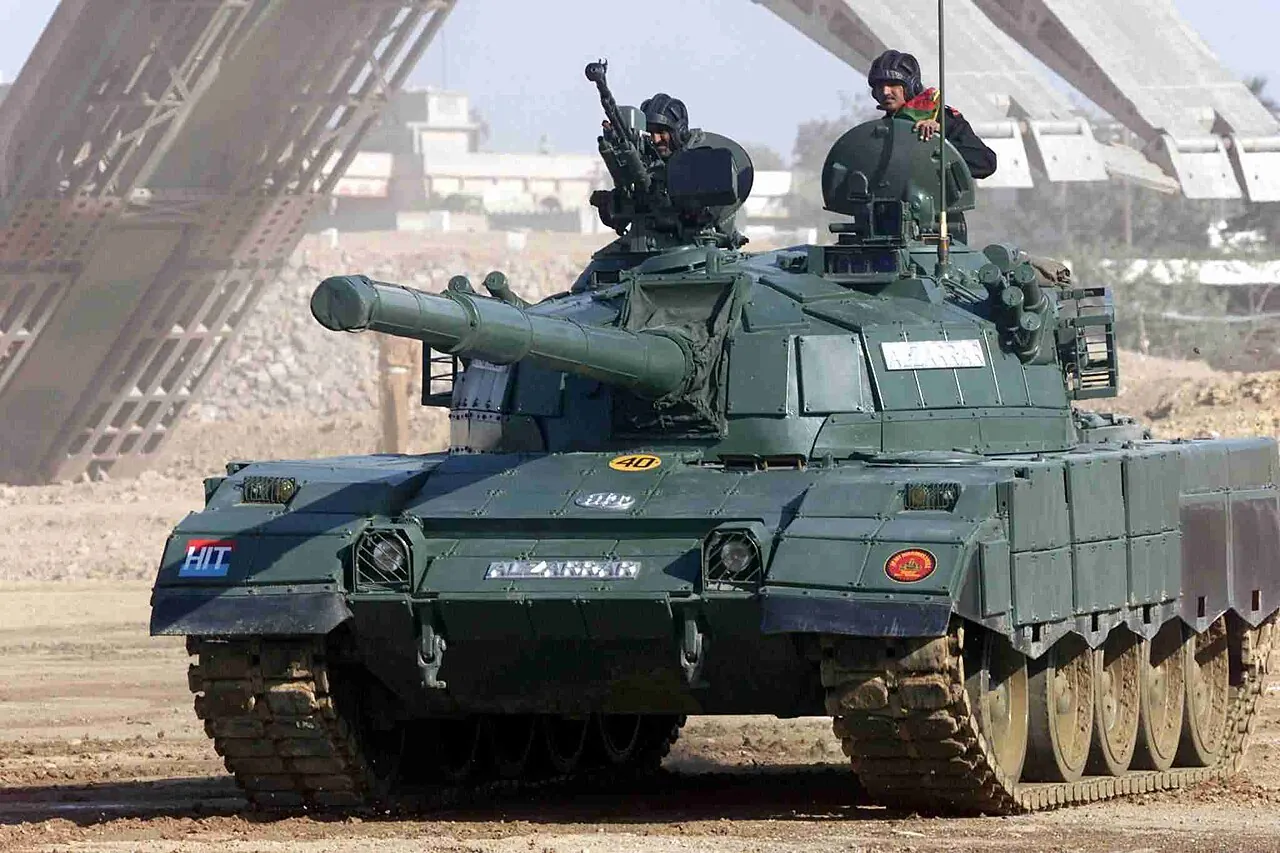
Al-Khalid: Pakistan’s own main battle tank
Al-Khalid is the tank Pakistan calls its own. It was developed by Heavy Industries Taxila (HIT) together with China’s Norinco as the MBT-2000 programme, and HIT builds it at its Tank Factory in Taxila, north of Rawalpindi. The design pairs a Chinese-lineage hull and 125 mm smoothbore gun with a carousel autoloader — which is why the crew is three rather than four — and a Ukrainian diesel powerpack from the same family that powers the T-80UD. Pakistan bought T-80UDs from Ukraine in 1997–2002 and built its logistics around that engine line.
Two versions are in service. The baseline Al-Khalid (~300) entered serial production in the early 2000s. Al-Khalid I (~80), inducted in August 2020, is HIT’s mid-life upgrade with improved fire control, sights and protection. Al-Khalid II is listed by HIT as a development programme and has not been fielded. A separate Al-Khalid product page with a full specification sheet follows in the next wave of this hub.
Al-Khalid family at a glance
| Item | Detail |
|---|---|
| Developer / builder | HIT Taxila with Norinco (MBT-2000) |
| Main armament | 125 mm smoothbore gun, autoloader |
| Crew | 3 (commander, gunner, driver) |
| Powerpack | Ukrainian diesel, same family as T-80UD |
| Variants in service | Al-Khalid (~300); Al-Khalid I (~80, inducted Aug 2020) |
| Next step | Al-Khalid II — in development, not fielded |
Haider: the VT-4 built in Taxila
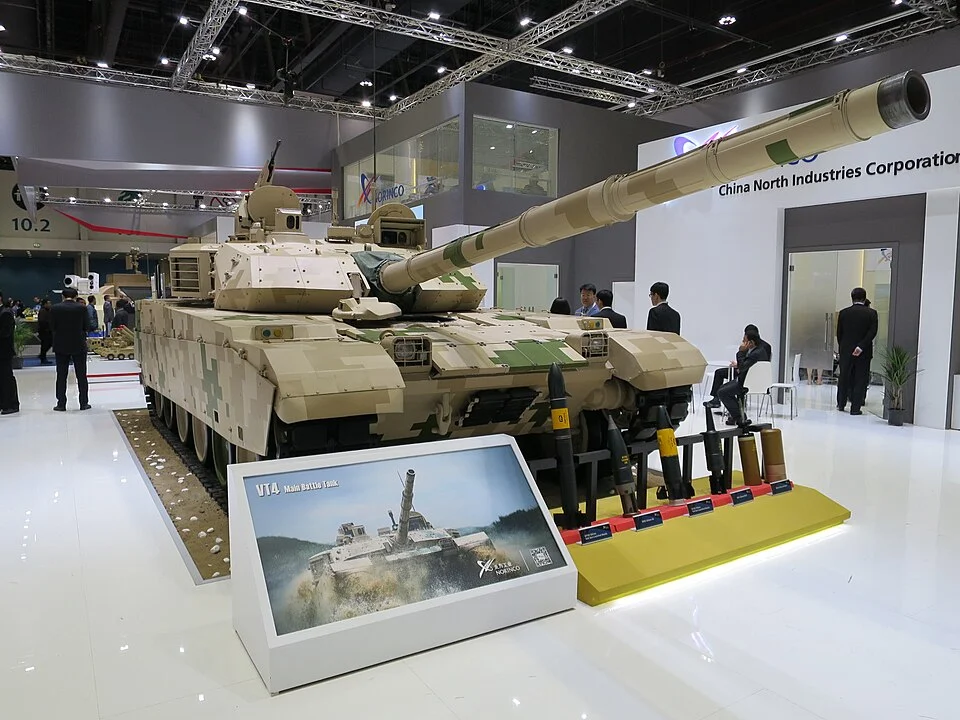
Haider is the name Pakistan gives to the VT-4 (Norinco’s export MBT-3000) when it is assembled at HIT under licence. The VT-4 purchase from China was confirmed in February 2020; the public contract trail shows 176 tanks for roughly USD 859 million signed in 2018/19, with “over 300” expected in total. On 6 March 2025 HIT rolled out the first locally produced Haider. In November 2024 HIT put indigenous content at 39 percent, with the main gun 97 percent locally made.
The Army’s stated plan covers 679 VT-4 and Haider tanks combined. That figure is a programme ceiling, not a delivered count, and it should be read alongside the fact that no official delivery schedule has been published. In practice the Haider line is Pakistan’s route to retiring Type 69-II and Type 85-IIAP hulls. See also the ranking of the 10 most exported tanks in the world.
Modernisation: what changes by 2030
Three lines define the armour plan: the VT-4/Haider programme with its 679-tank ceiling, which replaces the oldest Chinese types; Al-Khalid I upgrades and Al-Khalid II development, which keep the domestic design relevant; and the T-80UD fleet, which has no announced successor and depends on a Ukrainian supply chain under wartime strain. The FY2026-27 budget raised the procurement head by 39.6 percent to PKR 925.8 billion (Dawn/Janes, June 2026); armour competes for that money with the J-10CE, Hangor submarines and the reported J-35A package.
The structural constraint is single-supplier dependence: SIPRI data show China supplied 81 percent of Pakistan’s major-arms imports in 2020–24, and Haider’s indigenous-content target is as much about supply security as about industrial pride.
Armoured vehicles: Talha, Saad, Hamza, Viper and M113
Below the tank fleet sits a large but ageing armoured personnel carrier (APC) park built on the M113 family, which HIT rebuilds at its Heavy Rebuild Factory. HIT’s own Talha APC — a locally produced M113 derivative — reached 250 vehicles by 2006 and more than 400 today, with the Saad APC as a further development. Hamza is HIT’s 6×6 wheeled infantry fighting vehicle (IFV), in service with the Army and offered for export; Viper is a tracked IFV unveiled at IDEAS 2018. Mohafiz and Aahan are lighter protected vehicles from HIT’s USD 31 million Iraq export package (44 Talha, 60 Mohafiz, 300 Aahan).
None of these vehicles has an official fleet number beyond the Talha figure. Pakistan’s APC fleet is almost entirely domestic or American-origin; Turkish armoured vehicles do not appear in it — see which Turkish weapons Pakistan actually uses.
Artillery and rocket forces: SH-15, M109, A-100 and Fatah
The Army’s artillery modernisation has moved faster than its tank line. The headline buy is the Chinese SH-15 155 mm truck-mounted howitzer: 236 ordered in batches, with a stated range of 53 km using rocket-assisted projectiles (RAP). Alongside it serve 400+ American M109 self-propelled howitzers and the A-100 300 mm MLRS.
The Fatah family is where Pakistan’s artillery turns into a long-range strike arm. Fatah-1 is a guided multiple launch rocket (GMLRS) with a 140 km range, tested in January 2021 and reported by ISPR as in service by August 2021. Fatah-2, a 400 km quasi-ballistic rocket, was fired in an ISPR-announced training launch on 28 April 2026. Fatah-4, a 750 km ground-launched cruise missile (GLCM), had its first test on 30 September 2025 and was described as newly inducted into the Army Rocket Force Command, which was raised in August 2025. The full missile ladder — Nasr, Abdali, Shaheen, Babur and Ra’ad — is covered in Pakistan’s missiles list and ranges.
| System | Number | Range | Origin | Status (source) |
|---|---|---|---|---|
| SH-15 155 mm truck-mounted howitzer | 236 ordered (batches) | 53 km (RAP) | China (Norinco) | Ordered / deliveries in progress |
| M109 155 mm SP howitzer | 400+ | conventional 155 mm | USA | In service |
| A-100 300 mm MLRS | not published | 300 mm rocket | China | In service |
| Fatah-1 GMLRS | not published | 140 km | Pakistan (NESCOM/GIDS) | In service (ISPR, Aug 2021) |
| Fatah-2 | not published | 400 km | Pakistan (NESCOM) | Training launch 28 Apr 2026 (ISPR) |
| Fatah-4 GLCM | not published | 750 km | Pakistan (NESCOM) | First test 30 Sep 2025; ARFC raised Aug 2025 |
Attack helicopters: Z-10ME in, T129 out
In July 2018 Pakistan ordered 30 T129 ATAK helicopters from Türkiye’s TUSAŞ for about USD 1.5 billion. The T129 uses an American-origin engine, Washington never issued the export licence, and by 2022 the programme was effectively cancelled — DG ISPR said the Army had “moved on”. Separately, 12 AH-1Z Vipers built for Pakistan in 2017–18 were never delivered and sit in US storage at AMARG.
The replacement is Chinese. On 2 August 2025 ISPR announced the induction of the first Z-10ME attack helicopters at Multan. They join legacy AH-1F Cobras and four Mi-35M delivered in 2018. Z-10ME fleet numbers have not been published. The Türkiye–Pakistan side is in the defence cooperation timeline.
Pakistan vs India tanks: how to compare
The comparison with India deserves its own treatment: Envanter Medya’s India–Pakistan military strength comparison 2026 puts both fleets side by side with year-stamped sources, and the Turkish-language India–Pakistan tank power comparison goes deeper on armour alone. The table below lists the criteria and Pakistani values; India’s figures sit on the comparison page under the same IISS/SIPRI standard.
| Criterion | Pakistan (2026) | What to hold constant |
|---|---|---|
| Total MBT fleet | ~2,467–2,627 (IISS-derived; GFP 2026: 2,627) | Same source and year on both sides |
| Modern share | Al-Khalid/I ~380, T-80UD ~315–320, VT-4/Haider not itemised | Count post-1990 designs only |
| Domestic production | HIT Taxila: Al-Khalid, Al-Zarrar, Haider (39% local content, Nov 2024) | Local content, not just assembly |
| Main gun | 125 mm smoothbore across modern types | Ammunition family and supply |
| Supplier base | China 81% of 2020–24 imports (SIPRI); Ukraine for T-80UD | Single-supplier risk |
| Attack helicopters | Z-10ME inducted Aug 2025; AH-1F; Mi-35M 4 | Airframes actually delivered |
This hub does not run “who would win” scenarios. Tank counts describe inventories, not outcomes; terrain, air cover, logistics and ammunition stocks decide engagements.
Frequently Asked Questions
How many tanks does Pakistan have in 2026?
Roughly 2,450–2,650 main battle tanks, based on type figures relayed from the IISS Military Balance 2025; Global Firepower 2026 lists 2,627. Neither the Pakistan Army nor ISPR publishes an official count, so every total is an estimate.
What is the Al-Khalid tank?
Al-Khalid is Pakistan’s Heavy Industries Taxila (HIT) main battle tank, developed with China’s Norinco on the MBT-2000 design. It carries a 125 mm smoothbore gun with an autoloader and a three-man crew. About 300 baseline Al-Khalid and ~80 upgraded Al-Khalid I (inducted August 2020) are in service; Al-Khalid II is in development.
How many Al-Khalid tanks does Pakistan have?
About 380: ~300 Al-Khalid and ~80 Al-Khalid I, according to IISS-derived figures. HIT has not published a production total.
What is the Haider tank?
Haider is the HIT-built, licence-produced version of China’s VT-4 (MBT-3000). The first locally produced Haider rolled out at Taxila on 6 March 2025; HIT put local content at 39% in November 2024, with the gun 97% indigenous. The Army’s long-term plan covers 679 VT-4 and Haider tanks combined.
How much does a Pakistan Army tank cost?
No official unit price is published. The only public contract figure is ~USD 859 million for 176 VT-4 tanks (2018/19), a package that includes support, so it should not be divided by the tank count.
Does Pakistan have attack helicopters?
Yes. The Army inducted its first Chinese Z-10ME attack helicopters on 2 August 2025 at Multan (ISPR) and flies legacy AH-1F Cobras and four Mi-35M. The 30-helicopter T129 ATAK order (2018) was effectively cancelled in 2022 over a US engine licence.
Related Envanter Medya guides
- Pakistan’s Military Inventory: How Many Tanks, Jets and Submarines? (2026)
- India–Pakistan Military Strength Comparison 2026
- India’s Military Strength: How Many Tanks, Fighter Jets and Missiles? (2026)
- Pakistan Missiles List and Ranges
- Which Turkish Weapons Does Pakistan Use?
- Pakistan Defence Budget 2026-27
- The 10 Most Exported Tanks in the World (2026)
- What Is a Main Battle Tank (MBT)?
- Turkey’s Military Strength: Tanks, Jets and Drones (2026)
Sources
- Heavy Industries Taxila (HIT) — official site
- Quwa — HIT Haider main battle tank (rollout, local content, 679-tank plan)
- Janes — Pakistan inducts first Z-10ME helicopter into service (Aug 2025)
- Anadolu Agency — Pakistan Army on T129 helicopter deal reports
- Dawn — Fatah-2 training launch, April 2026 (ISPR)
- Janes — Pakistan Army test-launches Fatah-IV missile (Sep 2025)
- Arab News — Fatah-4 and Army Rocket Force Command
- Dawn — FY2026-27 defence budget breakdown
- SIPRI — Trends in International Arms Transfers 2024 (China share)
- Global Firepower 2026 — Pakistan (auxiliary source, not a verified inventory)