The World’s 10 Longest-Endurance UAVs (2026 Endurance Comparison)

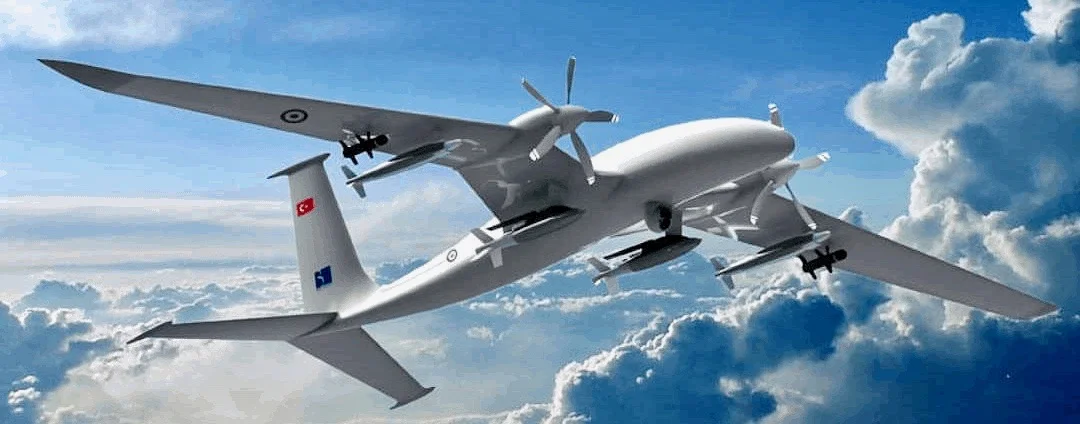
Durations vary substantially with payload; each row states the condition under which it was measured.
Ranking: endurance among conventional UAVs
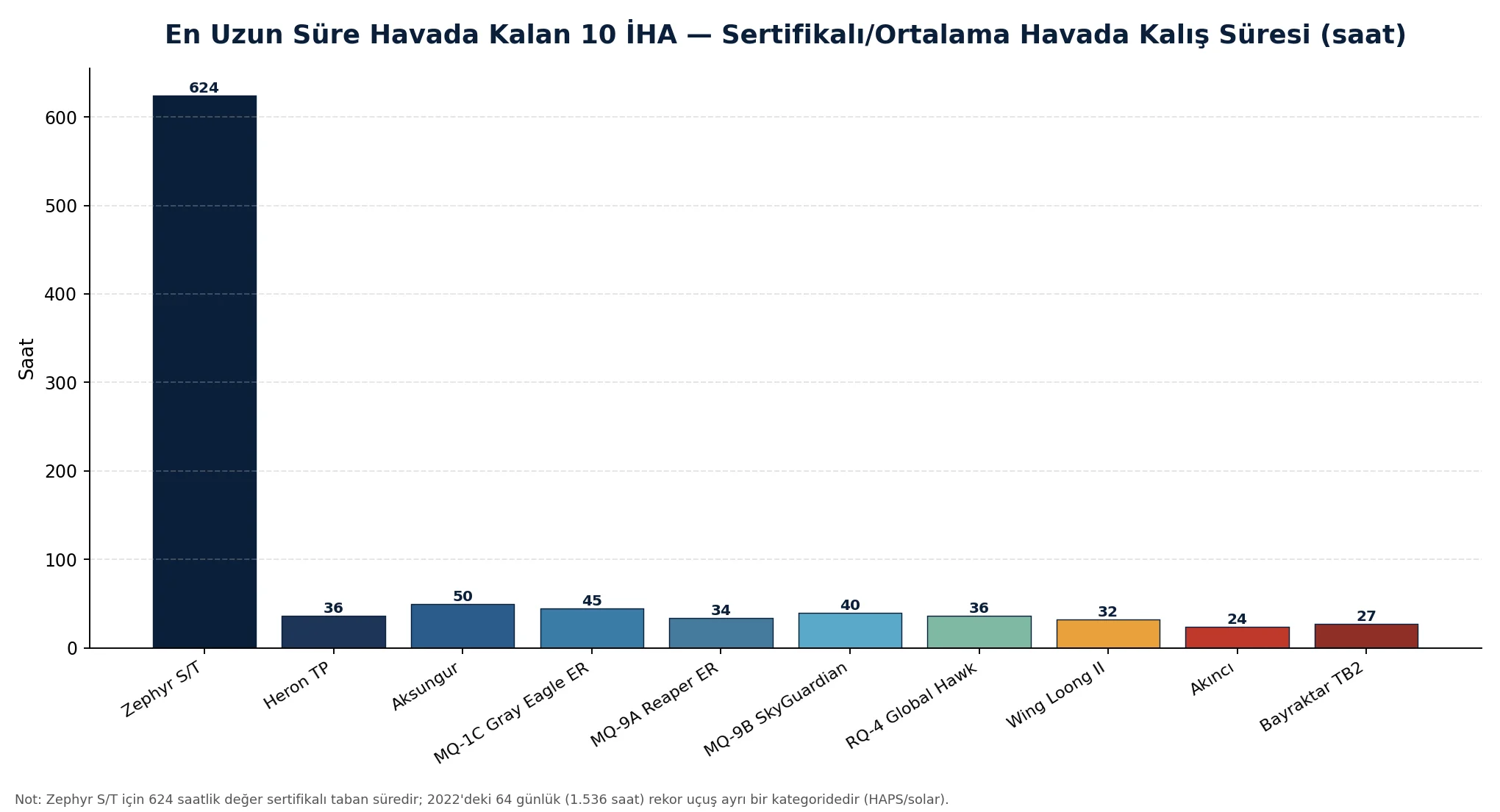
The chart below shows how the table looks once solar-powered stratospheric platforms are excluded. Leaving Zephyr off the list is not a way of understating its performance — it simply operates under different physics and in a different mission class: Zephyr flies for weeks rather than hours, but carries a payload measured in kilograms and no weapons at all.
| UAV | Maximum duration (hours) | Measurement condition |
|---|---|---|
| TAI Aksungur (Turkey) | 50 | with light payload |
| MQ-9A Reaper ER (US) | 42 | with external fuel tank |
| MQ-1C Gray Eagle ER (US) | 41.9 | test flight |
| Wing Loong 3 (China) | 40 | manufacturer claim |
| MQ-9B SkyGuardian (US) | 40 | manufacturer claim |
| IAI Heron TP (Israel) | 36 | manufacturer claim |
| RQ-4 Global Hawk (US) | 34 | 30-34 depending on mission profile |
| Bayraktar TB2 (Turkey) | 27 | Turkish aviation record |
| Bayraktar AKINCI (Turkey) | 25 | test record 25h 3min |
The metric that most defines a UAV’s value on the battlefield is how long it can stay airborne. Long endurance means watching a wider area without interruption, tracking the same target for hours, and covering more ground with fewer platforms. This article, the opening file in envantermedya.com’s weekly “World’s…” comparison series, ranks UAV/UCAV systems already in service — or entering service in the near future — against a single criterion: maximum flight duration.
The reason endurance has become such a decisive metric has to do with a shift in operational doctrine. Traditional manned reconnaissance aircraft and helicopters are bound by pilot fatigue, refueling, and crew rotation; unmanned platforms remove most of those constraints. A command wanting to watch an area continuously for 24 hours can either rotate several short-endurance platforms through the sky, or achieve the same result with a single long-endurance platform — and the second option usually means less logistical load and lower total cost.
The ranking is built on manufacturer data, official test-flight results, and figures confirmed by the defense press. Because endurance figures change with payload, fuel configuration, and mission profile, the condition under which each figure was measured is noted in parentheses. Zephyr S, a solar-powered stratospheric HALE (High Altitude Long Endurance) platform, performs on a scale of weeks and months rather than hours, so it is marked as a separate category in the list and not compared directly with the other MALE/HALE-class UAVs. Readers interested in the distinction can find the technical difference between the two classes in our files on what is a MALE UAV (TR) and what is a HALE UAV (TR), and the historical development of the armed-UAV concept in our file on what is a UCAV (TR).
One point worth flagging when comparing endurance figures is that most of what manufacturers publish are “maximum” values. In real operational missions, platforms are typically flown in a more conservative profile, below those ceiling figures, since maximum endurance is usually achieved under ideal scenarios — a reduced munitions load, an auxiliary fuel tank, or optimal weather. Because of this, there can be a gap between a platform’s “on-paper” figure and its typical mission duration in the field; this file attempts to distinguish the two wherever possible.
Another important distinction is that endurance alone is not a marker of superiority. A short-range but cheap, easily deployable platform (like the TB2) may suit a particular operational doctrine better, while a very high-endurance but expensive and logistically demanding platform (like Global Hawk) meets a different need. This list should therefore be read not as a “best UAV” ranking, but as a comparison of a single pure technical metric — maximum flight duration.
Overview
The table below summarizes the key figures for the 10 platforms covered in this week’s file. The ranking follows maximum endurance value; the figures in parentheses show the configuration under which that number was achieved.
| Rank | UAV | Country / Manufacturer | Maximum Flight Duration | Range | Payload |
|---|---|---|---|---|---|
| 1 | Zephyr S (AALTO HAPS) | United Kingdom — AALTO / formerly Airbus | 1,614 hours (67 days, solar HALE) | Stratospheric station-keeping, no conventional range definition | ~5 kg |
| 2 | CAIG Wing Loong 3 | China — AVIC/CAIG | 40+ hours | 10,000 km | 2,100 kg (external) |
| 3 | General Atomics MQ-9B SkyGuardian/SeaGuardian | United States — General Atomics | 40+ hours | ~6,000 km | 2,155 kg external |
| 4 | MQ-1C Gray Eagle Extended Range | United States — General Atomics | 41.9 hours (test flight); 40 hours operational target | ~3,300 km | 590 kg external |
| 5 | TAI Aksungur | Turkey — TUSAŞ | Maximum 50-60 hours (light payload); 24 hours SIGINT; 12 hours full payload | ~8,500 km (reported) | 750 kg |
| 6 | MQ-9A Reaper (Extended Range configuration) | United States — General Atomics | 27 hours standard, 34-42 hours ER/external tank | 5,926 km | 1,746 kg |
| 7 | IAI Heron TP (Eitan) | Israel — Israel Aerospace Industries | 36 hours | ~7,400 km | 1,000 kg |
| 8 | RQ-4 Global Hawk | United States — Northrop Grumman | 30-34 hours | 22,800 km (ferry range) | 1,360 kg |
| 9 | Baykar Bayraktar Akıncı | Turkey — Baykar | 24-25 hours (test record 25 hours 3 min) | ~6,000 km | 1,350 kg (combined) |
| 10 | Baykar Bayraktar TB2 | Turkey — Baykar | 27 hours 3 minutes (Turkish aviation record) | 300 km (line-of-sight) | 150 kg |
The List
1. Zephyr S / AALTO HAPS — 67 days of uninterrupted flight

Technical Specifications
| Wingspan | ~25 m |
| Weight | ~75 kg (flight weight) |
| Altitude | 60,000-70,000 ft (stratosphere) |
| Power source | Solar panels + lithium-sulfur battery |
| Max speed | ~130 km/h |
Zephyr is the product of an engineering approach entirely different from fuel-powered UAVs. Its carbon-fiber airframe and slender wings collect solar energy through the day and hold altitude overnight on energy stored in its battery. In a flight completed on 28 April 2025, the platform stayed airborne for 67 days, 6 hours and 52 minutes without interruption — surpassing its own 2022 record of 64 days and beating an unmanned-flight endurance record that had stood for five decades.
The platform’s roughly 60 kg flight weight and 25-meter wingspan point to a structure a tenth as heavy as a typical MALE UAV. Combined with an altitude capability reaching 23,200 meters (76,100 ft), this extremely light airframe sits entirely outside the reach of commercial air traffic and most air-defense systems. Zephyr’s 5-kilogram payload looks modest by conventional UAV standards, but it is enough for tasks such as a lightweight communications relay unit or a low-resolution optical sensor.
Development History
The program originally ran under Airbus Defence and Space; the first record — 25 days, 23 hours, 57 minutes — was set during a 2018 test flight in Arizona. The platform was later transferred to an independent company, AALTO HAPS, and development continues under that name.
Operational Use
Zephyr is not used in the classic armed/reconnaissance UAV category; it serves communications relay, wide-area ISR, and satellite-like fixed-point surveillance missions. Interest from the US Army and stratospheric-communications trials by telecom firms such as NTT DOCOMO point to the platform’s dual civilian-military potential.
User Countries
The UK-based program runs joint test flights with the US Army.
Advantages
Can stay airborne for months without fuel, low operating cost, satellite-like persistence for communications and ISR missions.
Disadvantages
Very limited payload capacity, fragile in weather conditions (particularly jet streams and storms), cannot be armed.
Current Status
The program is in active testing, with commercialization and serial-production decisions still pending.
2. CAIG Wing Loong 3 — endurance above 40 hours

Technical Specifications
| Wingspan | 24 m |
| MTOW | ~6,200 kg |
| Payload | 2,100 kg (total, internal+external) |
| Range | 10,000 km |
| Engine | Domestic turboprop |
Wing Loong 3 targets endurance above 40 hours thanks to an enlarged airframe and increased fuel capacity compared with its predecessor, Wing Loong II — well above the earlier model’s 32-hour figure. The platform was first shown publicly at the 2022 Zhuhai Airshow.
Wing Loong 3’s fuselage length of 12.2 meters and height of 4.3 meters represent significant growth over earlier members of the family. A 10,000-kilometer range figure points to intercontinental deployment capability, not just regional reach — part of China’s strategy of basing these platforms with distant client states and allies. The effort to develop a domestic turboprop engine also aligns with China’s broader goal of reducing dependence on foreign engine suppliers.
Development History
The third generation of AVIC/CAIG’s Wing Loong family, the platform was built on the export success of earlier models and designed for greater payload and longer range.
Operational Use
Designed for long-range reconnaissance, surveillance, and strike missions; capable of carrying multiple munitions stations.
User Countries
Targeted at the Chinese People’s Liberation Army and export customers (various operators across the Middle East and Africa).
Advantages
Increased range and payload compared with the Wing Loong II series, competitive export pricing.
Disadvantages
Restricted access to Western electronic-warfare and sensor technology, a smaller body of independently verified operational record than Western platforms.
Current Status
Serial production and export marketing continue; as covered in our Gulf UCAV procurement file, it competes directly with TAI Aksungur and Baykar Akıncı in the Middle East market.
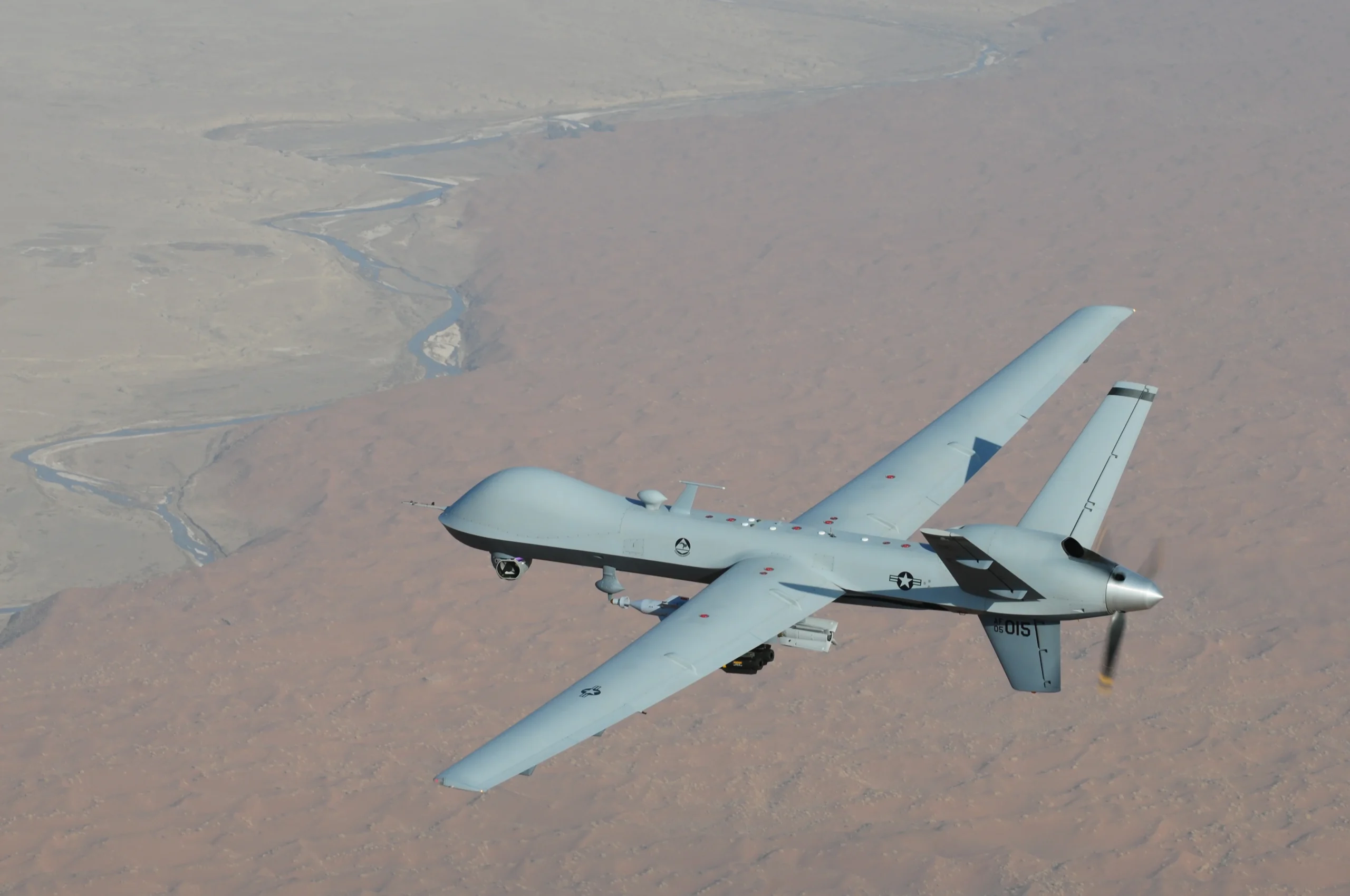
3. General Atomics MQ-9B SkyGuardian/SeaGuardian — certified 40+ hour endurance
Technical Specifications
| Wingspan | 24 m |
| MTOW | 5,670 kg |
| Payload | 2,155 kg external (9 hardpoints) |
| Max altitude | 40,000-50,000 ft |
| Max speed | ~482 km/h |
The MQ-9B is the first platform in General Atomics’ product family to earn NATO STANAG 4671 certification for integration into civil airspace. Its 40+ hour endurance, combined with beyond-line-of-sight (BLOS) satellite control, makes a single sortie capable of round-the-clock, day-after-day patrol coverage.
Development History
Developed as a redesigned version of the MQ-9A Reaper with extended wings for civil certification and NATO compatibility; SkyGuardian is configured for land missions, SeaGuardian with a maritime patrol sensor package.
Operational Use
Used or ordered by countries such as the United Kingdom, Belgium, Australia, and India for ISR, border security, and maritime patrol missions.
User Countries
United States, United Kingdom, Belgium, Australia, India (including a major 31-unit deal), with talks ongoing with Taiwan.
Advantages
Certified to fly in civil airspace, Lynx multi-mode radar, long endurance covering a wide sea/land area.
Disadvantages
High unit and operating cost, restricted customer access due to export controls (the US ITAR regime).
Current Status
New sales agreements continue to be signed with countries such as India and Poland; the platform is regularly displayed at multinational exercises such as RIMPAC.
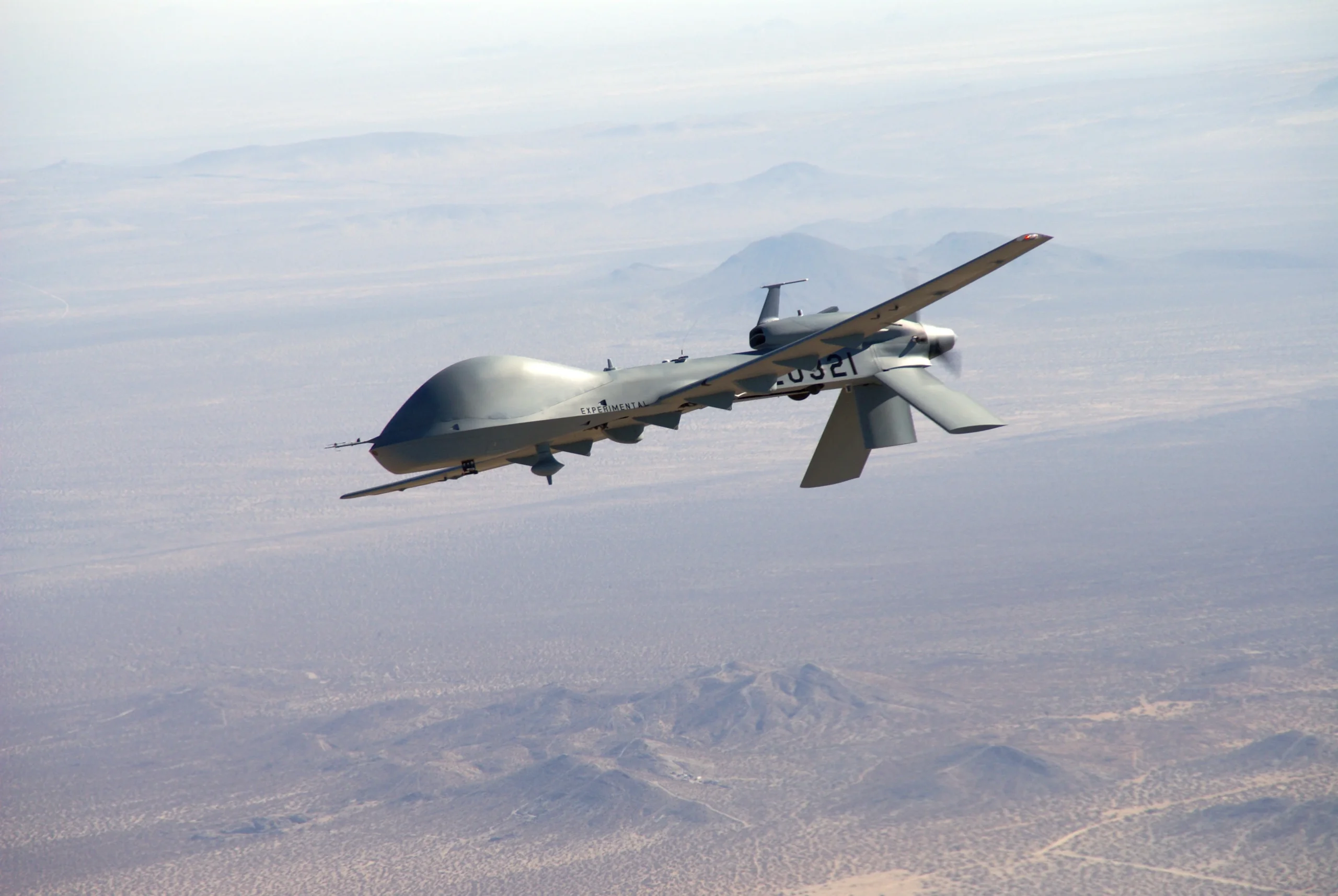
4. MQ-1C Gray Eagle Extended Range — 41.9-hour test record
Technical Specifications
| Wingspan | ~17 m |
| MTOW | ~1,633 kg |
| Payload | 590 kg external |
| Max altitude | ~29,000 ft |
| Range | ~3,300 km |
Compared with the standard Gray Eagle’s 25-hour endurance, the ER (Extended Range) version made a significant leap with a deep-body fuel tank and a new Lycoming DEL-120 engine. General Atomics announced that during a test flight at El Mirage, California, the ER platform stayed airborne for 41.9 hours, exceeding its 40-hour target.
Development History
Following the US Army’s decision to upgrade its existing Gray Eagle fleet to the ER standard, General Atomics fully converted its production line to the ER configuration.
Operational Use
Deployed at Army brigade level for reconnaissance, surveillance, and target-acquisition (ISR) missions along with light strike roles.
User Countries
Primarily used by the US Army; as covered in our TB3 comparison file (TR), allied export talks are ongoing.
Advantages
Directly integrated operation with ground troops, autonomous use at brigade level, extended endurance from increased fuel capacity.
Disadvantages
Lower payload and altitude compared with the MQ-9 family, limited weapons variety.
Current Status
ER fleet deliveries continue, with the US Army’s inventory undergoing a gradual fleet renewal.
5. TAI Aksungur — a 12-60 hour range depending on payload
Technical Specifications
| Wingspan | 24.2 m |
| MTOW | 3,300 kg |
| Payload | 750 kg (at 25,000 ft altitude) |
| Engine | 2x TEI-PD170 turbo-diesel |
| Max altitude | 40,000 ft (service ceiling) |
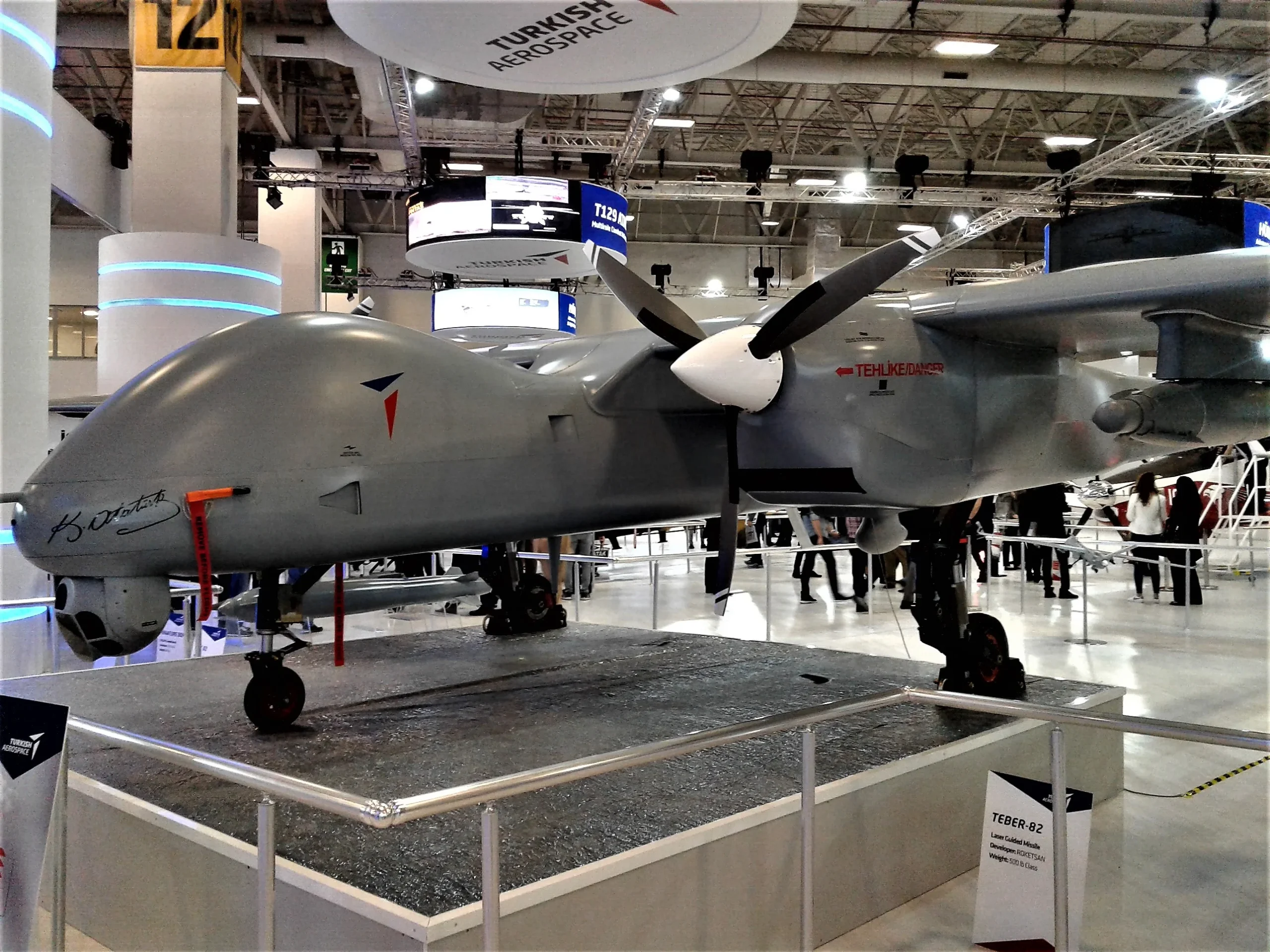
Aksungur’s endurance figure varies widely with mission profile: 12 hours with a full payload in a strike or maritime patrol mission, 24 hours in a SIGINT (signals-intelligence) configuration, and up to 50 hours — according to Turkish officials, with some sources citing 60 hours — in test flights with a lightened load. That wide range stems from the fuel efficiency of its twin turbo-diesel engines.
Development History
Built on TUSAŞ’s ANKA program, Aksungur was introduced at the 2019 IDEF exhibition; its twin-boom airframe and twin-engine configuration allow the aircraft to continue flying even after a single-engine failure. That twin-engine architecture adds extra weight compared with single-engine rivals, but provides a critical safety margin that improves fault tolerance, particularly on long maritime-patrol missions.
The choice of TEI-PD170 diesel engines is no accident either; diesel fuel’s lower flammability risk compared with gasoline/kerosene alternatives, and the logistical convenience it offers for long-duration missions at sea, make Aksungur especially well suited to the maritime-patrol role.
Operational Use
The Turkish Navy took delivery of its first Aksungur in 2021 for maritime-patrol missions; it is actively used in the SIGINT and maritime-reconnaissance role.
User Countries
Turkey (Army and Navy).
Advantages
Twin-engine safety margin, flexible payload/endurance balance, high domestic engine and avionics content.
Disadvantages
Endurance drops significantly at full payload, lower maximum speed compared with the MQ-9 family.
Current Status
Fleet is expanding within the Turkish Navy and Army inventory, with export talks ongoing. Aksungur’s position against its rivals is examined in detail in our file comparing it to Gray Eagle and Heron TP.
6. General Atomics MQ-9A Reaper (Extended Range) — a configuration reaching up to 42 hours
Technical Specifications
| Wingspan | 20 m standard, 27 m ER wing |
| MTOW | ~5,670 kg |
| Payload | 1,746 kg |
| Max altitude | 50,000 ft |
| Max speed | ~482 km/h (240 KTAS) |
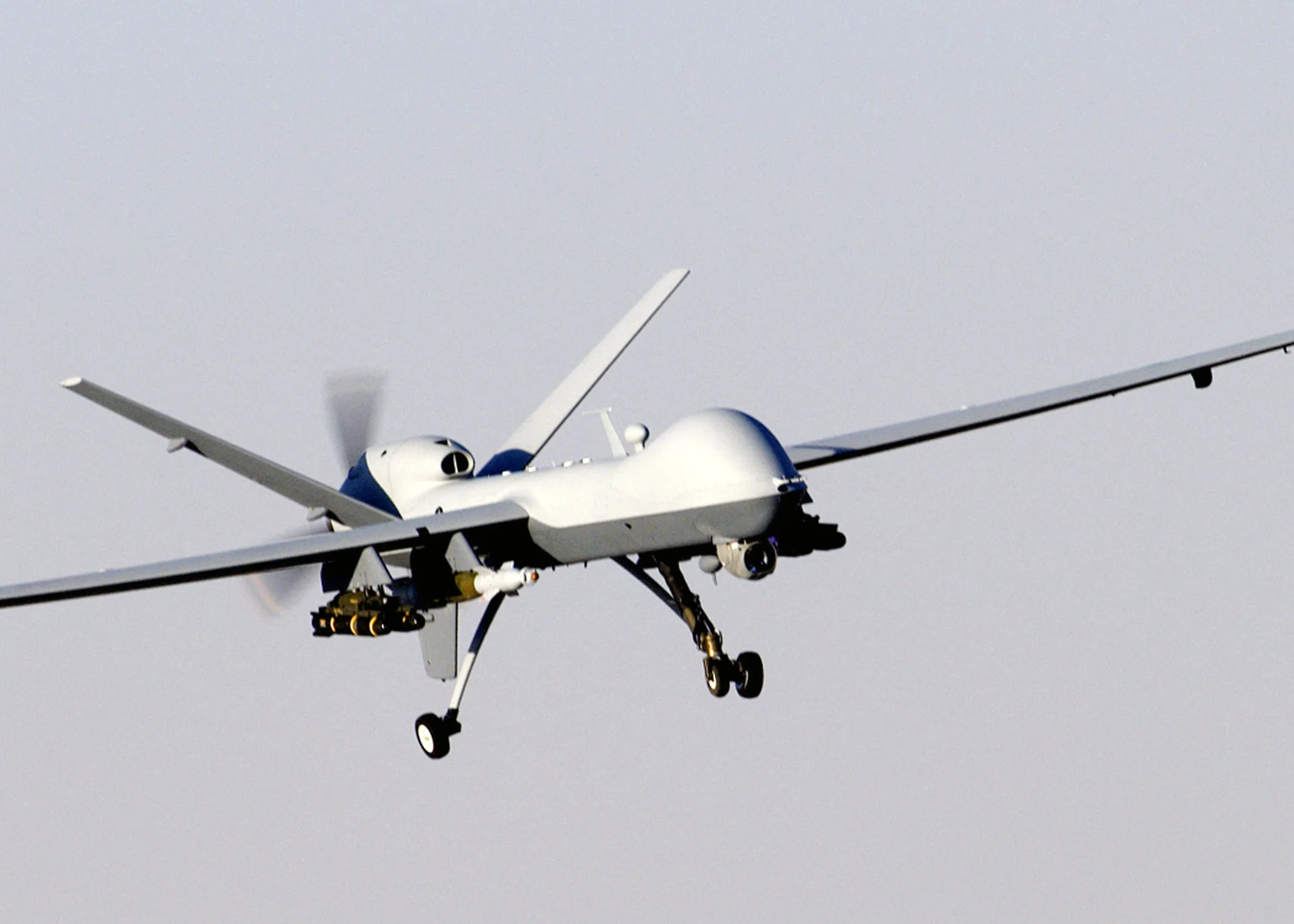
The standard MQ-9A Reaper flies missions with 27-hour endurance. In the ER (Extended Range) configuration, field-installable wing fuel pods and a strengthened landing gear push that figure to 34 hours; with two 450 kg external fuel tanks and a reduced munitions load, it can reach as much as 42 hours. Extending the wingspan to 27 meters (88 ft) supports that same 42-hour figure.
Development History
Developed as the enlarged, more powerful successor to the MQ-1 Predator, the Reaper serves as the US Air Force’s primary strike/ISR UAV; ER kits can be retrofitted to the existing fleet in the field. The speed and altitude gains its turboprop engine provides over the Predator’s piston engine have made the Reaper the United States’ most heavily used strike UAV since entering service in 2007.
Operational Use
Used extensively in strike and ISR missions in Afghanistan, Iraq, Syria, and the Sahel region; NATO allies also operate their own fleets.
User Countries
United States, United Kingdom, France, Italy, Netherlands, Spain, and various NATO allies.
Advantages
Wide, proven munitions integration (Hellfire, GBU series), high altitude and speed, retrofittable ER kit.
Disadvantages
Maximum endurance in the ER configuration comes only with a reduced munitions load, high operating cost.
Current Status
While the US fleet gradually transitions to the MQ-9B, the existing MQ-9A fleet continues to be used in active operations.
7. IAI Heron TP (Eitan) — 36 hours with a full payload
Technical Specifications
| Length | 14 m |
| MTOW | 5,300 kg |
| Payload | 1,000 kg |
| Engine | 1,200 HP Pratt & Whitney Canada PT6A turboprop |
| Max altitude | 45,000 ft |
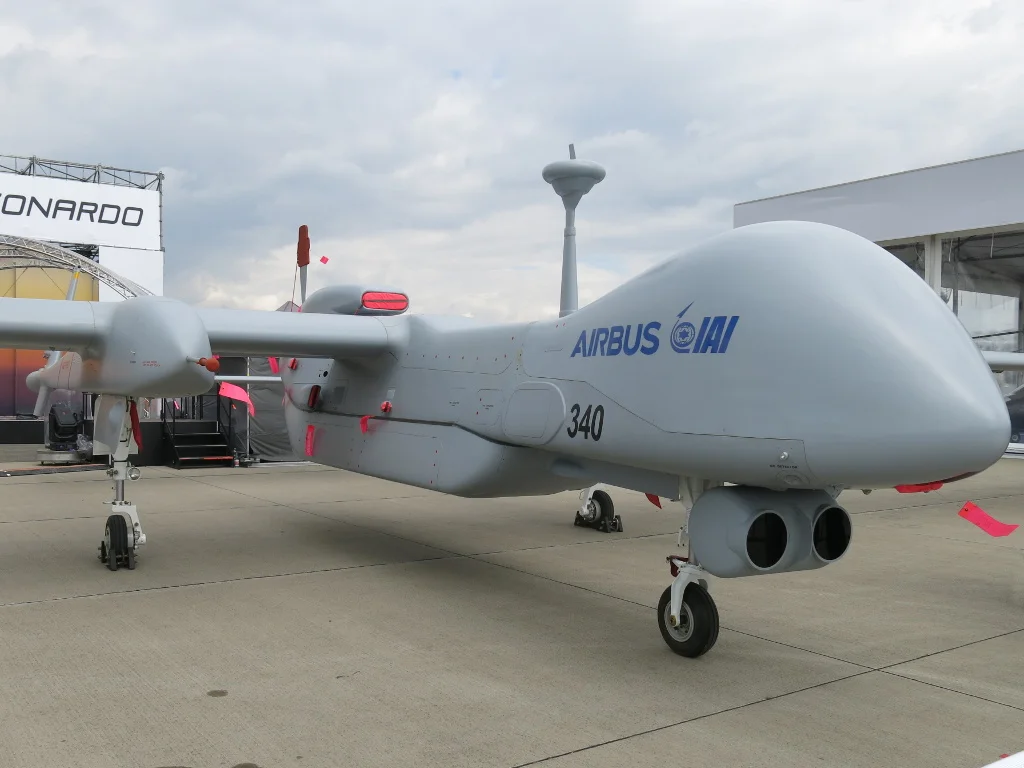
Heron TP can stay airborne for 36 hours with a full munitions/sensor load on a single turboprop engine — one of the highest per-engine efficiencies in its class. A cruise altitude above 40,000 ft keeps it clear of civil air traffic.
Development History
An enlarged version of IAI’s Heron family, the TP entered service with the Israeli Air Force under the name “Eitan”; its composite airframe and large internal volume allow for a variety of sensor and weapons packages. The program’s roots trace back to Israel’s UAV-development tradition dating to the 1980s, with Heron TP positioned as that lineage’s turboprop-powered, heavy-class product.
Operational Use
Used by the Israeli Air Force for strategic ISR and strike missions; modernized through AI-assisted sensor-fusion upgrades.
User Countries
Israel; lease/sale agreements exist with countries such as India and Germany.
Advantages
High payload capacity, strong engine performance, AI-assisted modernization program.
Disadvantages
High unit cost, restricted export subject to Israeli government approval.
Current Status
Active modernization continues through autonomy and sensor-software upgrades.
8. Northrop Grumman RQ-4 Global Hawk — 30-34 hours at 60,000 ft
Technical Specifications
| Wingspan | 39.9 m |
| MTOW | 14,628 kg |
| Payload | 1,360 kg (internal) |
| Max altitude | 60,000 ft (reported up to 65,000 ft on test flights) |
| Range | 22,800 km (ferry range) |
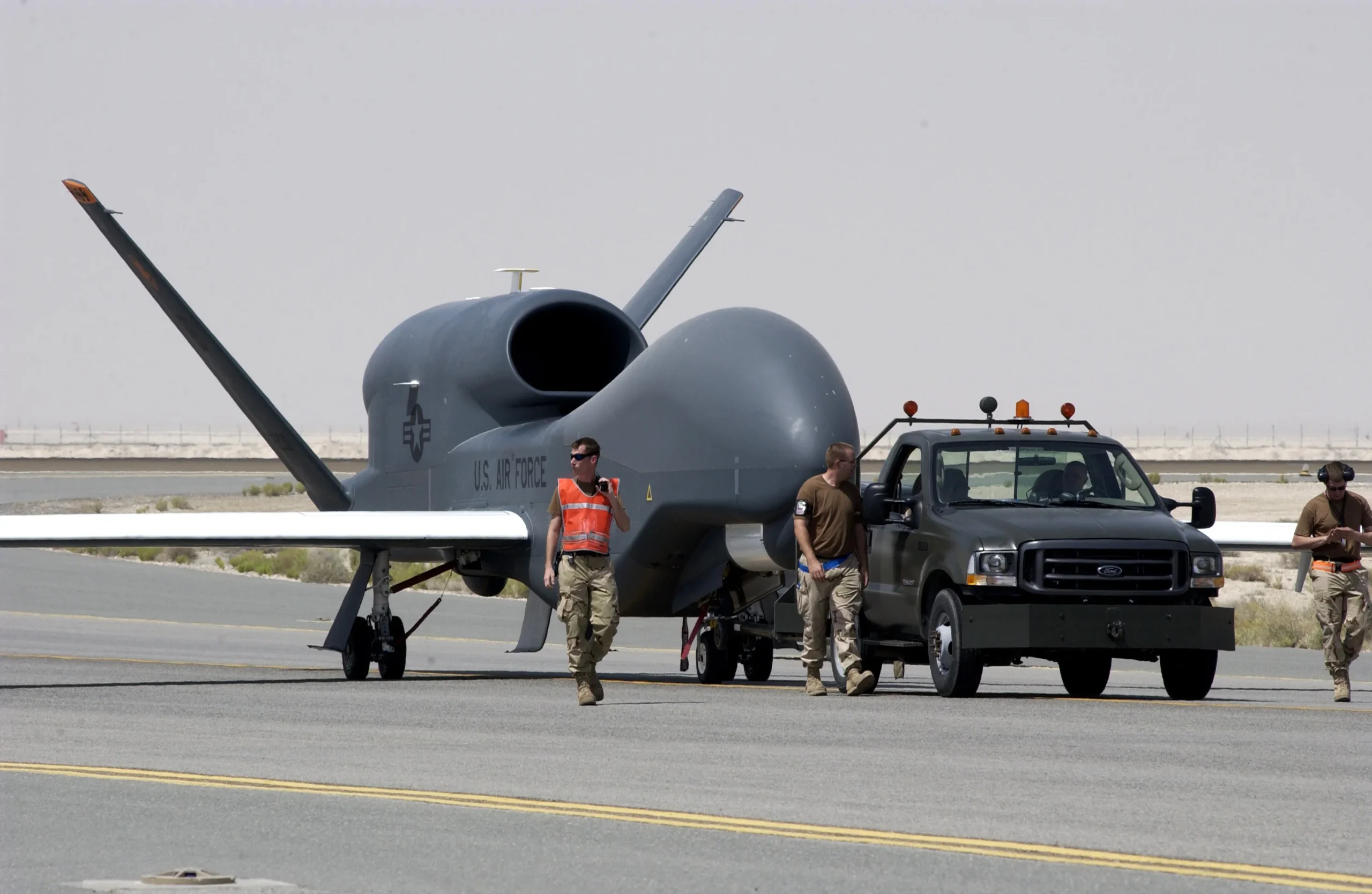
Global Hawk is the classic example of the HALE class; a single turbofan engine keeps it airborne for 30-34 hours at 60,000 ft. A typical mission profile covers a roughly 1,200-mile transit flight, 24 hours of continuous surveillance over the target area, and the return flight.
Development History
Developed in the late 1990s for the US Air Force’s Tier II+ HALE requirement, the platform was updated in later generations (RQ-4B) with a larger sensor package and airframe capacity.
Operational Use
Used for strategic ISR, wide-area cross-border surveillance, and maritime patrol (via the MQ-4C Triton derivative).
User Countries
US Air Force, NATO’s Alliance Ground Surveillance (AGS) program, Republic of Korea.
Advantages
Very high altitude gives a wide sensor field of view, long-range strategic transit capability.
Disadvantages
Very high unit cost, limited tactical flexibility given the lack of low-altitude/maneuvering capability, vulnerability to air-defense systems (as in Iran’s 2019 shootdown of an RQ-4 derivative).
Current Status
The US fleet is being modernized, with some units transferring to the MQ-4C Triton.
9. Baykar Bayraktar Akıncı — a 24-25 hour strike UAV
Technical Specifications
| Wingspan | 20 m |
| MTOW | 6,000 kg |
| Payload | 1,350 kg (combined internal+external) |
| Max altitude | 40,000 ft service ceiling, 30,000 ft operational |
| Max speed | 240 KTAS (~444 km/h) |
In a test flight in July 2021, Akıncı stayed airborne for 25 hours and reached an altitude close to 38,000 ft — a figure below Aksungur’s maximum among Turkish platforms, but above TB2’s. As of March 2025, the fleet had surpassed 100,000 total flight hours.
Development History
Akıncı is Baykar’s heavy-class strike UAV developed after TB2; it uses a twin-turboprop engine configuration and can carry MAM-L/MAM-C smart munitions as well as stand-off missiles.
Operational Use
Used by the Turkish Armed Forces for deep-strike and air-defense-suppression missions; field-tested in Libya and surrounding operations.
User Countries
Turkey; operator training is proceeding under a $3 billion agreement with Saudi Arabia.
Advantages
Wide munitions variety and stand-off weapons integration, a proven fleet track record exceeding 100,000 hours.
Disadvantages
Lower endurance and altitude compared with the MQ-9 family, no stealth (radar cross-section reduction) features.
Current Status
Full technical details are covered in our what is AKINCI file (TR); export agreements and fleet expansion continue.
10. Baykar Bayraktar TB2 — a 27-hour, 3-minute Turkish record
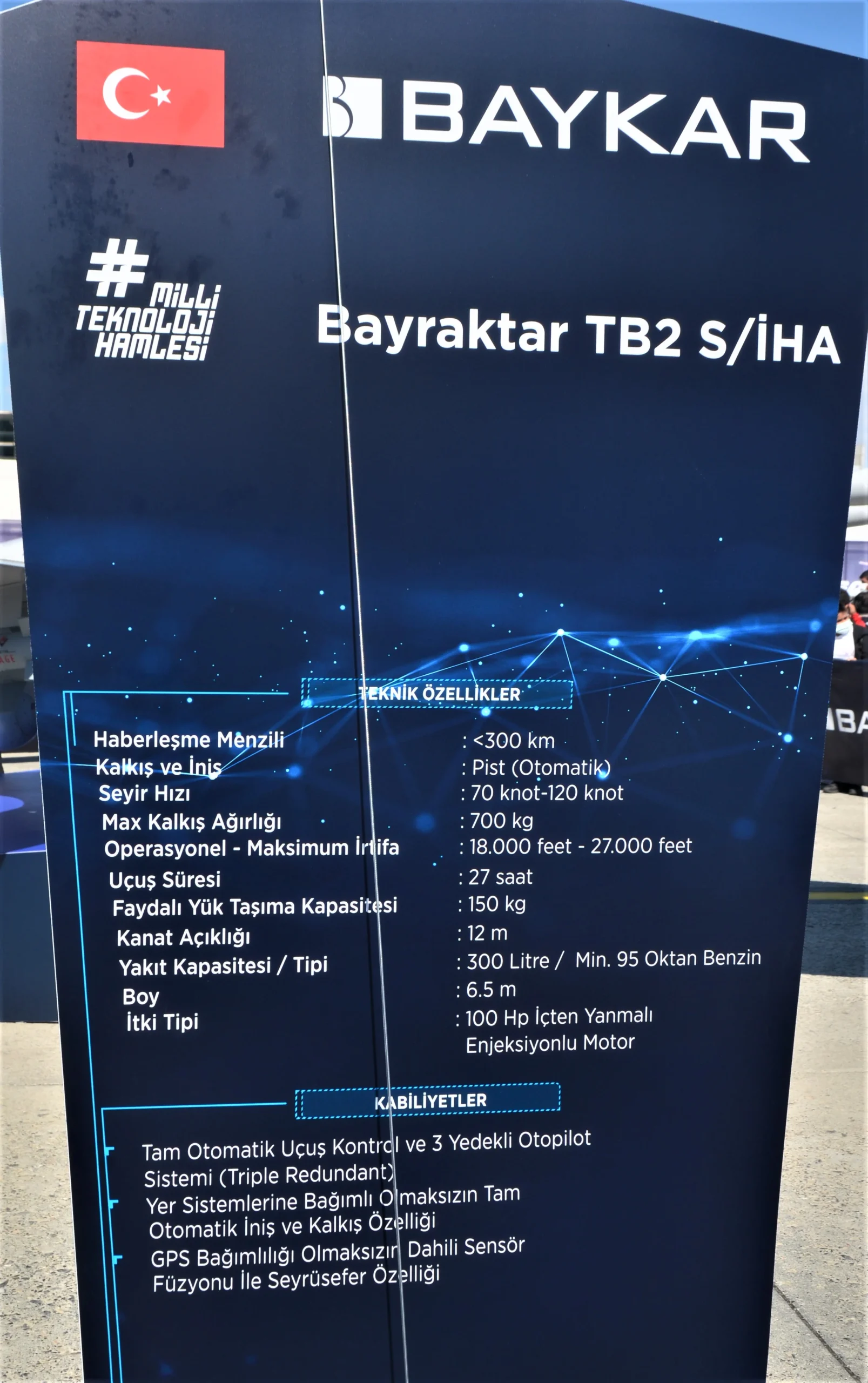
Technical Specifications
| Wingspan | 12 m |
| MTOW | 650-700 kg |
| Payload | 150 kg |
| Engine | 100 hp Rotax 912 |
| Max altitude | 27,000 ft |
Despite being the smallest and lightest platform on this list, TB2 holds the Turkish aviation-history endurance record with a flight of 27 hours and 3 minutes. That figure, thanks to a composite airframe and an efficient piston engine, delivers endurance comparable to far larger and heavier platforms.
Development History
Baykar’s first tactical-class armed UAV, entering service in 2014, TB2 laid the foundation for every subsequent Turkish UAV/UCAV program (Akıncı, TB3, Kızılelma).
Operational Use
Widely used in the conflicts in Syria, Libya, Nagorno-Karabakh, and Ukraine; its MAM-L/MAM-C smart munitions produced a high-accuracy strike record.
User Countries
Turkey and more than 30 export customer countries (including Ukraine, Azerbaijan, Poland, and Qatar).
Advantages
Low unit cost, a proven operational record, easy logistics and maintenance.
Disadvantages
Limited payload and range, low survivability against modern air-defense systems.
Current Status
TB2’s comparison with rival platforms is covered in our Orbiter 4 comparison file (TR); the platform is being gradually phased down in production in favor of TB3.
Comparative Charts
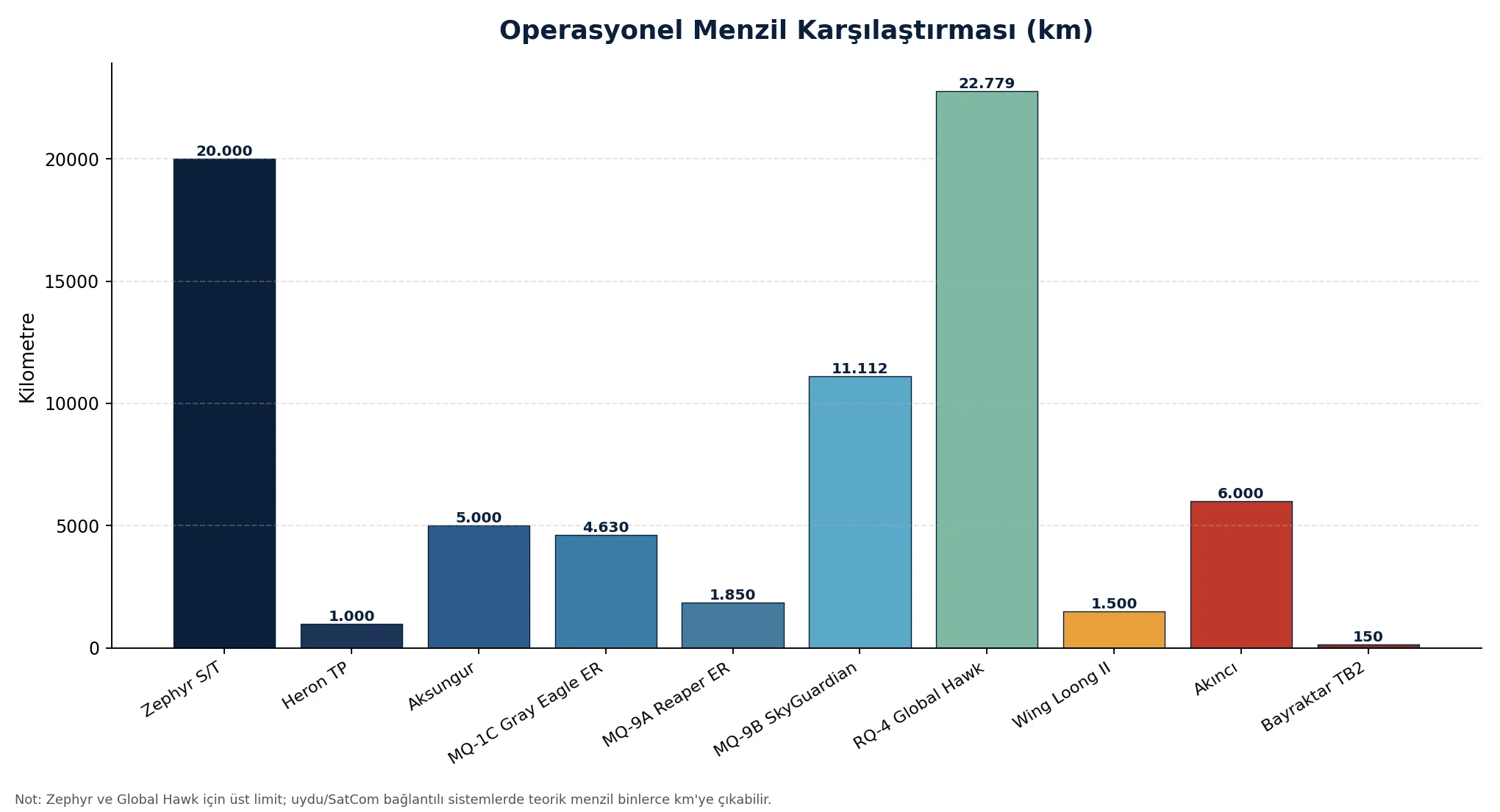
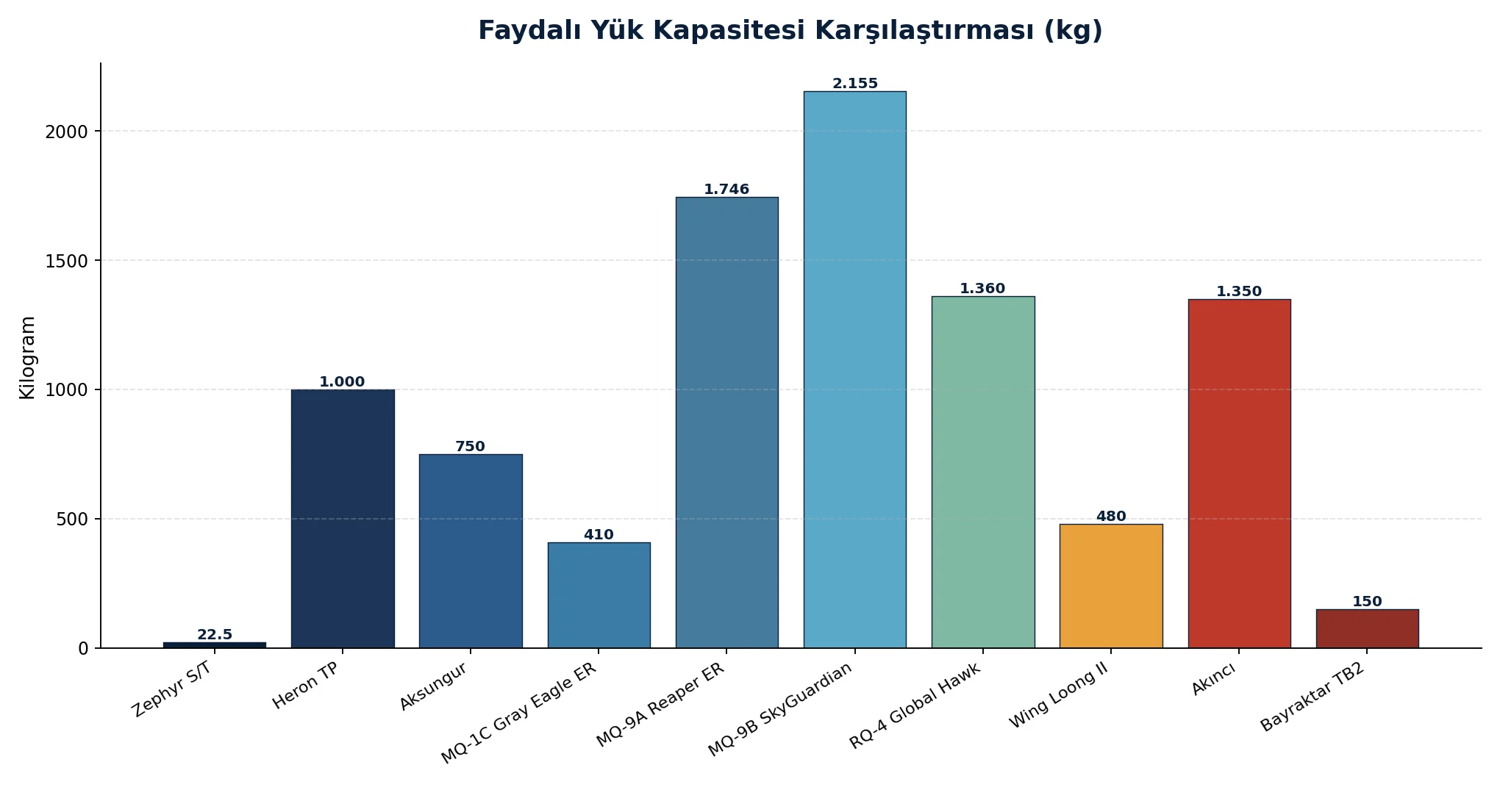
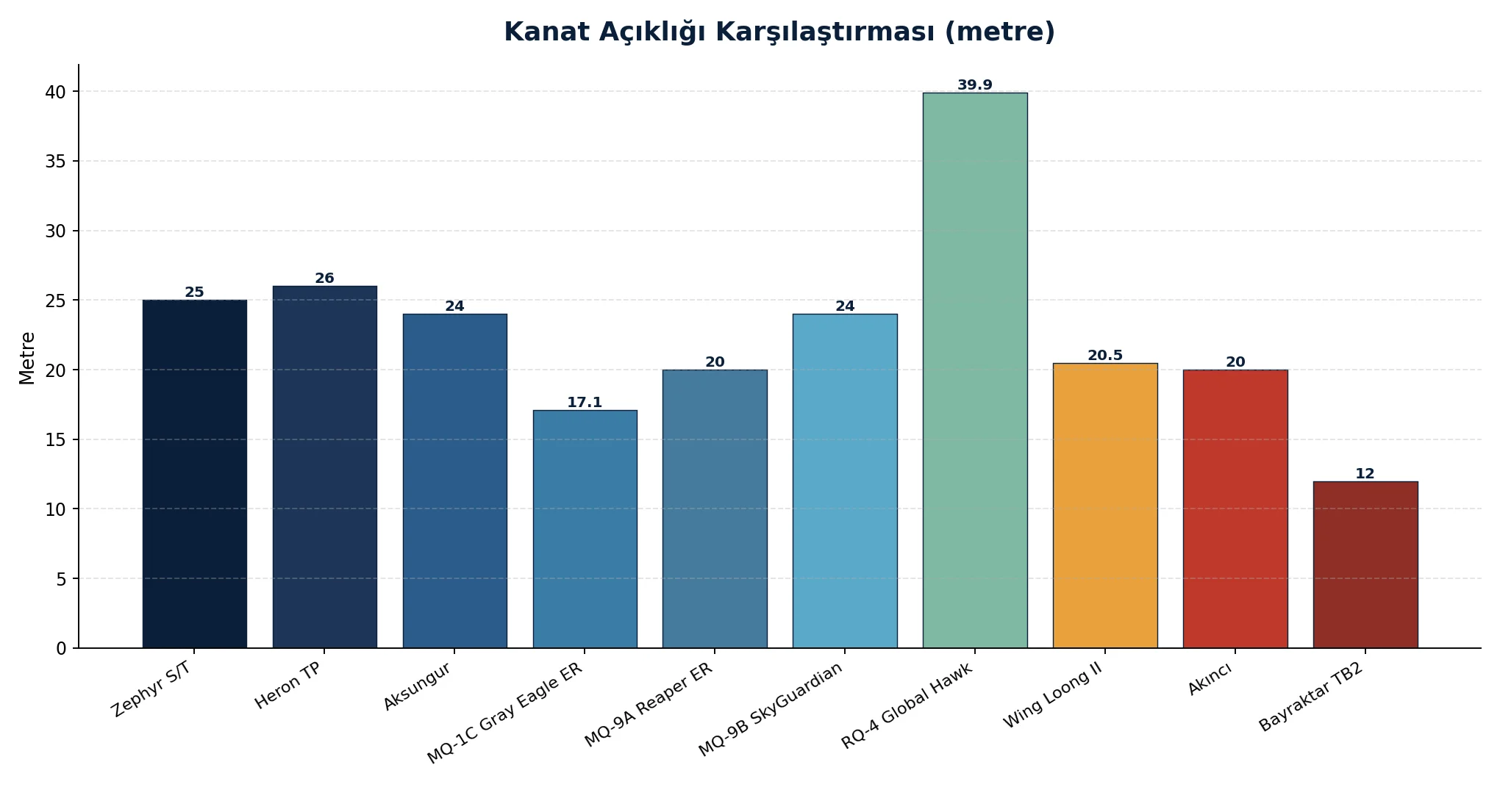
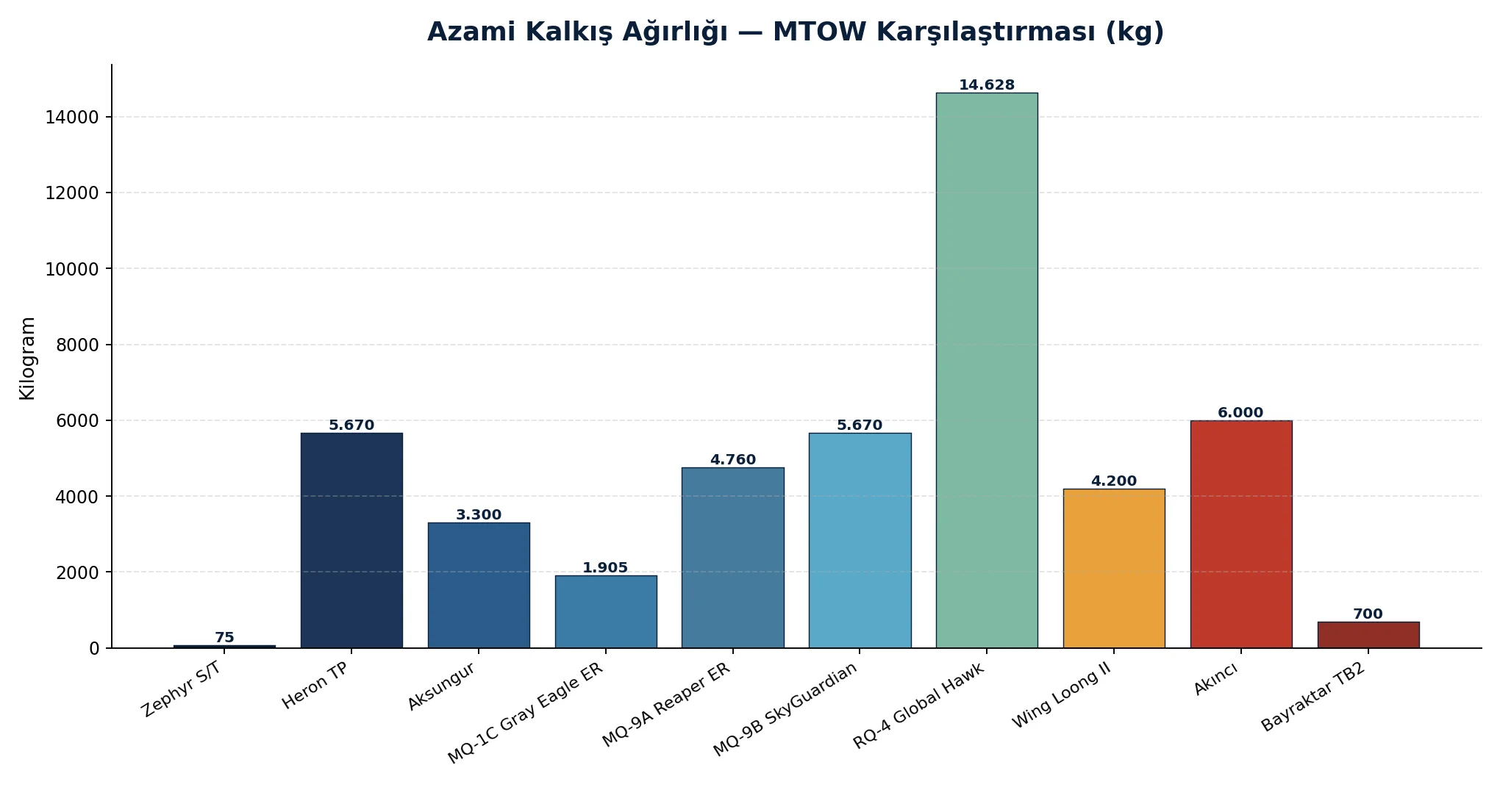
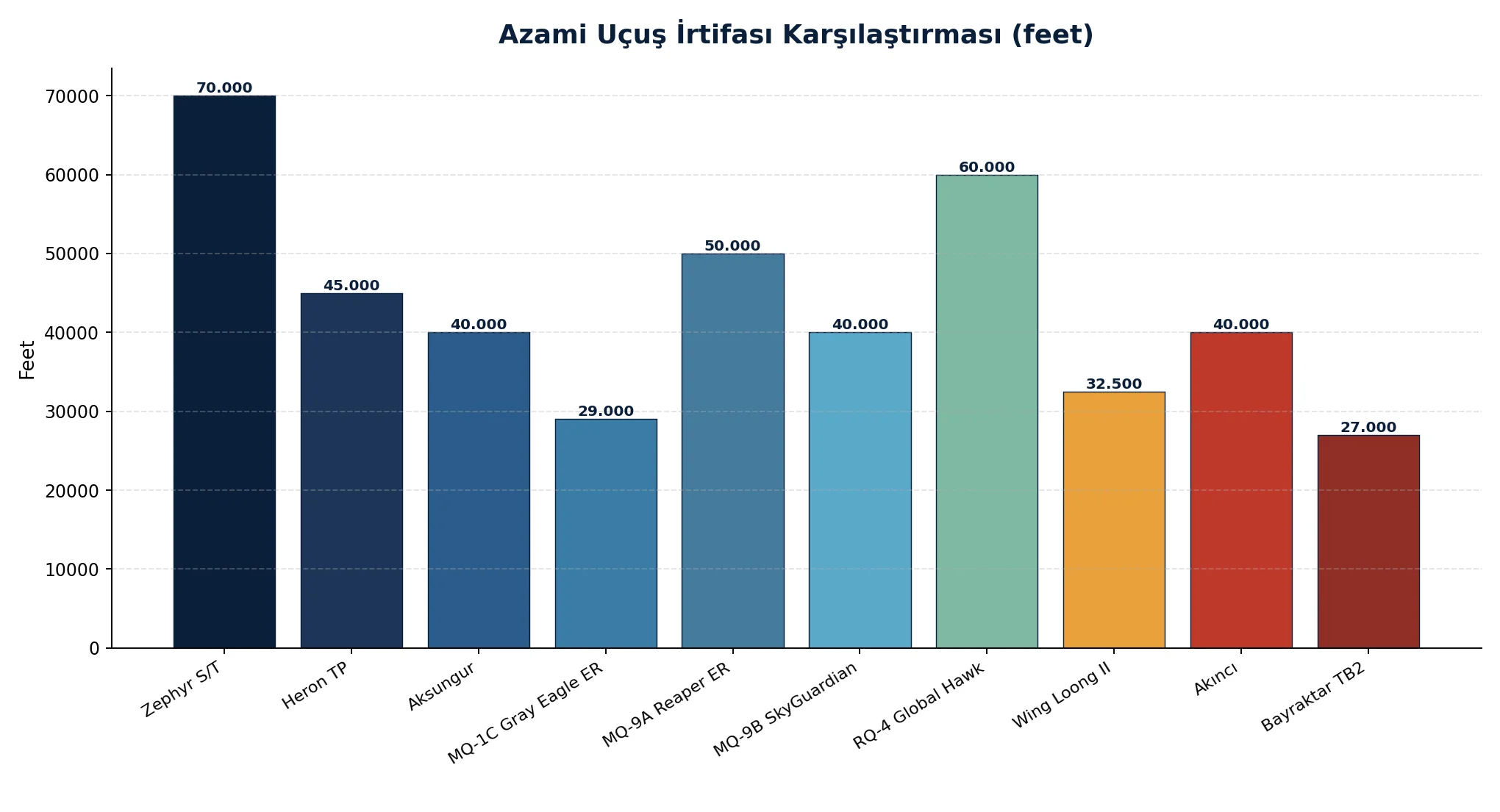
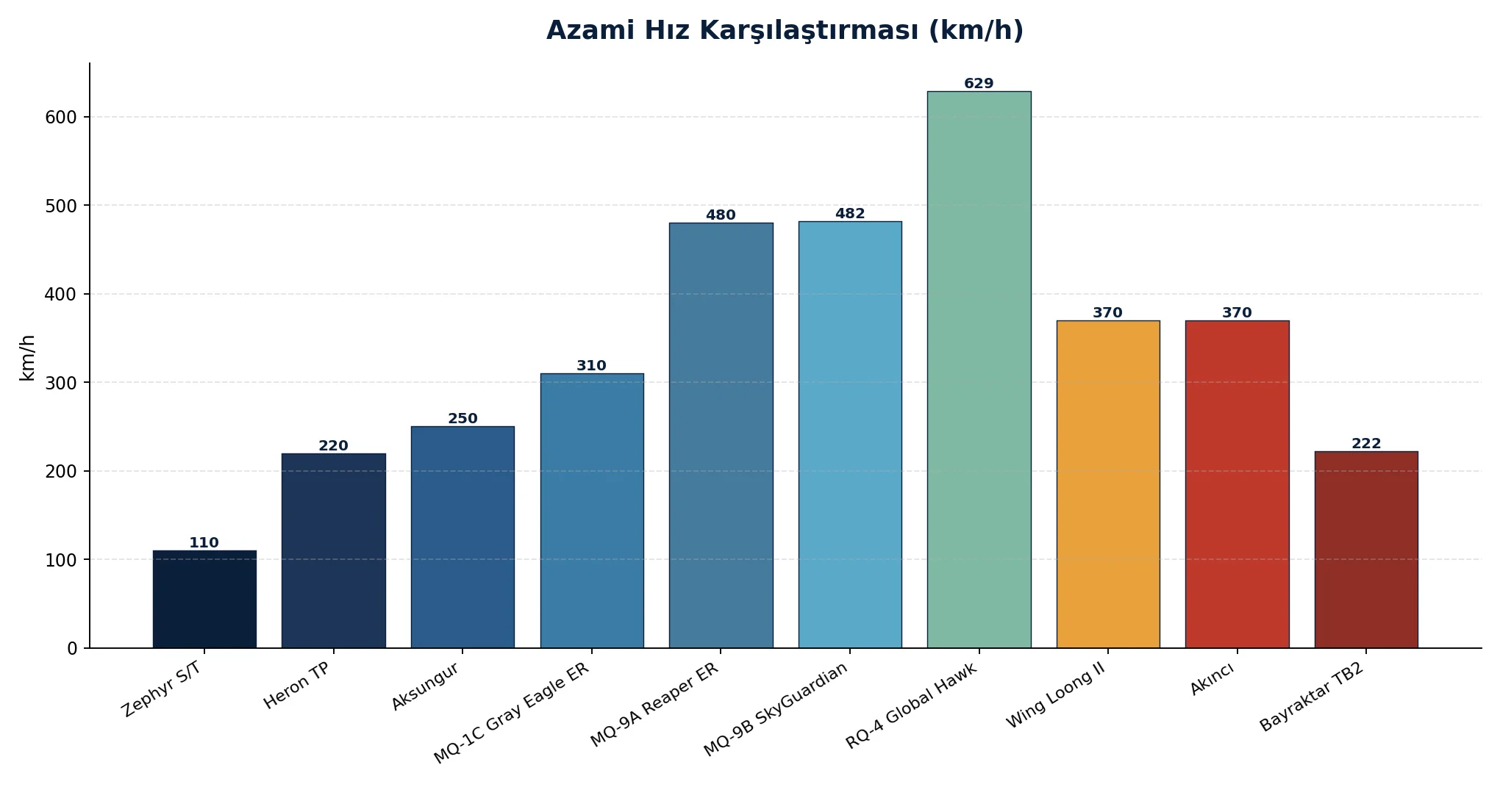
The seven charts below compare the key performance metrics of the 10 platforms on the list visually.
Weapons Integration Table
| UAV | Primary Weapons/Munitions Integration |
|---|---|
| Zephyr S | Unarmed (ISR/communications platform) |
| Wing Loong 3 | Numerous guided-bomb and missile stations (AR-1/2, GB series) |
| MQ-9B SkyGuardian/SeaGuardian | Hellfire missile, GBU-12/38 guided bombs (9 hardpoints) |
| Gray Eagle ER | Hellfire missile, GBU-44 Viper Strike |
| Aksungur | MAM-L/MAM-C smart munitions, Bozok missile |
| MQ-9A Reaper | Hellfire, GBU-12/38, AIM-9X (test) |
| Heron TP | Armable variants exist, primarily ISR-focused |
| RQ-4 Global Hawk | Unarmed (pure ISR platform) |
| Akıncı | MAM-L/MAM-C/MAM-T, SOM-A stand-off missile, KGK guidance kit |
| TB2 | MAM-L/MAM-C smart munitions |
Full Technical Specifications Table
| UAV | Wingspan | MTOW | Payload | Max Altitude | Max Speed | Endurance |
|---|---|---|---|---|---|---|
| Zephyr S | ~25 m | ~75 kg | ~5 kg | 60,000-70,000 ft | ~130 km/h | 1,614 hours |
| Wing Loong 3 | 24 m | ~6,200 kg | 2,100 kg | ~30,000 ft | ~370 km/h | 40+ hours |
| MQ-9B | 24 m | 5,670 kg | 2,155 kg | 40,000-50,000 ft | 482 km/h | 40+ hours |
| Gray Eagle ER | ~17 m | ~1,633 kg | 590 kg | ~29,000 ft | ~309 km/h | 41.9 hours (test) |
| Aksungur | 24.2 m | 3,300 kg | 750 kg | 40,000 ft | ~180 km/h | 12-60 hours (profile-dependent) |
| MQ-9A Reaper (ER) | 20-27 m | ~5,670 kg | 1,746 kg | 50,000 ft | 482 km/h | 27-42 hours |
| Heron TP | 16.6 m | 5,300 kg | 1,000 kg | 45,000 ft | ~370 km/h | 36 hours |
| Global Hawk | 39.9 m | 14,628 kg | 1,360 kg | 60,000 ft | ~630 km/h | 30-34 hours |
| Akıncı | 20 m | 6,000 kg | 1,350 kg | 40,000 ft | ~444 km/h | 24-25 hours |
| TB2 | 12 m | 650-700 kg | 150 kg | 27,000 ft | 222 km/h | 27 hours 3 min |
User Countries Table
| UAV | Main User Countries |
|---|---|
| Zephyr S | United Kingdom (developer), US Army (test partner) |
| Wing Loong 3 | China, various Middle East/Africa export customers |
| MQ-9B | United States, United Kingdom, Belgium, Australia, India |
| Gray Eagle ER | US Army |
| Aksungur | Turkey |
| MQ-9A Reaper | United States, United Kingdom, France, Italy, Netherlands, Spain |
| Heron TP | Israel, India (lease), Germany (lease) |
| Global Hawk | United States, NATO (AGS), South Korea |
| Akıncı | Turkey, Saudi Arabia (agreement stage) |
| TB2 | Turkey, Ukraine, Azerbaijan, Poland, Qatar, 30+ countries |
Editor’s Note
All data in this file was compiled as of 13 July 2026 based on publicly available manufacturer data, official test-flight results, and figures confirmed by the defense press. Endurance figures in particular can vary significantly with payload, fuel configuration, and mission profile; manufacturers’ modernization programs (engine changes, added fuel tanks, wing extensions, and similar upgrades) may change these figures in the future. The series continues weekly with a new “World’s…” comparison file.
Frequently Asked Questions
Which UAV has the longest endurance?
Within the conventional fuel-powered MALE/HALE class, that title is shared between Wing Loong 3 and MQ-9B SkyGuardian/SeaGuardian at 40+ hours. However, the solar-powered Zephyr S / AALTO HAPS platform holds the absolute record, in a category of its own, at 67 days (1,614 hours).
How many hours does the Bayraktar TB2 stay airborne?
TB2 holds the Turkish aviation-history endurance record with a flight of 27 hours and 3 minutes.
What is the range of the MQ-9 Reaper?
The standard MQ-9A Reaper has a range of roughly 5,926 km; in the ER (Extended Range) configuration, additional fuel tanks can extend that figure.
How many hours can the Wing Loong 3 fly?
Wing Loong 3 is designed to target endurance above 40 hours — significantly above its predecessor Wing Loong II’s 32-hour performance.
How long does the Akıncı stay airborne?
Bayraktar Akıncı stayed airborne for 25 hours in a July 2021 test flight, reaching the second-highest endurance figure among Turkish platforms after Aksungur.
What are the advantages of the Heron TP?
Heron TP can fly for 36 hours with a full munitions/sensor load on a single turboprop engine; its 1,000 kg payload capacity and AI-assisted sensor-fusion upgrades are among its standout advantages.
What is TAI Aksungur’s maximum flight duration?
Aksungur’s endurance varies by mission: 12 hours with a full payload, 24 hours in a SIGINT mission, and up to 50-60 hours in light-payload test flights.
Why isn’t the Zephyr S counted in the same category as other UAVs?
Zephyr S is a solar-powered stratospheric HALE platform; because it uses an engineering approach entirely different from conventional fuel-powered MALE/HALE UAVs and flies on a day/month scale, it is marked as a separate category.
At what altitude does the RQ-4 Global Hawk fly?
Global Hawk has a service ceiling of 60,000 ft; it has been reported to reach as high as 65,000 ft on test flights.
What is the Gray Eagle Extended Range’s test record?
The MQ-1C Gray Eagle ER stayed airborne for 41.9 hours during a test flight at El Mirage, California, exceeding its 40-hour target.
Which countries use the MQ-9B?
The United States, United Kingdom, Belgium, Australia, and India are among the main user countries; India signed a major deal for 31 units.
What is the difference between the Wing Loong 3 and the Wing Loong II?
Wing Loong 3 offers 40+ hours of endurance thanks to an enlarged airframe and increased fuel capacity, while the Wing Loong II’s maximum endurance stays at 32 hours; payload capacity is also significantly increased on the Wing Loong 3.
Which UAVs on this list are armed?
Wing Loong 3, MQ-9B, Gray Eagle ER, Aksungur, MQ-9A Reaper, Akıncı, and TB2 are used in armed configurations. Zephyr S and RQ-4 Global Hawk are pure ISR/communications platforms; armable variants of the Heron TP exist, though its primary use remains ISR-focused.
Sources
- AALTO HAPS / Airbus Defence and Space — Zephyr S program statements and flight records
- AVIC / CAIG — Wing Loong 3 technical data, Zhuhai Airshow 2022 exhibition materials
- General Atomics Aeronautical Systems — MQ-9B, MQ-9A, MQ-1C Gray Eagle ER technical specifications and test-flight statements
- TUSAŞ (Turkish Aerospace Industries) — Aksungur technical specifications
- Israel Aerospace Industries (IAI) — Heron TP technical data
- Northrop Grumman — RQ-4 Global Hawk technical specifications
- Baykar — Bayraktar Akıncı and TB2 technical specifications and flight records
- US Department of Defense / US Army program statements
- NATO Alliance Ground Surveillance (AGS) program materials