





The World’s Fastest Military Helicopters (2026): The Record Nobody Has Broken in 40 Years


Tiltrotors and compound helicopters are kept in a separate section rather than the main table.
Speed rankings in military aviation are usually about fighter jets; with helicopters the ranking itself is almost beside the point. The real story is not which machine is marginally quicker but that nearly every helicopter is bunched into the same narrow band. This file ranks the helicopters in service, then opens up the physics that confines them to that band — and finally looks at how the platforms that break out actually do it.
Methodology: what counts as a helicopter here?
The critical decision in this file is classification. Public lists routinely place tiltrotors and compound platforms in the same table as helicopters, yet these are different aerodynamic architectures:
| Architecture | How it works | How we treat it here |
|---|---|---|
| Conventional helicopter | A single main rotor produces both lift and thrust | The main table — the ranking consists only of these |
| Tiltrotor | The rotors tilt forward into propellers; the wing takes over lift | A separate section — excluded from the helicopter ranking |
| Compound helicopter | A thrust propeller and/or wing is added alongside the rotor | A separate section — a different architecture from a conventional helicopter |
| Record flight | A specially prepared, unloaded machine measured under controlled conditions | Handled in the record section; never mixed into the ranking |
Table one: the fastest conventional helicopters in service
The list below gives stated maximum speeds for conventional helicopters currently in service. That the entire field fits inside a 74 km/h band is the real subject of this file.
| # | Helicopter | Country | Role | km/h | Note |
|---|---|---|---|---|---|
| 1 | Mi-35M | Russia | Attack / transport | 335 | The fastest conventional helicopter, on a clean airframe and powerful engines |
| 2 | Ka-52 Alligator | Russia | Attack | 315 | Coaxial twin rotors; no tail rotor |
| 3 | AW139M | Italy | Multirole | 310 | A civil-derived airframe; the military version sits in the same speed band |
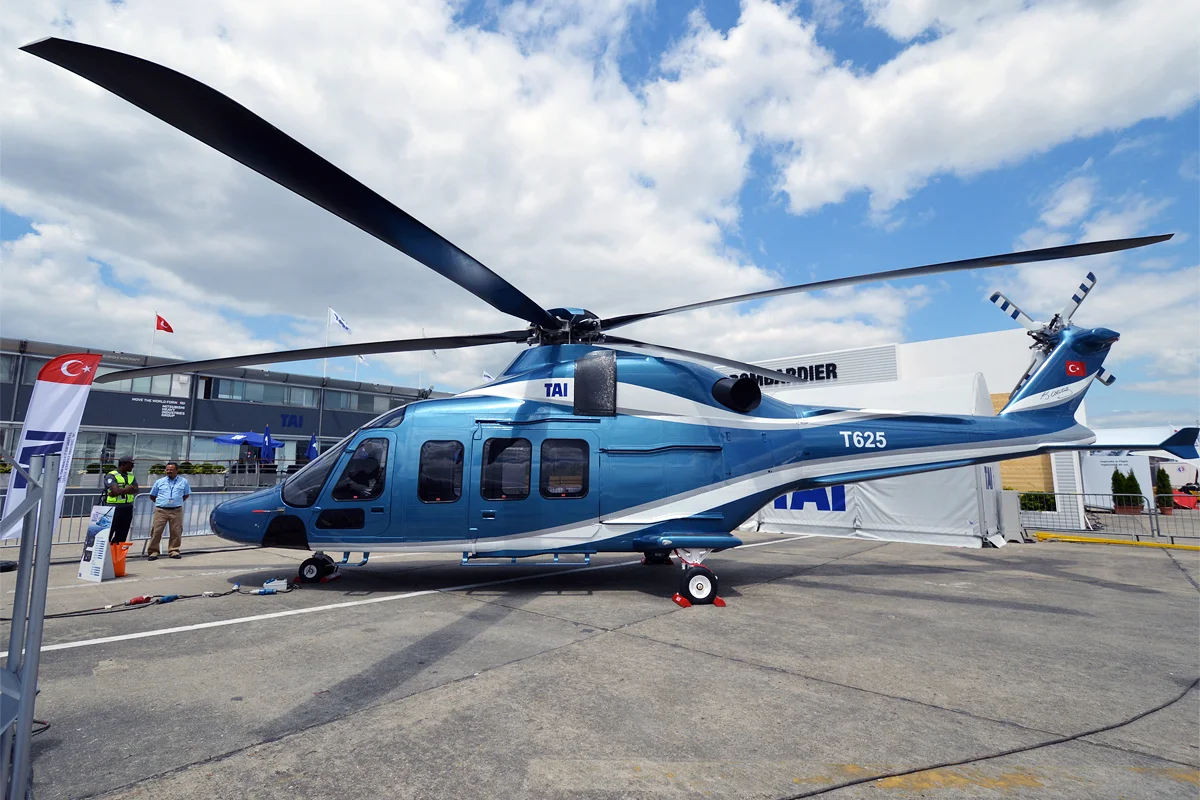
| 4 | T625 Gökbey | Türkiye | Utility | 306 | Built by TUSAŞ; moving into series production |
| 5 | CH-47F Chinook | USA | Heavy lift | 302 | Tandem rotors; unexpectedly quick for the heavy lift class |
| 6 | NH90 | Europe | Multirole | 300 | European joint programme; naval and land versions share the band |
| 7 | UH-60M Black Hawk | USA | Utility | 294 | One of the most widely operated military helicopters in the world |
| 8 | AH-64E Apache Guardian | USA | Attack | 293 | On an attack mission speed is traded against weapon load and time on station |
| 9 | T129 ATAK | Türkiye | Attack | 281 | An attack helicopter built by TUSAŞ; narrow, agile airframe |
| 10 | CH-53K King Stallion | USA | Heavy lift | 261 | Heavy lift; an external load capacity near 16 tonnes takes priority over speed |

A record that has stood for forty years
Aviation records are usually refreshed every few years. The absolute helicopter speed record has not moved since 1986 — and not for want of trying.
Why the wall exists: the advancing blade nears the speed of sound
As a helicopter’s rotor turns, the blade moving into the direction of flight and the blade moving backwards see very different airspeeds. The advancing blade tip adds the aircraft’s forward speed to the rotor’s own rotational speed. A typical rotor tip runs at about 790 km/h; the table below shows what happens once forward speed is added on top:
| Flight speed | Advancing blade tip (km/h) | Mach | What happens |
|---|---|---|---|
| 250 km/h | 1.040 | 0,85 | A comfortable operating region; compressibility effects still limited |
| 300 km/h | 1.090 | 0,89 | The cruise band of most military helicopters |
| 350 km/h | 1.140 | 0,93 | Vibration and noise begin to rise noticeably |
| 400 km/h | 1.190 | 0,97 | Very close to the speed of sound; shock waves and drag climb fast |
| 450 km/h | 1.240 | 1,01 | The advancing tip goes supersonic; not sustainable on a conventional rotor |
The other half of the problem works in mirror image. While the advancing blade races toward the speed of sound, the retreating blade has the aircraft’s forward speed subtracted from its own rotational speed; at 400 km/h the airflow over that blade becomes too slow to generate lift, and the blade stalls. The result is one side of the rotor producing more lift than the other — an imbalance. Aviation calls this retreating blade stall, and it is what fixes the speed ceiling of a conventional helicopter.
The platforms that break the wall — and what it costs them
The wall is not impassable; but the only way past it is to give up part of the helicopter architecture. Every platform below exceeds 400 km/h, and none of them is a helicopter in the conventional sense:
| Platform | Architecture | km/h | Status | How it gets past |
|---|---|---|---|---|
| V-22 Osprey | Tiltrotor | 565 | In service | The rotors tilt forward and the wings take over lift — in level flight it is an aeroplane |
| V-280 Valor | Tiltrotor | 520 | In development | The nacelles stay fixed and only the rotors tilt; it still lands like a helicopter |
| Eurocopter X3 | Compound helicopter | 472 | Experimental | Two thrust propellers and short wings added to the rotor; 472 km/h measured in 2013 |
| SB-1 Defiant | Compound helicopter | 460 | Prototype | Coaxial twin rotors plus a pusher propeller; rotor load is split across two rotors |
| Westland Lynx (G-LYNX) | Conventional helicopter | 400,87 | FAI record | Conventional architecture just under the wall; unmatched for forty years |
What it costs shows up in the Osprey programme’s own history: the tiltrotor architecture demanded a far more complex drive system than a conventional helicopter, a much higher unit cost and a long maturation period. The equation is similar for compound helicopters — an extra propeller and wing mean weight and maintenance burden. Which is why the overwhelming majority of military helicopters in the world today remain conventional, and remain in the 300 km/h band.
Four things that set helicopter speed
Rotor tip speed
Rotor rpm is held fixed, because letting the tip approach the speed of sound means noise, vibration and drag. A designer can defer the problem by lowering rotor rpm, but hover performance then suffers. Helicopter design is largely the balance between those two constraints.
Airframe drag
Unlike aeroplanes, helicopters usually leave landing gear, rotor head and external stores exposed to the airflow. Part of why the Mi-35M sits at the top of the list is an airframe cleaner than most of its contemporaries.
Payload and external stores
Missile and rocket launchers under the stub wings of an attack helicopter, or the sensor turret of a scout, generate substantial drag. The maximum speed printed in a brochure is usually the clean-configuration figure; with a full weapon load it is not reached.
Engine power — but less than you would think
A more powerful engine speeds a helicopter up to a point; once the rotor reaches its aerodynamic limit, additional power turns into vibration rather than speed. That is why the speed wall on a conventional helicopter is a rotor problem, not an engine one.
Where does Türkiye sit in this table?
Türkiye appears with two platforms. The T625 Gökbey sits in the upper half at 306 km/h, and the T129 ATAK at 281 km/h in the natural band for attack helicopters. Both fall inside the global norm — because the width of that band is not a design choice but a limit drawn by physics.
We have produced no estimate for the T929. When an official figure is published this page will be updated and the platform added to the table.
Türkiye’s position here is measured less by speed ranking than by being among the countries able to design and build their own helicopters. Sitting mid-table on speed is not a shortfall; anyone wanting out of this band has to abandon the conventional helicopter architecture entirely.
Frequently asked questions
What is the fastest helicopter in the world?
Why does the V-22 Osprey not count as the fastest helicopter?
Why are helicopters stuck around 300 km/h?
Why has the 1986 record never been broken?
What is Türkiye’s fastest helicopter?
What is a compound helicopter?
Sources
- Fédération Aéronautique Internationale (FAI) — certified helicopter speed records
- Presidency of Defence Industries (SSB) — statements on the T129, T625 and T929 programmes
- TUSAŞ official product documentation
- Boeing, Sikorsky, Bell, Leonardo and Airbus Helicopters official product literature
- US Army and Marine Corps platform fact sheets
- International Institute for Strategic Studies (IISS) — The Military Balance