Military Power of Armenia: How Many Tanks, Aircraft and Missiles Are in the Inventory? (2026)

Armenia’s military inventory captures one of the most far-reaching military transformations in the South Caucasus over the past six years. Having suffered heavy losses against Azerbaijan’s drone-heavy campaign in the 44-day war of 2020, and having lost its presence in Karabakh entirely in September 2023, Armenia had to rebuild its defence planning from scratch. Today New Delhi and Paris have largely taken Moscow’s place at the procurement table. This file examines the land, air and air-defence inventory of the Armenian Armed Forces using Global Firepower, IISS and SIPRI data, together with the current state of relations with Türkiye.
At a Glance
- Active personnel: Global Firepower gives 65,000 active personnel, 210,000 reserves and 5,000 paramilitary. Conscription remains in place; the reform launched after the 2020 war aims to raise the share of contract soldiers
- Main battle tanks: 109 (Global Firepower). The core is about 100 T-72A/Bs; after the 2020 losses, artillery and air defence took priority over tanks
- Military aircraft: 69 (Global Firepower): 4 Su-30SM fighters, 14 attack aircraft (Su-25) and 36 helicopters, 20 of them attack helicopters
- Artillery: Global Firepower counts 104 self-propelled guns, 193 towed guns and 100 rocket launchers. The shift to 155 mm is under way with MArG and ATAGS from India and CAESAR from France
- Naval platforms: None. Armenia is landlocked and has no navy
- Defence budget: The 2026 budget allocates 563.1 billion drams (about 1.46-1.5 billion US dollars) to the Defence Ministry, roughly 16 percent below 2025’s 661 billion drams. Global Firepower gives 1.48 billion dollars
Note: The inventory figures below are approximate values drawn from open sources such as Global Firepower, the IISS Military Balance and SIPRI.
About the Armenia Armed Forces
The Armenian Armed Forces consist of the Ground Forces and the Air and Air Defence Forces; as the country is landlocked there is no navy. Border security is handled by border troops under the National Security Service.
The Global Firepower 2026 count shows 65,000 active personnel, 210,000 reserves and 5,000 paramilitary elements; with a Power Index score of 2.2016 the country ranks 101st of 145. Conscription is in force, while the post-2020 reform aims to raise the share of contract personnel and the readiness of the reserve system.
President Vahagn Khachaturyan is head of state and Prime Minister Nikol Pashinyan leads the government. Pashinyan’s Civil Contract party won 49.89 percent of the vote and 64 seats in the 7 June 2026 election and formed a government on its own. The government’s priorities are completing the peace process with Azerbaijan and making procurement diversification permanent.
The 2026 budget allocates 563.1 billion drams, about 1.46-1.5 billion US dollars, to the Defence Ministry. That is roughly 16 percent below 2025’s 661 billion drams and the first decline since the 2020 war; the government openly said the peace process launched in Washington on 8 August 2025 could ease pressure on military spending. Defence spending had more than doubled from 306 billion drams in 2021 to 2025.
Ties with Russia are weakening but not severed: Armenia has frozen its participation in the Collective Security Treaty Organization since February 2024, while Russia’s 102nd military base in Gyumri remains in place. In procurement India has become the top supplier with about 43 percent of imports, and contracts worth about 250 million dollars have been signed with France. The EU’s civilian monitoring mission EUMA has been deployed along the border since February 2023.
Domestic industry is limited but growing: Arsenal Armtech produces the Hrazdan and Sevan mortars and the Lusan armoured vehicle based on the licensed Buran; AK-103, AK-12 and AK-15 rifles are produced under licence. The Krunk, X-55 and Baze UAV families and the domestic DDS-10K drone interceptor are part of the home-grown response to the lessons of 2020.
Land Forces Inventory
| System type | Est. quantity |
|---|---|
| Main battle tanks (T-72) | According to the IISS, about 100 T-72As and T-72Bs, 1 T-90S won as a prize at the 2014 tank biathlon and 8 T-54/T-55s in storage. The figures should be read with caution given the heavy losses of 2020 |
| Infantry fighting vehicles (BMP) | About 100 BMP-1s, 25 BMP-1K command vehicles, 15 BMP-2s and 12 BRM-1K reconnaissance vehicles, all Soviet legacy |
| Armoured personnel carriers | 108 BTR-60s, 18 BTR-70s, 4 BTR-80s and 20 MT-LBs; the 50 ACMAT Bastions bought from France in 2023 became the first Western-made armoured vehicles |
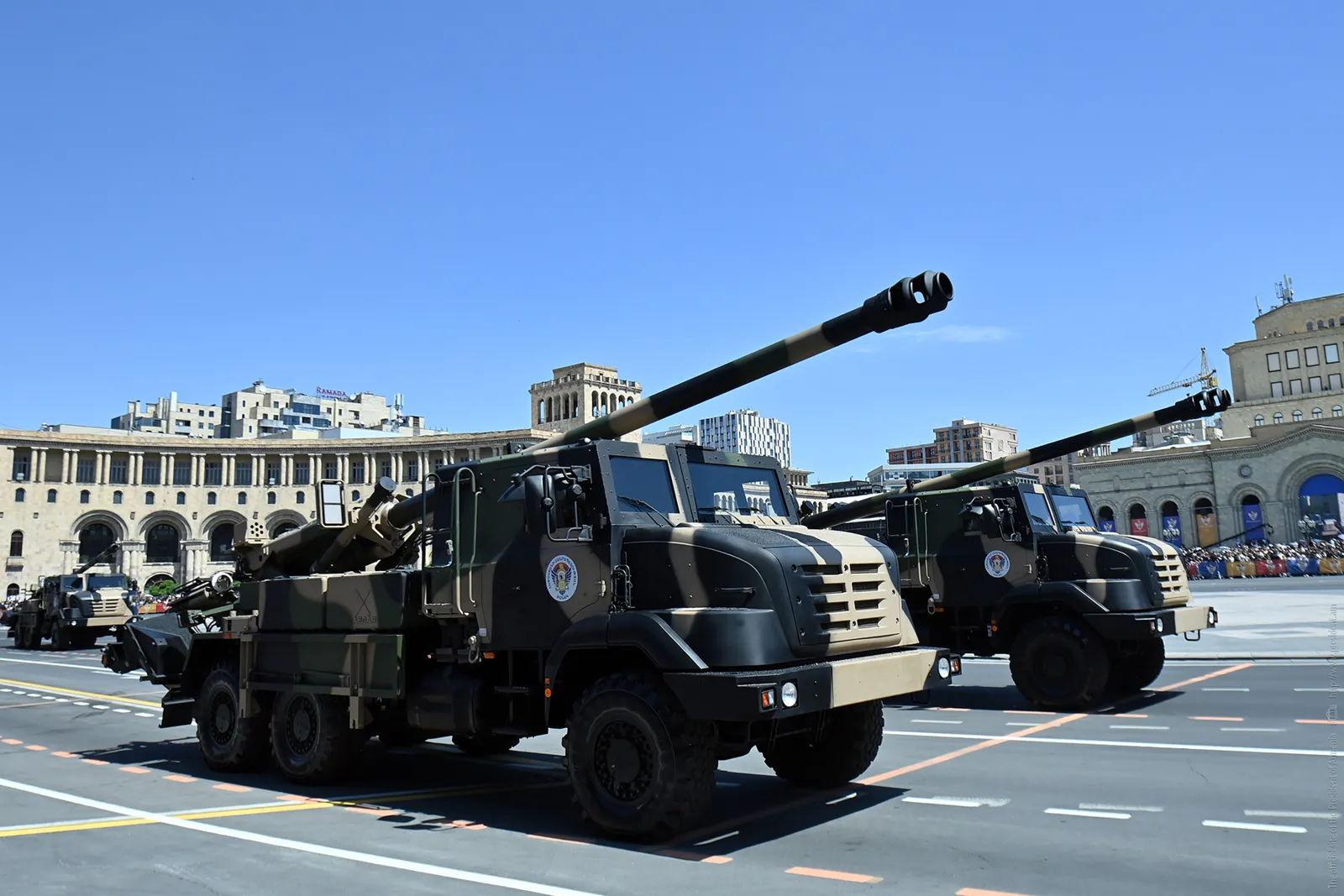
| Self-propelled artillery | The 72 Indian-made MArG 155 BR guns (locally named Mihr) ordered in November 2022 were fully delivered by January 2026; 36 CAESARs were ordered in June 2024. The legacy fleet has 28 2S3 Akatsiyas and 9 2S1 Gvozdikas |
| Towed artillery | 60 D-30s, 34 D-20s and 26 2A36 Giatsint-Bs; 6 Indian-made 155 mm ATAGS are in service, with 84 more planned |
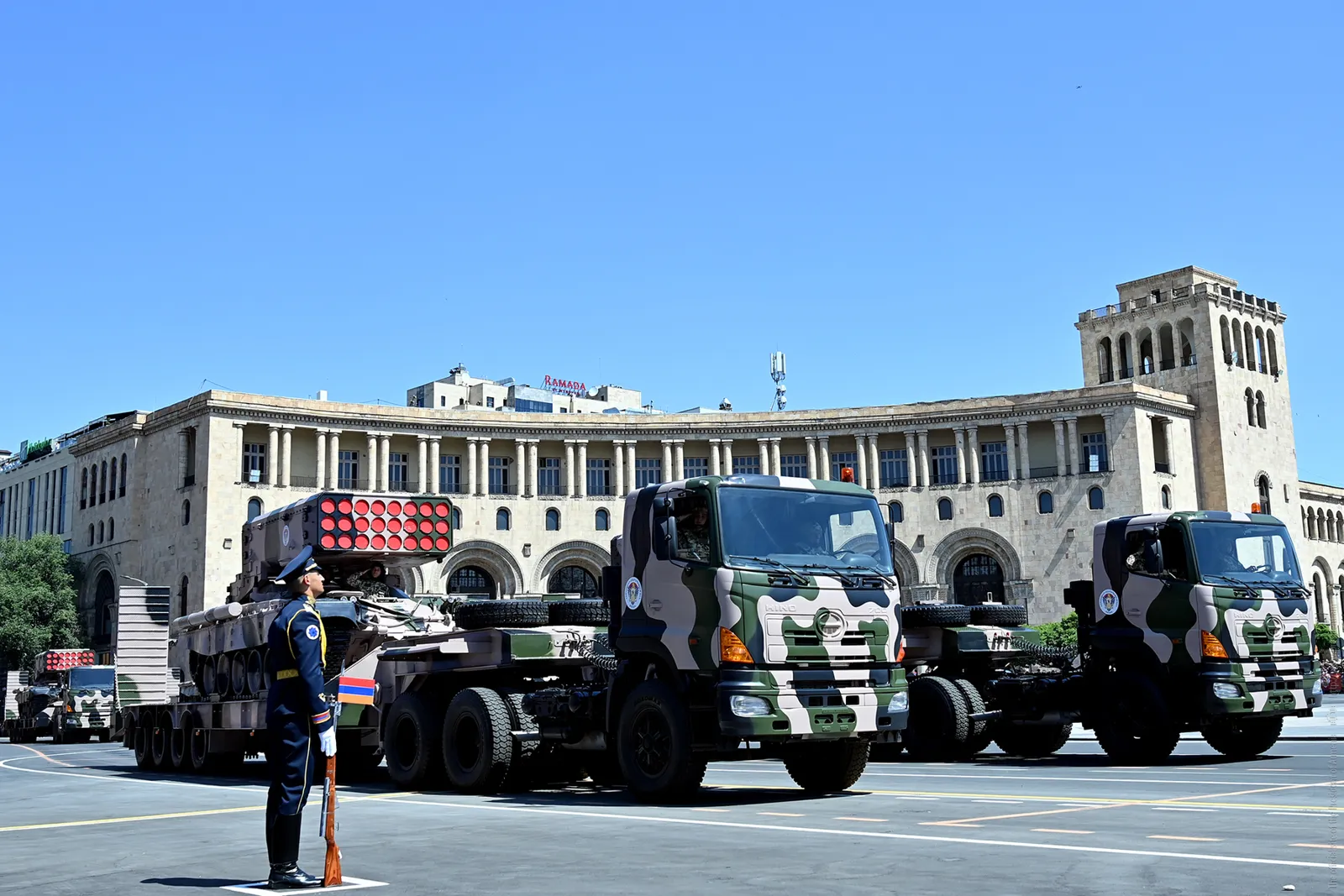
| Rocket artillery | Four batteries of Indian-made Pinaka (locally named Shant) worth 250 million dollars, with guided Pinaka rocket deliveries starting in January 2026; plus up to 50 BM-21s, TOS-1As, 2 BM-30 Smerch, 8 Chinese-made WM-80s and 6 AR1As |
Air Force Inventory
| Platform | Est. quantity |
|---|---|
| Total military aircraft | 69 (Global Firepower): 4 fighters, 14 attack aircraft, 36 helicopters (20 attack) |
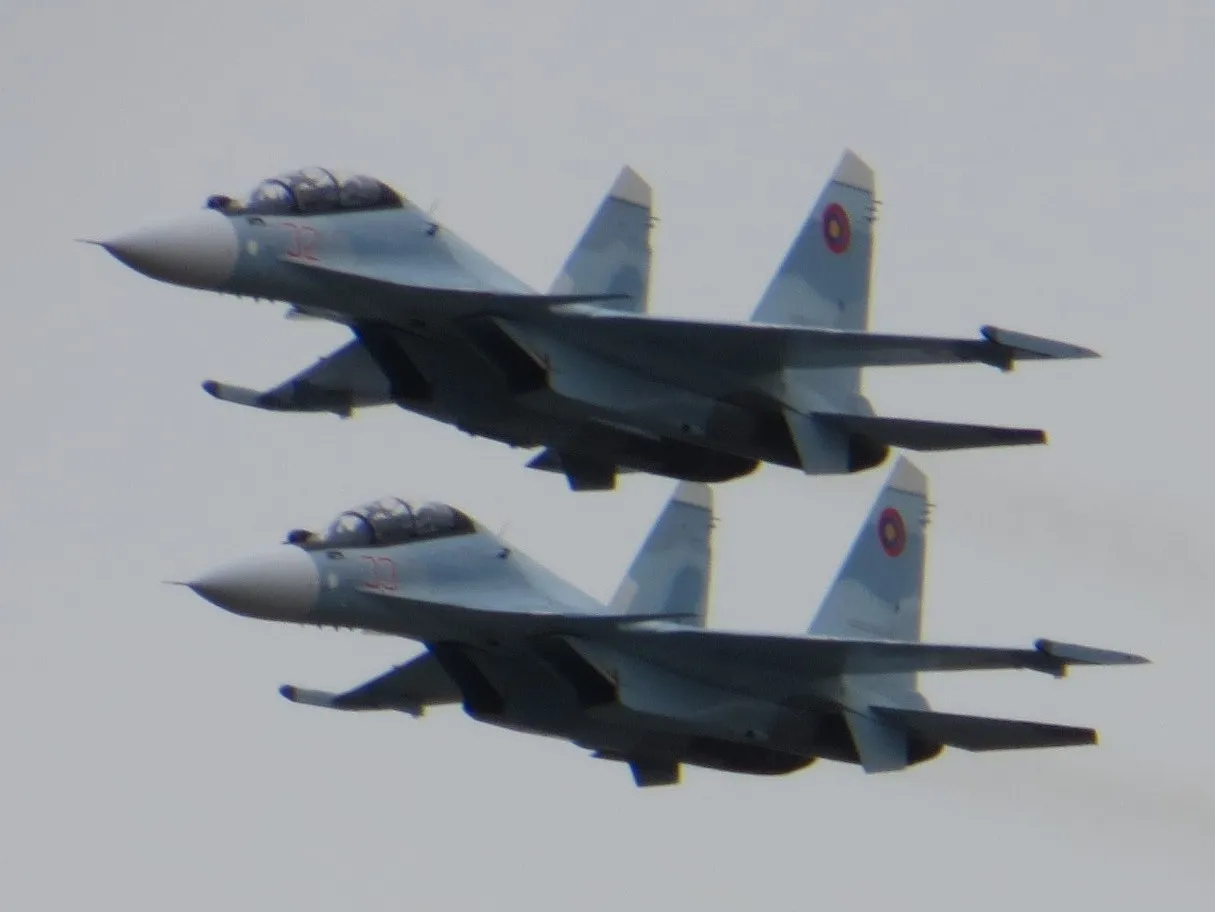
| Multirole fighters (Su-30SM) | 4 Su-30SMs, bought from Russia in 2019-2020 without a missile package; a follow-on order for 8 more pending since 2020 has not been delivered. At the 28 May 2026 parade the jets carried munitions that analysts identified as Iranian-made Yasin glide bombs |
| Close air support (Su-25) | Global Firepower counts 14 attack aircraft; the backbone of the fleet is the Su-25 and Su-25K |
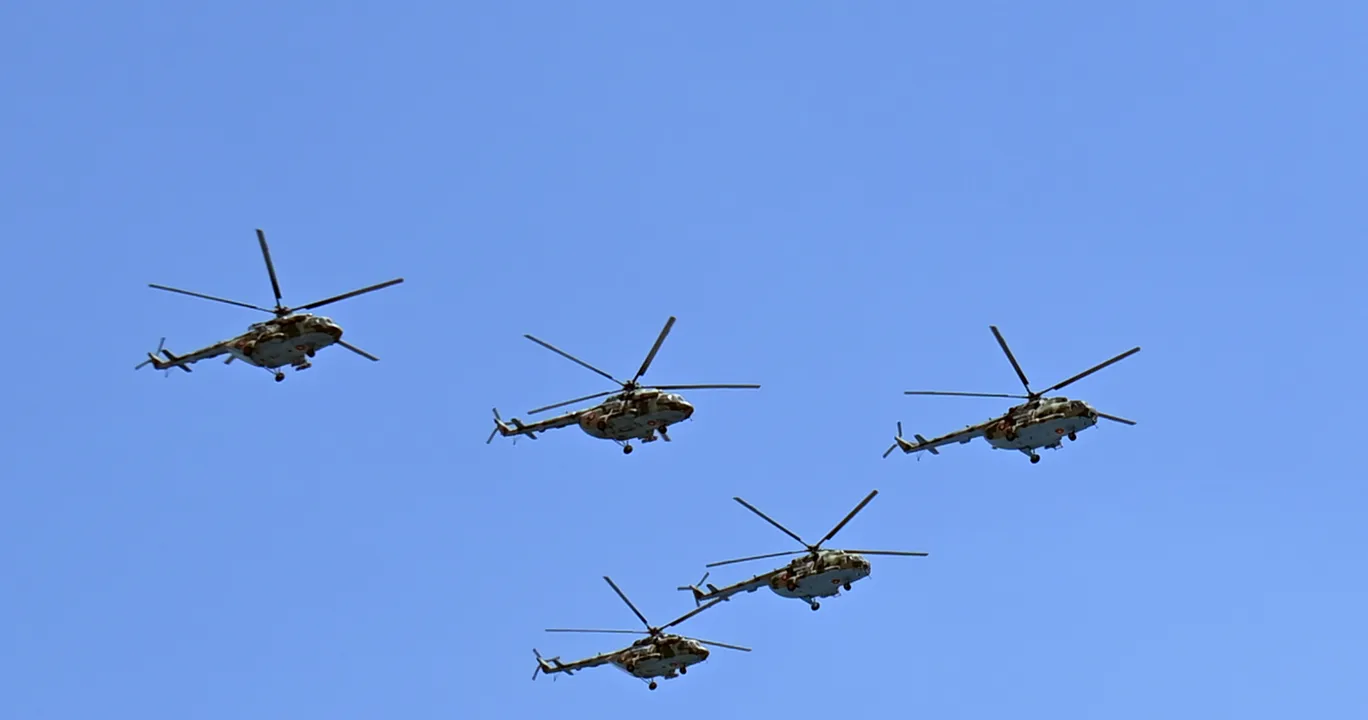
| Helicopters | 36 helicopters; 20 are Mi-24 attack helicopters, the rest Mi-8/Mi-17 and Mi-2 transport and training helicopters |
| Training and transport | L-39 jet trainers and Il-76 heavy transports |
| UAVs | The domestic Krunk, X-55 and Baze reconnaissance UAV families and domestic loitering munition projects; the domestic DDS-10K drone interceptor was also shown at the 2026 parade |
Missile and Air-Defence Systems
| System | Type / Note |
|---|---|
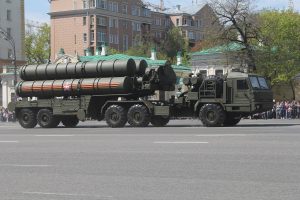
| Long-range air defence (S-300) | S-300PT and S-300PS; with sites around the capital Yerevan they form the upper layer of air defence |
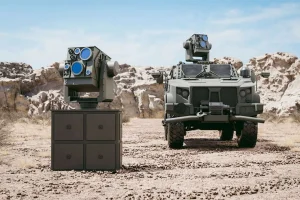
| Medium range (Akash and Buk) | The first battery of the Indian-made Akash (4 launchers and a Rajendra radar) was delivered in November 2024 and shown publicly in February 2026; talks on Akash-NG continue. Alongside are 2 Buk-M1-2 batteries |
| Short range | Tor-M2KM, about 75 Osas (at least 35 from Jordan), Kub, Krug, S-125 and Strela-10; the Iranian-made Majid AD-08 was also seen at the 2026 parade |
| MANPADS and counter-drone | Igla, Igla-S and Verba; a Mistral 3 letter of intent was signed with France in October 2023. The Zen counter-drone system was acquired from India |
| Radar | 3 Thales GM200 radars from France; the Indian-made Rajendra radar delivered with the Akash battery |
| Ballistic missiles | 4 Iskander-E launchers (first seen during preparations for the 2016 parade), more than 7 Scuds (R-17) and more than 3 Tochkas |
Naval Power
| Class / Type | Est. quantity |
|---|---|
| Naval force status | Landlocked — no coastline and no navy |
| Frigates / corvettes / submarines | None |
| Lake Sevan | There is no military naval element on the country’s largest body of water; surveillance is a task for border and law-enforcement units |
| The element that substitutes for naval power | Small peacekeeping contingents serving with KFOR in Kosovo and UNIFIL in Lebanon, together with the air-defence and helicopter fleets |
The Turkey Angle: Turkish Defence Industry
There are no Turkish defence systems in Armenia’s inventory and no defence cooperation between the two countries; diplomatic relations have yet to be established and the land border has been closed since 1993. Even so, relations have reached their most advanced point in decades through the normalisation process that began in late 2021 with the appointment of special envoys, Ambassador Serdar Kılıç for Türkiye and Ruben Rubinyan for Armenia.
In 2026 the process accelerated with concrete steps: Turkish Airlines launched scheduled Istanbul-Yerevan flights in March 2026, the two sides agreed to simplify visa procedures, Türkiye issued new rules in May 2026 allowing goods traded with Armenia to move under streamlined customs procedures, and the two countries decided to jointly restore the historic Ani Bridge. Armenia has renovated the Margara crossing and Türkiye the Alican crossing.
Türkiye’s position is clear: full reopening of the border depends on Armenia signing a final peace agreement with Azerbaijan. Signature of the text initialled at the White House in August 2025 awaits a change to the constitutional preamble that Baku objects to; on 15 October 2026 Pashinyan said he aims to sign and ratify the agreement before 2031. Progress on the transport route that will link Azerbaijan with Nakhchivan is also strengthening expectations in Yerevan that the border will open soon.
In defence terms, Türkiye’s influence in the region comes from the battlefield rather than direct trade: the Bayraktar TB2 drones used in 2020 by Türkiye’s ally Azerbaijan, along with Turkish training support, were among the decisive factors in the course of the war. The share Armenia now devotes to air-defence and counter-drone systems such as Akash, Mistral 3, Zen and DDS-10K is a direct response to the effectiveness Turkish drones proved in the field. If the peace agreement is signed, the centre of gravity of the relationship will be transport, energy and trade; in defence, what can be expected in the short term is confidence-building rather than cooperation.
Frequently Asked Questions
How many tanks does Armenia have? The Global Firepower 2026 count shows 109 tanks. According to the IISS the core is about 100 T-72As and T-72Bs, plus 1 T-90S and 8 T-54/T-55s in storage. Given the losses of the 2020 war, the figures should be treated as approximate.
Does Armenia have fighter jets? Yes, in limited numbers. It has 4 Su-30SMs bought from Russia in 2019-2020 and around 14 Su-25 attack aircraft. A follow-on order for 8 Su-30SMs pending since 2020 has not been delivered.
Which countries does Armenia buy weapons from? Until 2020 the main supplier was Russia. Today India leads with about 43 percent of imports: Pinaka rocket launchers, the Akash air-defence system, MArG and ATAGS howitzers and the Zen counter-drone system. France supplies the CAESAR howitzer, the Bastion armoured vehicle and the GM200 radar.
Does Armenia have a navy? No. Armenia is a landlocked country and has no navy or naval platforms.
Is there a military relationship between Türkiye and Armenia? No. There are no diplomatic relations or defence cooperation between the two countries, and the land border has been closed since 1993. In the normalisation process launched in 2021, steps such as direct flights, trade facilitation and the restoration of the Ani Bridge were taken in 2026; Türkiye ties the full opening of the border to the signing of the Armenia-Azerbaijan peace agreement.
Bottom Line
Armenia’s inventory is the inventory of an army in transition: on paper Soviet and Russian systems still dominate, but every new item points in a different direction. The Pinaka, Akash, MArG and ATAGS from India and the French CAESAR and GM200 clearly show the lesson the army drew from 2020: the priority is not the number of tanks and aircraft but long-range firepower and layered air defence against drones. The first budget decline and progress in the peace process suggest Yerevan has chosen to balance rearmament with diplomacy rather than pursue it without limit. For Türkiye the picture is defined less by defence than by the normalisation agenda; signature of the peace agreement will be the decisive threshold both for opening the border and for re-establishing the regional security balance.
Related Reading
Sources
- Global Firepower — Armenia
- IISS — The Military Balance
- SIPRI — Arms Transfers Database
- Wikipedia — Armed Forces of Armenia
- Wikipedia — List of equipment of the Armenian Armed Forces
- ARKA — Armenia’s 2026 defence budget
- EVN Report — Armenia’s new army and procurement diversification
- Armenian Weekly — The role of India and France
- JAMnews — Results of the 7 June 2026 election
- Al-Monitor — Türkiye-Armenia direct trade step
- Al-Monitor — Ani Bridge restoration
- Daily Sabah — Pashinyan’s 2031 target