F-35B Releases Eight StormBreakers in a Single Pass

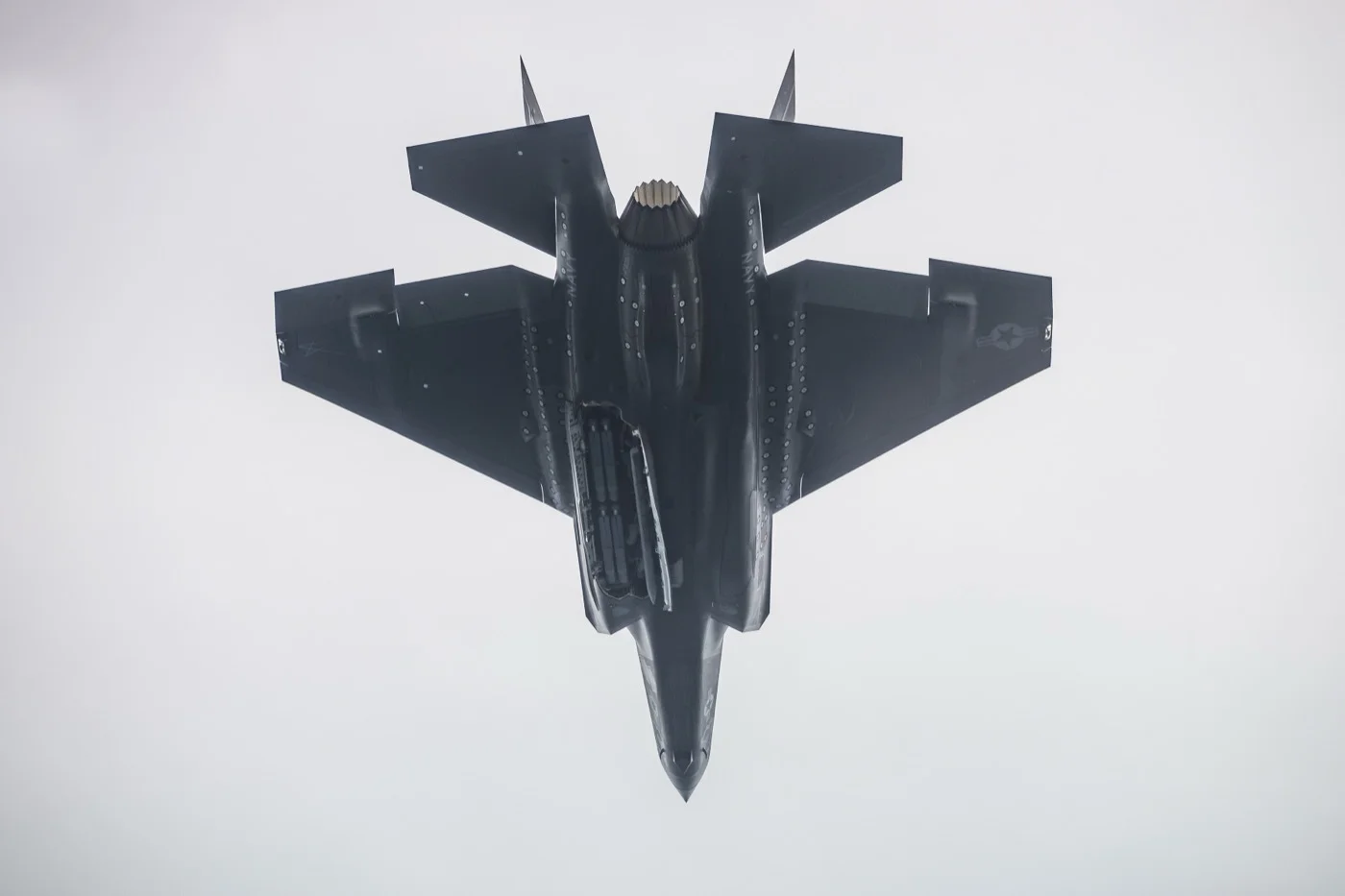
Raytheon says an F-35B released eight StormBreaker weapons simultaneously during a flight test in Arizona, a “ripple eight” event intended to demonstrate engaging multiple moving targets in a single pass. The RTX business unit described the test as part of continuing StormBreaker integration work on the F-35.
Why a simultaneous release is hard
Dropping eight weapons at once validates more than carriage capacity. Munitions released in close proximity must separate cleanly without being disturbed by airflow around the airframe — a distinct engineering problem for aircraft releasing from internal bays.
That the test used the F-35B is notable. Of the three variants, the short take-off and vertical landing version has the most constrained internal bay volume, owing to the lift fan. Demonstrating the configuration on the B implies the A and C variants can carry it as well.
Raytheon did not disclose an integration completion date or the software block in which the capability will become operational.
What StormBreaker is
The GBU-53/B StormBreaker, formerly Small Diameter Bomb II, is a small-diameter winged precision munition. Its defining feature is a tri-mode seeker combining millimetre-wave radar, imaging infrared and semi-active laser guidance in a single weapon.
That combination lets one munition serve both fixed and moving targets. Millimetre-wave radar tracks movers through fog, smoke, dust and cloud; imaging infrared sharpens target discrimination; the laser mode allows designation by a ground or airborne party. Range against moving targets exceeds 45 miles, roughly 72 kilometres.
A networked data link allows the weapon to receive updates after release — essential when a target has moved from where it was when the weapon left the aircraft.
The case for small diameter
StormBreaker’s folding wings and narrow body exist because of carriage arithmetic. Preserving the F-35’s low observability requires weapons to be carried internally, which caps available volume. Several small-diameter munitions occupy the space a single 2,000-pound bomb would fill.
In a stealth configuration the F-35’s internal bay typically accommodates four large weapons. With purpose-built racks, small-diameter munitions multiply that figure. An eight-round load meaningfully increases the number of targets engageable per sortie without using external pylons — and therefore without enlarging the aircraft’s radar signature.
That is a planning parameter in contested airspace. Striking more targets while remaining stealthy reduces the number of aircraft required for a given mission and lowers cumulative exposure.
Where it is fielded
StormBreaker is already approved for operational use on the F-15E Strike Eagle. The US Air Force and Navy are integrating it with the F/A-18E/F Super Hornet. F-35 integration is the broadest strand, because the aircraft serves with a large group of operators including many NATO members.
For European F-35 users — among them the Netherlands, the United Kingdom, Italy, Norway, Denmark and Belgium — the integration means an all-weather option against moving ground targets.
The moving target problem
Recent conflicts have settled the question of precision munitions against fixed targets. The difficulty concentrates on movers: air defence systems, missile launchers, tactical vehicles and field artillery relocate shortly after being detected.
Operations in Ukraine and the Middle East have pushed the detect-decide-strike cycle toward a matter of minutes. An aircraft capable of engaging eight separate moving targets in one sortie compresses that cycle directly.
The Turkish angle
Türkiye’s removal from the F-35 programme means this integration has no direct bearing on its inventory. The underlying trend, however, tracks Turkish industry’s own priorities. TÜBİTAK SAGE’s KUZGUN family, ROKETSAN’s TEBER and Laser Guided Mini Missile, and the TOLUN wing-assisted munition all sit in the small-diameter, high-quantity precision category.
Multi-mode seeker technology for moving targets remains a critical subsystem in Turkish development. Indigenous millimetre-wave radar and imaging infrared seekers are treated as a precondition for a munitions portfolio insulated from export restrictions.
Sources
- RTX/Raytheon official statement, 14 September 2026
- US Air Force GBU-53/B StormBreaker programme information
- Lockheed Martin F-35 weapons integration information