U.S. Army Autonomously Destroys Drone Swarms with ‘Golden Shield’ at Fort Hood: Sensor on One Vehicle, Shooter on Another

The U.S. Army’s 1st Cavalry Division fielded a detect-track-kill chain that autonomously detected and destroyed enemy drones using an air defence network called “Golden Shield” during a live-fire exercise at Fort Hood, Texas, on 7-9 April 2026. The exercise was recorded as the first live demonstration in which an autonomous sensor on one platform classified the target and passed engagement data directly to an autonomous weapon system on another platform to complete the kill.
The exercise was held under “Pegasus Charge,” the division’s initiative to modernise its armoured forces. According to Army sources, Golden Shield is not a single weapon or radar but a collection of systems that merges a command-and-control layer, numerous sensors and effectors of different types (an effector being the weapon or jamming system that neutralises a target) into one network.
Sensor on one vehicle, shooter on another
The standout concept in the exercise was running what the defence industry calls the “sensor-to-shooter” chain without human intervention. That chain consists simply of these steps: a sensor sees a threat, the system classifies it, and then a weapon is fired. In the traditional set-up, there are pauses between these steps where an operator must make a decision; in the Golden Shield test, those pauses were eliminated and the engagement was completed at “machine speed.”
The critical innovation was that the sensor and the weapon were not on the same vehicle. An autonomous sensor on one tactical vehicle detected the airborne target, classified it as hostile, and relayed the kill command wirelessly to an autonomous weapon system on a second vehicle. The Army says this distributed arrangement had never before been demonstrated with live fire.
Alfred Grein, Executive Director of the DEVCOM Ground Vehicle Systems Center, assessed the system with the words: “Formation-based, layered protection is the way of the future, and this is the start of it.” Maj. Kevin Correa, Air and Missile Defense Chief of the 1st Cavalry Division, described the goal as “to take the systems we tested this week and begin integrating them into the training of our armoured units.”
The HARPE micro-missile and a robotic ground sensor
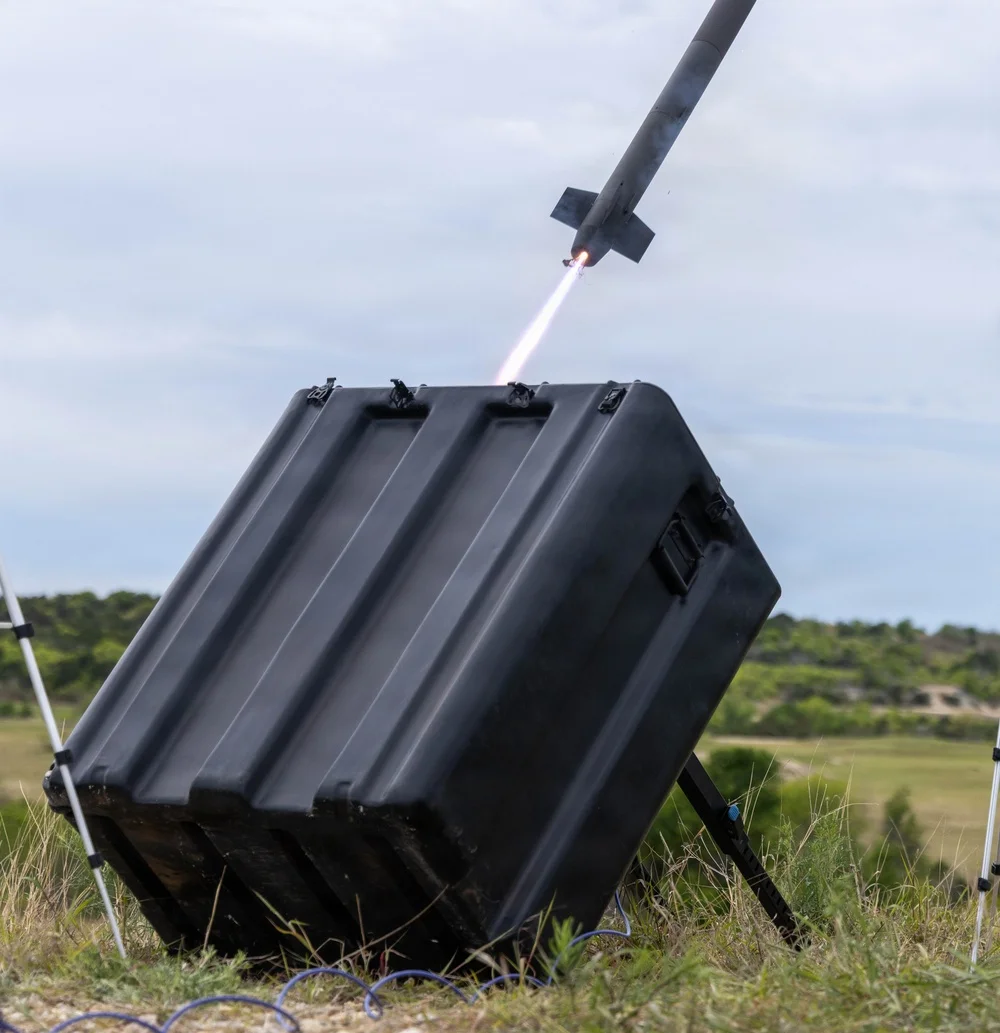
Two systems drew attention in imagery released from the exercise. The first was Perseus Defense’s guided micro-missile HARPE, which the firm markets as a low-cost, mass-producible drone interceptor. According to open sources, the missile — about 38 centimetres (15 inches) long — is designed to target low, small drones (NATO’s Group 1 and Group 2 unmanned aircraft) at a cost of under 10,000 dollars per unit. Set against the quarter-million-dollar-plus price of conventional interceptor missiles, that cost is meant to make firing in volume against swarm attacks economically viable.
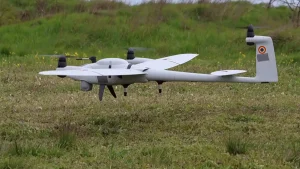
The second system was Swarmbotics’ FireAnt V4 autonomous ground vehicle. This man-portable unmanned ground vehicle (UGV) operated in the exercise as a forward sensor node, scanning the terrain. The core logic of such robotic platforms is to push detection range forward without putting personnel at risk and to provide a view of the target from different angles.
| Element | Role in the exercise |
|---|---|
| 1st Cavalry Division | Unit running the exercise (Fort Hood, Texas) |
| Golden Shield network | Collection of command-and-control + sensor + effector systems |
| Perseus Defense HARPE | Guided micro-missile (interceptor) |
| Swarmbotics FireAnt V4 | Autonomous ground vehicle (forward sensor) |
Why the swarm threat matters so much
The problem Golden Shield is trying to solve has come into sharp focus in recent years’ conflicts. Cheap, numerous small drones create an economically unsustainable equation for armies defending with expensive interceptors; the attacker forces the defender to spend hundreds of thousands of dollars on missiles using drones worth a few thousand. Autonomous, low-cost interceptors aim to swing that imbalance back in the defender’s favour.
The same pressure applies to Turkey, in a region where drone swarms are steadily maturing. Turkish defence industry has in recent years turned toward a similar threat spectrum with laser-based systems, electronic jammers and low-altitude air defence layers. The U.S. Army’s autonomous sensor-to-shooter trial shows that the leading design trend in this field is not standalone weapons but interconnected, data-centric networks.
Because Golden Shield’s architecture rests on open standards and rapid software updates, the network can reportedly be scaled up or down with new sensors and weapons as the mission demands. Army officials said the systems tested will from now on be folded gradually into armoured-unit training.
Open-source verification notes
- The exercise dates are 7-9 April 2026 according to the U.S. Army’s official release and the DVIDS image caption (the HARPE firing photo is dated 7 April 2026).
- The statement that this was “the first time an autonomous sensor on one platform relayed an engagement command to an autonomous weapon on another platform to achieve a kill” rests directly on the U.S. Army’s statement.
- HARPE’s roughly 38 cm length, sub-10,000-dollar cost and Group 1/Group 2 target class appear in secondary sources; the official Army release does not share the missile’s detailed technical specifications.
- FireAnt V4’s forward-sensor role rests on the image caption and an Army Recognition account.
- The quotes (Alfred Grein, Maj. Kevin Correa) are taken from the U.S. Army’s official article.
Sources
- U.S. Army — 1st Cavalry Division tests ‘Golden Shield’ counter-drone system (army.mil/article/291721)
- DVIDS — 1st Cavalry Division tests ‘Golden Shield’ layered defense system (image caption, Spc. Julian Winston)
- Army Recognition — U.S. Army Tests ‘Golden Shield’ Sensor-to-Shooter Network